Exercise Questions

 You are here
Last updated at October 12, 2026 by Teachoo
Transcript
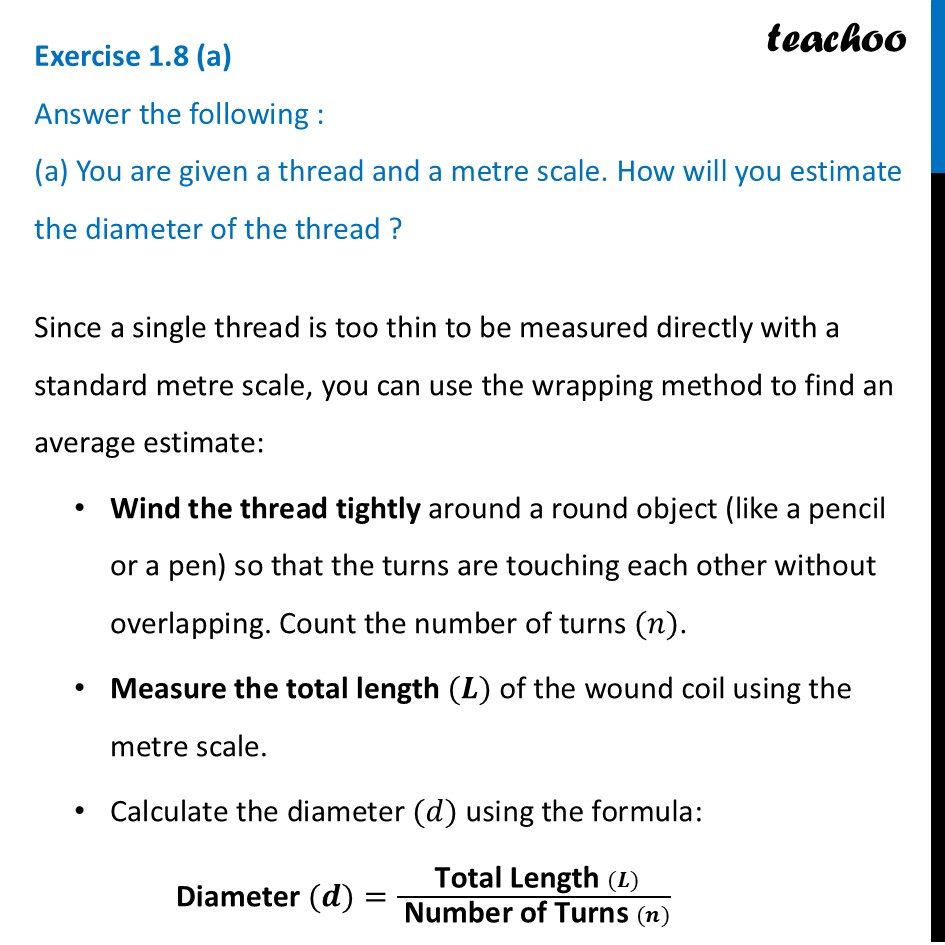
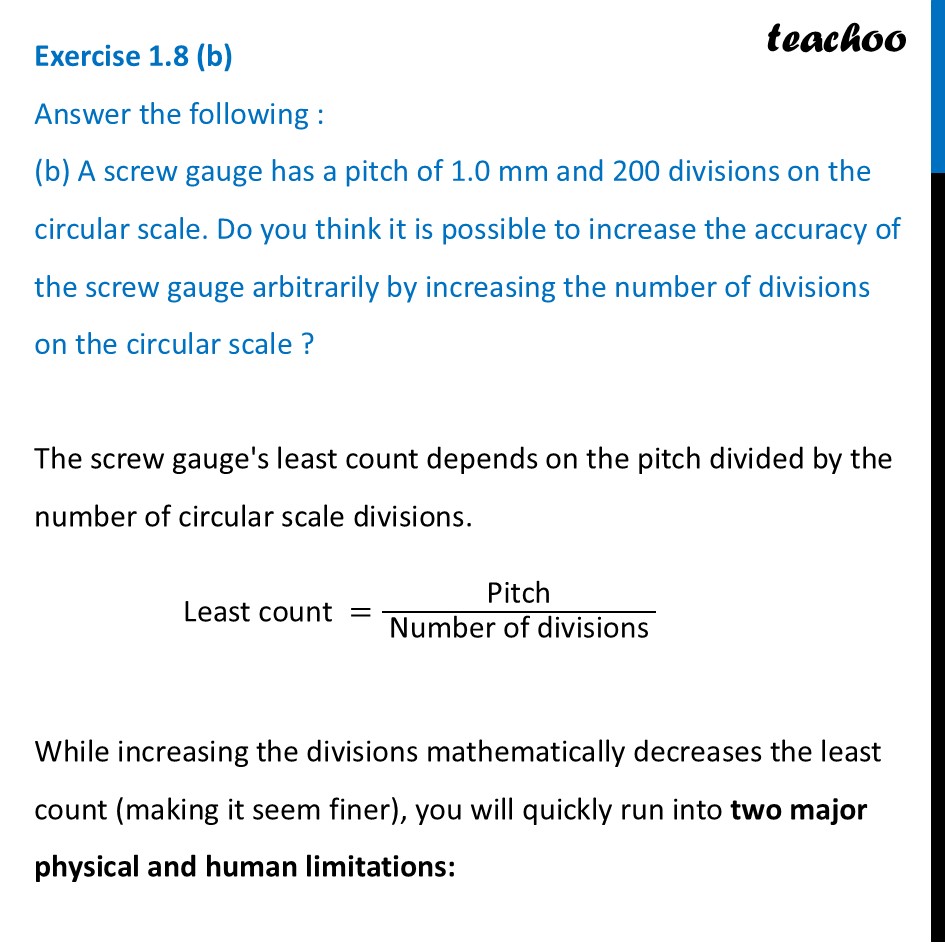
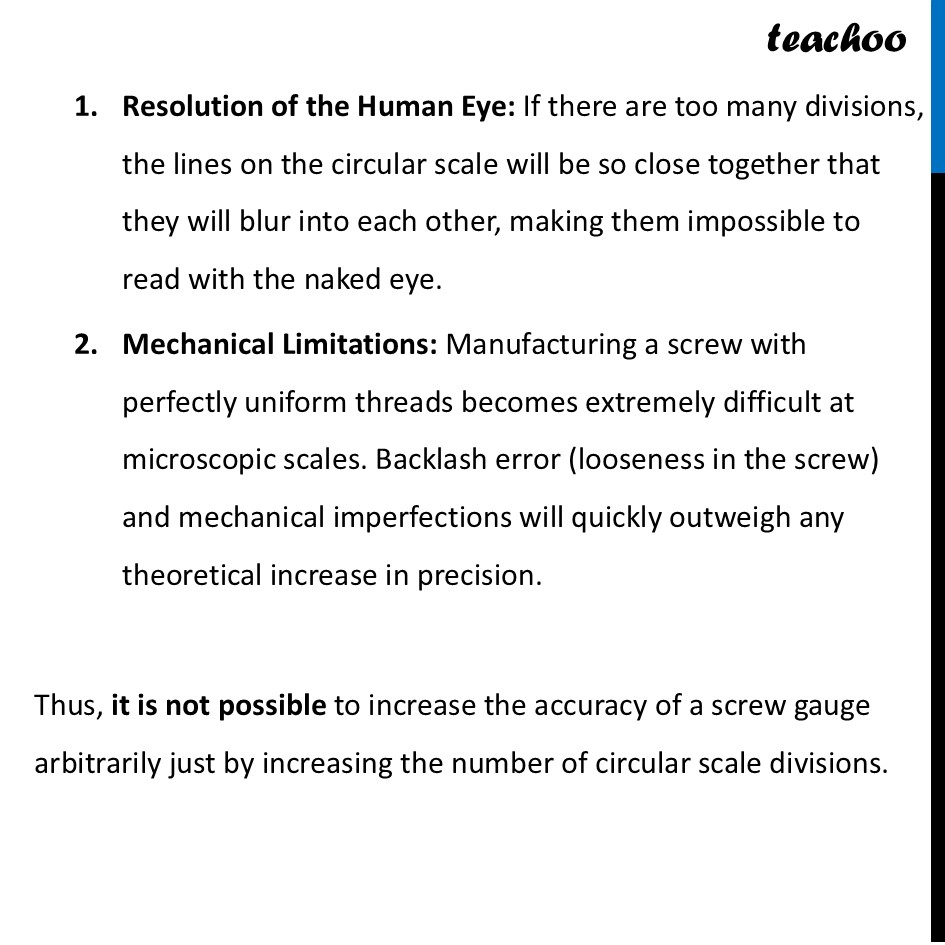
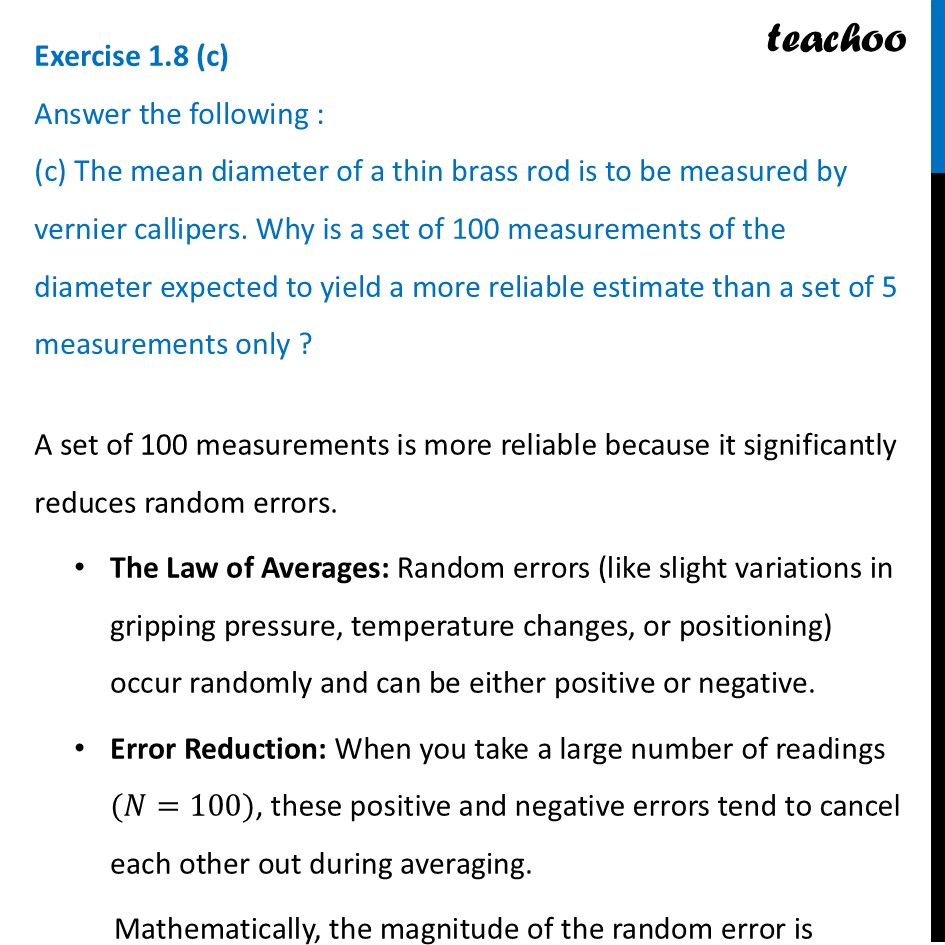
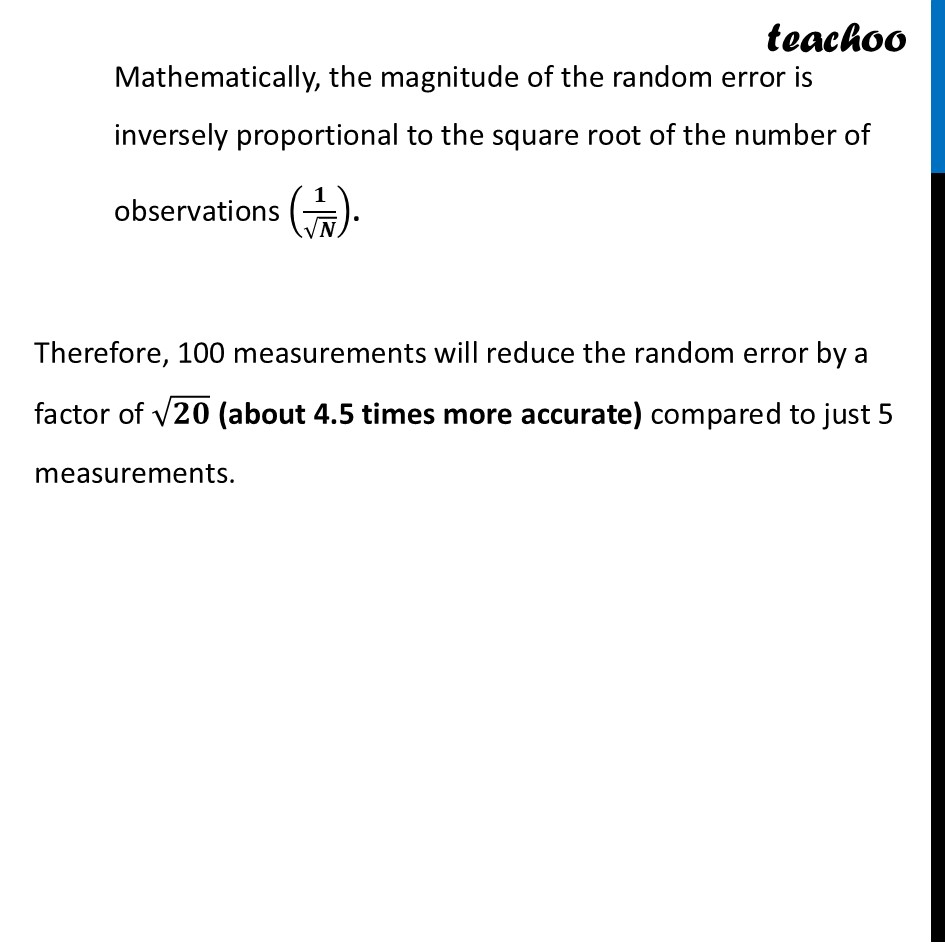
Exercise 1.8 (a) Answer the following : (a) You are given a thread and a metre scale. How will you estimate the diameter of the thread ? Since a single thread is too thin to be measured directly with a standard metre scale, you can use the wrapping method to find an average estimate: Wind the thread tightly around a round object (like a pencil or a pen) so that the turns are touching each other without overlapping. Count the number of turns (𝑛). Measure the total length (𝑳) of the wound coil using the metre scale. Calculate the diameter (𝑑) using the formula: Diameter (𝒅)=( Total Length (𝑳))/( Number of Turns (𝒏)) Exercise 1.8 (b) Answer the following : (b) A screw gauge has a pitch of 1.0 mm and 200 divisions on the circular scale. Do you think it is possible to increase the accuracy of the screw gauge arbitrarily by increasing the number of divisions on the circular scale ? The screw gauge's least count depends on the pitch divided by the number of circular scale divisions. Least count =( Pitch )/( Number of divisions ) While increasing the divisions mathematically decreases the least count (making it seem finer), you will quickly run into two major physical and human limitations: Resolution of the Human Eye: If there are too many divisions, the lines on the circular scale will be so close together that they will blur into each other, making them impossible to read with the naked eye. Mechanical Limitations: Manufacturing a screw with perfectly uniform threads becomes extremely difficult at microscopic scales. Backlash error (looseness in the screw) and mechanical imperfections will quickly outweigh any theoretical increase in precision. Thus, it is not possible to increase the accuracy of a screw gauge arbitrarily just by increasing the number of circular scale divisions. Exercise 1.8 (c) Answer the following : (c) The mean diameter of a thin brass rod is to be measured by vernier callipers. Why is a set of 100 measurements of the diameter expected to yield a more reliable estimate than a set of 5 measurements only ? A set of 100 measurements is more reliable because it significantly reduces random errors. The Law of Averages: Random errors (like slight variations in gripping pressure, temperature changes, or positioning) occur randomly and can be either positive or negative. Error Reduction: When you take a large number of readings (𝑁=100), these positive and negative errors tend to cancel each other out during averaging. Mathematically, the magnitude of the random error is inversely proportional to the square root of the number of observations ((1)/(sqrt(𝑁))). Therefore, 100 measurements will reduce the random error by a factor of sqrt(20) (about 4.5 times more accurate) compared to just 5 measurements. Mathematically, the magnitude of the random error is inversely proportional to the square root of the number of observations ((𝟏)/(sqrt(𝑵))). Therefore, 100 measurements will reduce the random error by a factor of sqrt(𝟐𝟎) (about 4.5 times more accurate) compared to just 5 measurements.