End-of-Chapter Exercises

 You are here
Last updated at August 14, 2026 by Teachoo
Transcript
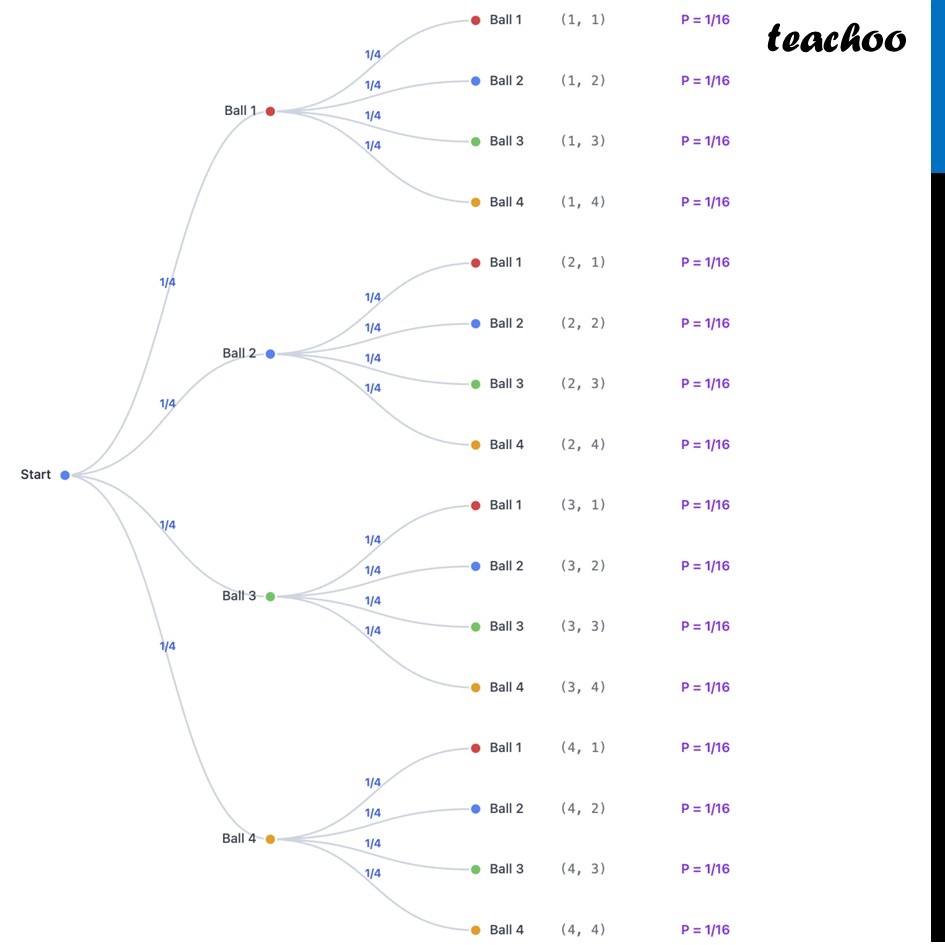
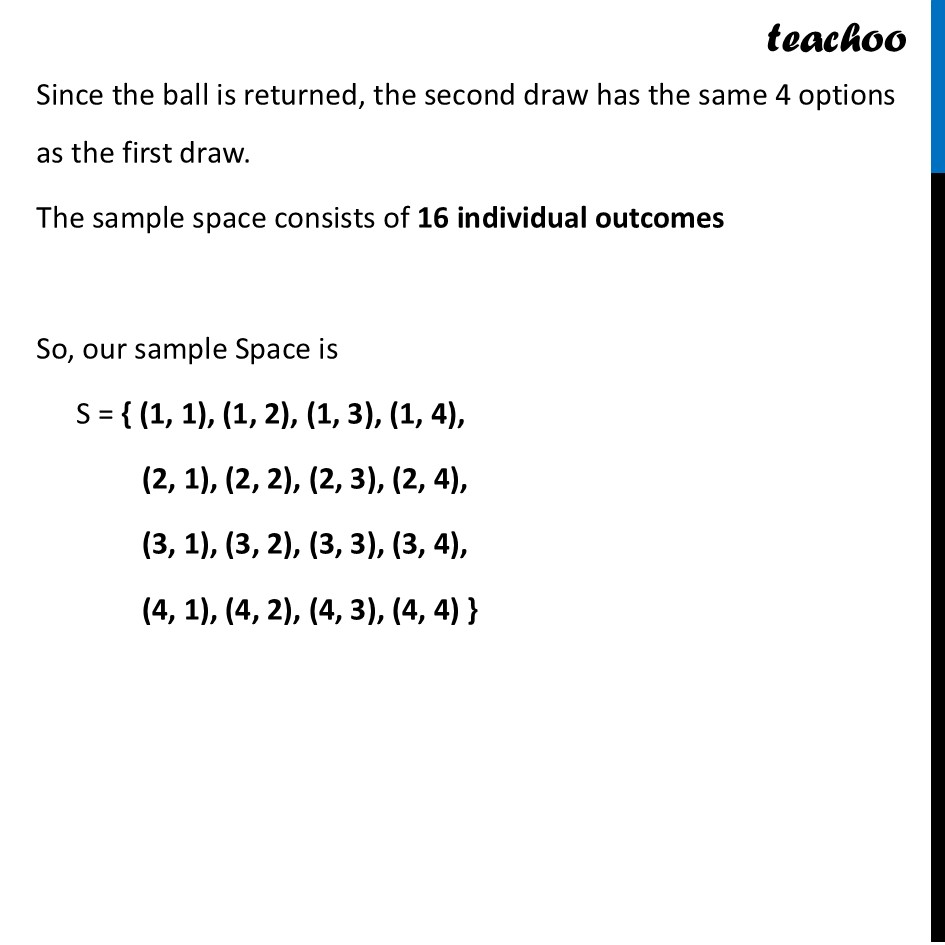
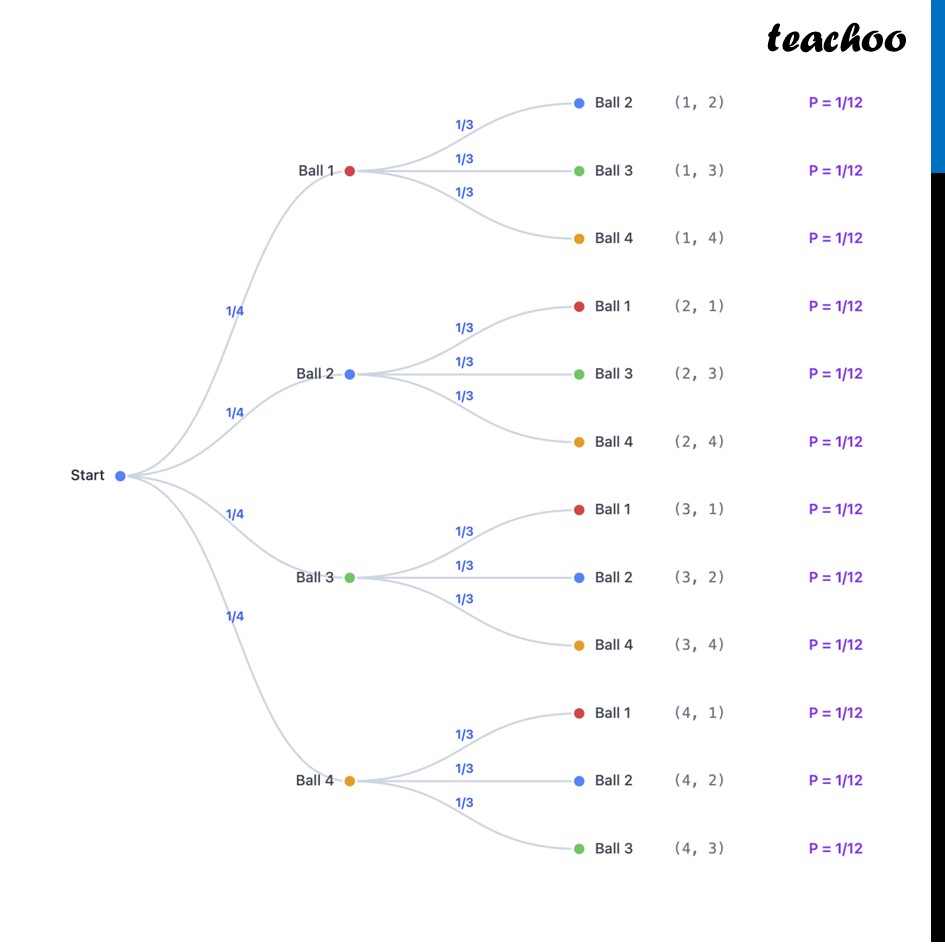
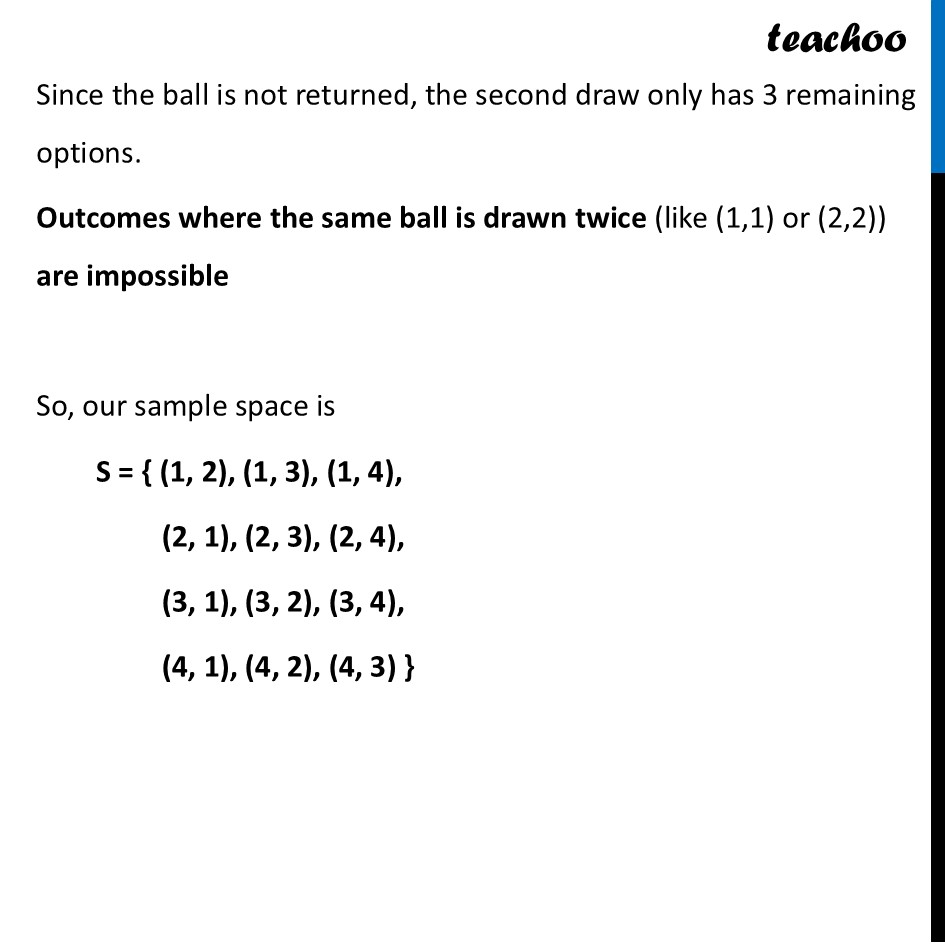
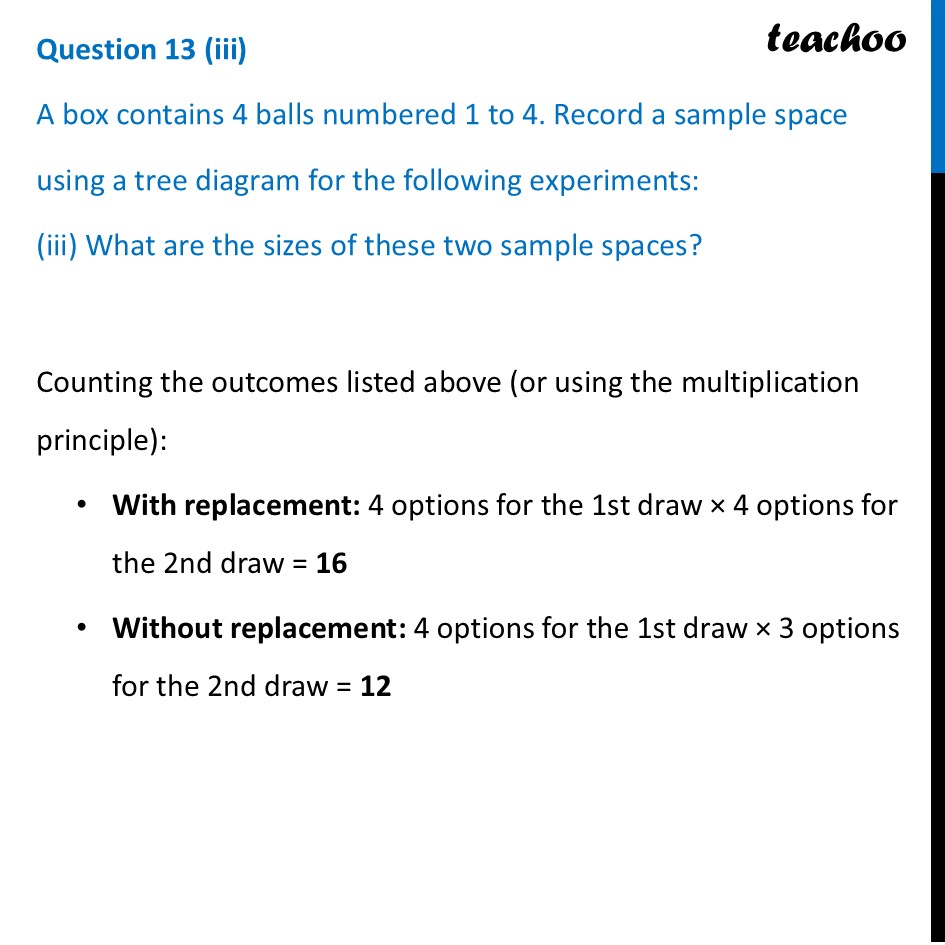
Question 13 (i) A box contains 4 balls numbered 1 to 4. Record a sample space using a tree diagram for the following experiments: (i) A ball is drawn, and the number is recorded. Then the ball is returned, and a second ball is drawn and recorded. Here, the ball is taken out with replacement So, our probabilities when picking second ball remains same for all cases Let’s make the tree diagram now Since the ball is returned, the second draw has the same 4 options as the first draw. The sample space consists of 16 individual outcomes So, our sample Space is S = { (1, 1), (1, 2), (1, 3), (1, 4), (2, 1), (2, 2), (2, 3), (2, 4), (3, 1), (3, 2), (3, 3), (3, 4), (4, 1), (4, 2), (4, 3), (4, 4) } Question 13 (ii) A box contains 4 balls numbered 1 to 4. Record a sample space using a tree diagram for the following experiments: (ii) A ball is drawn and recorded. Without replacing the first ball, the experimenter draws and records a second ball. Here, the ball is taken out without replacement So, our probabilities when picking second ball needs to be carefully calculated Let’s make the tree diagram now Since the ball is not returned, the second draw only has 3 remaining options. Outcomes where the same ball is drawn twice (like (1,1) or (2,2)) are impossible So, our sample space is S = { (1, 2), (1, 3), (1, 4), (2, 1), (2, 3), (2, 4), (3, 1), (3, 2), (3, 4), (4, 1), (4, 2), (4, 3) } Question 13 (iii) A box contains 4 balls numbered 1 to 4. Record a sample space using a tree diagram for the following experiments: (iii) What are the sizes of these two sample spaces? Counting the outcomes listed above (or using the multiplication principle): With replacement: 4 options for the 1st draw × 4 options for the 2nd draw = 16 Without replacement: 4 options for the 1st draw × 3 options for the 2nd draw = 12