CBSE Class 10 Sample Paper for 2026 Boards - Maths Standard

 You are here
CBSE Class 10 Sample Paper for 2026 Boards - Maths Standard
Last updated at August 14, 2026 by Teachoo
Transcript
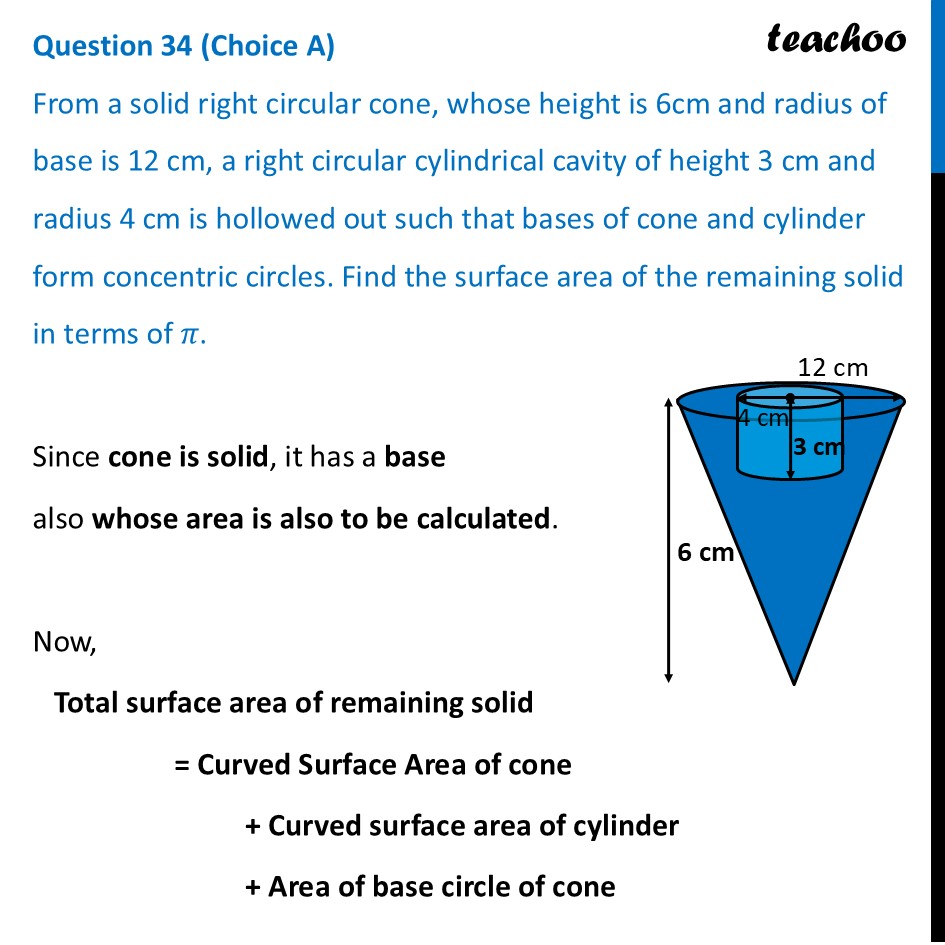
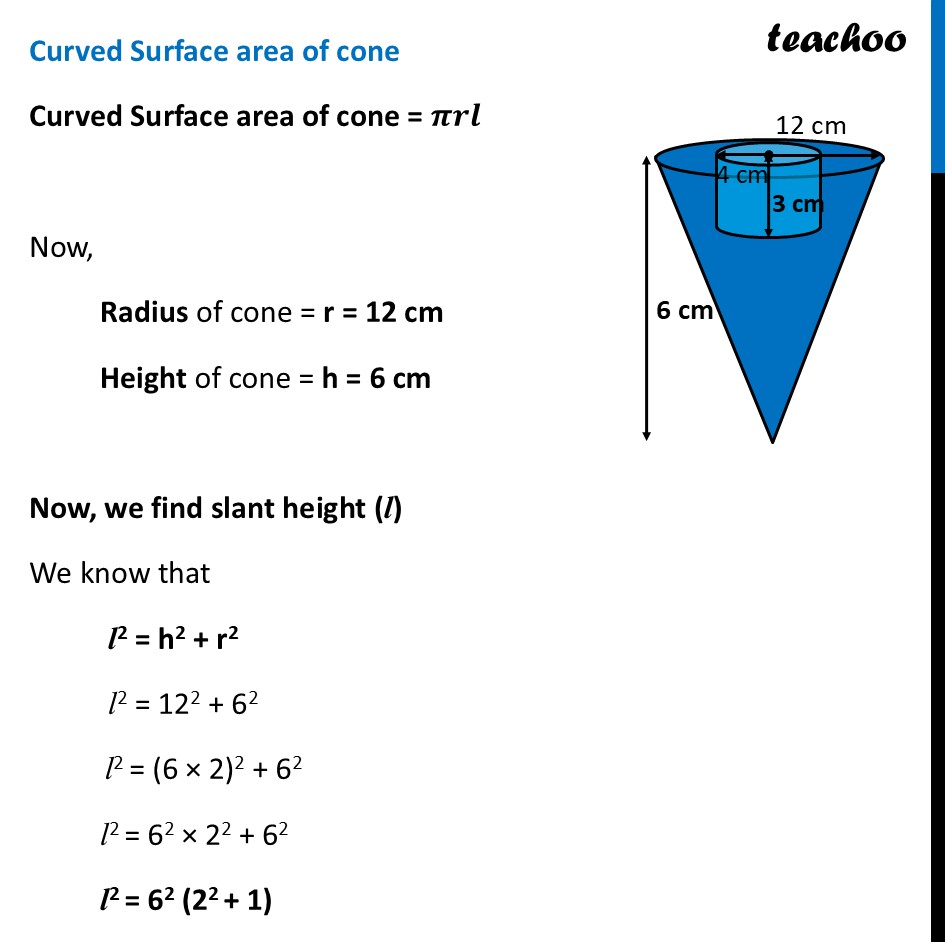
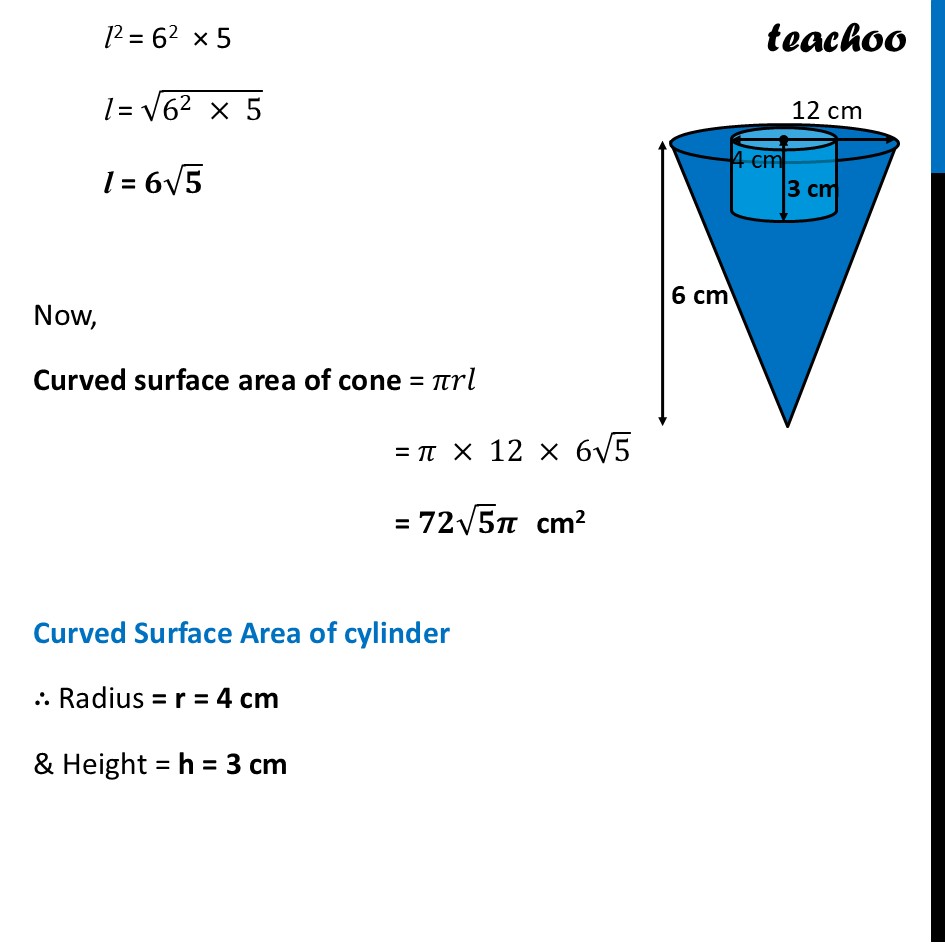
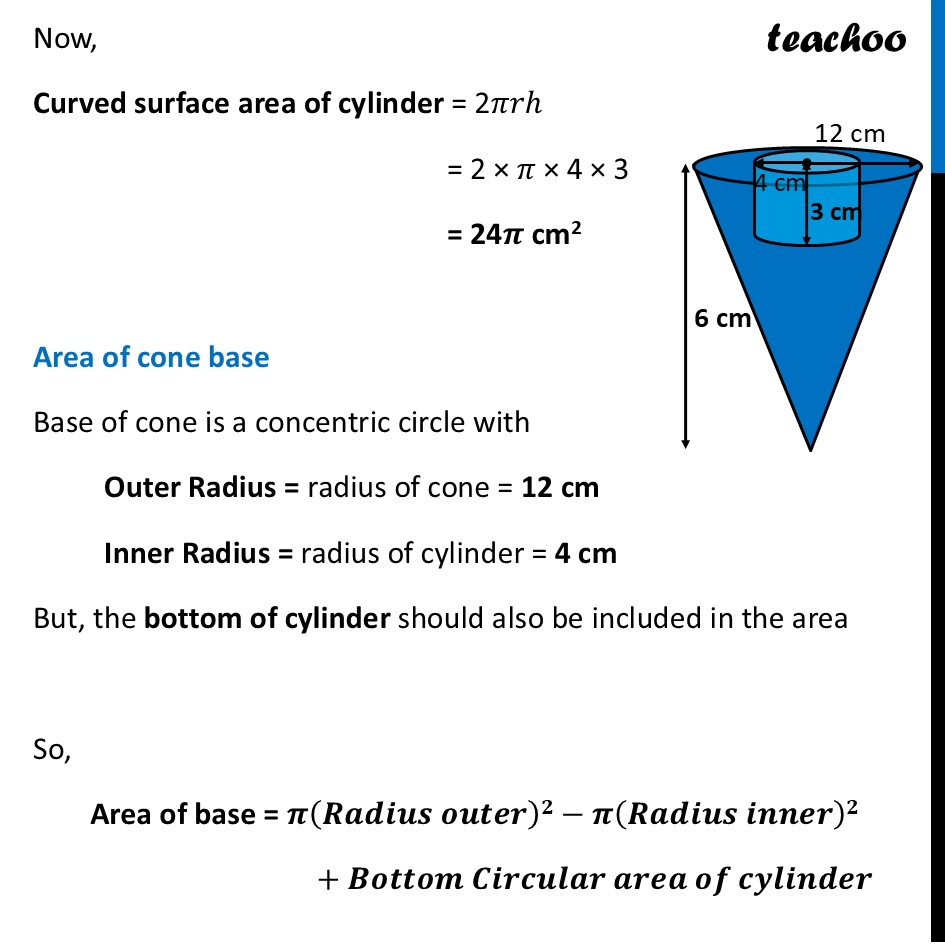
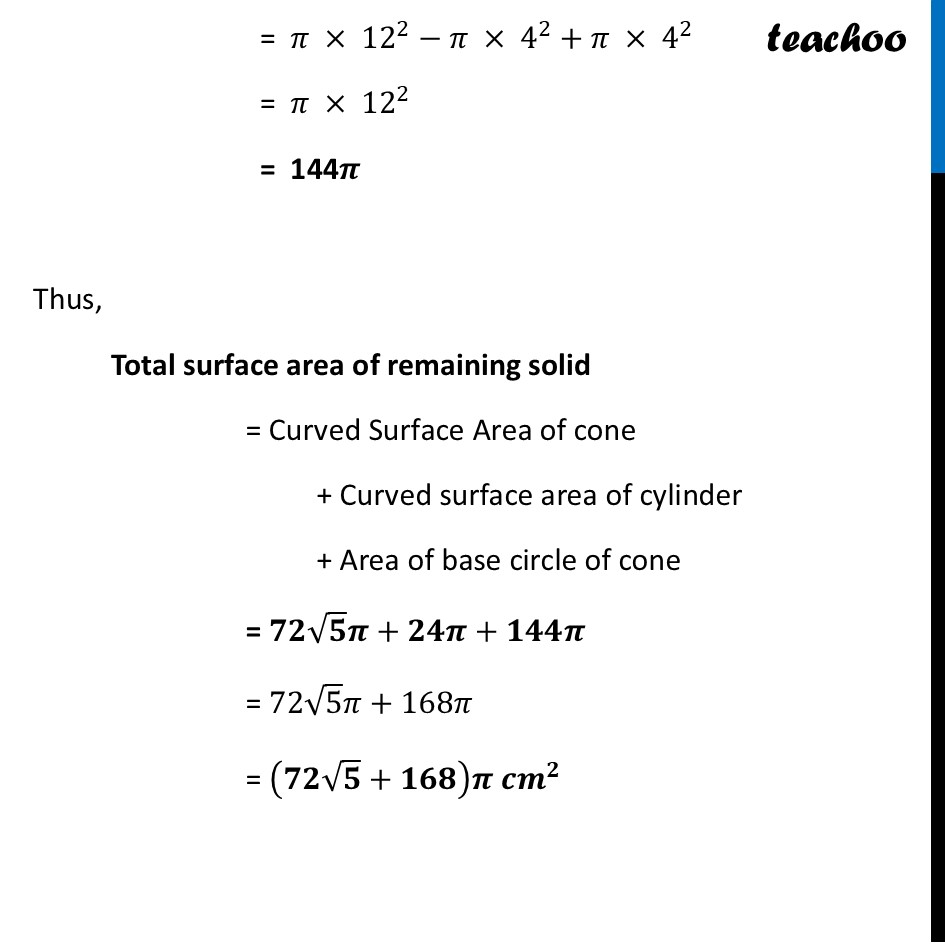
Question 34 (Choice A) From a solid right circular cone, whose height is 6cm and radius of base is 12 cm, a right circular cylindrical cavity of height 3 cm and radius 4 cm is hollowed out such that bases of cone and cylinder form concentric circles. Find the surface area of the remaining solid in terms of 𝜋.Since cone is solid, it has a base also whose area is also to be calculated. Now, Total surface area of remaining solid = Curved Surface Area of cone + Curved surface area of cylinder + Area of base circle of cone Curved Surface area of cone Curved Surface area of cone = 𝝅𝒓𝒍 Now, Radius of cone = r = 12 cm Height of cone = h = 6 cm Now, we find slant height (l) We know that l2 = h2 + r2 l2 = 122 + 62 l2 = (6 × 2)2 + 62 l2 = 62 × 22 + 62 l2 = 62 (22 + 1) l2 = 62 × 5 l = √(6^2 × 5) l = 𝟔√𝟓 Now, Curved surface area of cone = 𝜋𝑟𝑙 = 𝜋 × 12 × 6√5 = 𝟕𝟐√𝟓 𝝅 cm2 Curved Surface Area of cylinder ∴ Radius = r = 4 cm & Height = h = 3 cm Now, Curved surface area of cylinder = 2𝜋𝑟ℎ = 2 × 𝜋 × 4 × 3 = 24𝝅 cm2 Area of cone base Base of cone is a concentric circle with Outer Radius = radius of cone = 12 cm Inner Radius = radius of cylinder = 4 cm But, the bottom of cylinder should also be included in the area So, Area of base = 𝝅(𝑹𝒂𝒅𝒊𝒖𝒔 𝒐𝒖𝒕𝒆𝒓)𝟐−𝝅(𝑹𝒂𝒅𝒊𝒖𝒔 𝒊𝒏𝒏𝒆𝒓)𝟐 + 𝑩𝒐𝒕𝒕𝒐𝒎 𝑪𝒊𝒓𝒄𝒖𝒍𝒂𝒓 𝒂𝒓𝒆𝒂 𝒐𝒇 𝒄𝒚𝒍𝒊𝒏𝒅𝒆𝒓 = 𝜋 × 122−𝜋 × 42+𝜋 × 4^2 = 𝜋 × 122 = 144𝝅 Thus, Total surface area of remaining solid = Curved Surface Area of cone + Curved surface area of cylinder + Area of base circle of cone = 𝟕𝟐√𝟓 𝝅+𝟐𝟒𝝅+𝟏𝟒𝟒𝝅 = 72√5 𝜋+168𝜋 = (𝟕𝟐√𝟓+𝟏𝟔𝟖)𝝅 𝒄𝒎^𝟐