You are here
What do we actually see on the Earth’s surface?
How do many surface shapes become one idea?
Observe many natural shapes
Mountains, plains, valleys, rivers, deserts and coasts
↓
Notice that each has a different form
Some are high, low, flat, dry, coastal or below the ocean
↓
All these natural surface features are called landforms.
- Look around, and the Earth’s surface has many shapes .
- There are tall mountains and flat plains .
- There are valleys , plateaus and deserts .
- There are rivers , coasts and even the hidden ocean floor .
- All these natural shapes have one common name.
- We call them landforms .
![Introduction - Shaping of the Earth’s Surface - [Teachoo] - Concepts](https://cdn.teachoo.com/8e81f3a9-542e-4b49-b6a7-bf8819b1a7c5/wide-educational-landscape-showing-the-earths-surface-with-mountains-plateau-plain-valley-river-desert-and-coast-together-no-text-or.jpg)
The Earth’s surface carries many different shapes — mountains, plateaus, plains, valleys, rivers, deserts and coasts
What exactly is a landform?
Landform
Land
the ground beneath us
Form
a shape or feature
↓
A natural feature or shape found on the Earth’s surface.
- A landform is any natural feature on the surface.
- It is made by nature , not by humans.
- Mountains, valleys, plateaus and plains are landforms.
- Deserts, deltas, beaches and caves are landforms too.
- Even the hidden ocean floor is a landform.
Definition — Landform
A landform is a natural feature on the Earth’s surface.
It is formed by processes such as weathering, erosion, deposition and the movement of the Earth’s crust.
Examples: mountains, valleys, plateaus, plains, deserts and coastal features.
It is formed by processes such as weathering, erosion, deposition and the movement of the Earth’s crust.
Examples: mountains, valleys, plateaus, plains, deserts and coastal features.
Can we see some examples of landforms?
| Landform | What It Looks Like |
|---|---|
| Mountain | A very high, raised part of the land, e.g. the Himalaya |
| Valley | A low area between hills or mountains, often with a river |
| Plateau | A raised stretch of flat land, e.g. the Deccan Plateau |
| Plain | A wide stretch of flat, low land, e.g. the Ganga plains |
| Desert | A dry, sandy region with dunes, e.g. the Thar Desert |
| Coast | The land along the edge of the sea, with beaches and cliffs |
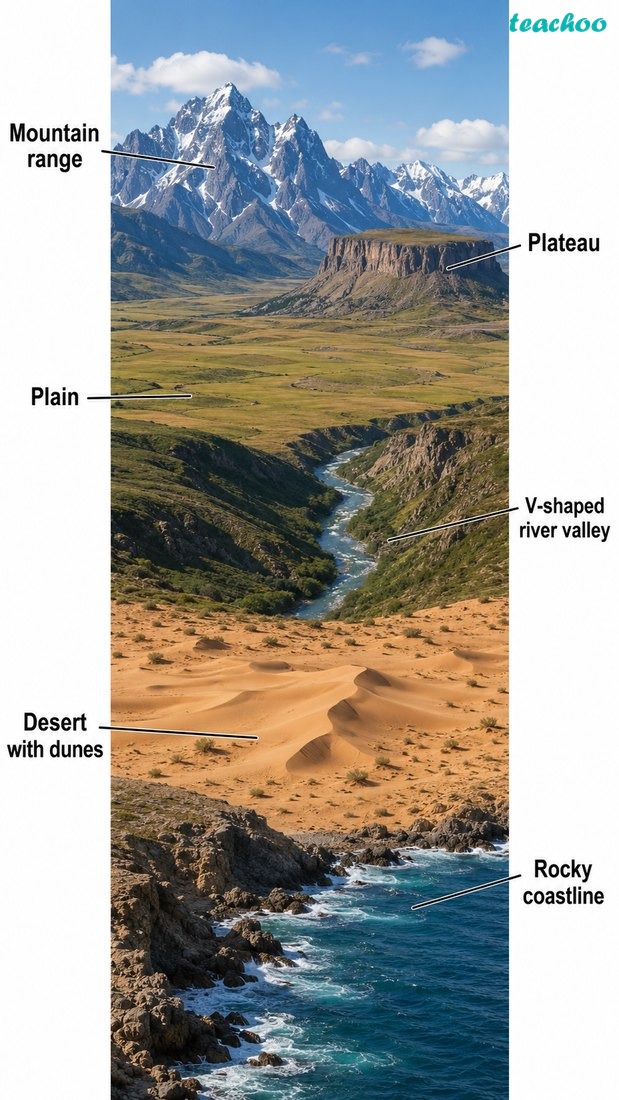
Some common landforms — mountain, plateau, plain, valley, desert and coast
💬 Think about it
The ground under your feet feels solid and still. But it does not stay the same forever. Over time it can rise into mountains, or even shake in an earthquake . What makes solid land change its shape like this? Let us find out.
How do landforms change their shape?
What two forces change the Earth’s surface?
Change in the Earth’s Surface
two kinds of force
1. Internal forces
Act from within Earth
Plate tectonics
Example:
The Himalaya
A volcano
An ocean basin
2. External forces
Act on the surface
Weathering and erosion
Example:
A river valley
A waterfall
A delta
A beach
- Landforms do not change on their own.
- Forces act on the Earth’s surface and change it.
- There are two types of such forces.
- One works from inside the Earth — the internal forces .
- The other works on the surface — the external forces .
Example 1 — A Sudden Change from Within
- In 2001, a big earthquake struck Kutch, Gujarat.
- Parts of the land rose by almost a metre.
- This happened in just seconds .
- It shows how internal forces act.
- They can change land almost instantly .
Example 2 — A Slow Change from Outside
- The Ganga river has flowed over these plains for ages.
- Bit by bit, it wears away soil in one place.
- It drops that soil somewhere else.
- It shows how external forces act.
- They change land very slowly .
How are internal and external forces different?
Internal Forces
External Forces
Act from
inside
the Earth.
Act on the
surface
of the Earth.
Work through
plate tectonics
.
Work through
weathering and erosion
.
Often sudden, like an earthquake.
Usually very slow, like a river’s flow.
Build up
land — mountains, volcanoes, ocean basins.
Wear down
and reshape land — valleys, deltas, beaches.
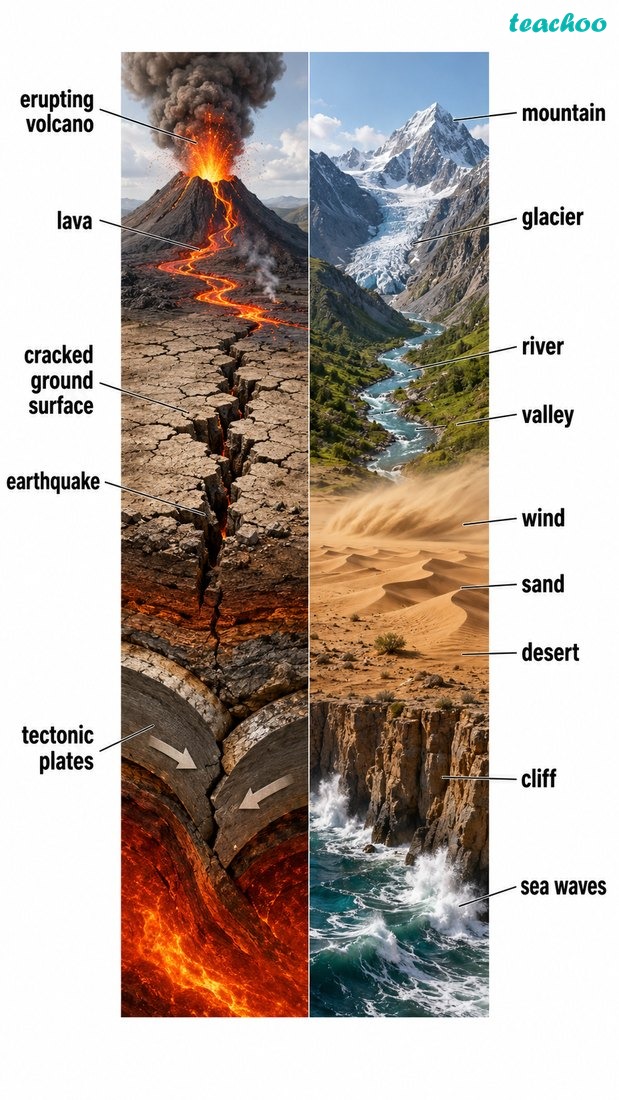
Internal forces build the land up; external forces wear it down
We will study the two forces one by one. We begin with the
internal forces
— that is, plate tectonics. And since plate tectonics works deep inside the Earth, we first look at the Earth’s layers.