You are here
Where do plates actually interact with each other?
Plate Boundary
Plate
a large slab of rock
Boundary
an edge where two things meet
↓
The edge where two tectonic plates meet each other.
What are the three boundary types?
Plate Boundaries
three ways plates meet
1. Convergent
Move towards each other
Mountains and volcanoes
Example:
Himalaya
2. Divergent
Move away from each other
New crust forms
Example:
Mid-Atlantic Ridge
3. Transform
Slide past each other
Mostly causes quakes
Example:
San Andreas Fault
- Plates meet each other at their edges.
- These edges are called plate boundaries .
- There are three main types of boundary.
- These are convergent , divergent and transform .
![2.3 Types of Plate Boundaries - Shaping of the Earth’s - [Teachoo] - Concepts](https://cdn.teachoo.com/fca1729c-8967-415a-b67d-6c6b2fcbe103/three-boundary-types-shown-together-in-one-educational-comparison-convergent-divergent-and-transform-boundaries-no-text..jpg)
The three types of plate boundaries — convergent, divergent and transform
What happens when two plates collide, moving towards each other?
Convergent
Con-
Latin for 'together'
-vergent
turning or moving
↓
Describes plates that push towards each other.
What happens at a convergent boundary?
Two plates push towards each other
↓
Land folds upward, or one plate sinks beneath the other
↓
Fold mountains, volcanoes, quakes.
What are the two collision cases?
Convergent Collisions
two common cases
1. Continent–continent
Land folds upward
Fold mountains form
Example:
Himalaya
2. Ocean–continent
Oceanic plate sinks
Subduction occurs
Example:
Volcanic activity
Earthquakes
- A convergent boundary forms where plates collide.
- When two continental plates collide, land pushes upward .
- This forms fold mountains , such as the Himalaya.
- An oceanic plate may collide with a continental one.
- The oceanic plate sinks beneath it — this is subduction .
- Subduction causes volcanic activity and earthquakes.
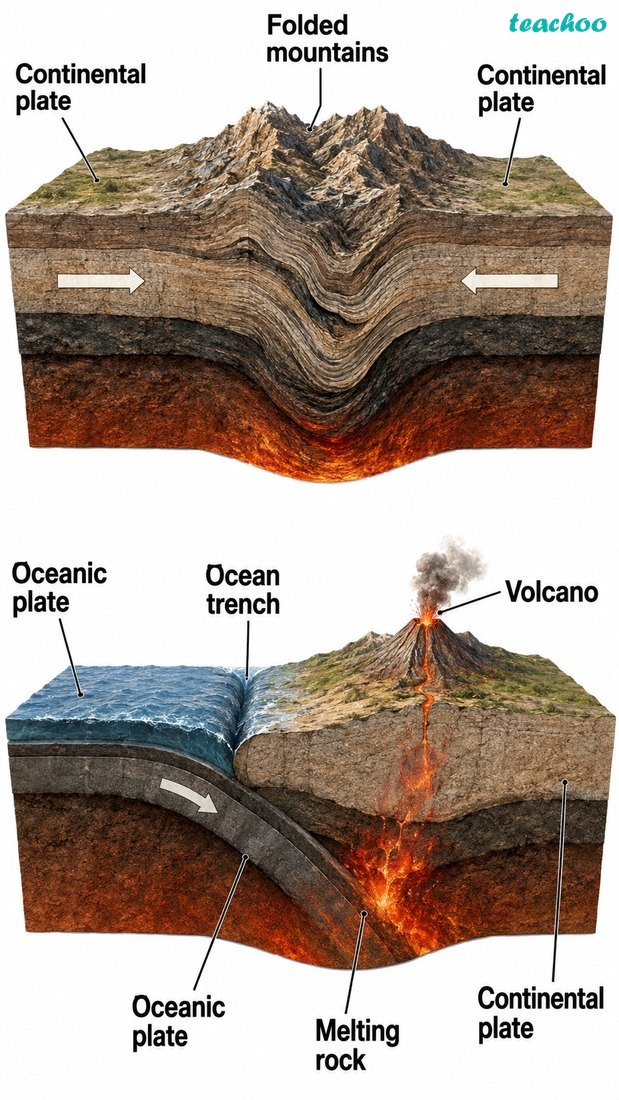
Convergent boundary — continent–continent collision forming fold mountains, and ocean–continent subduction
Example — The Himalaya
- The Indian and Eurasian plates have pushed together for ages.
- This collision folded the land upward.
- It created the towering Himalaya .
- It shows how plate movement builds the tallest mountains .
What happens when two plates move apart, away from each other?
Divergent
Di-
Latin for 'apart'
-vergent
turning or moving
↓
Describes plates that move away from each other.
What happens at a divergent boundary?
Two plates move apart
↓
Magma rises up through the gap
↓
New crust forms, e.g. mid-ocean ridge.
- A divergent boundary forms where plates move apart.
- Magma rises up from the mantle to fill the gap.
- It cools there to form new crust .
- The Mid-Atlantic Ridge formed this way.
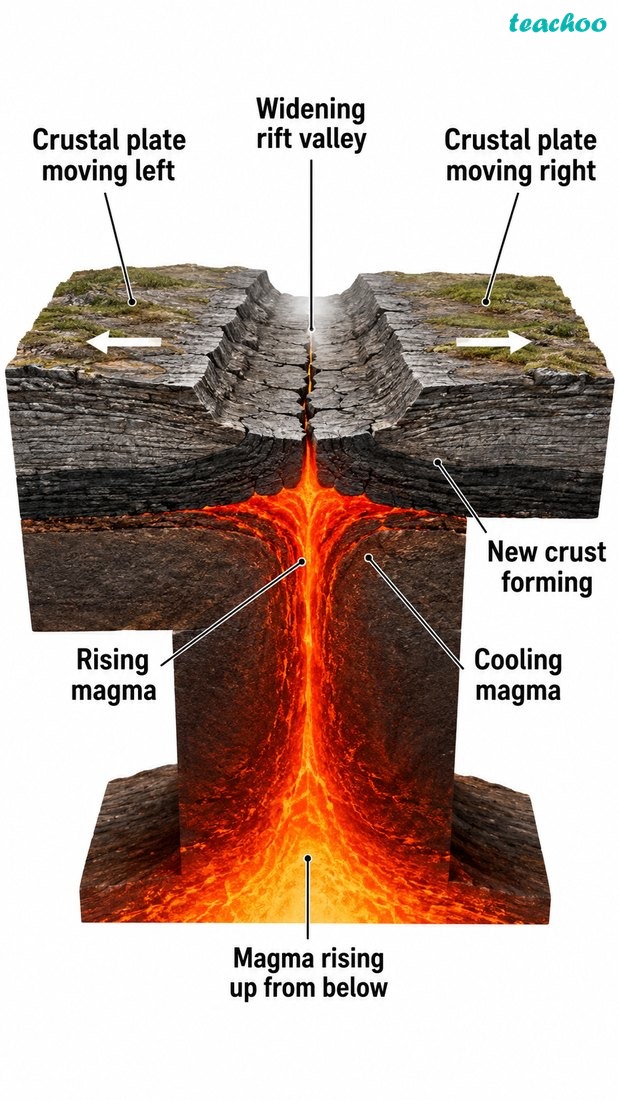
Divergent boundary — the plates move apart and magma rises to form new crust
What happens when two plates slide past each other sideways?
Transform
Trans-
Latin for 'across'
-form
shape or structure
↓
Describes plates that slide past each other sideways.
What happens at a transform boundary?
Two plates slide past each other
↓
No crust is created or destroyed
↓
Mostly causes earthquakes.
- A transform boundary forms where plates slide past each other.
- No new crust is created here.
- None is destroyed either.
- This sliding mainly causes earthquakes .
- The San Andreas Fault is one example.
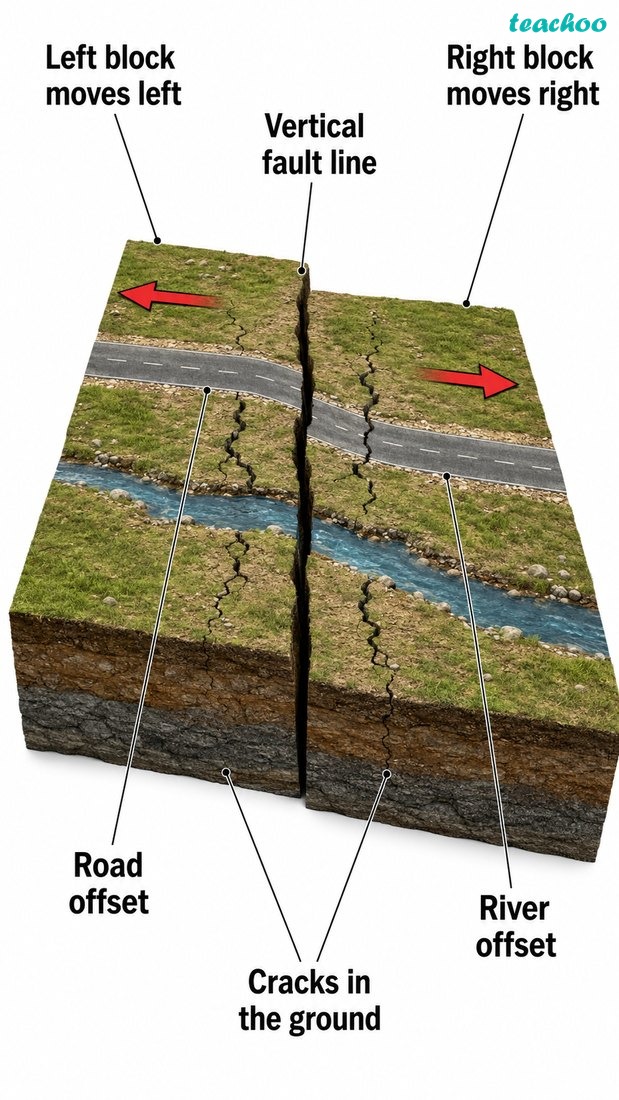
Transform boundary — the plates slide past each other, causing earthquakes
Important Points
- Convergent boundaries build fold mountains.
- They also trigger volcanoes and earthquakes.
- Divergent boundaries create new crust.
- They form features like mid-ocean ridges .
- Transform boundaries mainly cause earthquakes.
- This happens as plates grind past each other.
| Boundary Type | Plate Movement | What It Creates |
|---|---|---|
| Convergent | Plates move towards each other | Fold mountains (e.g. Himalaya), or volcanoes and earthquakes when an oceanic plate sinks |
| Divergent | Plates move apart | New crust forms, e.g. mid-ocean ridges like the Mid-Atlantic Ridge |
| Transform | Plates slide past each other | Mostly earthquakes, e.g. along the San Andreas Fault |
Definition — Plate Boundary
The edge where two tectonic plates meet.
It is classified as convergent, divergent or transform.
This depends on how the plates move.
It is classified as convergent, divergent or transform.
This depends on how the plates move.
Where do earthquakes and volcanoes usually occur?
Why do earthquakes and volcanoes form belts?
Plate boundaries concentrate movement
Plates collide, move apart or slide past each other
↓
The crust breaks or magma rises
This produces earthquakes and volcanic activity
↓
Events cluster along boundaries
They do not occur evenly across the Earth
↓
The belt around the Pacific Ocean is called the Ring of Fire.
- Earthquakes and volcanoes do not happen just anywhere.
- Most of them occur along the plate boundaries .
- This is where plates collide, split apart or slide past each other.
- A famous belt of them rings the Pacific Ocean .
- This belt is called the Ring of Fire .
- This is the belt where most earthquakes and volcanoes happen.
🔎 LET’S EXPLORE
Examine the plate map (Fig. 2.3) with the earthquake and volcano map (Fig. 2.4). What correlation do you observe?
Show Answer
Earthquakes and volcanoes closely follow the plate boundaries.
- Plate boundaries in Fig. 2.3 line up with red dots.
- These dots mark earthquakes in Fig. 2.4.
- Orange triangles mark volcanoes in the same spots.
- Areas far from any boundary show very few of either.
❓ Test Yourself
-
What is a tectonic plate?
View Answer
A large slab of the Earth’s crust and upper mantle that moves slowly over the semi-molten asthenosphere below it. -
What causes tectonic plates to move?
View Answer
Convection currents in the mantle, caused by heat rising from the Earth’s core, push and pull the plates. -
Name the three types of plate boundaries.
View Answer
Convergent, divergent and transform boundaries. -
Which boundary type formed the Himalaya?
View Answer
A convergent boundary, where the Indian and Eurasian plates collided. -
What is the lithosphere made up of?
View Answer
The crust together with the rigid, uppermost part of the mantle.
We now know how plates form, move and meet — so what does all this movement actually add up to?
What does all this plate movement add up to?
Convergent, divergent, transform
↓
Builds mountains, valleys and ocean basins
↓
Triggers volcanoes and earthquakes
↓
Decides where continents and oceans sit today.
- This whole theory is called plate tectonics .
- It was given by W.J. Morgan .
- Together, plate movement builds mountains, valleys and ocean basins .
- It also triggers volcanoes and earthquakes.
- It explains why continents and oceans sit where they do.
Plate Tectonics
Plate
a large slab of rock
Tectonics
study of the Earth's structure
↓
The theory that moving plates build mountains and trigger quakes.
Definition — Plate Tectonics
A theory, given by W.J. Morgan, that the Earth’s crust is broken into large moving plates whose movement at boundaries builds mountains, valleys and ocean basins, and triggers volcanoes and earthquakes.
📝 What Have We Learned
- Plates meet at edges called plate boundaries .
- At a convergent boundary , plates collide and build fold mountains.
- At a divergent boundary , plates move apart and form new crust.
- At a transform boundary , plates slide past each other.
- This whole idea is called the theory of plate tectonics .