You are here
Exercise Set 5.5
Last updated at May 26, 2026 by Teachoo
Transcript
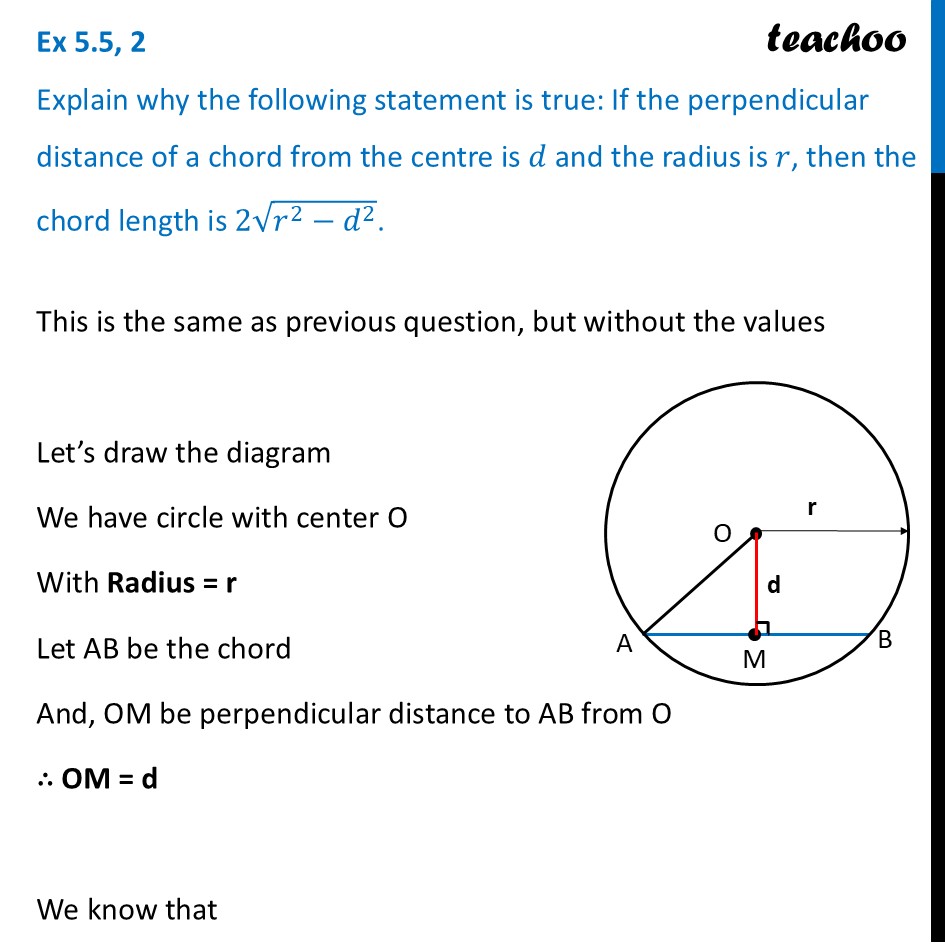
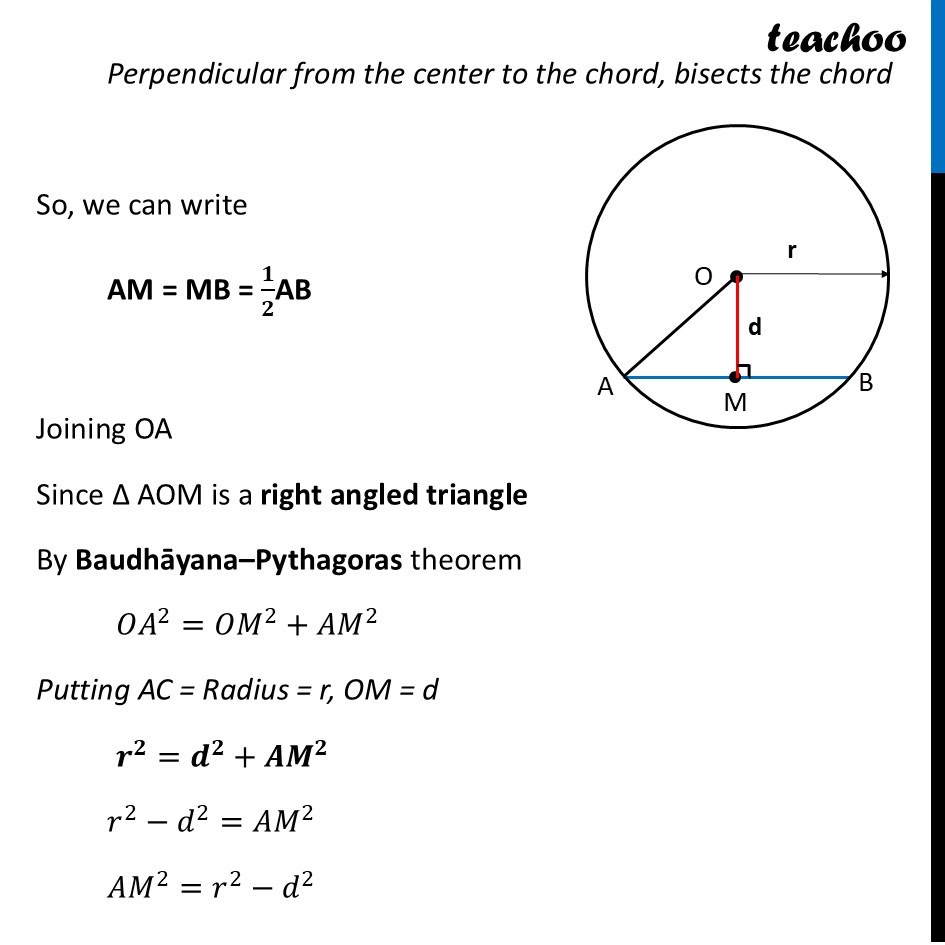
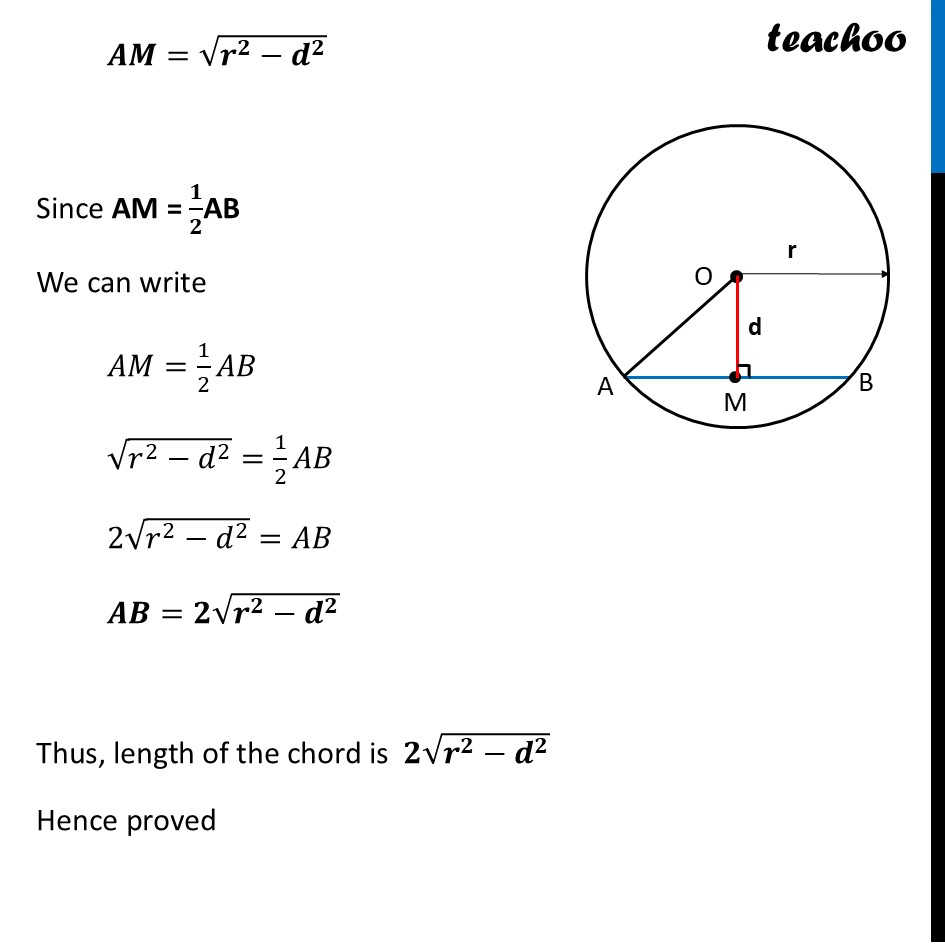
Ex 5.5, 2 Explain why the following statement is true: If the perpendicular distance of a chord from the centre is 𝑑 and the radius is 𝑟, then the chord length is 2√(𝑟^2−𝑑^2 ). This is the same as previous question, but without the values Let’s draw the diagram We have circle with center O With Radius = r Let AB be the chord And, OM be perpendicular distance to AB from O ∴ OM = d We know that Perpendicular from the center to the chord, bisects the chord So, we can write AM = MB = 𝟏/𝟐AB Joining OA Since ∆ AOM is a right angled triangle By Baudhāyana–Pythagoras theorem 〖𝑂𝐴〗^2=〖𝑂𝑀〗^2+〖𝐴𝑀〗^2 Putting AC = Radius = r, OM = d 𝒓^𝟐=𝒅^𝟐+𝑨𝑴^𝟐 𝑟^2−𝑑^2=𝐴𝑀^2 𝐴𝑀^2=𝑟^2−𝑑^2 𝑨𝑴=√(𝒓^𝟐−𝒅^𝟐 ) Since AM = 𝟏/𝟐AB We can write 𝐴𝑀=1/2 𝐴𝐵 √(𝑟^2−𝑑^2 )=1/2 𝐴𝐵 2√(𝑟^2−𝑑^2 )=𝐴𝐵 𝑨𝑩=𝟐√(𝒓^𝟐−𝒅^𝟐 ) Thus, length of the chord is 𝟐√(𝒓^𝟐−𝒅^𝟐 ) Hence proved