You are here



Symmetries of Circle
Last updated at May 26, 2026 by Teachoo
Transcript
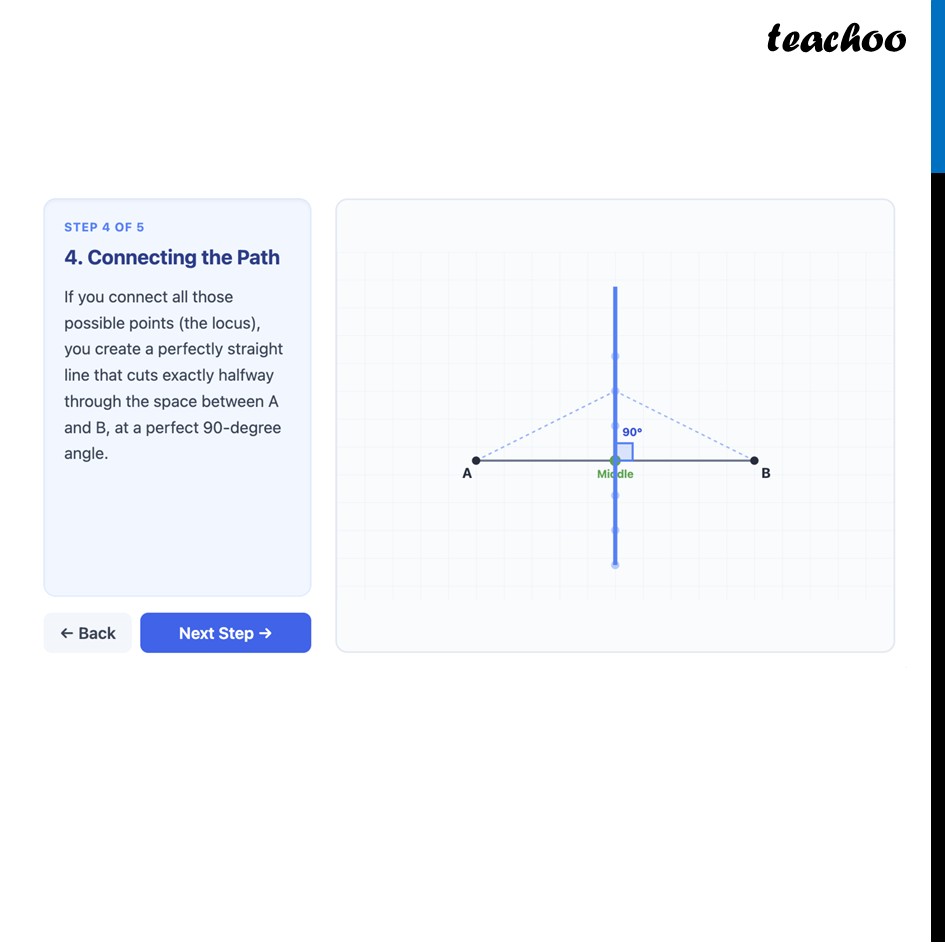
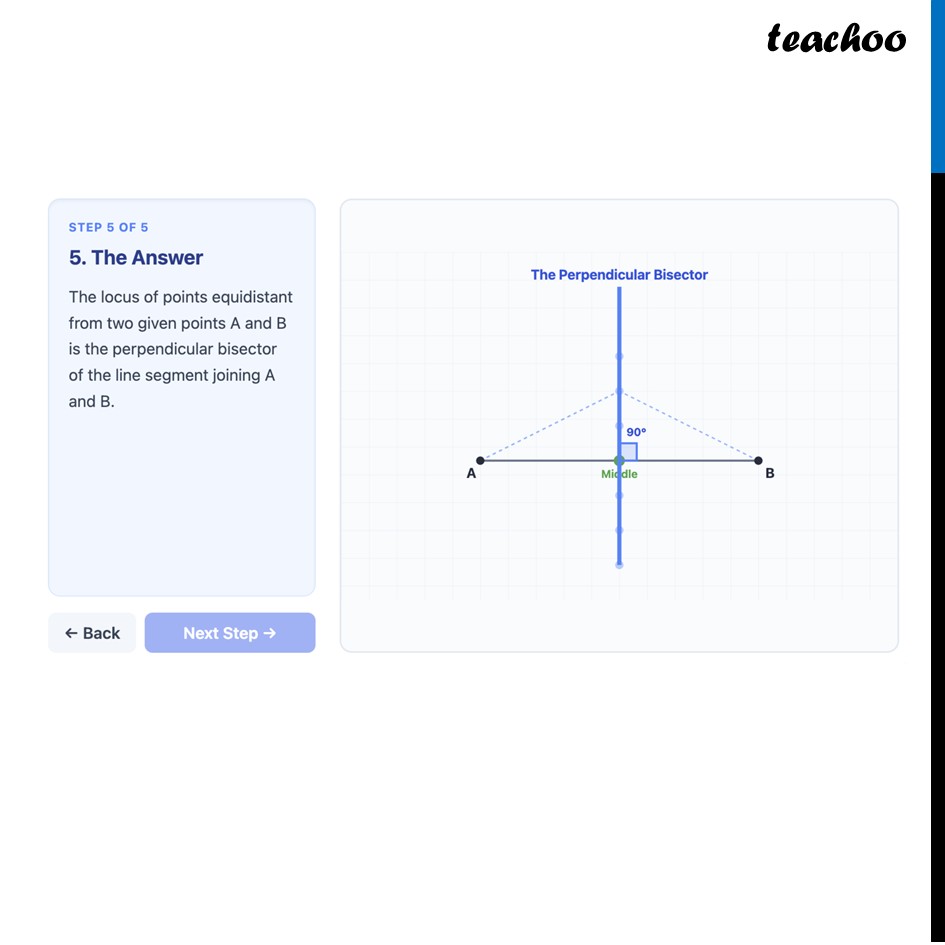
Question 3 - Think & Reflect (Page 94) The locus of points at a given distance from a given point is a circle. What can we say about the locus of points equidistant from two given points? (Hint: We know that any point that is equidistant from two given points A and B lies on the perpendicular bisector of AB . Does this make the perpendicular bisector the locus? For this, we have to show that all the points on the perpendicular bisector are equidistant from A and B.) Let’s visualise this STEP 1 OF 5 Two Dots on Paper Imagine two dots on your paper: Point A and Point B. Back Next Step →STEP 2 OF 5 2. The Most Obvious Spot If you want to place a new dot that is the exact same distance from both A and B , the most obvious place to put it is right in the middle between them. Back Next Step →STEP 3 OF 5 3. Moving Up and Down But what if you move 'up' or 'down' from that middle point? As long as you stay exactly in the middle path, you will always be equally far from and B . Back Next Step →STEP 4 OF 5 4. Connecting the Path If you connect all those possible points (the locus), you create a perfectly straight line that cuts exactly halfway through the space between A and B , at a perfect 90 -degree angle. Back Next Step →STEP 5 OF 5 5. The Answer The locus of points equidistant from two given points A and B is the perpendicular bisector of the line segment joining and B . Back Next Step →To find the locus of points equidistant from two given points, we follow these steps Imagine two dots on your paper: Point A and Point B. If you want to place a new dot that is the exact same distance from both A and B, the most obvious place to put it is right in the middle between them. But what if you move "up" or "down" from that middle point? As long as you stay exactly in the middle path, you will always be equally far from A and B. If you connect all those possible points (the locus), you create a perfectly straight line that cuts exactly halfway through the space between A and B, at a perfect 90-degree angle. Thus, the locus is all points on the perpendicular bisector of AB