You are here
![[Class 9 Maths] We already know that 𝑥^2−𝑦^2=(𝑥−𝑦)(𝑥+𝑦) - Finding New - Finding New Algebraic Identities](https://cdn.teachoo.com/551b9f5c-dc48-48fe-856b-62eb1b917cc6/slide15.jpg)
Finding New Algebraic Identities
Last updated at August 14, 2026 by Teachoo
Transcript
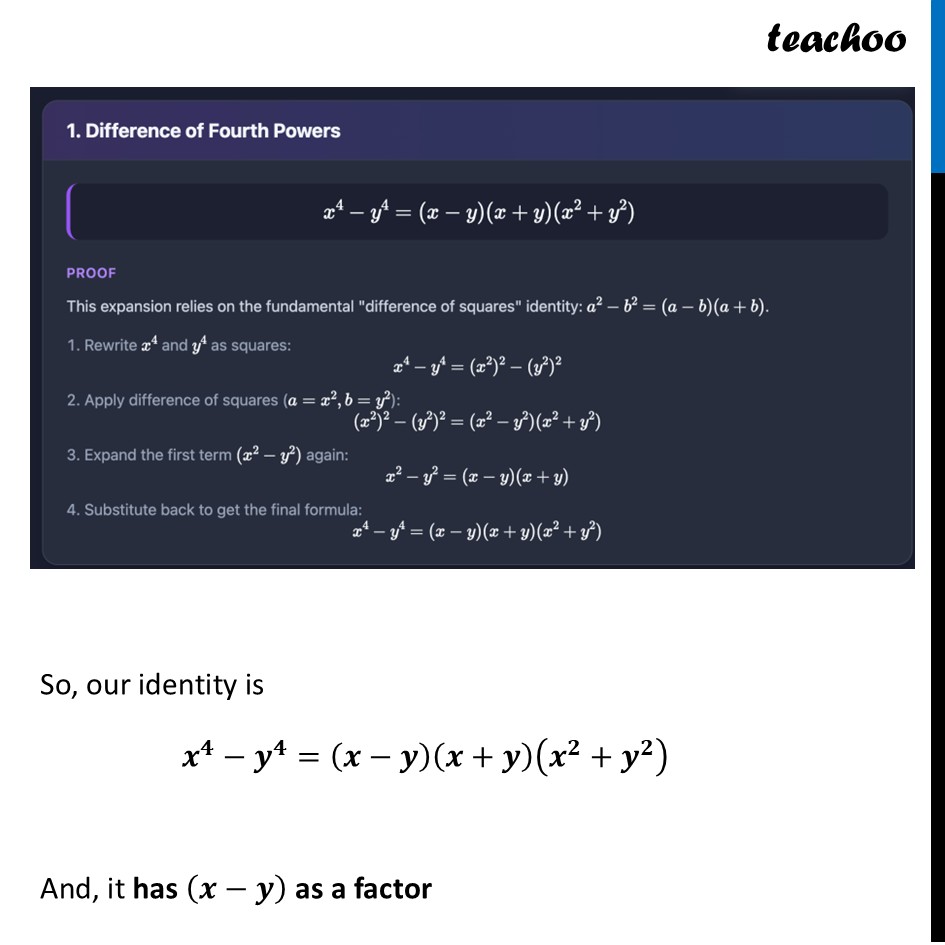
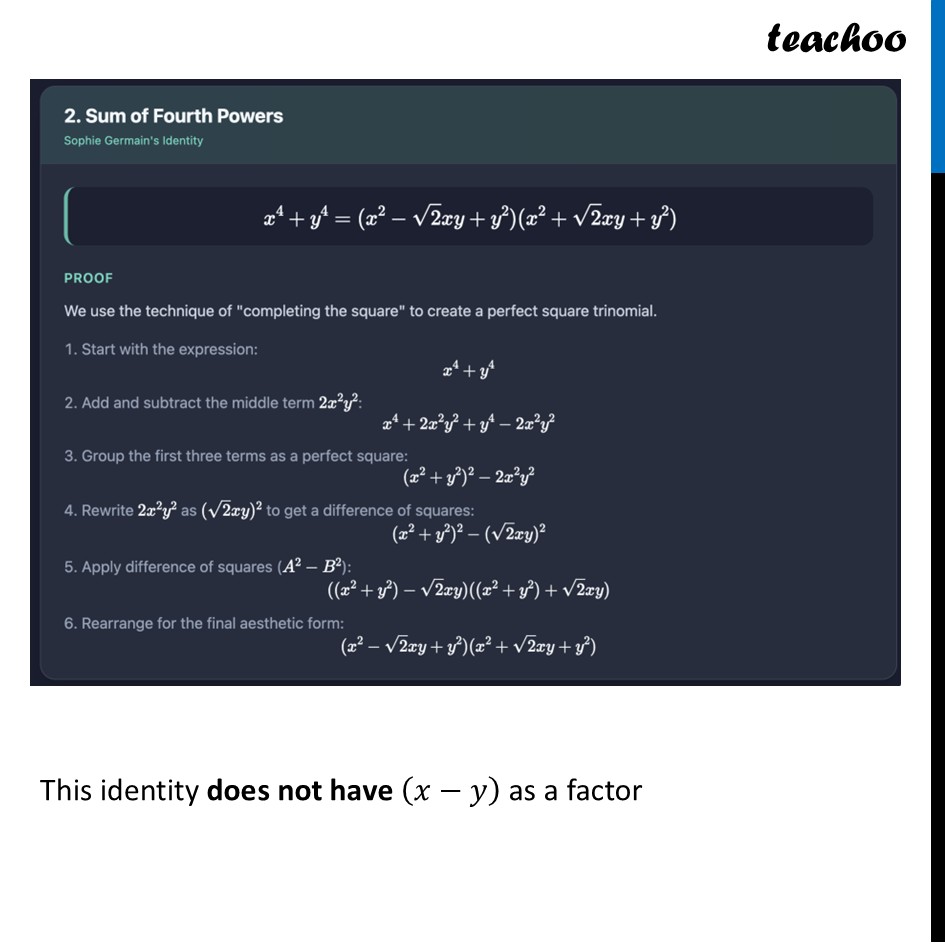
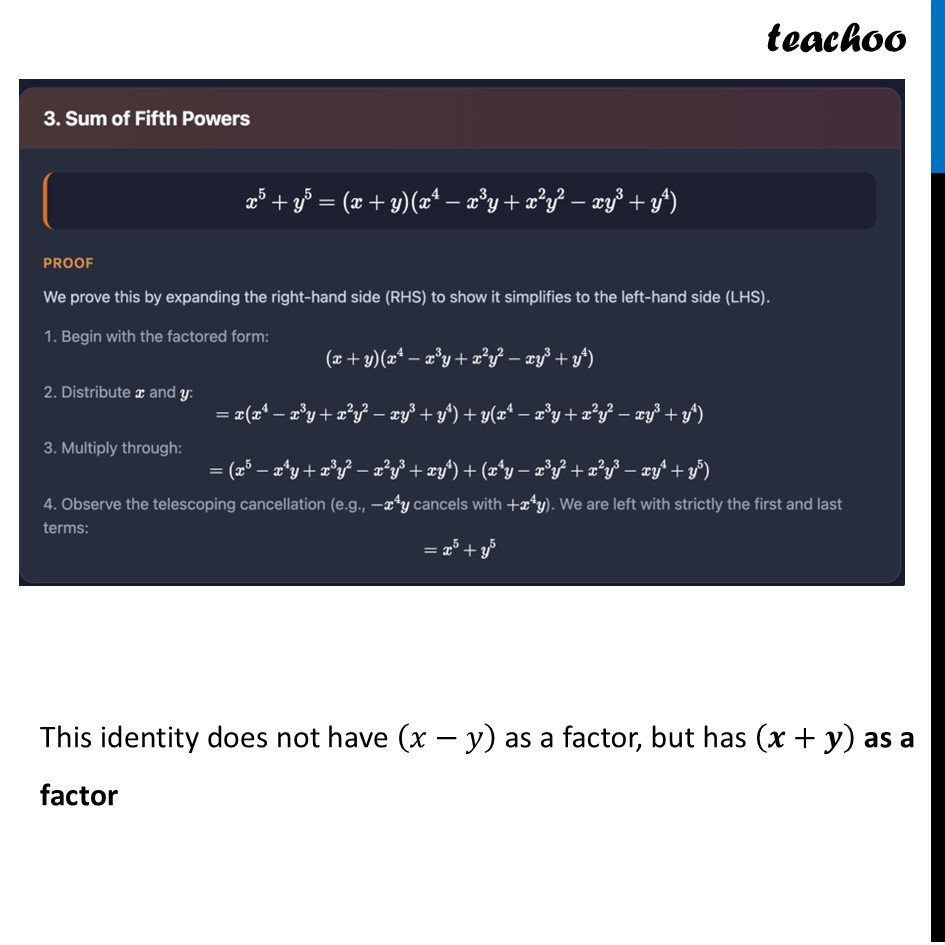
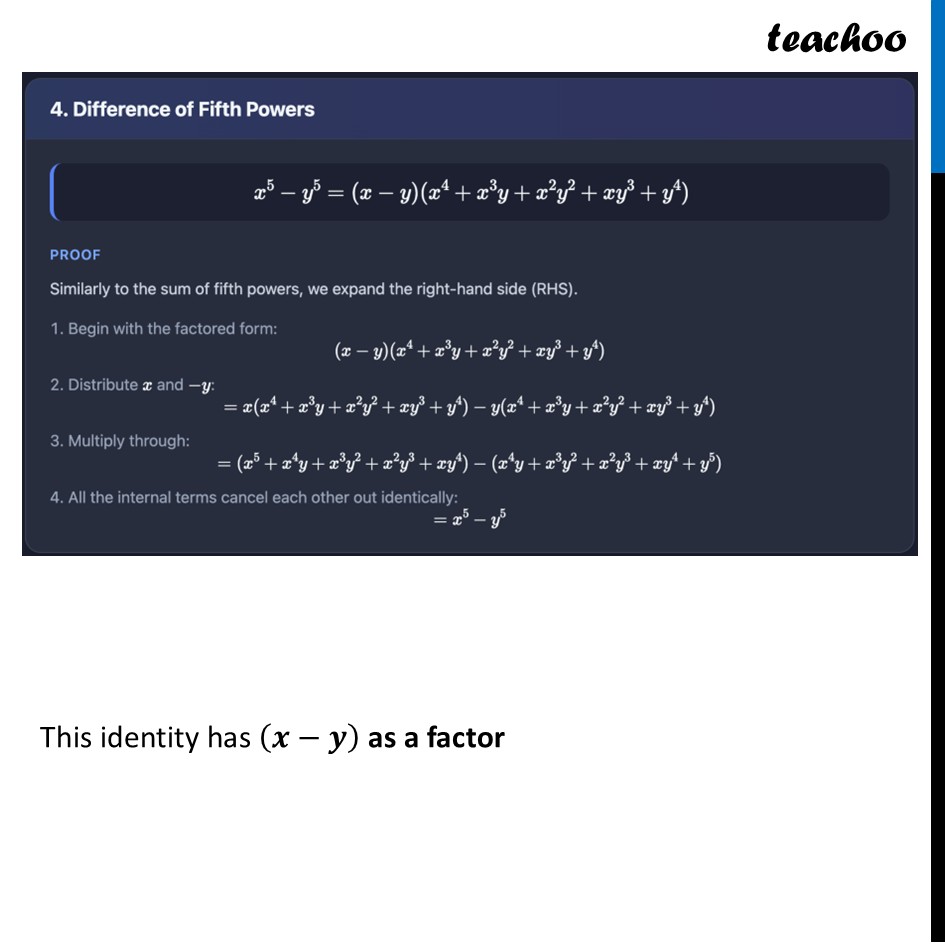
Question 1 - Think & Reflect (Page 85) We already know that 𝑥^2−𝑦^2=(𝑥−𝑦)(𝑥+𝑦). Further, we have verified that 𝑥^3−𝑦^3=(𝑥−𝑦)(𝑥^2+𝑥𝑦+𝑦^2 ). Observe that 𝑥−𝑦 is a common factor of 𝑥^2−𝑦^2 and 𝑥^3−𝑦^3. Do you think 𝑥−𝑦 is also a factor of 𝑥^4−𝑦^4 ? Note that 𝑥^4−𝑦^4=(𝑥^2 )^2−(𝑦^2 )^2=(𝑥^2−𝑦^2 )(𝑥^2+𝑦^2 ). Can you see how 𝑥−𝑦 is a factor of 𝑥^4−𝑦^4 ? How about 𝑥^5−𝑦^5 ? Does this also have 𝑥−𝑦 as a factor? Let’s do this one by one Difference of Fourth Powers x^4-y^4=(x-y)(x+y)(x^2+y^2 ) PROOF This expansion relies on the fundamental "difference of squares" identity: a^2-b^2=(a-b)(a+b). Rewrite x^4 and y^4 as squares: x^4-y^4=(x^2 )^2-(y^2 )^2 Apply difference of squares (a=x^2,b=y^2 ) : (x^2 )^2-(y^2 )^2=(x^2-y^2 )(x^2+y^2 ) Expand the first term ( x^2-y^2 ) again: x^2-y^2=(x-y)(x+y) Substitute back to get the final formula: x^4-y^4=(x-y)(x+y)(x^2+y^2 ) So, our identity is 𝒙^𝟒−𝒚^𝟒=(𝒙−𝒚)(𝒙+𝒚)(𝒙^𝟐+𝒚^𝟐 ) And, it has (𝒙−𝒚) as a factor Sum of Fourth Powers Sophie Germain's Identity x^4+y^4=(x^2-√2 xy+y^2 )(x^2+√2 xy+y^2 ) PROOF We use the technique of "completing the square" to create a perfect square trinomial. Start with the expression: x^4+y^4 Add and subtract the middle term 2x^2 y^2 : x^4+2x^2 y^2+y^4-2x^2 y^2 Group the first three terms as a perfect square: (x^2+y^2 )^2-2x^2 y^2 Rewrite 2x^2 y^2 as (√2 xy)^2 to get a difference of squares: (x^2+y^2 )^2-(√2 xy)^2 Apply difference of squares (A^2-B^2 ) : ((x^2+y^2 )-√2 xy)((x^2+y^2 )+√2 xy) Rearrange for the final aesthetic form: (x^2-√2 xy+y^2 )(x^2+√2 xy+y^2 ) This identity does not have (𝑥−𝑦) as a factor Sum of Fifth Powers x^5+y^5=(x+y)(x^4-x^3 y+x^2 y^2-xy^3+y^4 ) PROOF We prove this by expanding the right-hand side (RHS) to show it simplifies to the left-hand side (LHS). Begin with the factored form: (x+y)(x^4-x^3 y+x^2 y^2-xy^3+y^4 ) Distribute x and y : =x(x^4-x^3 y+x^2 y^2-xy^3+y^4 )+y(x^4-x^3 y+x^2 y^2-xy^3+y^4 ) Multiply through: =(x^5-x^4 y+x^3 y^2-x^2 y^3+xy^4 )+(x^4 y-x^3 y^2+x^2 y^3-xy^4+y^5 ) Observe the telescoping cancellation (e.g., -x^4 y cancels with +x^4 y ). We are left with strictly the first and last terms: =x^5+y^5 This identity does not have (𝑥−𝑦) as a factor, but has (𝒙+𝒚) as a factor Difference of Fifth Powers x^5-y^5=(x-y)(x^4+x^3 y+x^2 y^2+xy^3+y^4 ) PROOF Similarly to the sum of fifth powers, we expand the right-hand side (RHS). Begin with the factored form: (x-y)(x^4+x^3 y+x^2 y^2+xy^3+y^4 ) Distribute x and -y : =x(x^4+x^3 y+x^2 y^2+xy^3+y^4 )-y(x^4+x^3 y+x^2 y^2+xy^3+y^4 ) Multiply through: =(x^5+x^4 y+x^3 y^2+x^2 y^3+xy^4 )-(x^4 y+x^3 y^2+x^2 y^3+xy^4+y^5 ) All the internal terms cancel each other out identically: =x^5-y^5 This identity has (𝒙−𝒚) as a factor