You are here

Exercise Set 4.5
Last updated at May 18, 2026 by Teachoo
Transcript
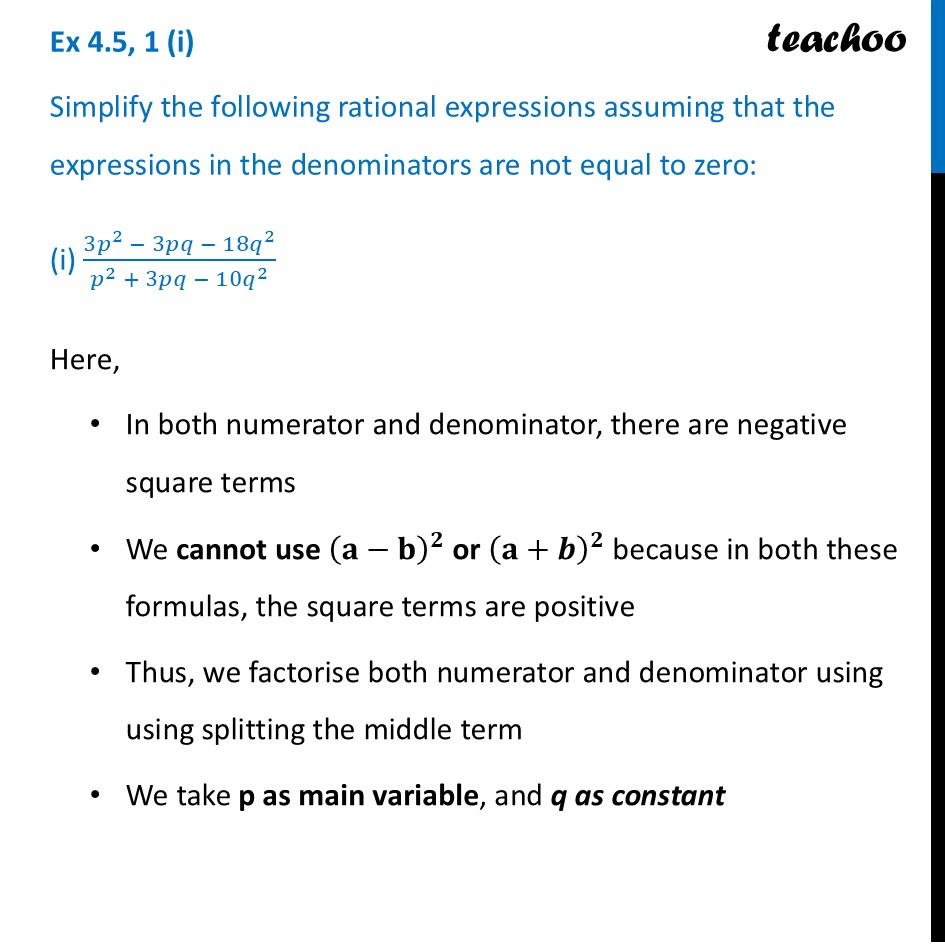
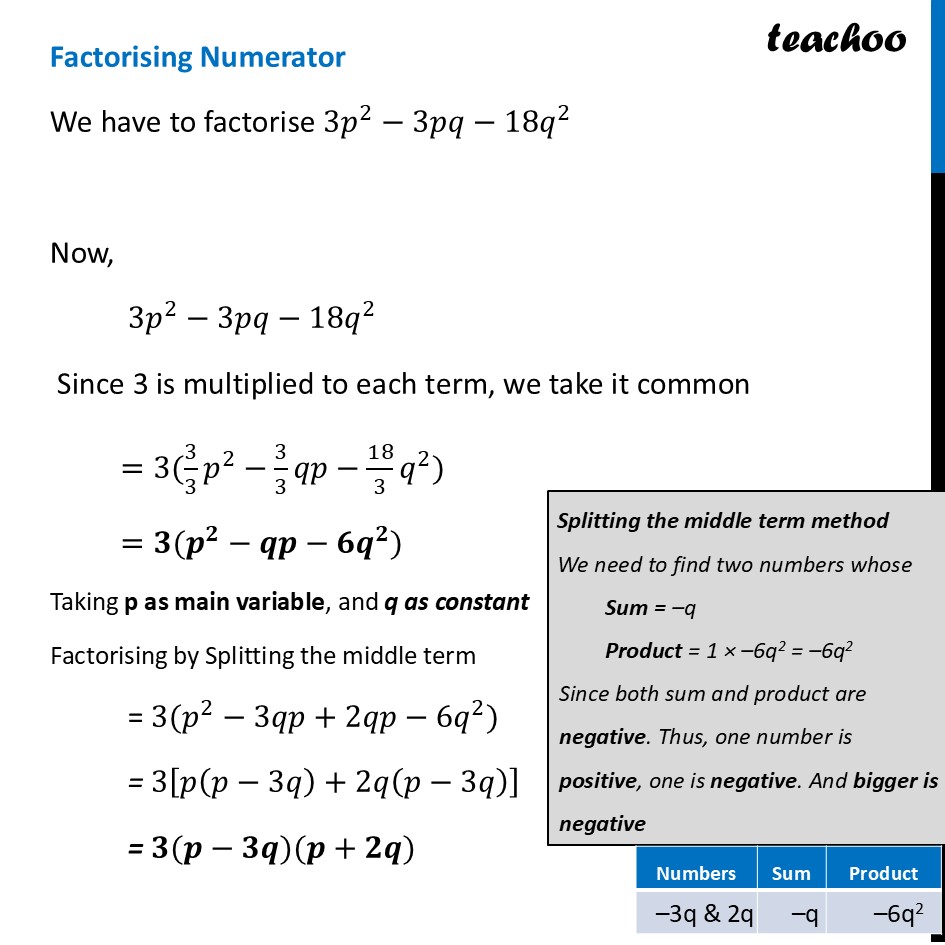
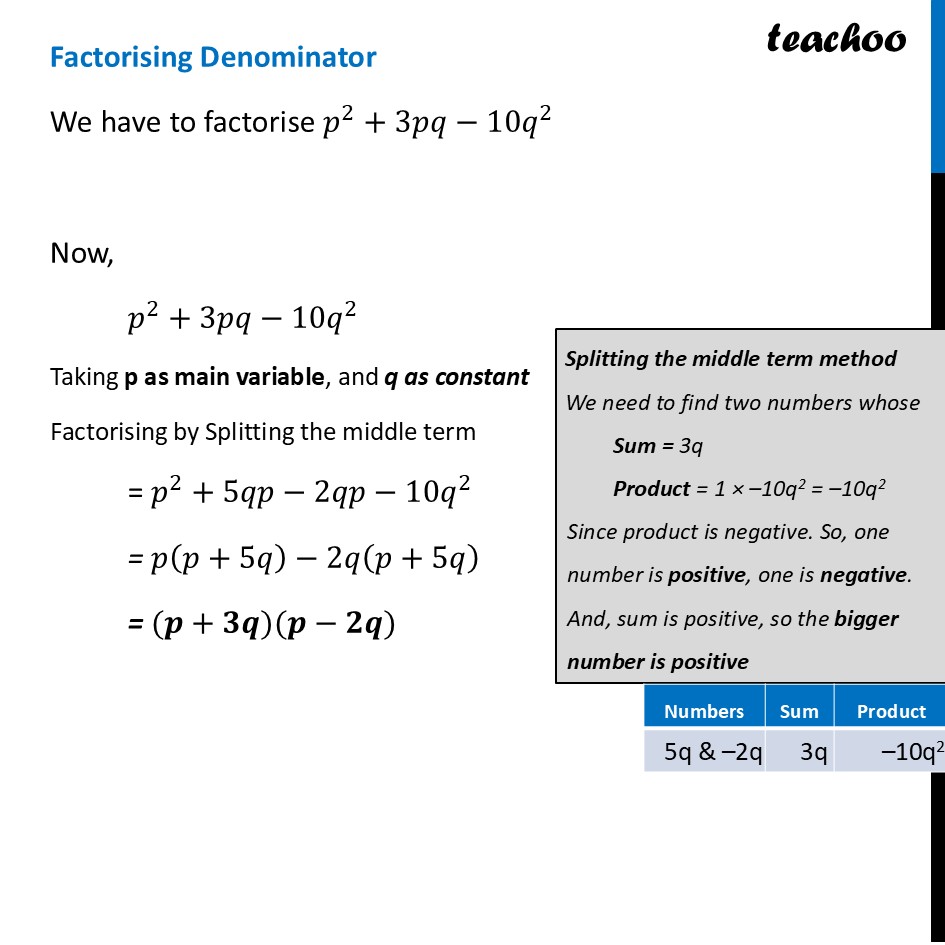
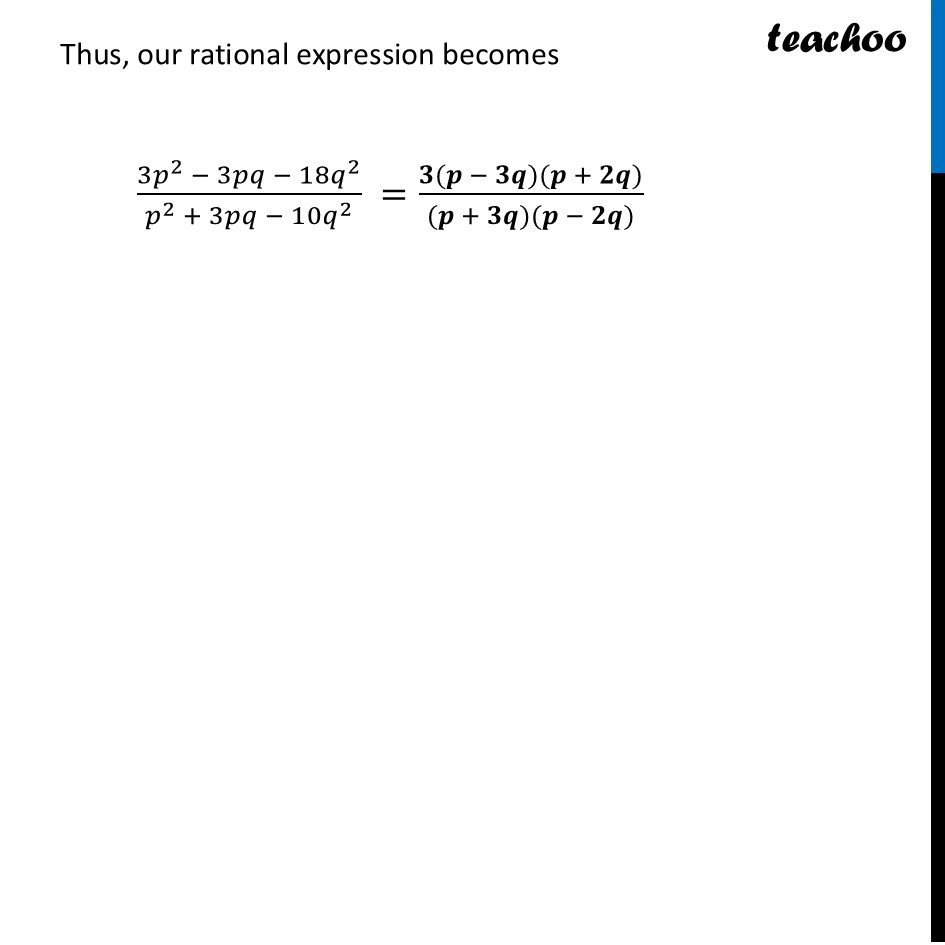
Ex 4.5, 1 (i) Simplify the following rational expressions assuming that the expressions in the denominators are not equal to zero: (i) (3𝑝^2 − 3𝑝𝑞 − 18𝑞^2)/(𝑝^2 + 3𝑝𝑞 − 10𝑞^2 ) Here, In both numerator and denominator, there are negative square terms We cannot use (𝐚−𝐛)^𝟐 or (𝐚+𝒃)^𝟐 because in both these formulas, the square terms are positive Thus, we factorise both numerator and denominator using using splitting the middle term We take p as main variable, and q as constant Factorising Numerator We have to factorise 3𝑝^2−3𝑝𝑞−18𝑞^2 Now, 3𝑝^2−3𝑝𝑞−18𝑞^2 Since 3 is multiplied to each term, we take it common =3(3/3 𝑝^2−3/3 𝑞𝑝−18/3 𝑞^2) =𝟑(𝒑^𝟐−𝒒𝒑−𝟔𝒒^𝟐) Taking p as main variable, and q as constant Factorising by Splitting the middle term = 3(𝑝^2−3𝑞𝑝+2𝑞𝑝−6𝑞^2) = 3[𝑝(𝑝−3𝑞)+2𝑞(𝑝−3𝑞)] = 𝟑(𝒑−𝟑𝒒)(𝒑+𝟐𝒒) Splitting the middle term method We need to find two numbers whose Sum = –q Product = 1 × –6q2 = –6q2 Since both sum and product are negative. Thus, one number is positive, one is negative. And bigger is negative Factorising Denominator We have to factorise 𝑝^2+3𝑝𝑞−10𝑞^2 Now, 𝑝^2+3𝑝𝑞−10𝑞^2 Taking p as main variable, and q as constant Factorising by Splitting the middle term = 𝑝^2+5𝑞𝑝−2𝑞𝑝−10𝑞^2 = 𝑝(𝑝+5𝑞)−2𝑞(𝑝+5𝑞) = (𝒑+𝟑𝒒)(𝒑−𝟐𝒒) Splitting the middle term method We need to find two numbers whose Sum = 3q Product = 1 × –10q2 = –10q2 Since product is negative. So, one number is positive, one is negative. And, sum is positive, so the bigger number is positive Thus, our rational expression becomes (3𝑝^2 − 3𝑝𝑞 − 18𝑞^2)/(𝑝^2 + 3𝑝𝑞 − 10𝑞^2 ) =(𝟑(𝒑 − 𝟑𝒒)(𝒑 + 𝟐𝒒))/((𝒑 + 𝟑𝒒)(𝒑 − 𝟐𝒒))