You are here

![Factor completely: (i) 9x^2 + 24xy + 16y^2 [Class 9 Ganita Manjari I] - Exercise Set 4.2](https://cdn.teachoo.com/8f4ab6f0-a320-436f-941e-aeb057a71ac4/slide49.jpg)
Exercise Set 4.2
Last updated at May 15, 2026 by Teachoo
Transcript
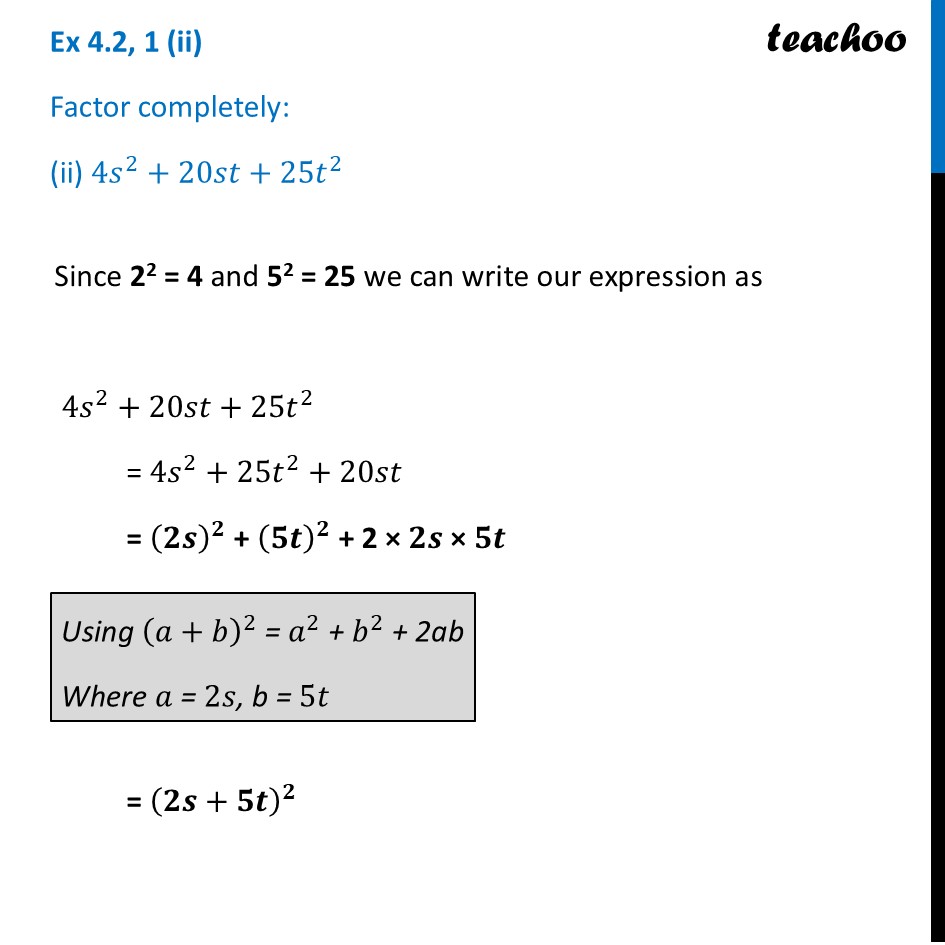
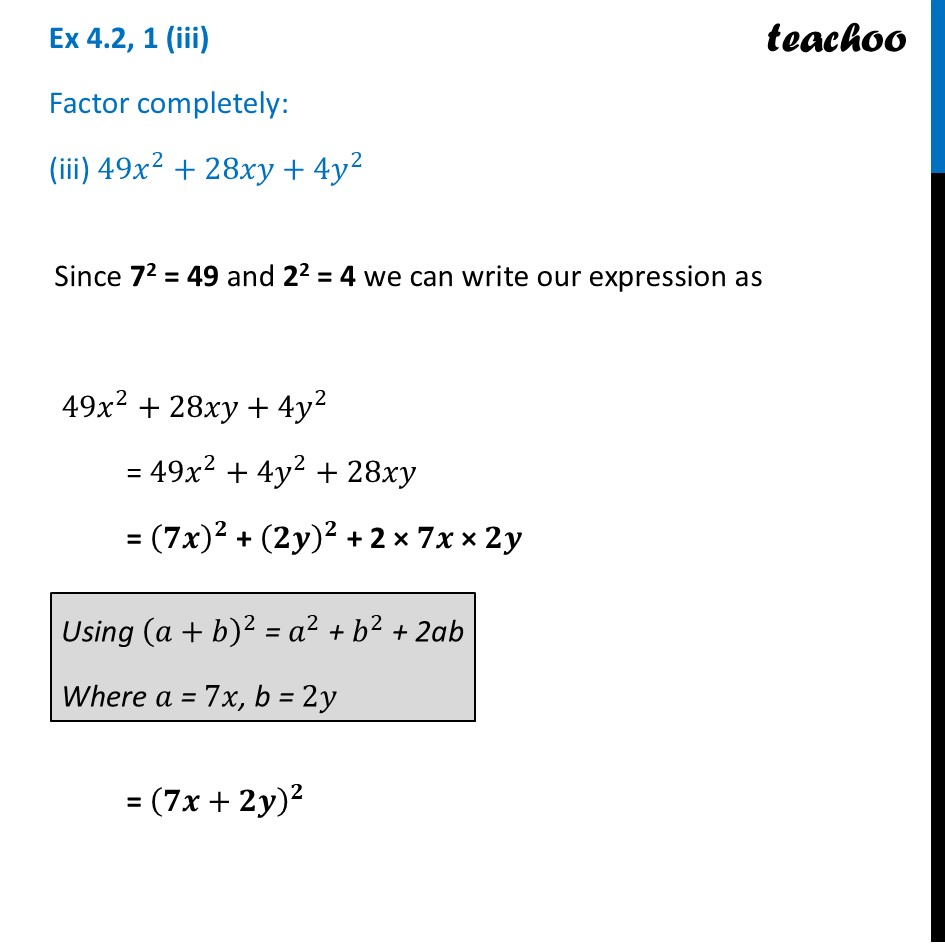
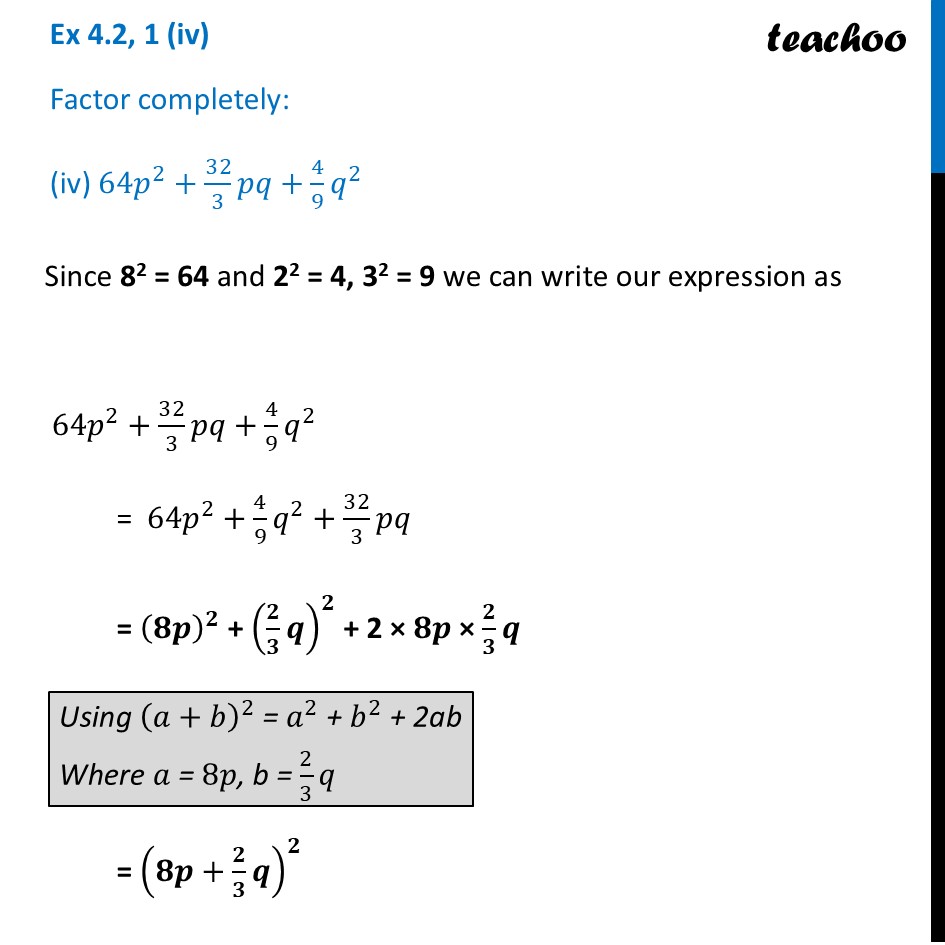
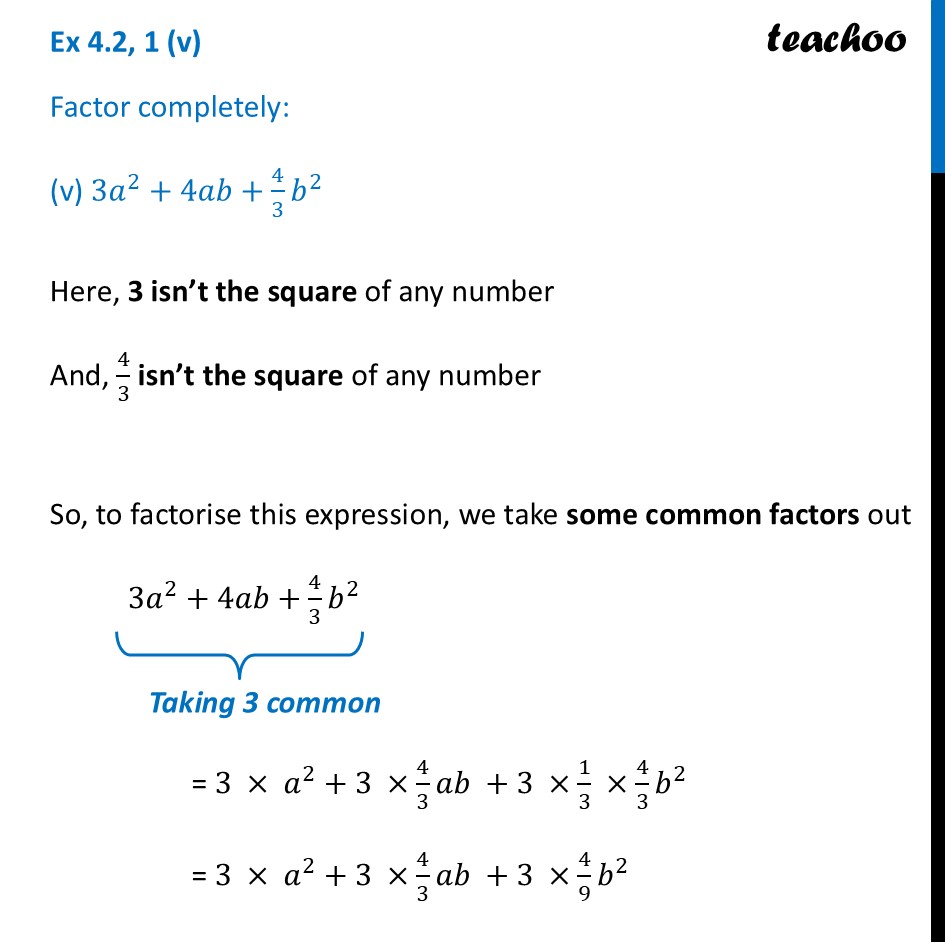
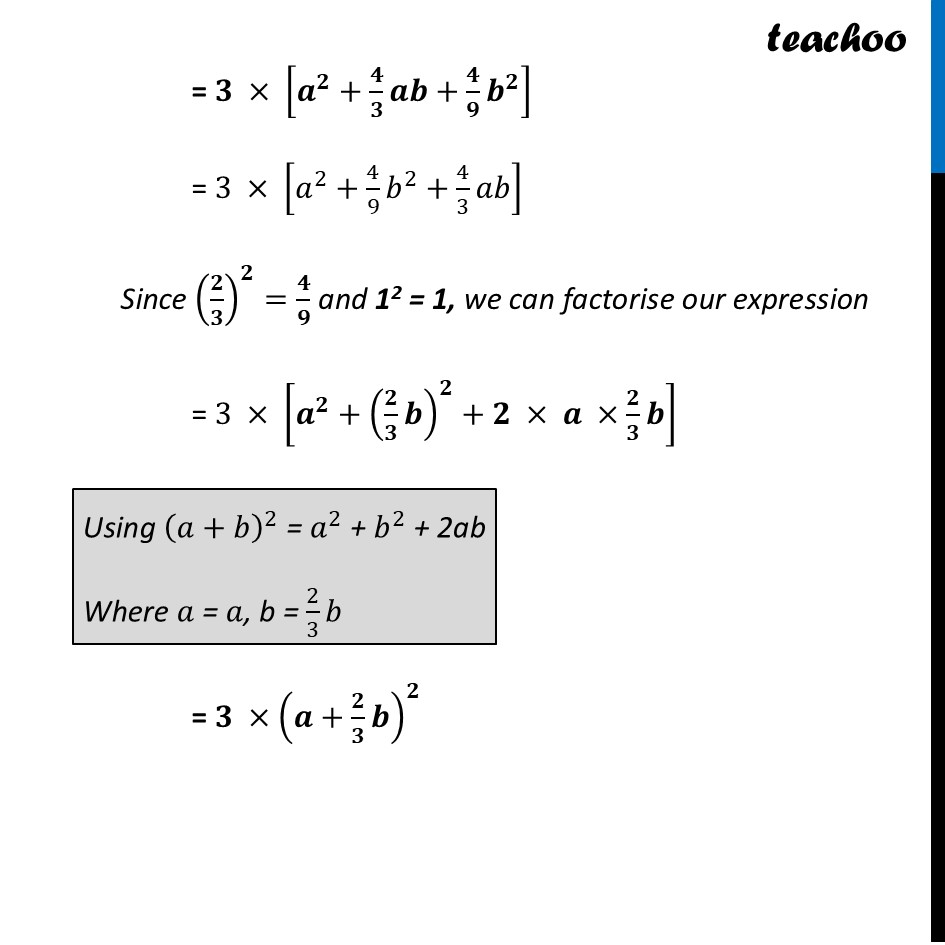
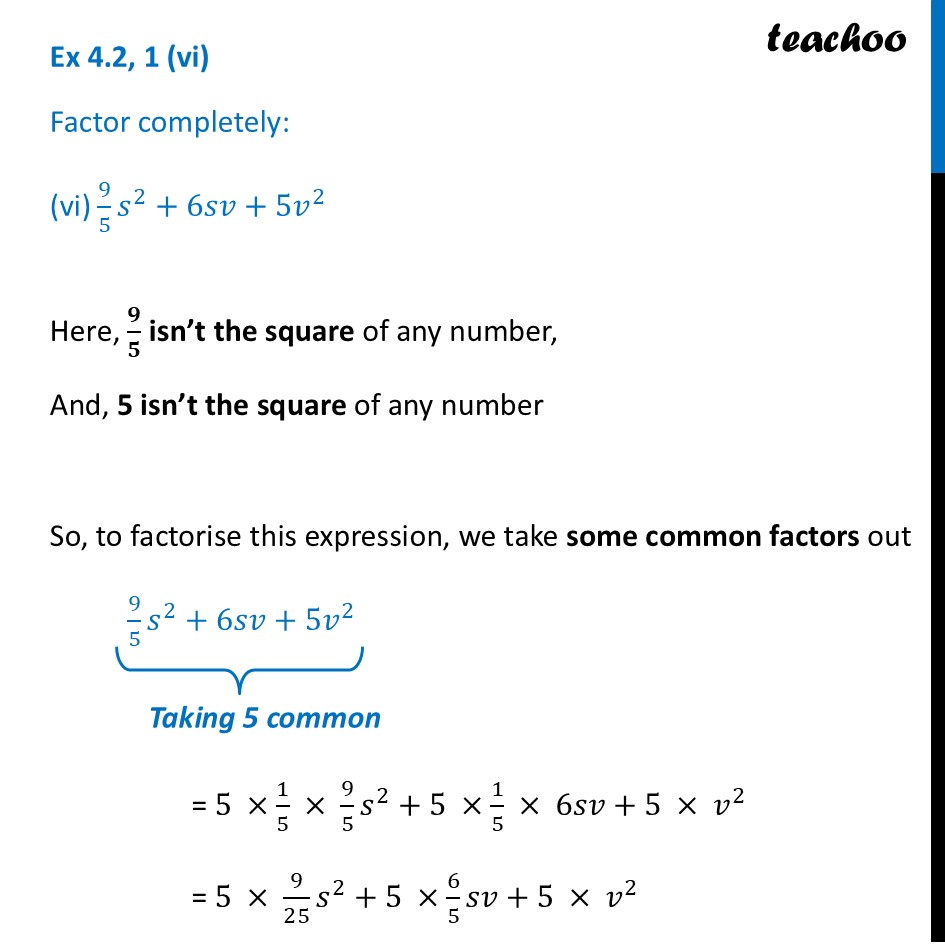
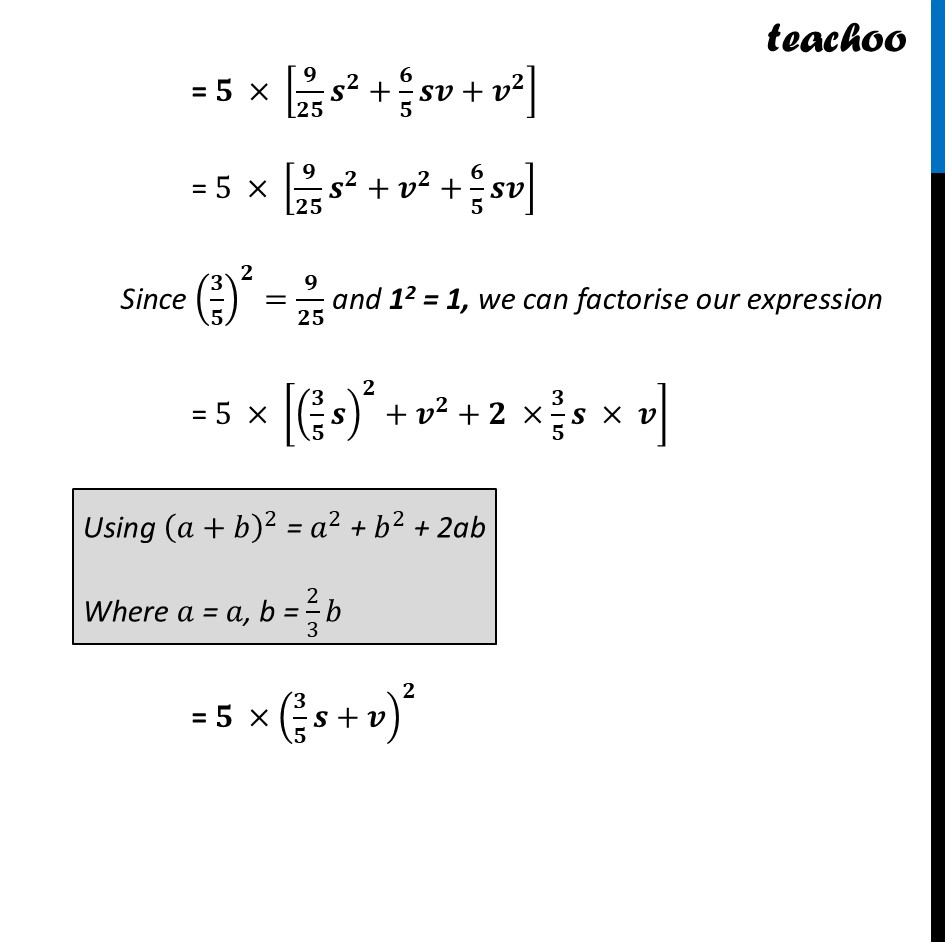
Ex 4.2, 1 (i) Factor completely: (i) 9𝑥^2+24𝑥𝑦+16𝑦^2 Since 32 = 9 and 42 = 16 we can write our expression as 9𝑥^2+24𝑥𝑦+16𝑦^2 = 9𝑥^2+16𝑦^2+24𝑥𝑦 = (𝟑𝒙)^𝟐 + (𝟒𝒚)^𝟐 + 2 × 𝟑𝒙 × 𝟒𝒚 = (𝟑𝒙+𝟒𝒚)^𝟐 Using (𝑎+𝑏)^2 = 𝑎^2 + 𝑏^2 + 2ab Where 𝑎 = 3𝑥, b = 4𝑦 Ex 4.2, 1 (ii) Factor completely: (ii) 4𝑠^2+20𝑠𝑡+25𝑡^2 Since 22 = 4 and 52 = 25 we can write our expression as 4𝑠^2+20𝑠𝑡+25𝑡^2 = 4𝑠^2+25𝑡^2+20𝑠𝑡 = (𝟐𝒔)^𝟐 + (𝟓𝒕)^𝟐 + 2 × 𝟐𝒔 × 𝟓𝒕 = (𝟐𝒔+𝟓𝒕)^𝟐 Using (𝑎+𝑏)^2 = 𝑎^2 + 𝑏^2 + 2ab Where 𝑎 = 2𝑠, b = 5𝑡 Ex 4.2, 1 (iii) Factor completely: (iii) 49𝑥^2+28𝑥𝑦+4𝑦^2 Since 72 = 49 and 22 = 4 we can write our expression as 49𝑥^2+28𝑥𝑦+4𝑦^2 = 49𝑥^2+4𝑦^2+28𝑥𝑦 = (𝟕𝒙)^𝟐 + (𝟐𝒚)^𝟐 + 2 × 𝟕𝒙 × 𝟐𝒚 = (𝟕𝒙+𝟐𝒚)^𝟐 Using (𝑎+𝑏)^2 = 𝑎^2 + 𝑏^2 + 2ab Where 𝑎 = 7𝑥, b = 2𝑦 Ex 4.2, 1 (iv) Factor completely: (iv) 64𝑝^2+32/3 𝑝𝑞+4/9 𝑞^2 Since 82 = 64 and 22 = 4, 32 = 9 we can write our expression as 64𝑝^2+32/3 𝑝𝑞+4/9 𝑞^2 = 64𝑝^2+4/9 𝑞^2+32/3 𝑝𝑞 = (𝟖𝒑)^𝟐 + (𝟐/𝟑 𝒒)^𝟐 + 2 × 𝟖𝒑 × 𝟐/𝟑 𝒒 = (𝟖𝒑+𝟐/𝟑 𝒒)^𝟐 Using (𝑎+𝑏)^2 = 𝑎^2 + 𝑏^2 + 2ab Where 𝑎 = 8𝑝, b = 2/3 𝑞 Ex 4.2, 1 (v) Factor completely: (v) 3𝑎^2+4𝑎𝑏+4/3 𝑏^2 Here, 3 isn’t the square of any number And, 4/3 isn’t the square of any number So, to factorise this expression, we take some common factors out 3𝑎^2+4𝑎𝑏+4/3 𝑏^2 = 3 × 𝑎^2+3 ×4/3 𝑎𝑏 +3 ×1/3 ×4/3 𝑏^2 = 3 × 𝑎^2+3 ×4/3 𝑎𝑏 +3 ×4/9 𝑏^2 Taking 3 common = 𝟑 × [𝒂^𝟐+𝟒/𝟑 𝒂𝒃+𝟒/𝟗 𝒃^𝟐 ] = 3 × [𝑎^2+4/9 𝑏^2+4/3 𝑎𝑏] Since (𝟐/𝟑)^𝟐=𝟒/𝟗 and 12 = 1, we can factorise our expression = 3 × [𝒂^𝟐+(𝟐/𝟑 𝒃)^𝟐+𝟐 × 𝒂 ×𝟐/𝟑 𝒃] = 𝟑 ×(𝒂+𝟐/𝟑 𝒃)^𝟐 Using (𝑎+𝑏)^2 = 𝑎^2 + 𝑏^2 + 2ab Where 𝑎 = 𝑎, b = 2/3 𝑏 Ex 4.2, 1 (vi) Factor completely: (vi) 9/5 𝑠^2+6𝑠𝑣+5𝑣^2 Here, 𝟗/𝟓 isn’t the square of any number, And, 5 isn’t the square of any number So, to factorise this expression, we take some common factors out 9/5 𝑠^2+6𝑠𝑣+5𝑣^2 = 5 ×1/5 × 9/5 𝑠^2+5 ×1/5 × 6𝑠𝑣+5 × 𝑣^2 = 5 × 9/25 𝑠^2+5 ×6/5 𝑠𝑣+5 × 𝑣^2 Taking 5 common = 𝟓 × [𝟗/𝟐𝟓 𝒔^𝟐+𝟔/𝟓 𝒔𝒗+𝒗^𝟐 ] = 5 × [𝟗/𝟐𝟓 𝒔^𝟐+𝒗^𝟐+𝟔/𝟓 𝒔𝒗] Since (𝟑/𝟓)^𝟐=𝟗/𝟐𝟓 and 12 = 1, we can factorise our expression = 5 × [(𝟑/𝟓 𝒔)^𝟐+𝒗^𝟐+𝟐 ×𝟑/𝟓 𝒔 × 𝒗] = 𝟓 ×(𝟑/𝟓 𝒔+𝒗)^𝟐 Using (𝑎+𝑏)^2 = 𝑎^2 + 𝑏^2 + 2ab Where 𝑎 = 𝑎, b = 2/3 𝑏