You are here

![Cube Identities - Formula, Examples [with Video] - Teachoo Maths - Finding New Algebraic Identities](https://cdn.teachoo.com/f55d3382-16c8-41ff-8598-d1c2e8482dc7/slide3.jpg)
Finding New Algebraic Identities
Last updated at August 14, 2026 by Teachoo
Transcript
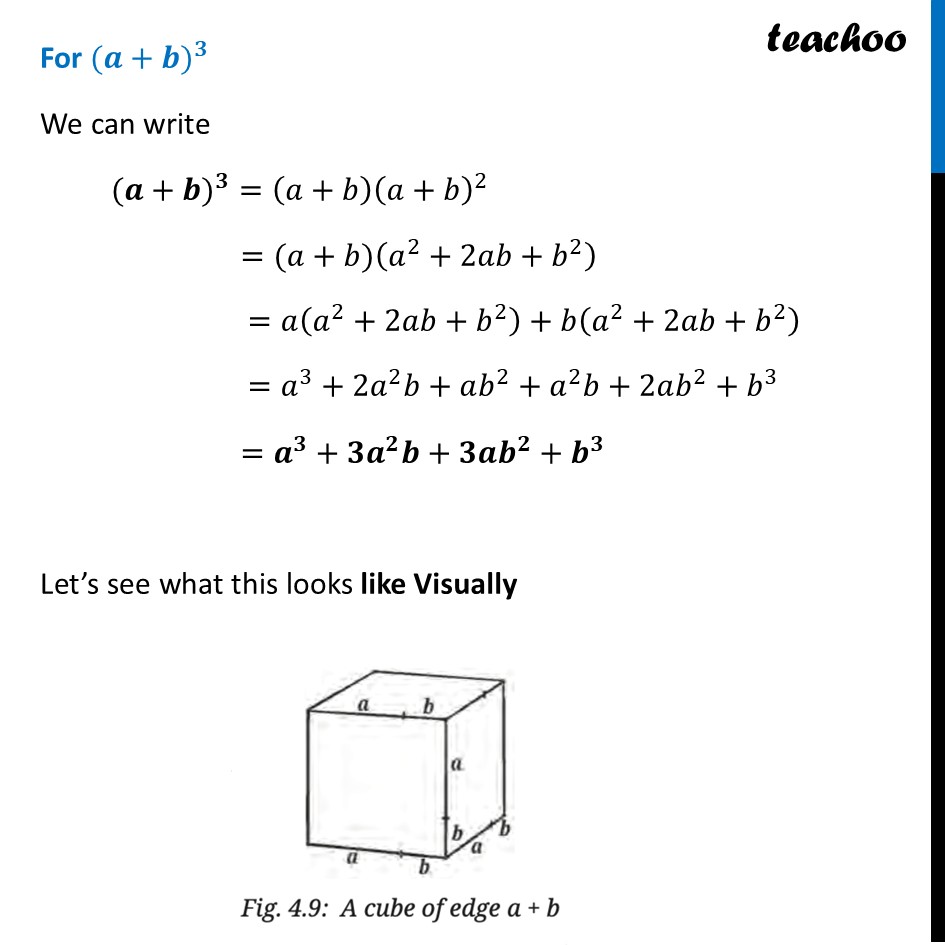
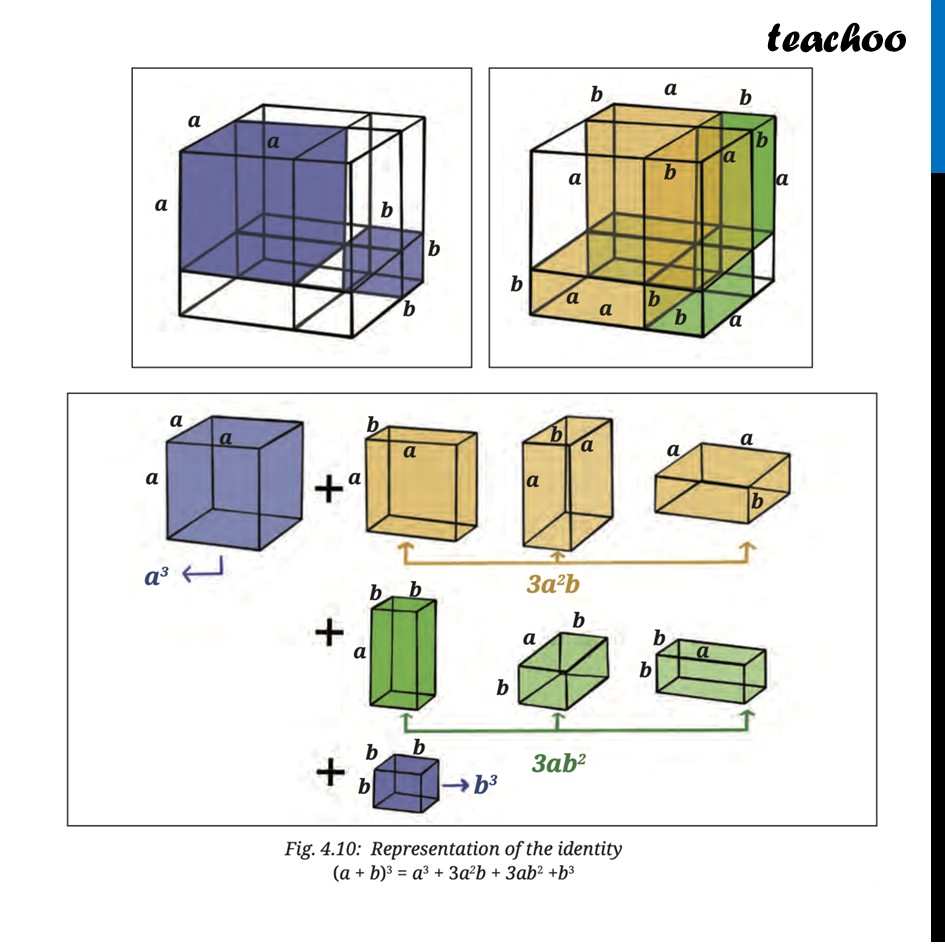
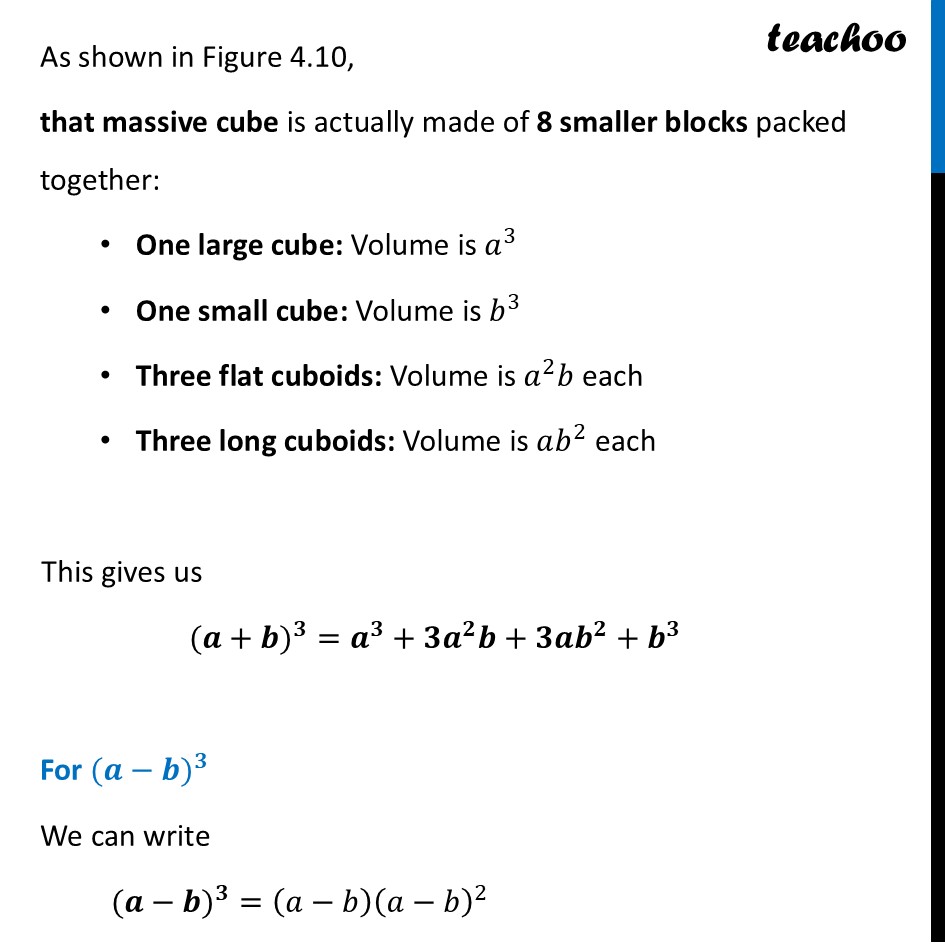
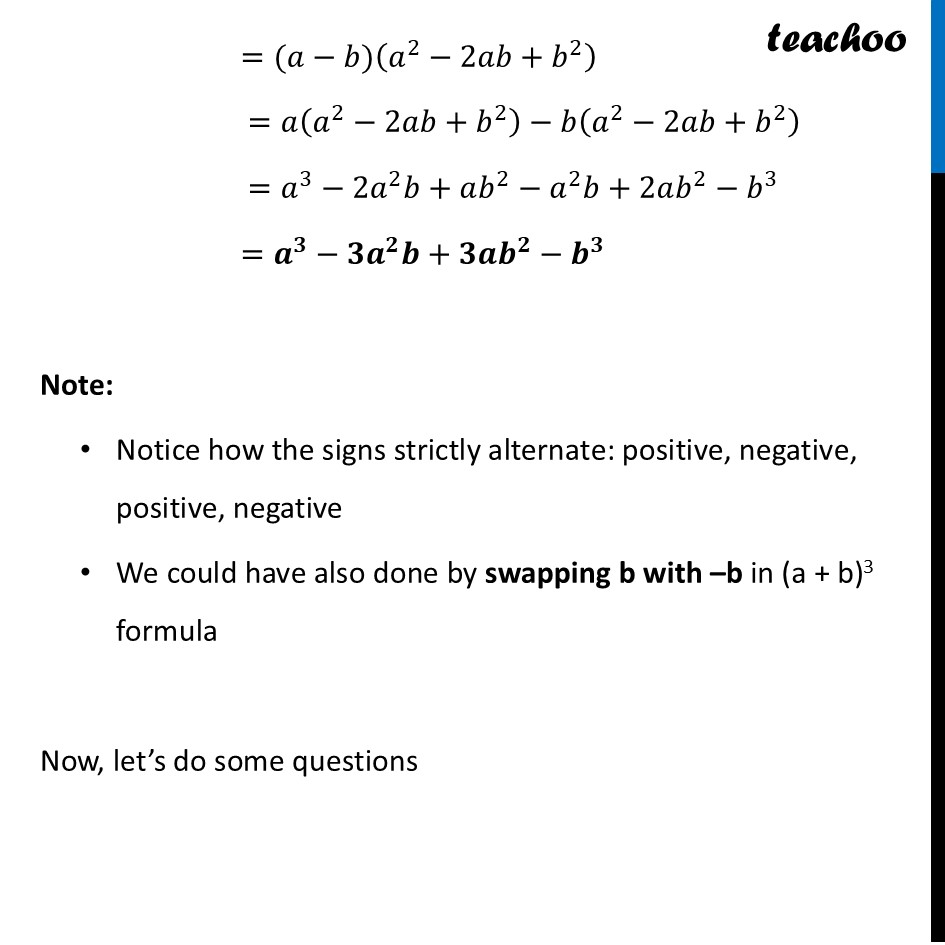
Cube Identities (a+b)^3 Formula ((a+b)^3=(a+b)^* (a+b)^2a^3+3a^2 b+3ab^2+b^3 ) a^3 is the cube of 〖3a〗^2 b and 3〖ab〗^2 are b^3 is the cube of the first term middle terms the second term (a-b)^3 Formula ((a-b)^3=(a-b)*(a-b)^2a^3-3a^2 b+3ab^2-b^3 ) Note the alternating signs:,,,+-+- For (𝒂+𝒃)^𝟑 We can write (𝒂+𝒃)^𝟑=(𝑎+𝑏) (𝑎+𝑏)^2 =(𝑎+𝑏)(𝑎^2+2𝑎𝑏+𝑏^2 ) =𝑎(𝑎^2+2𝑎𝑏+𝑏^2 )+𝑏(𝑎^2+2𝑎𝑏+𝑏^2 ) =𝑎^3+2𝑎^2 𝑏+𝑎𝑏^2+𝑎^2 𝑏+2𝑎𝑏^2+𝑏^3 =𝒂^𝟑+𝟑𝒂^𝟐 𝒃+𝟑𝒂𝒃^𝟐+𝒃^𝟑 Let’s see what this looks like Visually As shown in Figure 4.10, that massive cube is actually made of 8 smaller blocks packed together: One large cube: Volume is 𝑎^3 One small cube: Volume is 𝑏^3 Three flat cuboids: Volume is 𝑎^2 𝑏 each Three long cuboids: Volume is 𝑎𝑏^2 each This gives us (𝒂+𝒃)^𝟑=𝒂^𝟑+𝟑𝒂^𝟐 𝒃+𝟑𝒂𝒃^𝟐+𝒃^𝟑 For (𝒂−𝒃)^𝟑 We can write (𝒂−𝒃)^𝟑=(𝑎−𝑏) (𝑎−𝑏)^2 =(𝑎−𝑏)(𝑎^2−2𝑎𝑏+𝑏^2 ) =𝑎(𝑎^2−2𝑎𝑏+𝑏^2 )−𝑏(𝑎^2−2𝑎𝑏+𝑏^2 ) =𝑎^3−2𝑎^2 𝑏+𝑎𝑏^2−𝑎^2 𝑏+2𝑎𝑏^2−𝑏^3 =𝒂^𝟑−𝟑𝒂^𝟐 𝒃+𝟑𝒂𝒃^𝟐−𝒃^𝟑 Note: Notice how the signs strictly alternate: positive, negative, positive, negative We could have also done by swapping b with –b in (a + b)3 formula Now, let’s do some questions