You are here
Exercise Set 4.5
Last updated at May 18, 2026 by Teachoo
Transcript
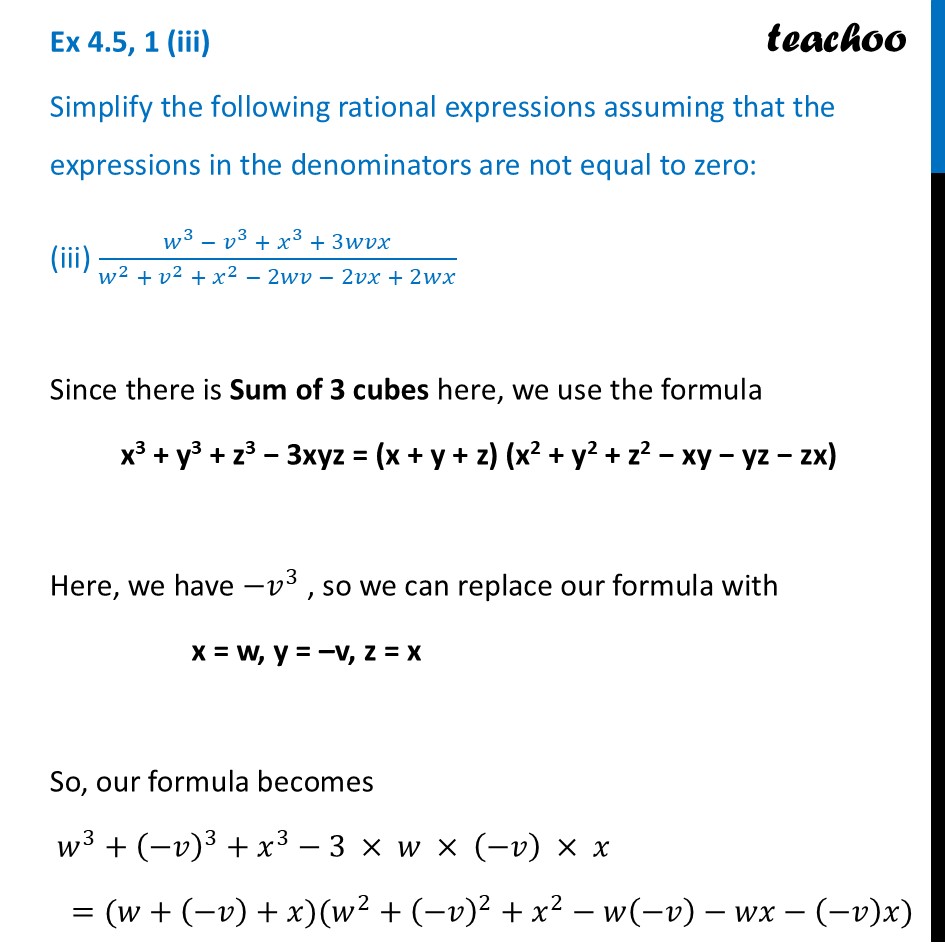
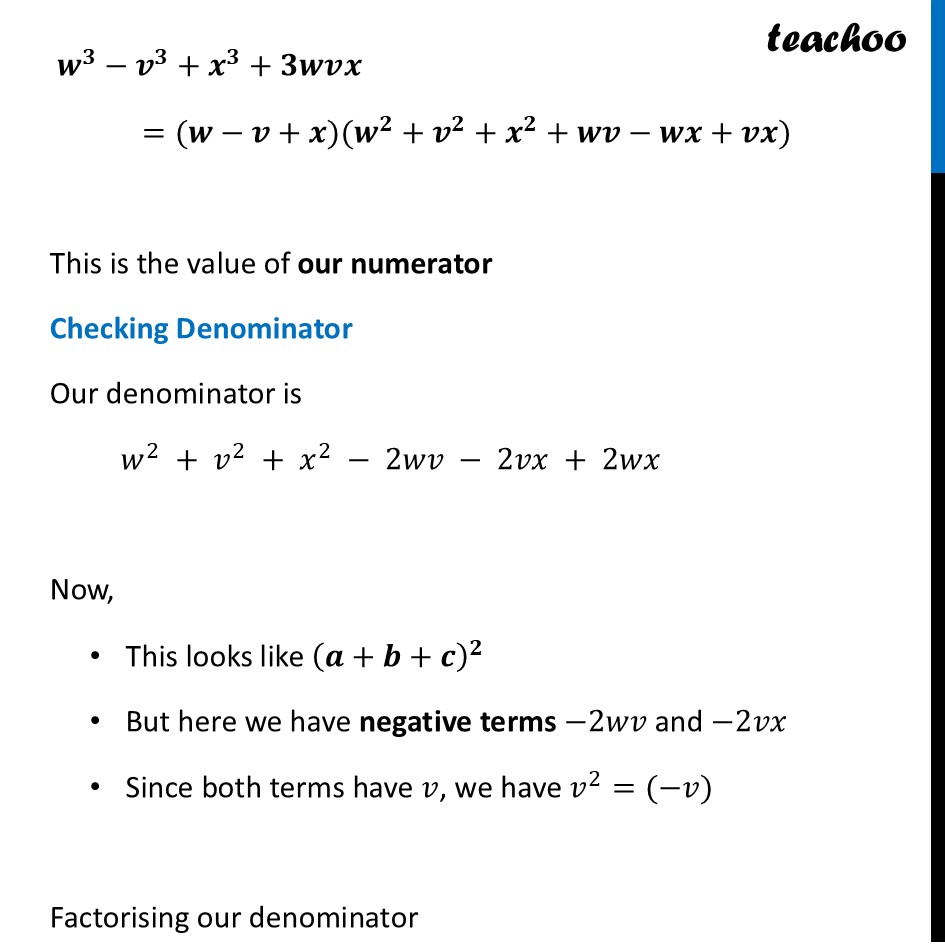
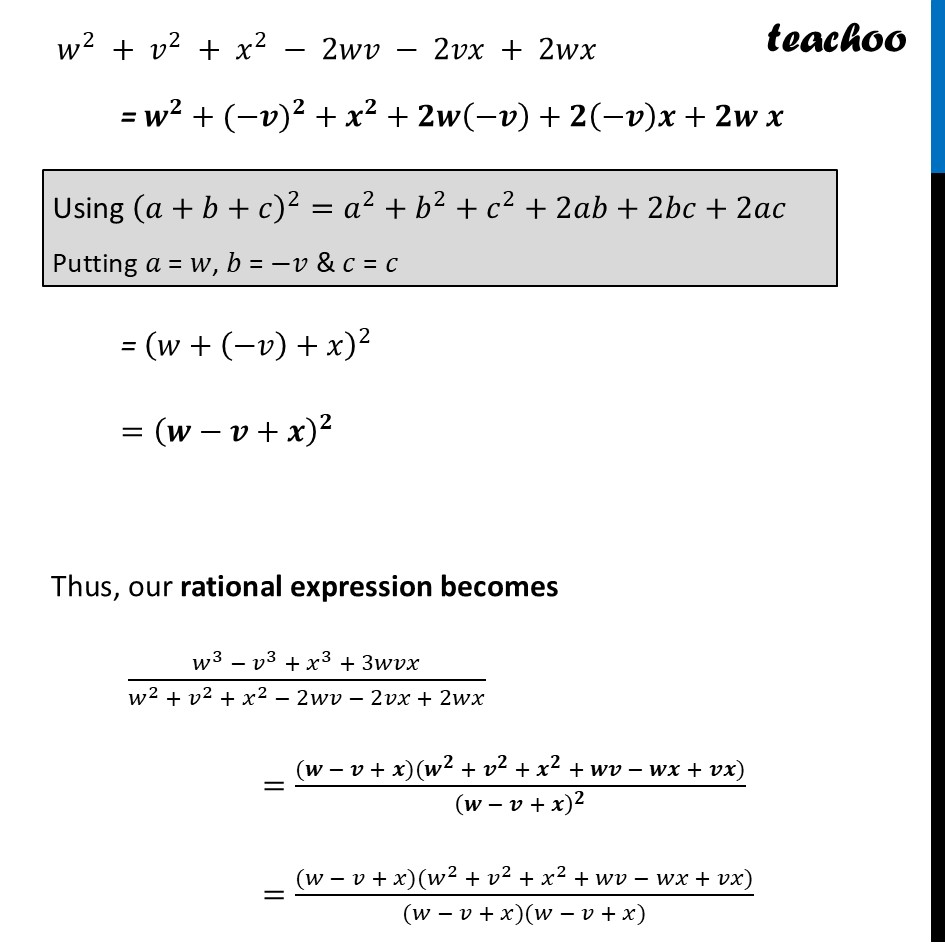
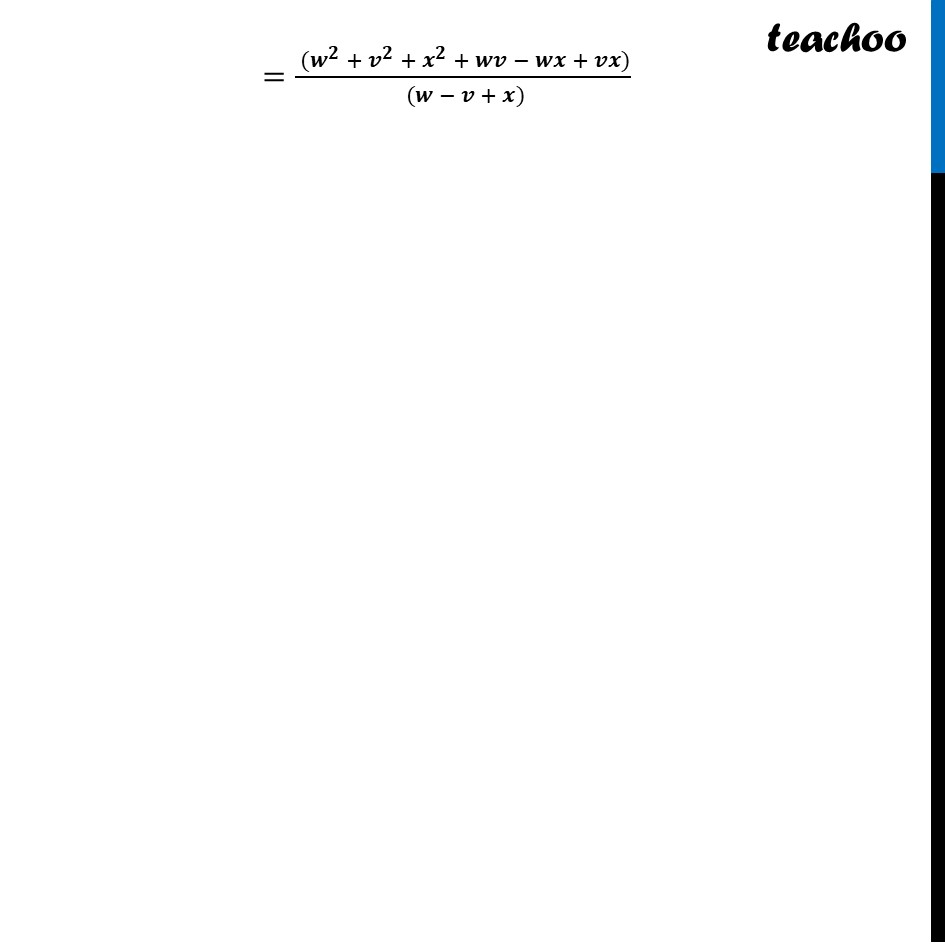
Ex 4.5, 1 (iii) Simplify the following rational expressions assuming that the expressions in the denominators are not equal to zero: (iii) (𝑤^3 − 𝑣^3 + 𝑥^3 + 3𝑤𝑣𝑥)/(𝑤^2 + 𝑣^2 + 𝑥^2 − 2𝑤𝑣 − 2𝑣𝑥 + 2𝑤𝑥) Since there is Sum of 3 cubes here, we use the formula x3 + y3 + z3 − 3xyz = (x + y + z) (x2 + y2 + z2 − xy − yz − zx) Here, we have −𝑣^3 , so we can replace our formula with x = w, y = –v, z = x So, our formula becomes 𝑤^3+(−𝑣)^3+𝑥^3−3 × 𝑤 × (−𝑣) × 𝑥 =(𝑤+(−𝑣)+𝑥)(𝑤^2+(−𝑣)^2+𝑥^2−𝑤(−𝑣)−𝑤𝑥−(−𝑣)𝑥) 𝒘^𝟑−𝒗^𝟑+𝒙^𝟑+𝟑𝒘𝒗𝒙 =(𝒘−𝒗+𝒙)(𝒘^𝟐+𝒗^𝟐+𝒙^𝟐+𝒘𝒗−𝒘𝒙+𝒗𝒙) This is the value of our numerator Checking Denominator Our denominator is 𝑤^2 + 𝑣^2 + 𝑥^2 − 2𝑤𝑣 − 2𝑣𝑥 + 2𝑤𝑥 Now, This looks like (𝒂+𝒃+𝒄)^𝟐 But here we have negative terms −2𝑤𝑣 and −2𝑣𝑥 Since both terms have 𝑣, we have 𝑣^2=(−𝑣) Factorising our denominator 𝑤^2 + 𝑣^2 + 𝑥^2 − 2𝑤𝑣 − 2𝑣𝑥 + 2𝑤𝑥 = 𝒘^𝟐+〖(−𝒗)〗^𝟐 + 𝒙^𝟐+𝟐𝒘(−𝒗)+𝟐(−𝒗)𝒙+𝟐𝒘 𝒙 = (𝑤+(−𝑣)+𝑥)^2 =(𝒘−𝒗+𝒙)^𝟐 Thus, our rational expression becomes (𝑤^3 − 𝑣^3 + 𝑥^3 + 3𝑤𝑣𝑥)/(𝑤^2 + 𝑣^2 + 𝑥^2 − 2𝑤𝑣 − 2𝑣𝑥 + 2𝑤𝑥) =((𝒘 − 𝒗 + 𝒙)(𝒘^𝟐 + 𝒗^𝟐 + 𝒙^𝟐 + 𝒘𝒗 − 𝒘𝒙 + 𝒗𝒙))/(𝒘 − 𝒗 + 𝒙)^𝟐 =((𝑤 − 𝑣 + 𝑥)(𝑤^2 + 𝑣^2 + 𝑥^2 + 𝑤𝑣 − 𝑤𝑥 + 𝑣𝑥))/((𝑤 − 𝑣 + 𝑥)(𝑤 − 𝑣 + 𝑥)) Using (𝑎+𝑏+𝑐)^2=𝑎^2+𝑏^2+𝑐^2+2𝑎𝑏+2𝑏𝑐+2𝑎𝑐 Putting 𝑎 = 𝑤, 𝑏 = −𝑣 & 𝑐 = 𝑐 =( (𝒘^𝟐 + 𝒗^𝟐 + 𝒙^𝟐 + 𝒘𝒗 − 𝒘𝒙 + 𝒗𝒙))/( (𝒘 − 𝒗 + 𝒙))