Chapter 10 Class 12 Vector Algebra

 You are here
Chapter 10 Class 12 Vector Algebra
Last updated at August 19, 2026 by Teachoo
Transcript
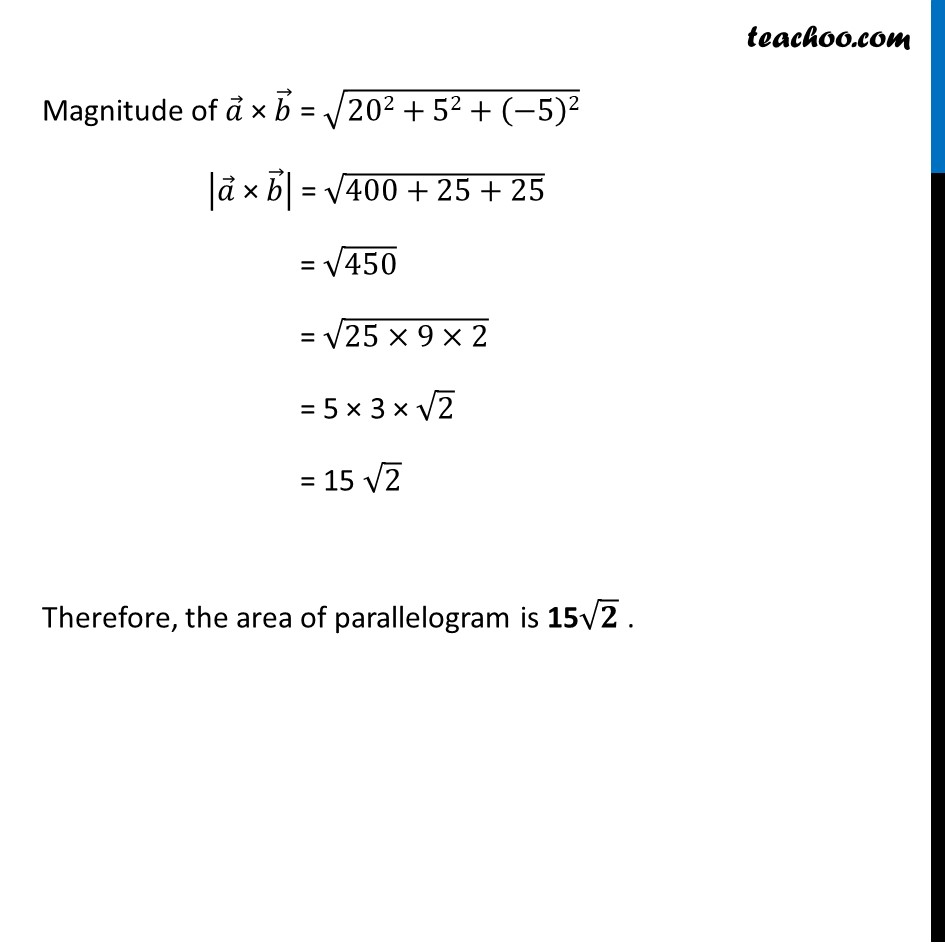
Ex 10.4, 10 Find the area of the parallelogram whose adjacent sides are determined by the vectors 𝑎 ⃗ = 𝑖 ̂ − 𝑗 ̂ + 3𝑘 ̂ and b = 2𝑖 ̂ − 7𝑗 ̂ + 𝑘 ̂ . 𝑎 ⃗ = 𝑖 ̂ − 𝑗 ̂ + 3𝑘 ̂ = 1𝑖 ̂ − 1𝑗 ̂ + 3k ̂ 𝑏 ⃗ = 2𝑖 ̂ − 7𝑗 ̂ + 𝑘 ̂ = 2𝑖 ̂ − 7𝑗 ̂ + 1k ̂ Area of parallelogram ABCD = |𝑎 ⃗" × " 𝑏 ⃗ | 𝒂 ⃗ × 𝒃 ⃗ = |■8(𝑖 ̂&𝑗 ̂&𝑘 ̂@1&−1&3@2&−7&1)| = 𝑖 ̂ (−1 × 1 − (−7) × 3) − 𝑗 ̂ (1 × 1 − 2 × 3) + 𝑘 ̂ (1 × −7 − 2 × −1) = 𝑖 ̂ (−1−(−21)) − 𝑗 ̂ (1 − 6) + 𝑘 ̂ (−7 −(−2)) = 𝑖 ̂ (−1 + 21) − 𝑗 ̂ (−5) + 𝑘 ̂ (−7 + 2) = 20 𝒊 ̂ + 5𝒋 ̂ − 5𝒌 ̂ Magnitude of 𝑎 ⃗ × 𝑏 ⃗ = √(202+52+(−5)2) |𝑎 ⃗" × " 𝑏 ⃗ | = √(400+25+25) = √450 = √(25×9×2) = 5 × 3 × √2 = 15 √2 Therefore, the area of parallelogram is 15√𝟐 .