You are here
Exercise Set 6.2
Last updated at May 31, 2026 by Teachoo
Transcript
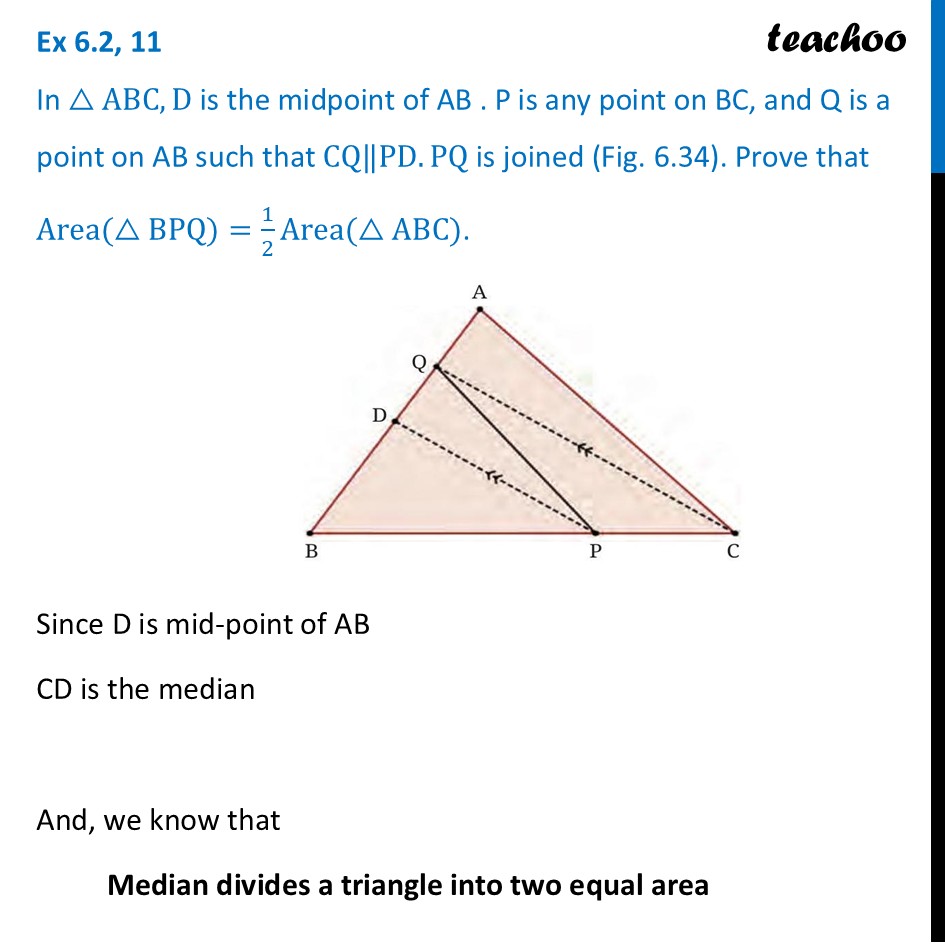
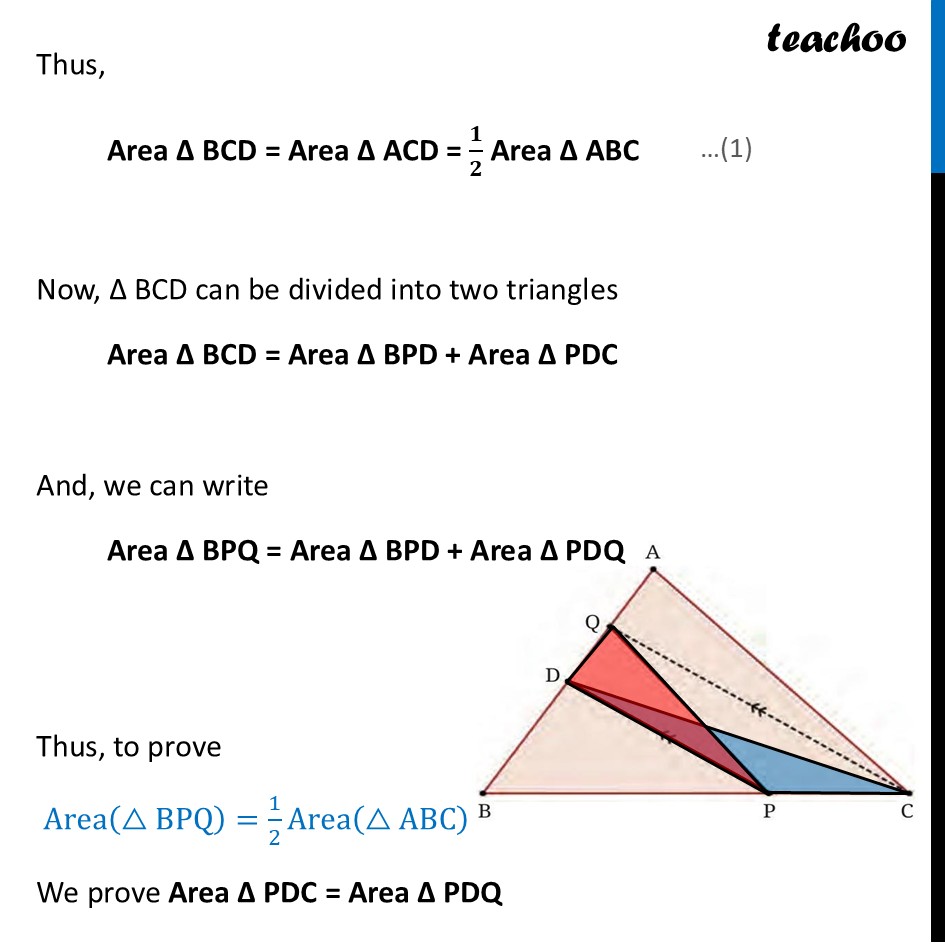
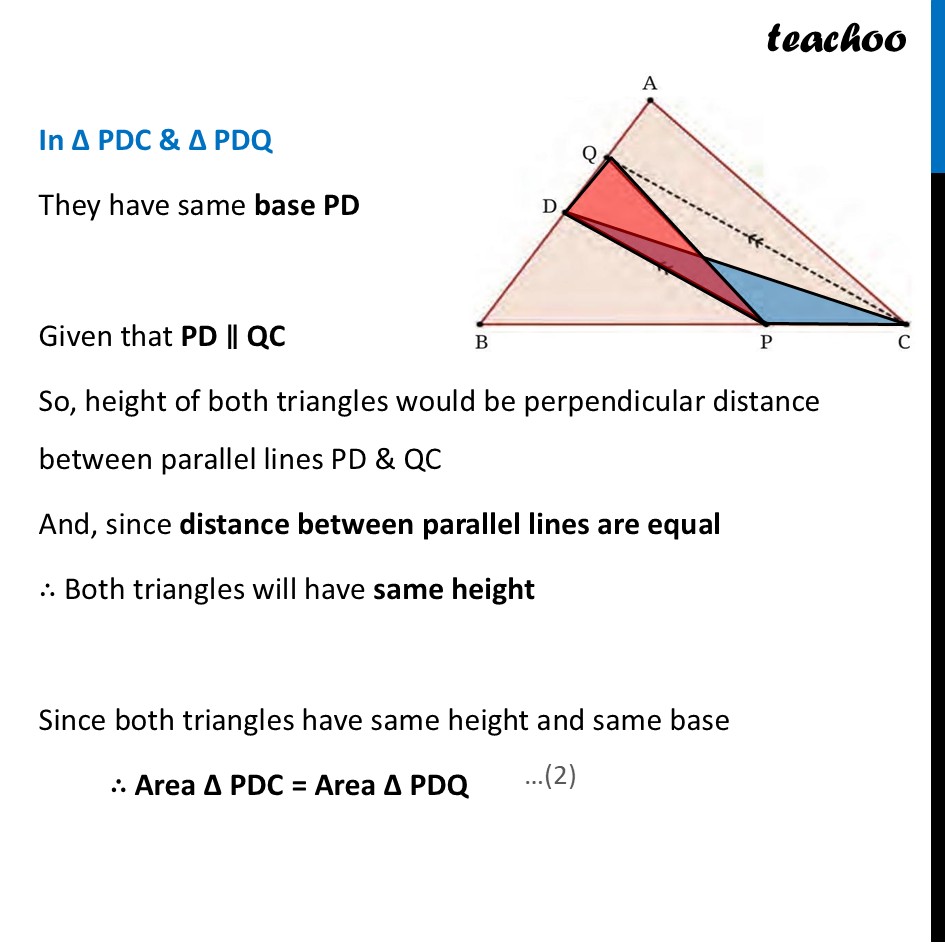
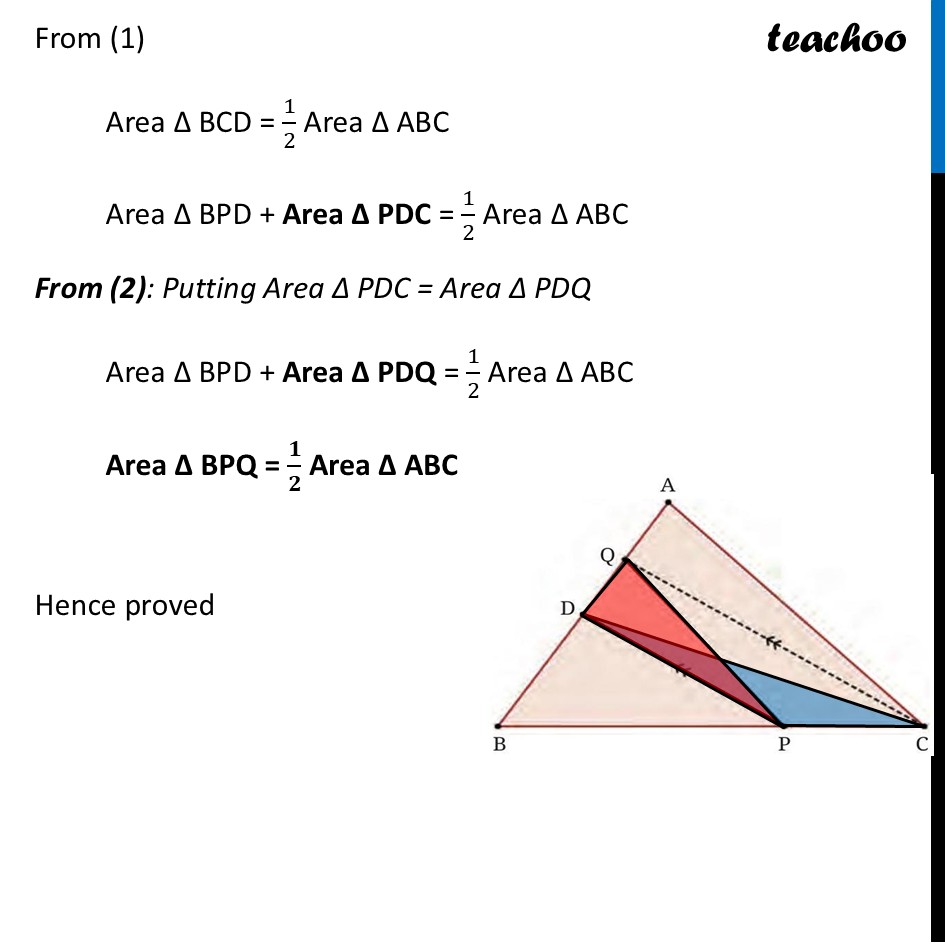
Ex 6.2, 11 In △ABC,D is the midpoint of AB . P is any point on BC, and Q is a point on AB such that CQ‖PD.PQ is joined (Fig. 6.34). Prove that Area(△BPQ)=1/2 Area(△ABC). Since D is mid-point of AB CD is the median And, we know that Median divides a triangle into two equal area Thus, Area ∆ BCD = Area ∆ ACD = 𝟏/𝟐 Area ∆ ABC Now, ∆ BCD can be divided into two triangles Area ∆ BCD = Area ∆ BPD + Area ∆ PDC And, we can write Area ∆ BPQ = Area ∆ BPD + Area ∆ PDQ Thus, to prove Area(△BPQ)=1/2 Area(△ABC) We prove Area ∆ PDC = Area ∆ PDQ In ∆ PDC & ∆ PDQ They have same base PD Given that PD ∥ QC So, height of both triangles would be perpendicular distance between parallel lines PD & QC And, since distance between parallel lines are equal ∴ Both triangles will have same height Since both triangles have same height and same base ∴ Area ∆ PDC = Area ∆ PDQ From (1) Area ∆ BCD = 1/2 Area ∆ ABC Area ∆ BPD + Area ∆ PDC = 1/2 Area ∆ ABC From (2): Putting Area ∆ PDC = Area ∆ PDQ Area ∆ BPD + Area ∆ PDQ = 1/2 Area ∆ ABC Area ∆ BPQ = 𝟏/𝟐 Area ∆ ABC Hence proved