You are here
Exercise Set 6.2
Last updated at May 31, 2026 by Teachoo
Transcript
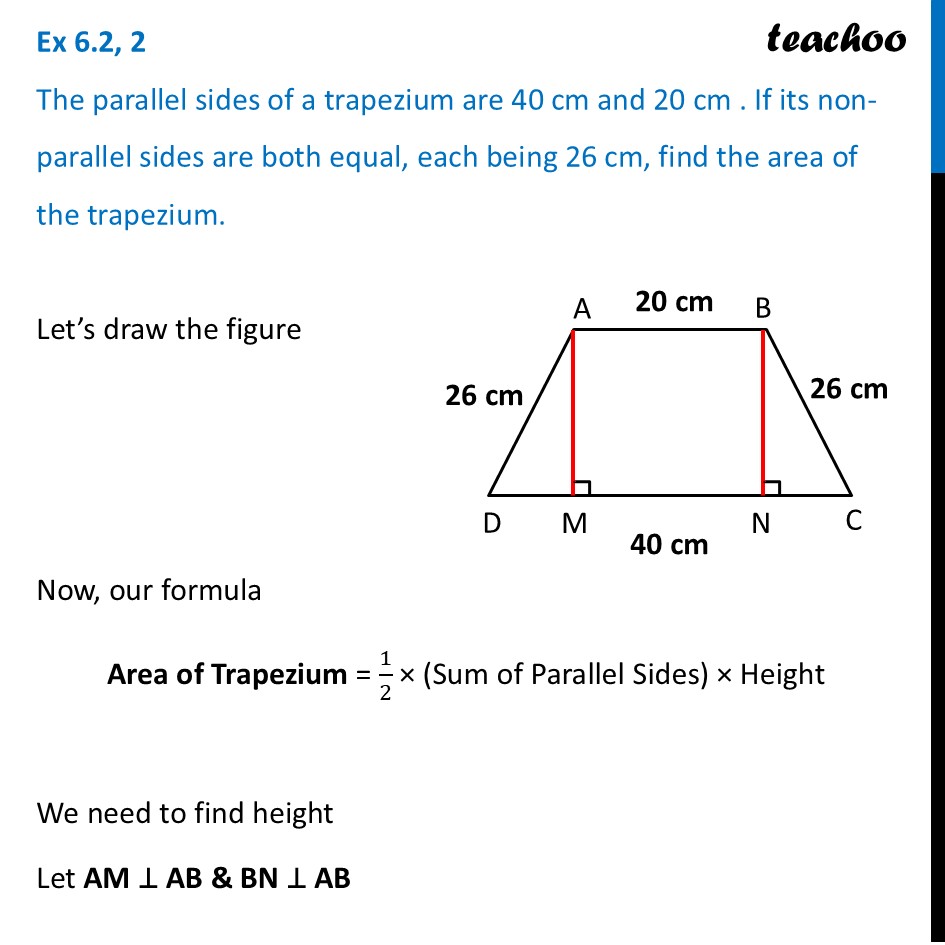
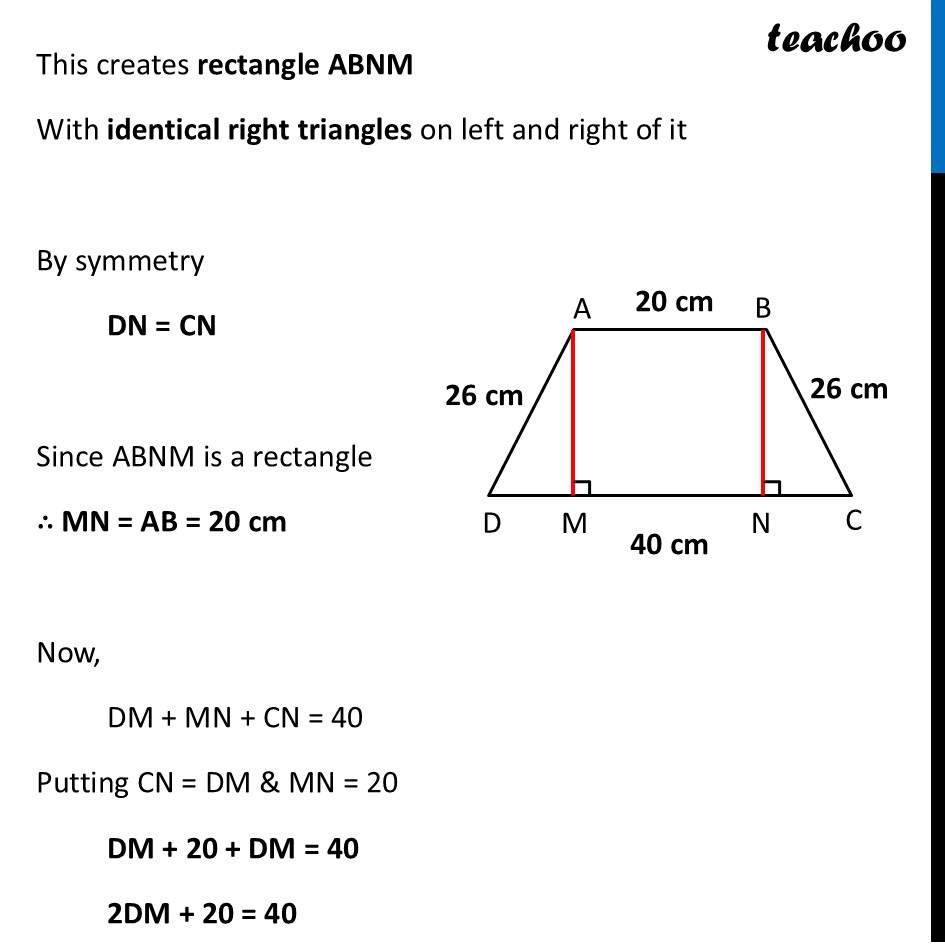
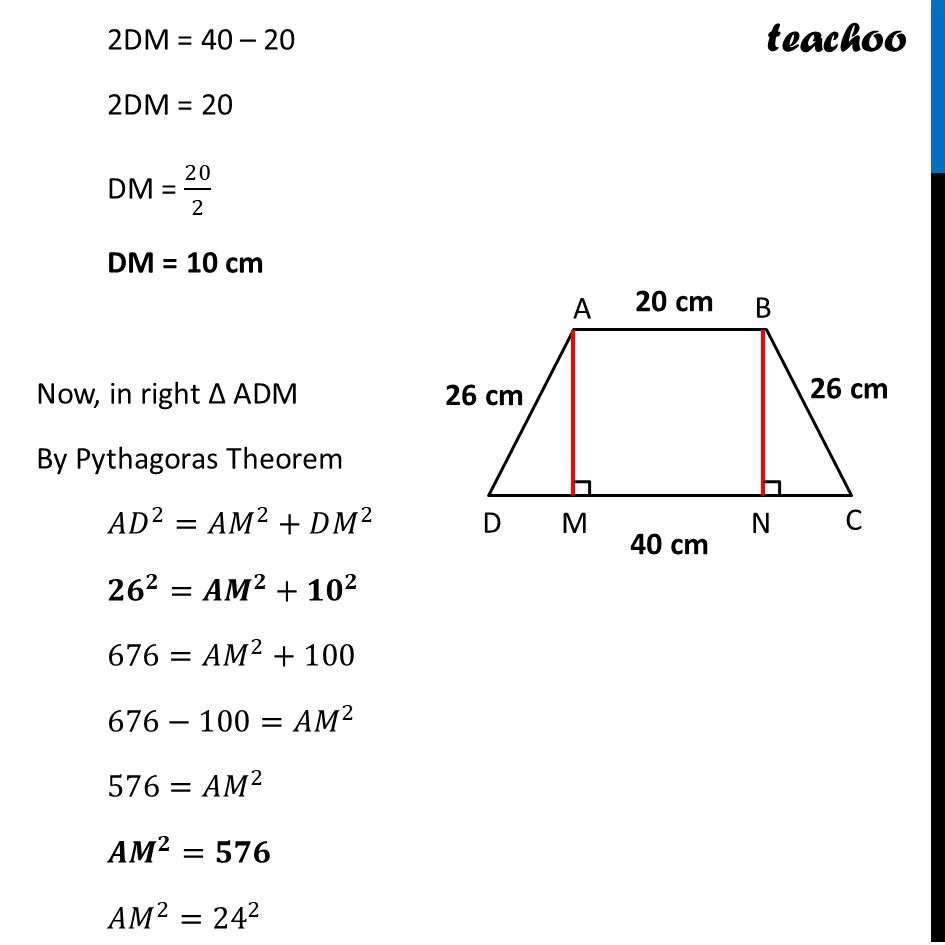
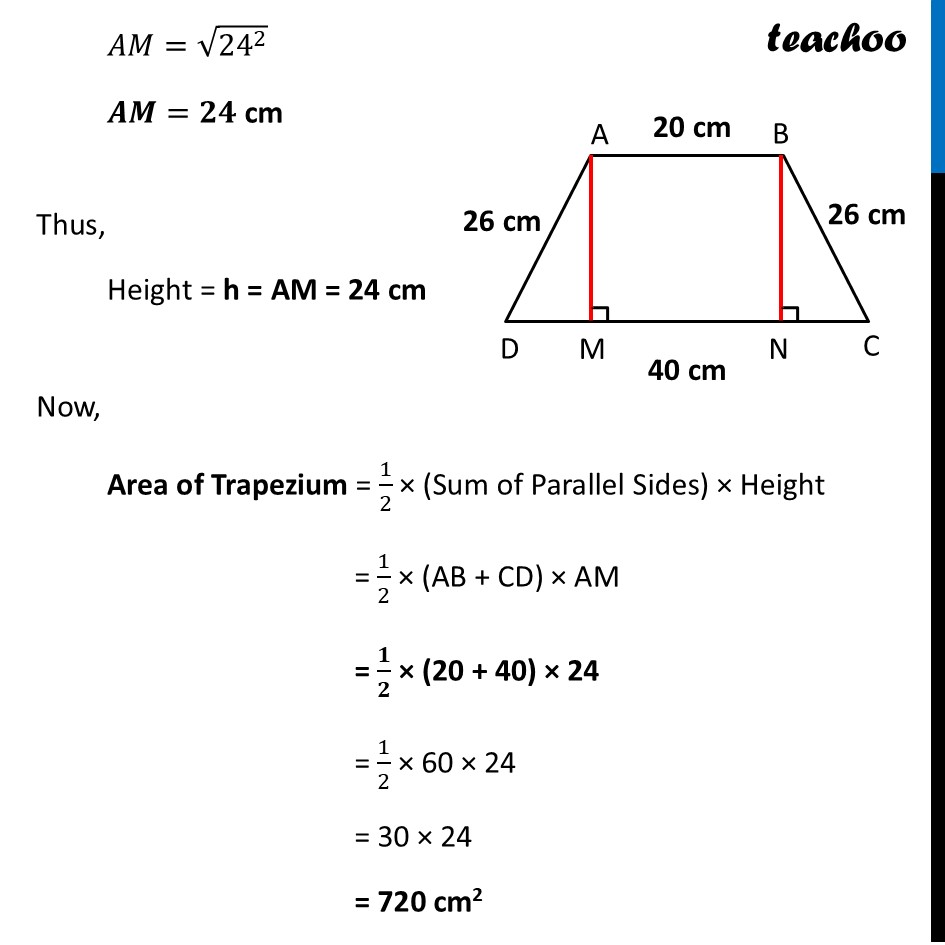
Ex 6.2, 2 The parallel sides of a trapezium are 40 cm and 20 cm . If its non-parallel sides are both equal, each being 26 cm, find the area of the trapezium. Let’s draw the figure Now, our formula Area of Trapezium = 1/2 × (Sum of Parallel Sides) × Height We need to find height Let AM ⊥ AB & BN ⊥ AB So, This creates rectangle ABNM With identical right triangles on left and right of it By symmetry DN = CN Since ABNM is a rectangle ∴ MN = AB = 20 cm Now, DM + MN + CN = 40 Putting CN = DM & MN = 20 DM + 20 + DM = 40 2DM + 20 = 40 2DM = 40 – 20 2DM = 20 DM = 20/2 DM = 10 cm Now, in right ∆ ADM By Pythagoras Theorem 𝐴𝐷^2=𝐴𝑀^2+𝐷𝑀^2 〖𝟐𝟔〗^𝟐=𝑨𝑴^𝟐+〖𝟏𝟎〗^𝟐 676=𝐴𝑀^2+100 676−100=𝐴𝑀^2 576=𝐴𝑀^2 𝑨𝑴^𝟐=𝟓𝟕𝟔 𝐴𝑀^2=24^2 𝐴𝑀=√(24^2 ) 𝑨𝑴=𝟐𝟒 cm Thus, Height = h = AM = 24 cm Now, Area of Trapezium = 1/2 × (Sum of Parallel Sides) × Height = 1/2 × (AB + CD) × AM = 𝟏/𝟐 × (20 + 40) × 24 = 1/2 × 60 × 24 = 30 × 24 = 720 cm2