You are here
![Try and find other patterns like this one [Class 9 Ganita Manjari] - Consecutive Square Numbers](https://cdn.teachoo.com/d65b37bb-8c17-49ef-891e-61a5202bc75b/slide9.jpg)
Consecutive Square Numbers
Last updated at May 15, 2026 by Teachoo
Transcript
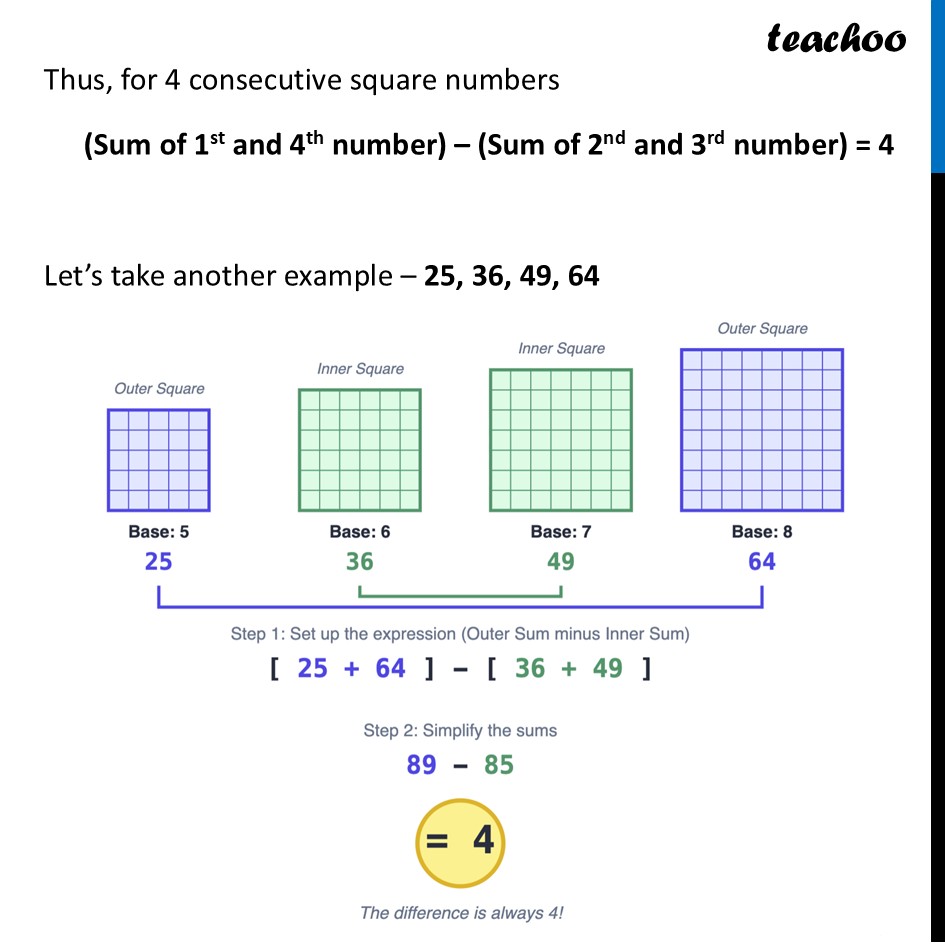
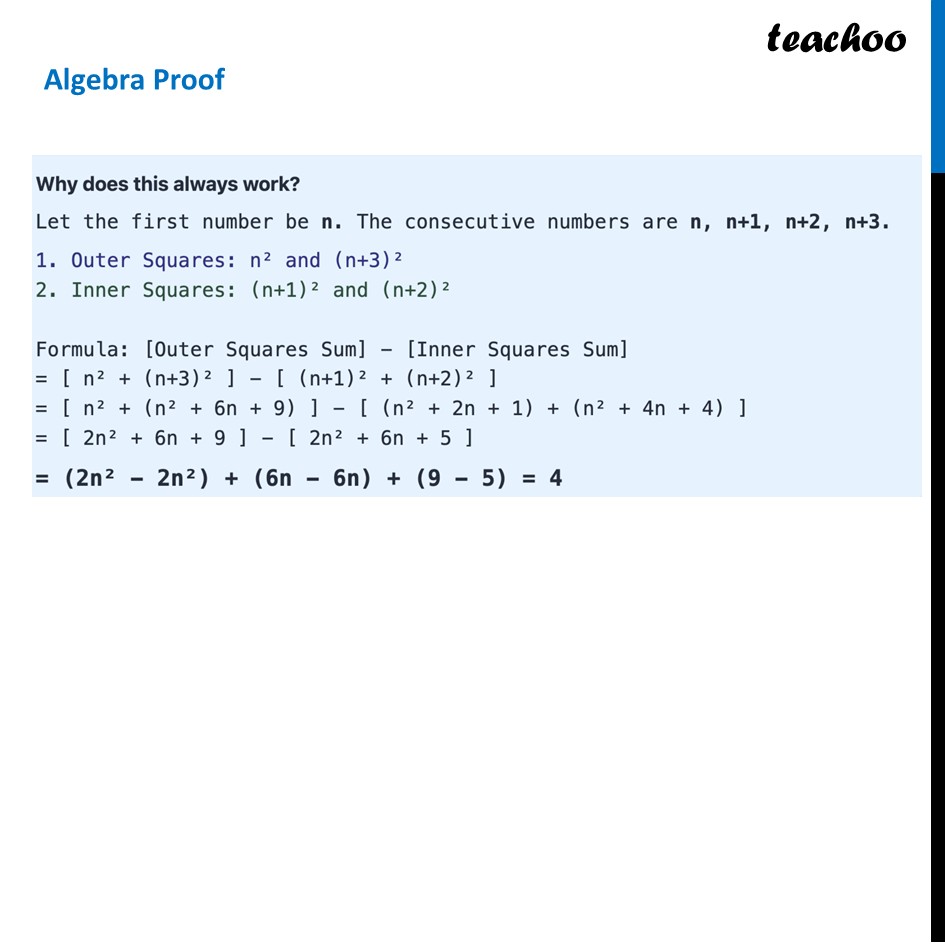
Question 1 - Think and Reflect (Page 69) Try and find other patterns like this one. For example, you could consider 4 consecutive squares and see if you can find a pattern. Let’s consider 4 consecutive square numbers 1, 4, 9, 16 Thus, for 4 consecutive square numbers (Sum of 1st and 4th number) – (Sum of 2nd and 3rd number) = 4 Let’s take another example – 25, 36, 49, 64 Inner Square Base: 7 Base: 8 Base: 5 25 Inner Square Base: 6 49 Step 1: Set up the expression (Outer Sum minus Inner Sum) Step 2: Simplify the sums 89-85 The difference is always 4!Algebra Proof Why does this always work? Let the first number be . The consecutive numbers are . Outer Squares: and Inner Squares: and