You are here

Consecutive Square Numbers
Last updated at May 15, 2026 by Teachoo
Transcript
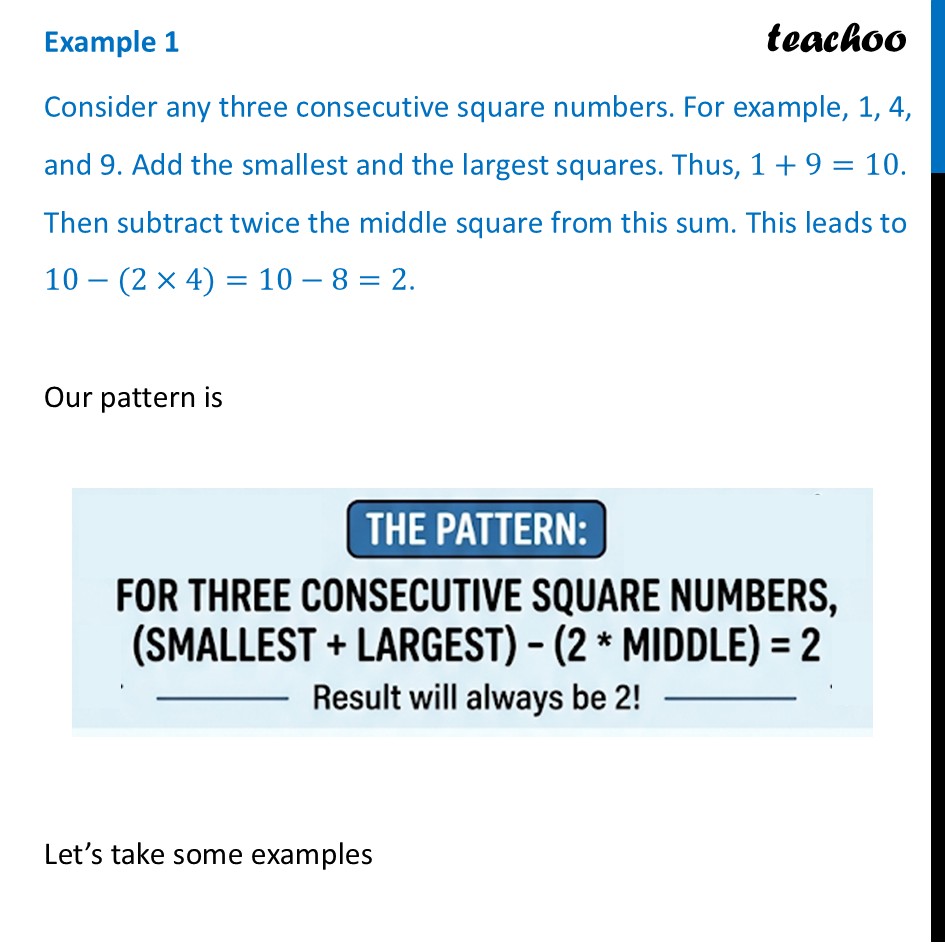
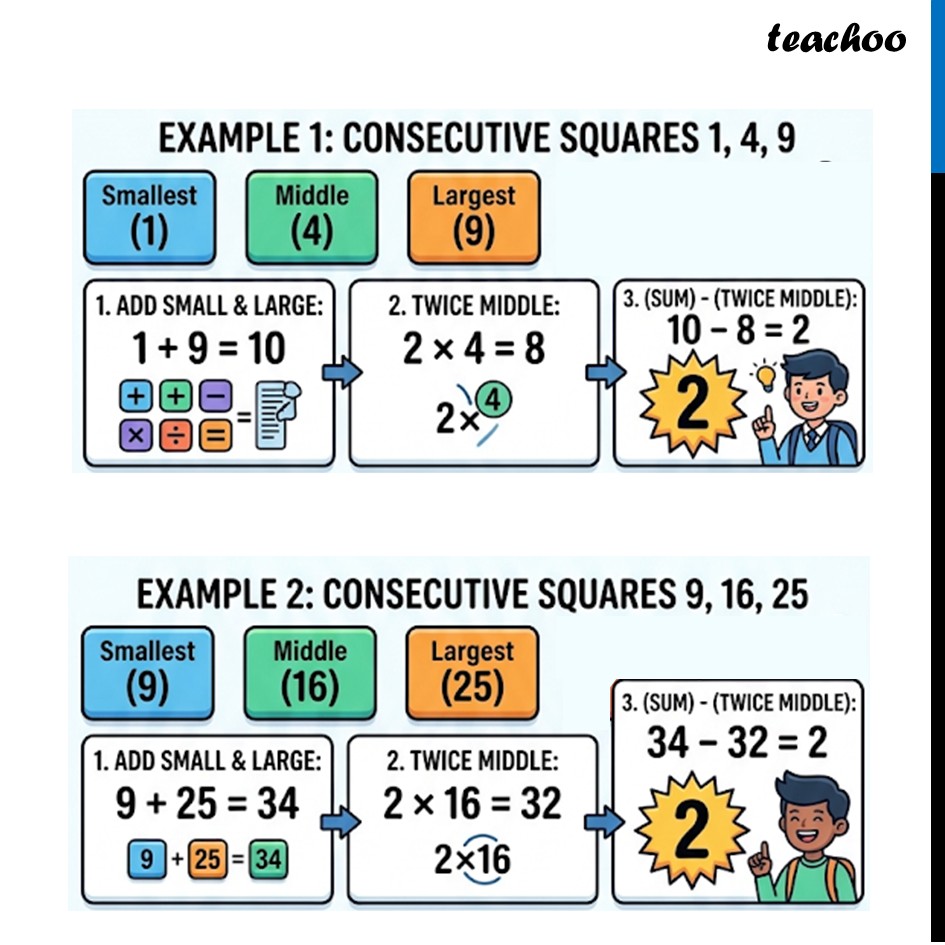
Example 1 Consider any three consecutive square numbers. For example, 1, 4, and 9. Add the smallest and the largest squares. Thus, 1+9=10. Then subtract twice the middle square from this sum. This leads to 10−(2×4)=10−8=2. Our pattern is THE PATTERN: FOR THREE CONSECUTIVE SQUARE NUMBERS, (SMALLEST + LARGEST) - (2 * MIDDLE) = 2 Result will always be 2 ! Let’s take some examples EXAMPLE 1: CONSECUTIVE SQUARES 1, 4, 9 Smallest (1) Middle (4) Largest (9) ADD SMALL & LARGE: TWICE MIDDLE: (SUM) - (TWICE MIDDLE):EXAMPLE 2: CONSECUTIVE SQUARES 9, 16, 25 Smallest (9) Middle (16) Largest (25) ADD SMALL & LARGE: TWICE MIDDLE: (SUM) - (TWICE MIDDLE):