You are here
Mr. “X” borrowed money from a money lender at a high rate of interest, as he could not pay the interest. Mr. “X” was forced to borrow from another landlord to settle the amount for the interest borrowed, to the money lender. State the consequences he may face in this situation.
Answer:
Answer by Student
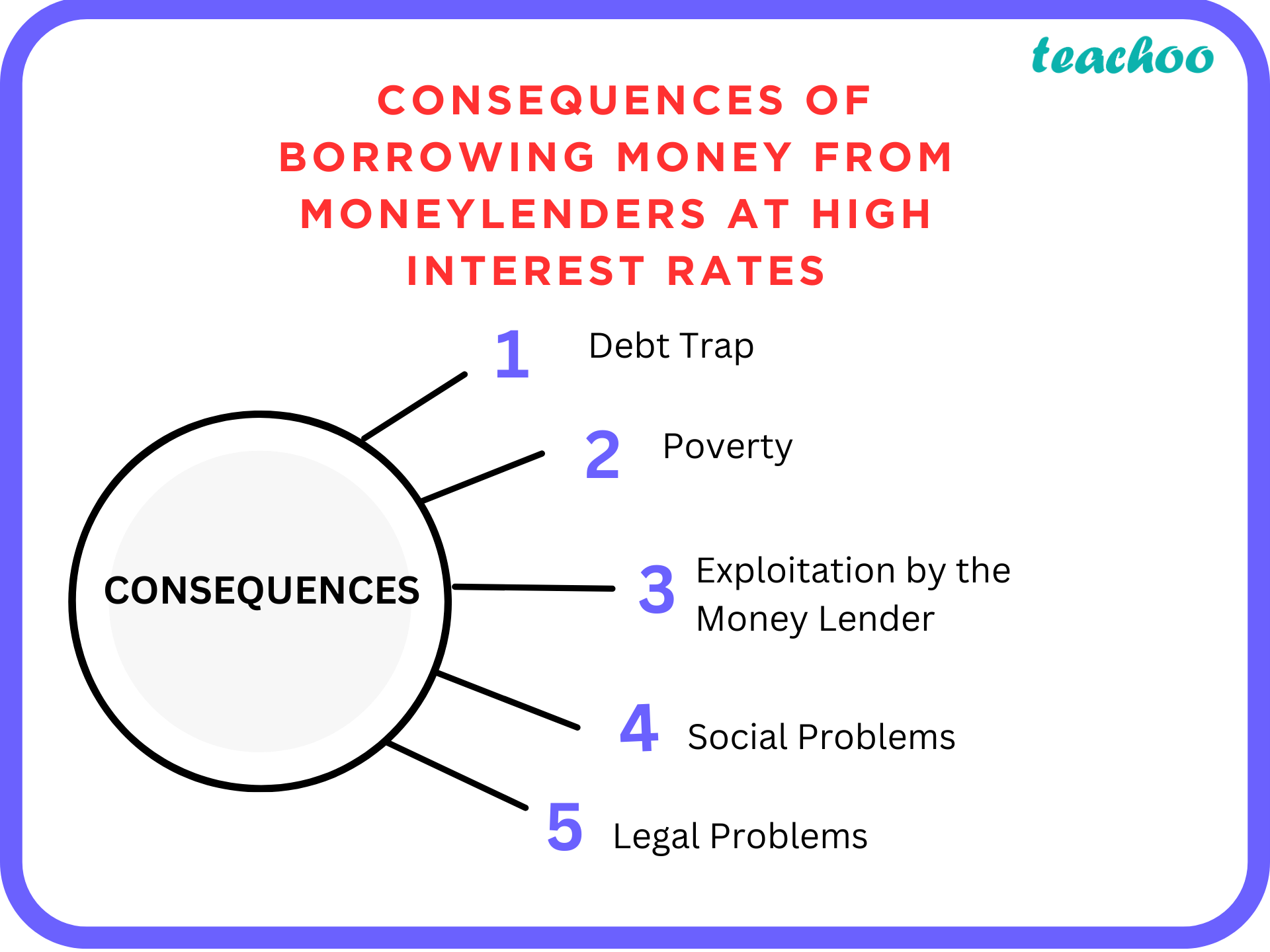
The consequences that Mr “X” may face in this situation are:
-
Debt trap
: One of the major consequences of informal credit is that it can lead to a debt trap. Mr “X” may fall into a debt trap, which means that he may get caught in a
vicious cycle of borrowing
more and more money to repay his previous loans and interest. He may end up paying more than what he borrowed and lose his income and assets.
-
Exploitation
: Mr “X” may face
exploitation by the money lender and the landlord,
who may charge him exorbitant rates of interest and impose harsh conditions on him. They may also harass him or threaten him with violence if he fails to repay them on time.
-
Poverty
: Mr “X” may
become poorer and poorer
as he spends most of his income on
repaying his loans and interest
. He may not have enough money to meet his basic needs or invest in his farm or business. He may also lose his land or property if he defaults on his loans. He may also lose his land or property if he defaults on his loans or mortgages them to his creditors.
-
Social problems
: Mr “X” may face social problems such as
stress, depression, shame, and loss of dignity due to his indebtedness
. He may also lose his social status and respect in his community. He may also face discrimination or ostracism by his creditors or other people.
- Legal problems : Mr “X” may face legal problems if he fails to repay his loans or violates the terms and conditions of his contracts. He may be sued by his creditors or taken to court for defaulting on his debts. He may also face penalties or punishments such as fines, imprisonment or confiscation of his assets.
Detailed Answer by Teachoo
-lock-
The situation that Mr “X” is facing is an example of informal credit, which means that he borrowed money from sources that are not regulated by the government or any authority. Informal credit is usually provided by money lenders, landlords, traders, relatives or friends who lend money to people who need it urgently or who do not have access to formal sources of credit such as banks or cooperatives.
Informal credit has some advantages such as easy availability, quick delivery, flexible terms and personal relations. However, it also has many disadvantages such as high interest rates, lack of security, unfair practices, and exploitation.
Some of the consequences that Mr “X” may face in this situation are:
- Debt trap : One of the major consequences of informal credit is that it can lead to a debt trap, which means that the borrower gets caught in a vicious cycle of borrowing more and more money to repay his previous loans and interest. This happens because the interest rates charged by informal lenders are very high and often compound over time. For example, if Mr “X” borrowed Rs 10,000 from a money lender at 36% per annum compound interest, he would have to pay Rs 13,600 after one year. If he could not pay this amount and borrowed another Rs 10,000 from a landlord at 24% per annum simple interest, he would have to pay Rs 14,400 after one year. Thus, his total debt would increase to Rs 28,000 after one year. If he continued this pattern of borrowing and repaying, his debt would keep increasing exponentially and he would never be able to get out of it.
A debt trap can have serious consequences for the borrower as he may end up paying more than what he borrowed and lose his income and assets. He may also become dependent on his creditors and lose his bargaining power and freedom.
- Exploitation : Another consequence of informal credit is that it can lead to exploitation by the lenders, who may charge exorbitant rates of interest and impose harsh conditions on the borrowers. They may also use unfair practices such as cheating, fraud, coercion or violence to extract money from them. For example, the money lender or the landlord may ask Mr “X” to sign a blank paper or a promissory note as a proof of his loan. They may then fill up any amount or date on it later and claim that he owes them more than what he actually borrowed. They may also force him to work for them as a bonded labourer or a tenant farmer without paying him any wages or rent. They may also harass him or threaten him with legal action or physical harm if he fails to repay them on time.
Exploitation can have negative consequences for the borrower as he may lose his rights and dignity as a human being. He may also suffer from physical and mental abuse and trauma.
- Poverty : A third consequence of informal credit is that it can lead to poverty for the borrower, who may become poorer and poorer as he spends most of his income on repaying his loans and interest. He may not have enough money to meet his basic needs such as food, clothing, shelter, health and education. He may also not have enough money to invest in his farm or business, which may affect his productivity and income. He may also lose his land or property if he defaults on his loans or mortgages them to his creditors.
Poverty can have adverse consequences for the borrower as he may face malnutrition, disease, illiteracy and low quality of life. He may also lose his self-confidence and self-esteem and become hopeless and helpless.
- Social problems : A fourth consequence of informal credit is that it can lead to social problems for the borrower, who may face stress, depression, shame and loss of dignity due to his indebtedness. He may also lose his social status and respect in his community, as he may be seen as a failure or a burden. He may also face discrimination or ostracism by his creditors or other people, who may look down upon him or avoid him. He may also feel isolated and lonely and lack social support and networks.
Social problems can have negative consequences for the borrower as he may lose his sense of belonging and identity. He may also become unhappy and dissatisfied with his life and lose his motivation and purpose.
- Legal problems : A fifth consequence of informal credit is that it can lead to legal problems for the borrower if he fails to repay his loans or violates the terms and conditions of his contracts. He may be sued by his creditors or taken to court for defaulting on his debts. He may also face penalties or punishments such as fines, imprisonment or confiscation of his assets.
Legal problems can have negative consequences for the borrower as he may lose his reputation and credibility. He may also face legal hassles and expenses. He may also lose his freedom and property.
-endlock-