The maximum value of [x (x - 1) + 1 ] (1/3) , 0 ≤ 𝑥 ≤ 1 is:
(a) 0 (b) 1/2 (c) 1 (d) ∛(1/3)
This question is inspired from Ex 6.5,29 (MCQ) - Chapter 6 Class 12 - Application of Derivatives
![Ques 43 (MCQ) - The maximum value of [x(x − 1) + 1]^1/3, 0 ≤ x ≤ 1 is - CBSE Class 12 Sample Paper for 2022 Boards (MCQ Based - for Term 1)](https://cdn.teachoo.com/b7cae1fb-5ed9-4f22-a597-67102ecef06c/slide111.jpg)
CBSE Class 12 Sample Paper for 2022 Boards (MCQ Based - for Term 1)

 You are here
CBSE Class 12 Sample Paper for 2022 Boards (MCQ Based - for Term 1)
Last updated at August 14, 2026 by Teachoo
This question is inspired from Ex 6.5,29 (MCQ) - Chapter 6 Class 12 - Application of Derivatives
Transcript
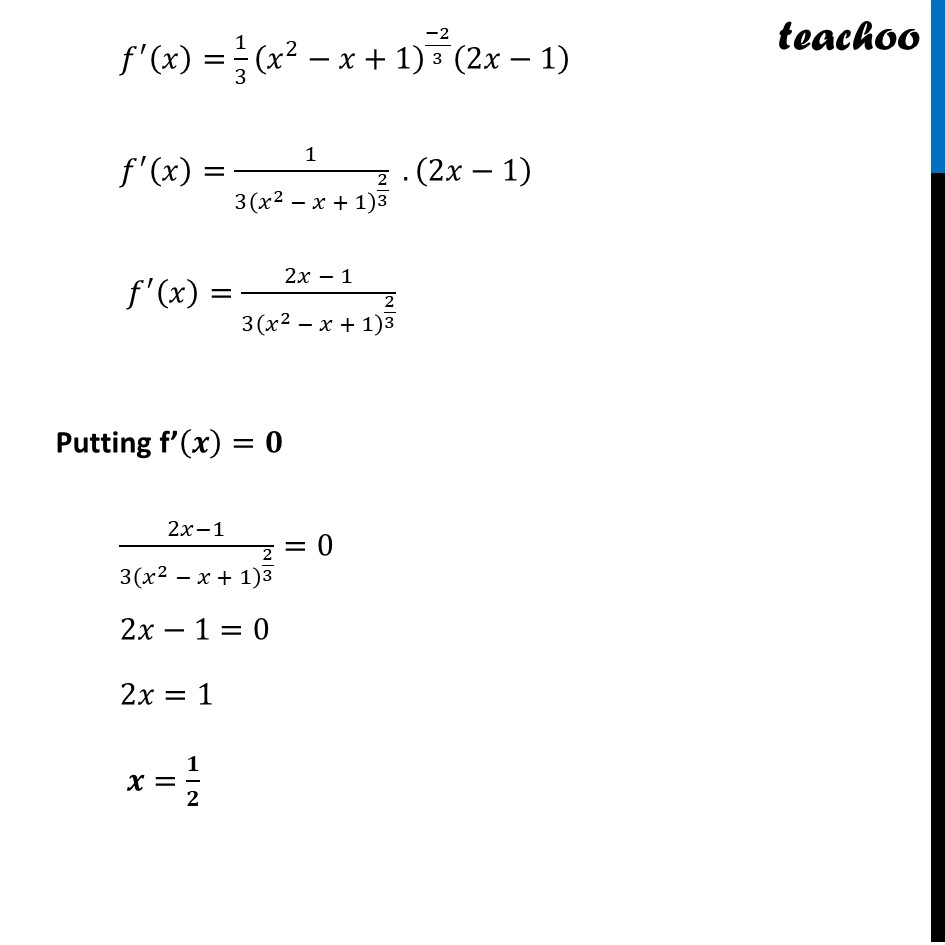
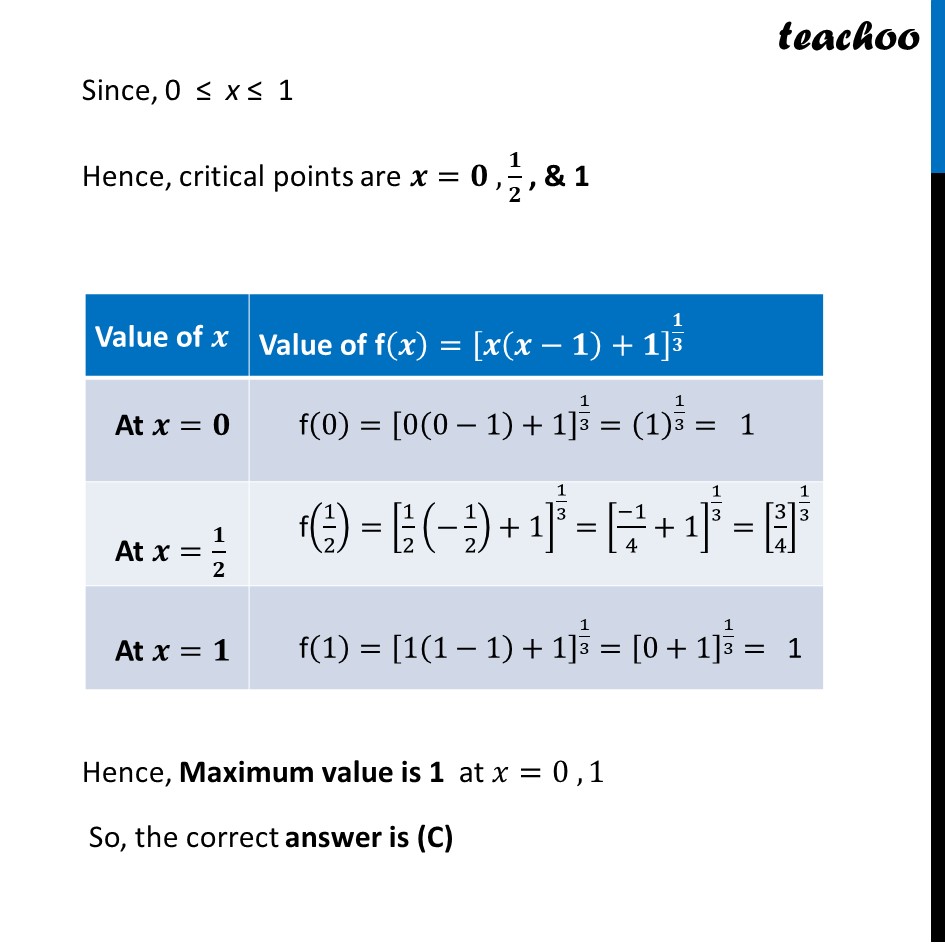
Question 43 The maximum value of ["𝑥 (𝑥 − 1) + 1" ]^(1/3) , 0 ≤ 𝑥 ≤ 1 is: (a) 0 (b) 1/2 (c) 1 (d) ∛(1/3) Let f(𝑥)=[𝑥(𝑥−1)+1]^(1/3) Finding f’(𝒙) 𝑓(𝑥)=[𝑥[𝑥−1]+1]^(1/3) 𝑓(𝑥)=[𝑥^2−𝑥+1]^(1/3) 𝑓^′ (𝑥)=(𝑑(𝑥^2 − 𝑥 + 1)^(1/3))/𝑑𝑥 𝑓^′ (𝑥)=1/3 (𝑥^2−𝑥+1)^(1/3 − 1) . 𝑑(𝑥^2 − 𝑥 + 1)/𝑑𝑥 𝑓^′ (𝑥)=1/3 (𝑥^2−𝑥+1)^((−2)/3) (2𝑥−1) 𝑓^′ (𝑥)=1/(3(𝑥^2 − 𝑥 + 1)^(2/3) ) .(2𝑥−1) 𝑓^′ (𝑥)=(2𝑥 − 1)/(3(𝑥^2 − 𝑥 + 1)^(2/3) ) Putting f’(𝒙)=𝟎 (2𝑥−1)/(3(𝑥^2 − 𝑥 + 1)^(2/3) )=0 2𝑥−1=0 2𝑥=1 𝒙=𝟏/𝟐 Since, 0 ≤ x ≤ 1 Hence, critical points are 𝒙=𝟎 ,𝟏/𝟐 , & 1 Hence, Maximum value is 1 at 𝑥=0 , 1 So, the correct answer is (C)