Checking continuity using LHL and RHL

 You are here
Checking continuity using LHL and RHL
Last updated at August 25, 2026 by Teachoo
Transcript
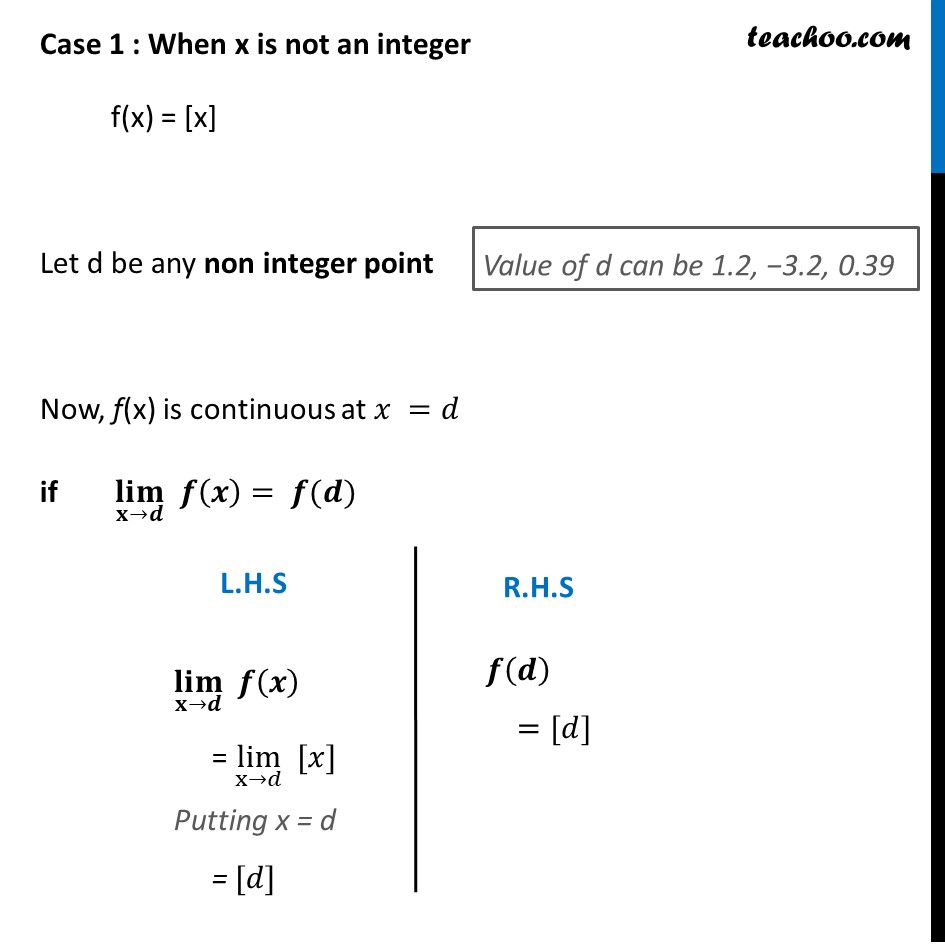
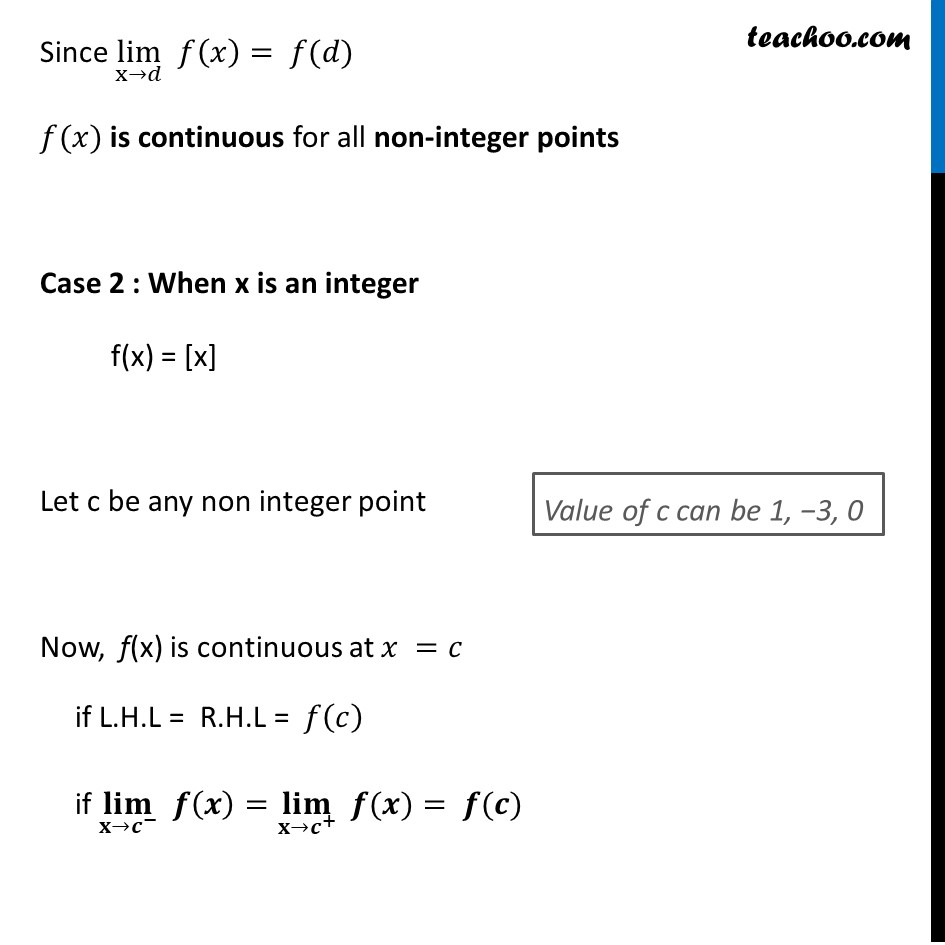
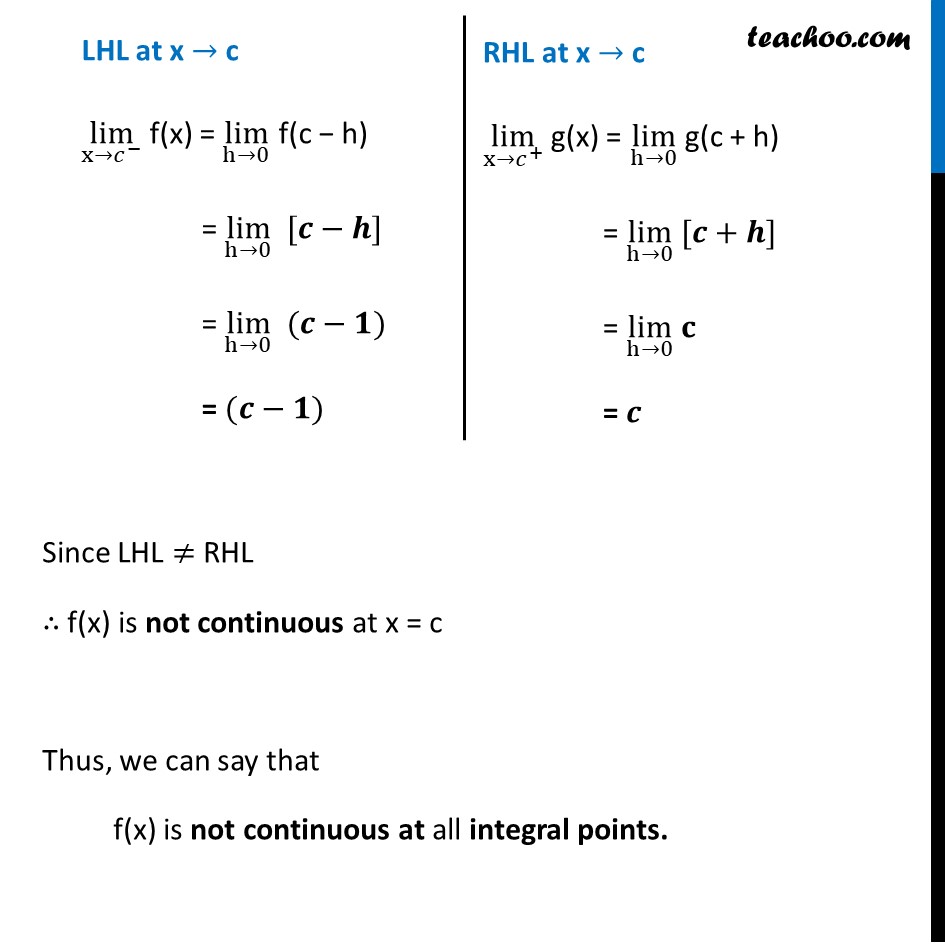
Example 15 (Introduction) Find all the points of discontinuity of the greatest integer function defined by 𝑓 (𝑥) = [𝑥], where [𝑥] denotes the greatest integer less than or equal to 𝑥 Greatest Integer Function [x] Going by same Concept Example 15 Find all the points of discontinuity of the greatest integer function defined by 𝑓(𝑥) = [𝑥], where [𝑥] denotes the greatest integer less than or equal to 𝑥Given 𝑓(𝑥) = [𝑥] Here, Continuity will be measured at – integer numbers, and non integer numbers Thus, we check continuity for When x is an integer When x is not an integerCase 1 : When x is not an integer f(x) = [x] Let d be any non integer point Now, f(x) is continuous at 𝑥 =𝑑 if (𝐥𝐢𝐦)┬(𝐱→𝒅) 𝒇(𝒙)= 𝒇(𝒅) L.H.S (𝐥𝐢𝐦)┬(𝐱→𝒅) 𝒇(𝒙) = lim┬(x→𝑑) [𝑥] Putting x = d = [𝑑] R.H.S 𝒇(𝒅) =[𝑑] Since lim┬(x→𝑑) 𝑓(𝑥)= 𝑓(𝑑) 𝑓(𝑥) is continuous for all non-integer points Case 2 : When x is an integer f(x) = [x] Let c be any non integer point Now, f(x) is continuous at 𝑥 =𝑐 if L.H.L = R.H.L = 𝑓(𝑐) if (𝐥𝐢𝐦)┬(𝐱→𝒄^− ) 𝒇(𝒙)=(𝐥𝐢𝐦)┬(𝐱→𝒄^+ ) " " 𝒇(𝒙)= 𝒇(𝒄) Value of c can be 1, −3, 0 LHL at x → c lim┬(x→𝑐^− ) f(x) = lim┬(h→0) f(c − h) = lim┬(h→0) [𝒄−𝒉] = lim┬(h→0) (𝒄−𝟏) = (𝒄−𝟏) RHL at x → c lim┬(x→𝑐^+ ) g(x) = lim┬(h→0) g(c + h) = lim┬(h→0) [𝒄+𝒉] = lim┬(h→0) 𝐜 = 𝒄 Since LHL ≠ RHL ∴ f(x) is not continuous at x = c Thus, we can say that f(x) is not continuous at all integral points.