
 You are here
What exactly is this famous wind system that shapes India’s climate?
Monsoon
Mausim
Arabic for season
Monsoon
seasonal wind reversal
↓
The seasonal reversal of wind direction, from the Arabic word 'mausim', meaning season.
- India’s climate is strongly influenced by monsoon winds .
- Ancient sailors first noticed the reversal of the wind system .
- They used this to travel by sailing ships .
- Arab traders named it ‘monsoon’, from mausim , meaning season.
![3.6 Monsoon - Atmosphere and Climate - [Teachoo] - Concepts](https://cdn.teachoo.com/77fe013f-3f1f-4d94-88db-846d4364ece7/the-monsoon-is-a-seasonal-reversal-of-winds-named-by-arab-traders-from-mausim-meaning-season..jpg)
In summer, what actually causes the south-west monsoon to blow in from the sea?
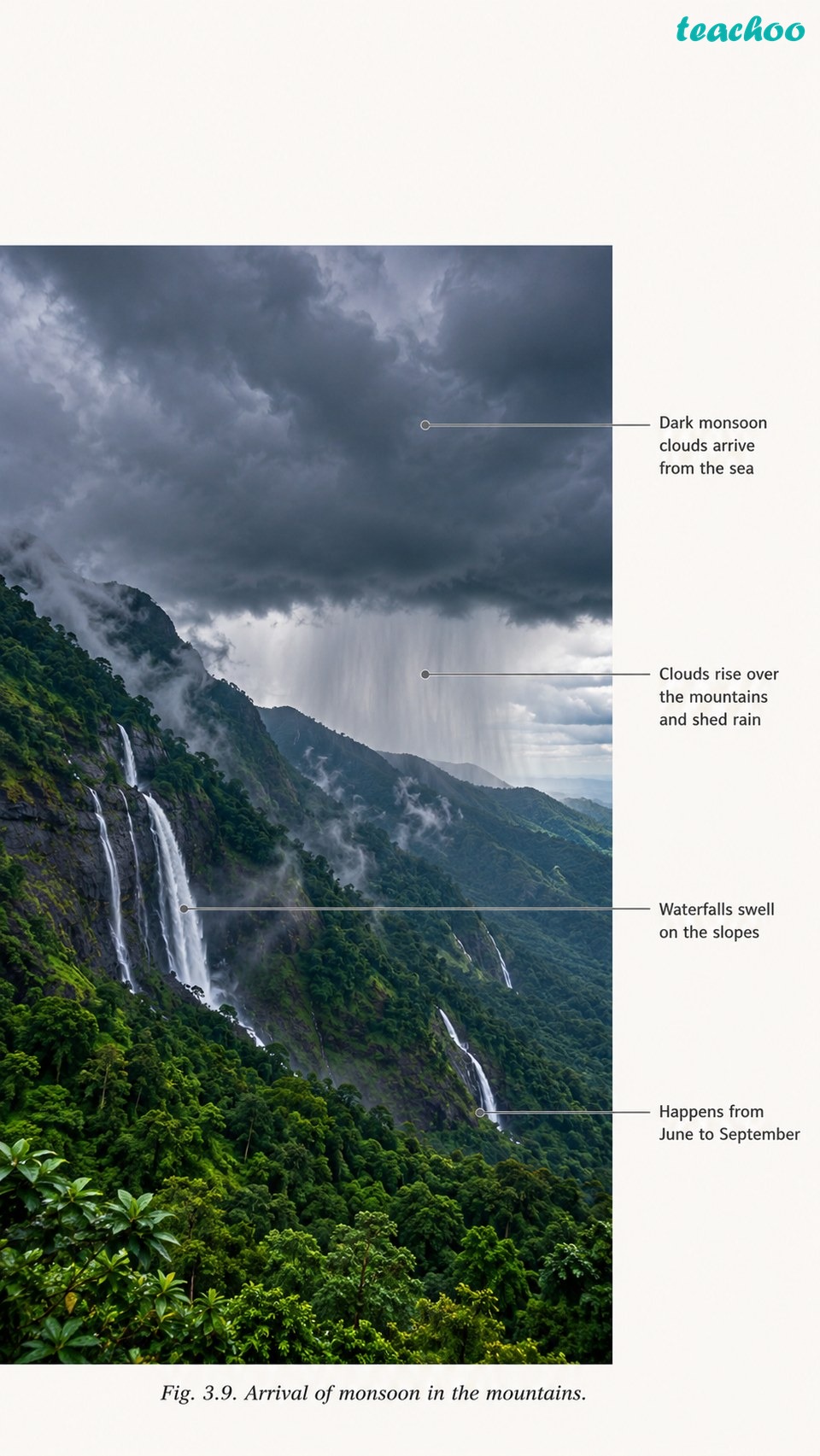
How does the south-west monsoon form?
Summer heating
India's landmass heats up faster than the ocean.
↓
Pressure difference
Low pressure forms over land, high pressure over the sea.
↓
Moist winds blow in
Winds carry moisture from the ocean towards the land.
↓
Heavy rainfall across India from June to September.
- The south-west monsoon is also called the summer monsoon.
- Winds blow from the sea across the Indian Ocean, Arabian Sea and Bay of Bengal.
- This happens between June and September .
- It is caused by the unequal heating of land and sea.
- It accounts for most of the rainfall in the country all year.
And how does this monsoon actually spread across the whole country?
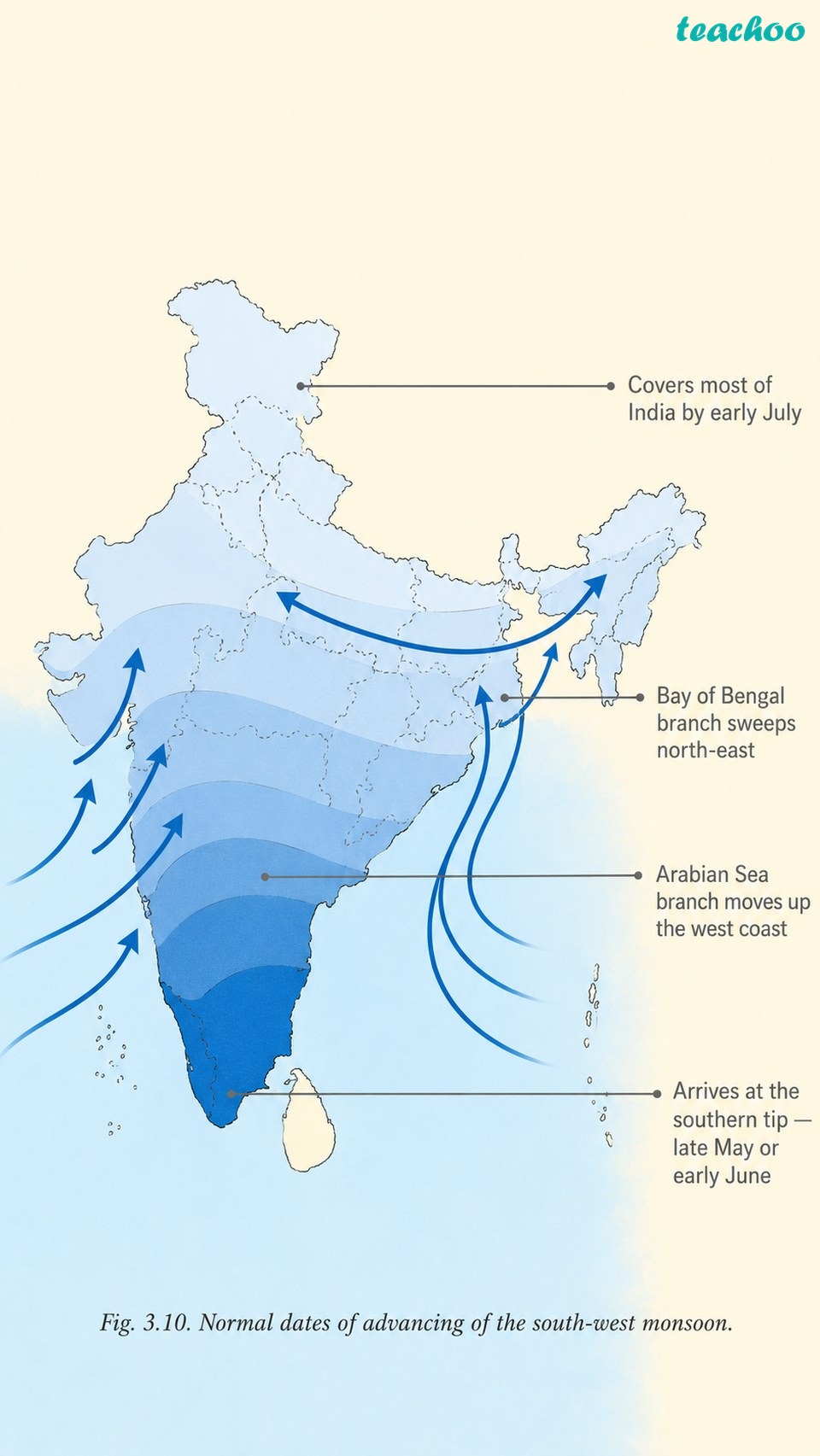
- The monsoon arrives from the oceanic side around late May or early June.
- It gradually spreads north and west .
- It covers most of India by early July .
- Focus on the direction and sequence , not memorising exact dates.
Then in winter, what makes the wind reverse and blow the other way?
How does the north-east monsoon form?
Winter cooling
India's landmass cools faster than the ocean.
↓
Pressure difference
High pressure forms over land, low pressure over the sea.
↓
Dry winds blow out
Winds blow from the land out towards the sea.
↓
These winds pick up moisture over the Bay of Bengal and rain on the south-east coast.
- The north-east monsoon occurs from October to February.
- These winds generally do not bring rain to most of India.
- Crossing the Bay of Bengal , they pick up moisture.
- They cause rain on the east coast — Tamil Nadu, Andhra Pradesh, parts of Karnataka.
- The monsoon withdraws from north-west India first, in late September.
South-West Monsoon
North-East Monsoon
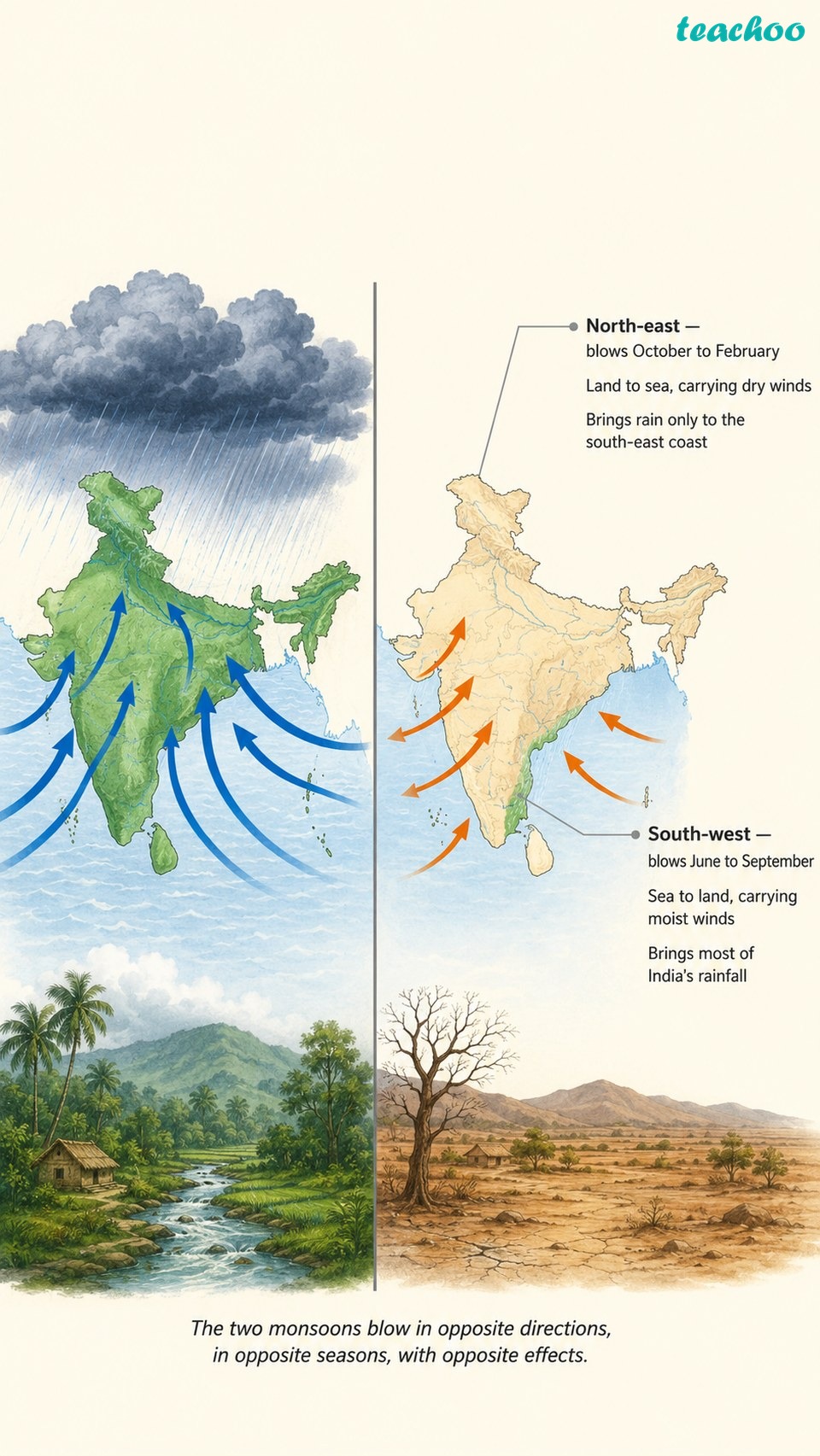
Blows June to September.
Blows October to February.
Sea to land, moist winds.
Land to sea, dry winds.
Brings most of India's rainfall.
Brings rain only to the south-east coast.
📋 NCERT Question 6b — Distinguish between the south-west
Distinguish between the following: the south-west monsoon and north-east monsoon.
View Answer →
Beyond just the rain, why does the monsoon matter so much to India?
Why does the monsoon matter so much to India?
Monsoon's Impact
Shapes Indian life
1. Economic Impact
Farmers rely on rain to sow
Affects food, prices, jobs
Example:
Agriculture, food economy
2. Water and Daily Life
Fills rivers and reservoirs
Changes transport, school
Example:
Reservoirs, school routines
3. Flood and Drought Risk
Too much rain causes floods
Too little causes droughts
Example:
Punjab floods, drought years
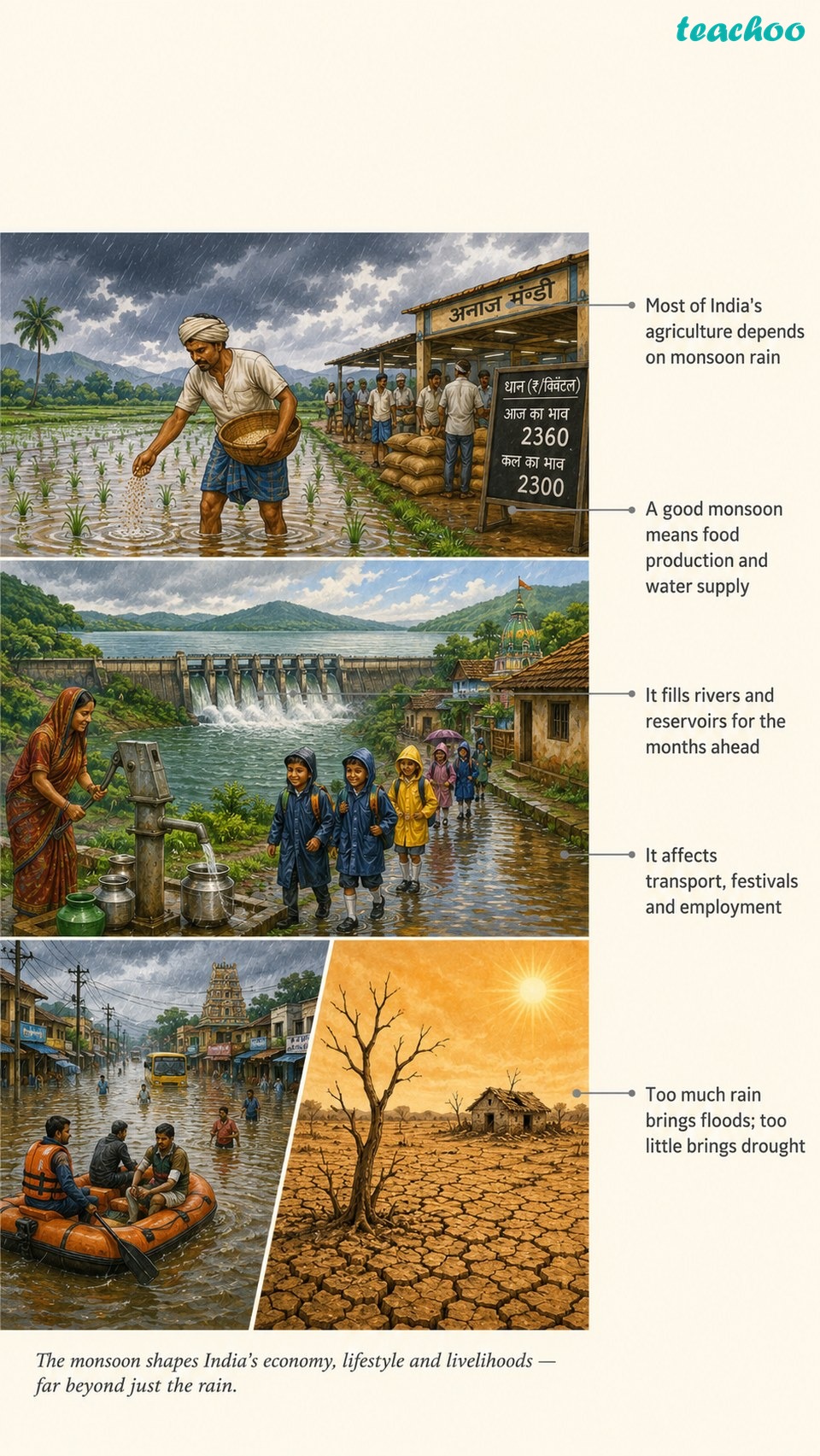
- Most of India’s agriculture depends on monsoon rainfall.
- A good monsoon ensures food production and water supply .
- Monsoon also affects transport, festivals and employment.
- Excessive rainfall causes floods , weak monsoons cause droughts .
- It greatly influences the economy, lifestyle and livelihoods of people.
🔎 LET’S EXPLORE
Describe in your own words how monsoon affects the lives of the people around you.
Show Answer
The monsoon touches almost every part of daily life, not just farming.
- It decides whether farmers get a good harvest that year.
- It fills our drinking water sources for the months ahead.
- Heavy rain can delay travel and change school routines.
- Festivals like Teej and Onam are tied to the monsoon season .
Did people study and predict the monsoon even before modern science?
How was the monsoon studied, then and now?
Monsoon Study
Across the ages
1. Ancient Texts
Used Moon, star positions
Example:
Krishiparashara
Brihatsamhita
Meghadutam
2. Modern Science
Uses satellites and models
Example:
National Monsoon Mission
Mission Mausam
- Krishiparashara used positions of the Moon and Sun to predict rain.
- Varahamihira , in the Brihatsamhita, used lunar mansions (nakshatras).
- Kalidasa , in the Meghadutam, traced the path of monsoon clouds.
- Many farming practices today still use these ancient methods .
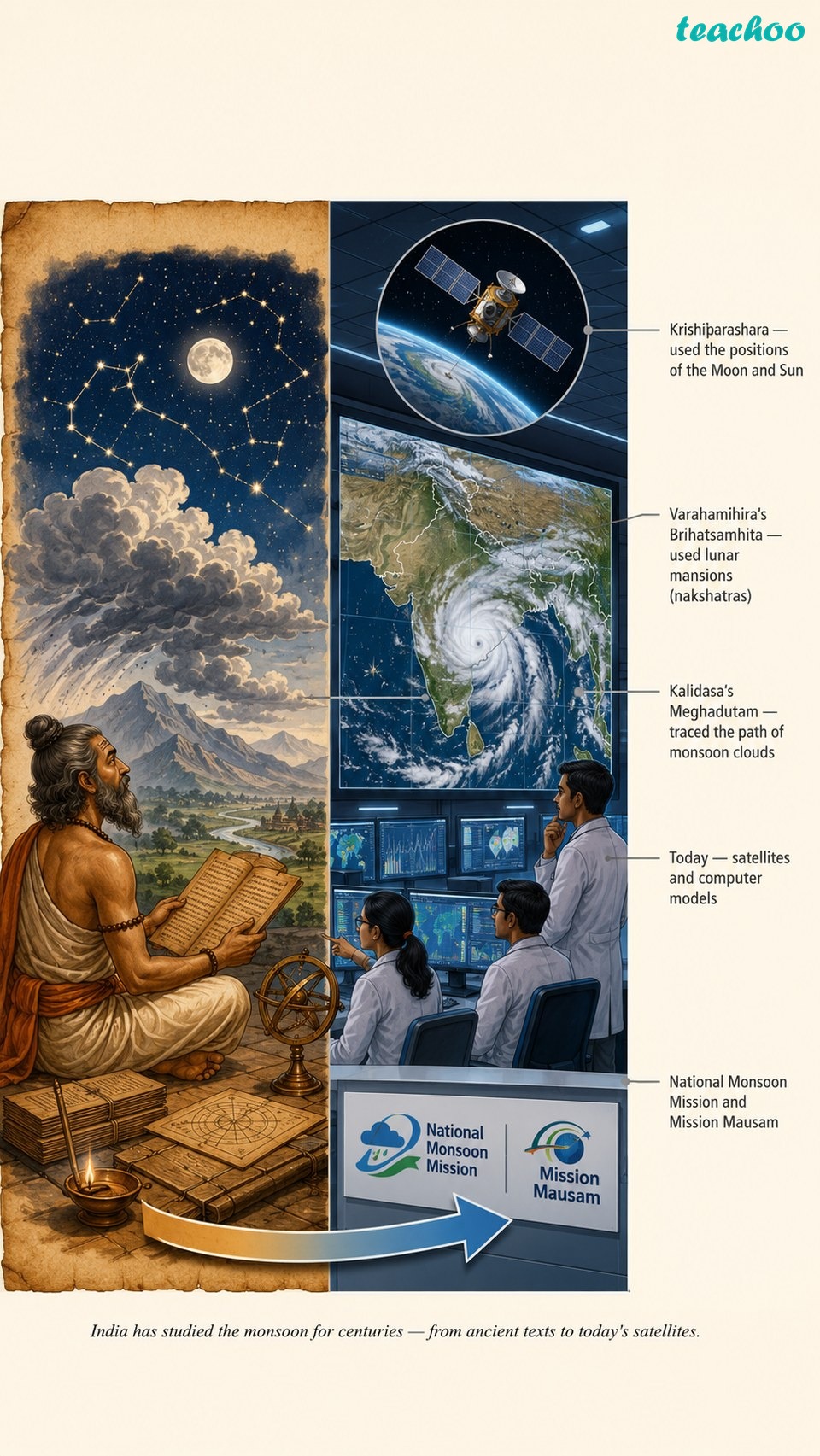
💡 DON’T MISS OUT
Under the
National Monsoon Mission (NMM)
, the Ministry of Earth Sciences has developed state-of-the-art weather and climate prediction models. ‘
Mission Mausam
’ aims to make India ‘Weather Ready’ and ‘Climate Smart’, improving forecasts for agriculture, disaster management and rural development.
Definition — Monsoon
The seasonal reversal of wind direction during a year.
From the Arabic word ‘mausim’, meaning season.
From the Arabic word ‘mausim’, meaning season.
📝 What Have We Learned
- Monsoon is the seasonal reversal of wind direction.
- The south-west monsoon brings most of India’s rainfall.
- The north-east monsoon waters only the south-east coast.
- Monsoon controls farming, water, economy and daily life.
- Ancient India and modern science both study and predict it.
