
 You are here
Now that we know why the atmosphere matters, what exactly is this life-support blanket made of?
![3.2 Composition of the Atmosphere - Atmosphere and Climate - [Teachoo] - Concepts](https://cdn.teachoo.com/ec56553f-a28a-4e0a-9ff2-3f878740fdbf/fig.-3.2.-composition-of-the-atmosphere-a-pie-diagram..jpg)
| Gas | Amount | Role |
|---|---|---|
| Nitrogen | About 78% | The most abundant gas |
| Oxygen | About 21% | Essential for breathing |
| Argon & Carbon Dioxide | 0.93% & 0.04% | Argon is inert; CO2 feeds plants |
| Other Gases | Tiny amounts | Helium, neon, krypton, xenon, ozone, hydrogen |
| Water Vapour & Dust | Varies 0.1–0.4% | Forms clouds, aids precipitation |
- The atmosphere is a mixture of various gases .
- Nitrogen and oxygen are the two most abundant gases.
- Both are essential to life on the Earth.
- Carbon dioxide, argon and others exist in smaller quantities .
- The atmosphere also has water vapour and tiny dust particles.
- Water vapour varies from 0.1% to 0.4% of the air.
- It plays a big role in cloud formation and precipitation.
- Composition also changes with altitude .
Nitrogen and oxygen make up almost all the air — so do the tiny leftover gases even matter?
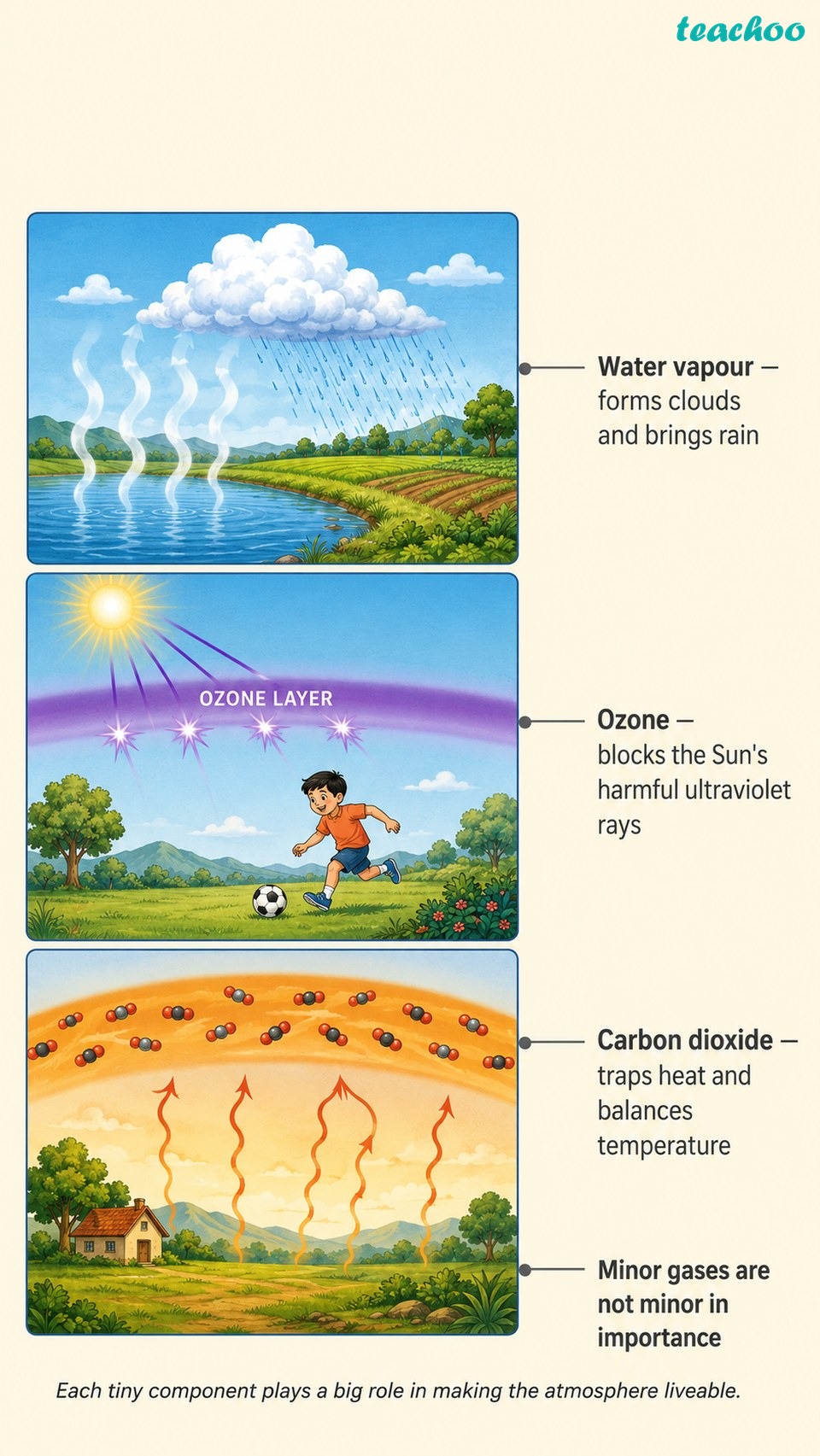
- Yes — minor gases are not minor in importance .
- Water vapour forms clouds and brings rain.
- Ozone blocks the Sun’s harmful ultraviolet radiation.
- Carbon dioxide helps trap heat and balance the Earth’s temperature.
- Each tiny component plays a big role in making the atmosphere liveable.
🔄 LET’S RECALL
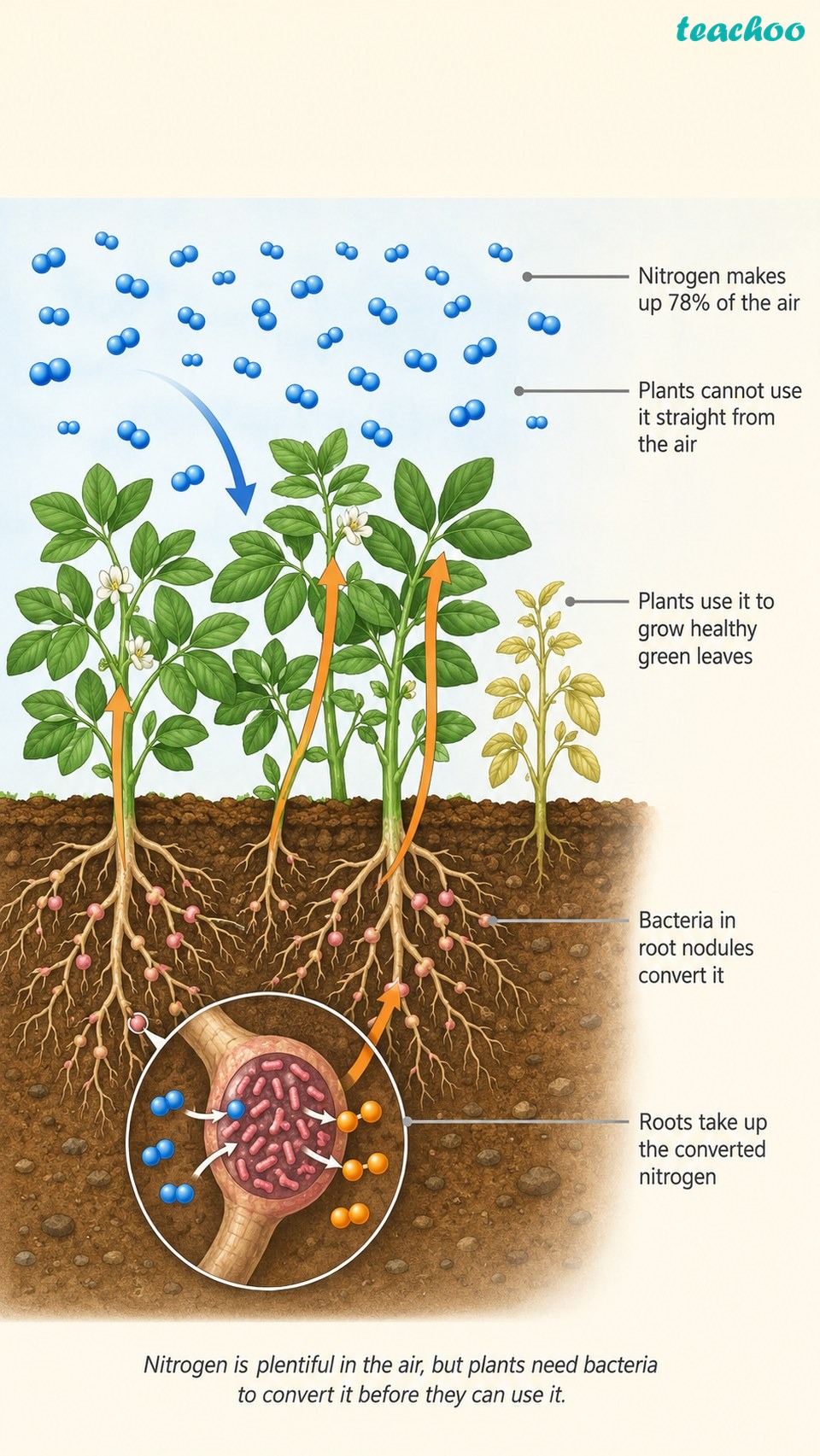
How is nitrogen useful for plants? Remember that you learnt this in the chapter ‘The Invisible Living World: Beyond Our Naked Eyes’, in your Grade 8 Science textbook.
Definition — Composition of the Atmosphere
The mixture of gases that makes up the air.
Mainly nitrogen (about 78%) and oxygen (about 21%).
Also argon, carbon dioxide, other gases, water vapour and dust.
Mainly nitrogen (about 78%) and oxygen (about 21%).
Also argon, carbon dioxide, other gases, water vapour and dust.
📝 What Have We Learned
- The atmosphere is a mixture of gases , water vapour and dust.
- Nitrogen (78%) and oxygen (21%) are the most abundant.
- Minor gases like ozone and carbon dioxide still matter a lot.
- Water vapour forms clouds and helps make rain.
- Composition changes with altitude .
