
 You are here
Why is it hotter near the equator and colder near the poles?
![3.4.1 Temperature and Heat Zones - Atmosphere and Climate - [Teachoo] - Concepts](https://cdn.teachoo.com/4213ebb3-2099-4fd3-9839-3eb269467a24/the-same-sunlight-spread-over-a-larger-area-warms-it-less-which-is-why-the-poles-are-cold..jpg)
Insolation
In-
incoming / into
Sol
Sun
-ation
process
↓
Incoming solar energy intercepted by Earth; it decreases from equator towards poles.
- The temperature of the atmosphere varies by day, night and season .
- An important factor is insolation .
- Near the equator, the Sun’s rays fall directly and vertically.
- Near the poles, the same rays fall at a low, slanting angle .
- Slanting rays spread their heat over a larger area , so it warms less.
- This is why insolation decreases from the equator towards the poles.
- So, temperature also decreases from the equator towards the poles.
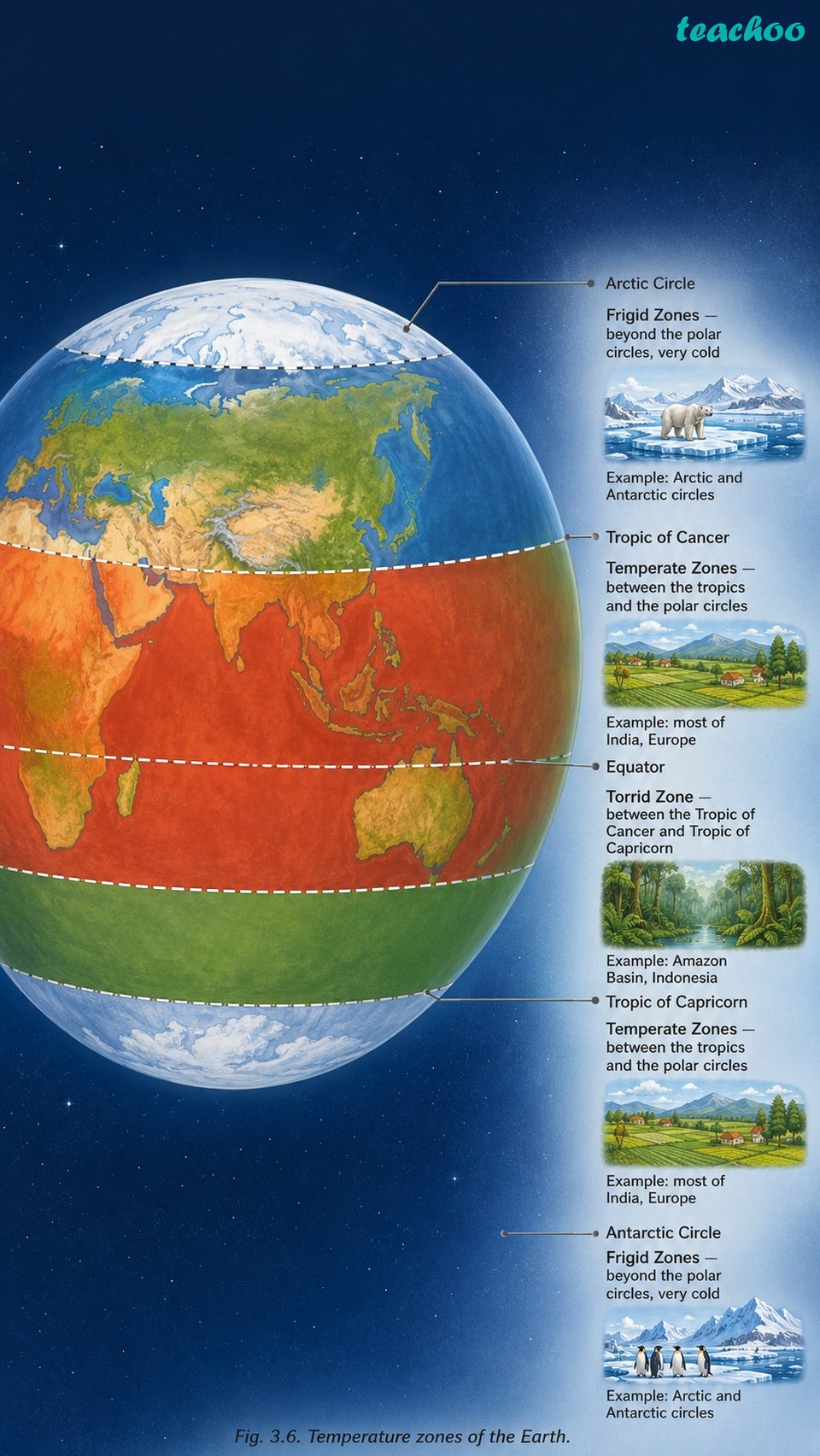
How do we divide the Earth using this pattern of heat?
How does the Earth divide into heat zones?
Heat Zones
Based on angle of sunlight
1. Torrid Zone
Nearest to the equator
Example:
Amazon Basin, Indonesia
2. Temperate Zones
Between tropics and poles
Example:
Most of India, Europe
3. Frigid Zones
Near the poles, very cold
Example:
Arctic, Antarctic circles
- The Torrid Zone lies between the Tropic of Cancer and Tropic of Capricorn.
- The Temperate Zones lie between the tropics and the polar circles.
- The Frigid Zones lie near the poles, beyond the polar circles.
