
 You are here
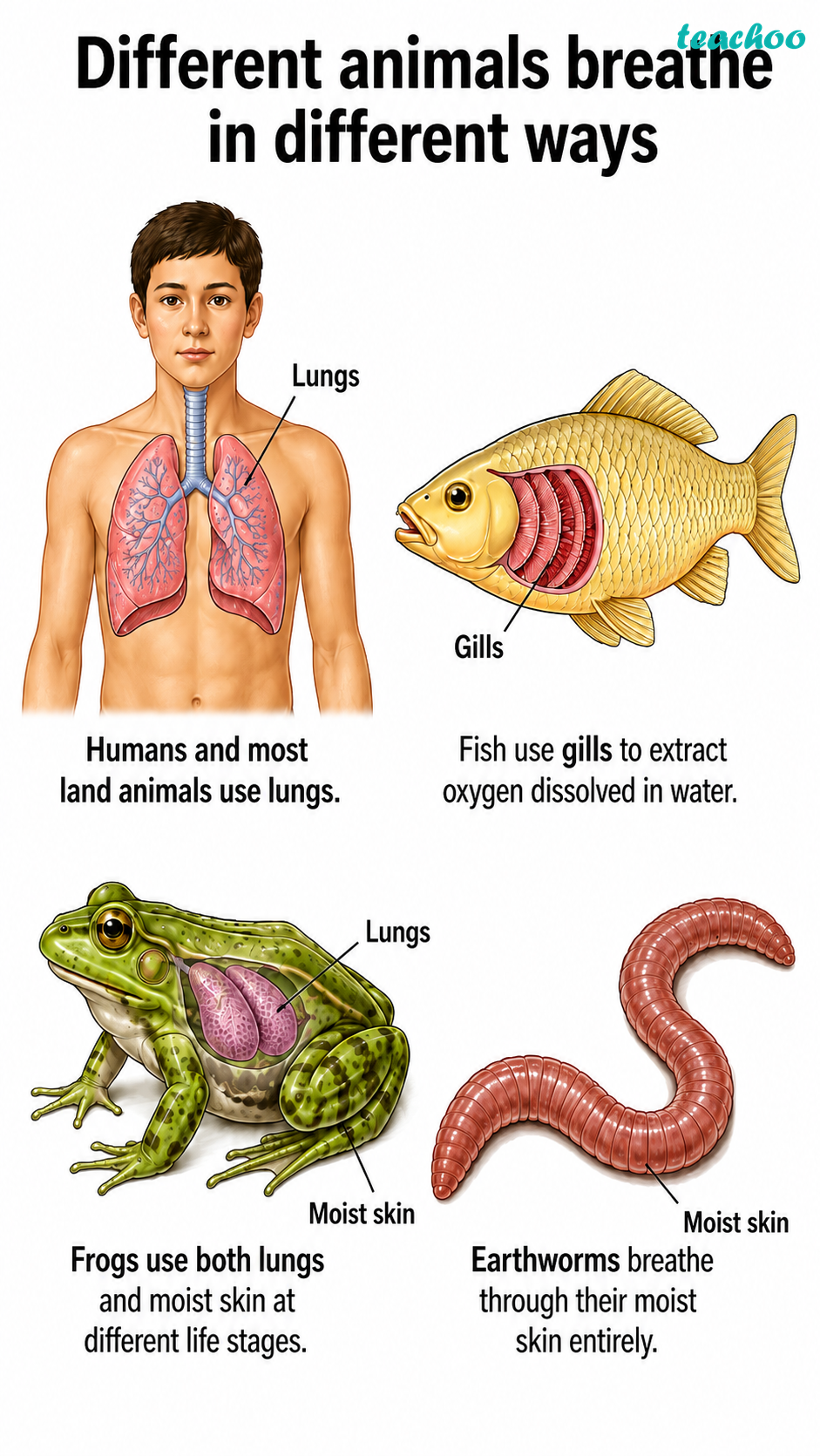
- Different animals live in different habitats — so they have different breathing mechanisms.
- Birds, elephants, lions, cows, lizards, and snakes breathe through lungs (though lung structure differs).
Breathing in Different Animals
- Most aquatic animals like fish breathe through gills — specialised structures richly supplied with blood vessels.
- Oxygen and carbon dioxide are exchanged between the blood and gases dissolved in water across the gills.
- Frogs (amphibians) live both on land and in water — tadpoles breathe through gills; adult frogs use lungs on land and skin in water.
- Earthworms breathe through their moist skin — gas exchange happens across the skin surface.
Example 1 — A Fish
- A fish takes in water and passes it over its gills.
- Gills extract dissolved oxygen from the water and release carbon dioxide.
- This is how a fish breathes — through gills, not lungs.
Example 2 — A Frog
- A tadpole lives in water and breathes through gills.
- As an adult frog, it breathes through lungs on land and through moist skin in water.
- This adaptation allows the frog to survive both in water and on land.
Example 3 — An Earthworm
- An earthworm has no lungs or gills.
- It breathes through its moist skin — oxygen and CO₂ pass directly through the skin.
- That is why earthworms cannot survive if their skin dries out — they cannot breathe.
Important Points
- Gills = breathing organs of fish — for gas exchange in water.
- Frogs use gills (as tadpoles), lungs (on land), and skin (in water).
- Earthworms use moist skin for gas exchange.
Definition — Gills
Specialised breathing structures in fish and other aquatic animals.
They are richly supplied with blood vessels and allow gas exchange between blood and water-dissolved gases.
They are richly supplied with blood vessels and allow gas exchange between blood and water-dissolved gases.
- Apart from the digestive system, the respiratory system, and the circulatory system, there are other systems in the body that work together to sustain life.
- You will study about them in higher grades.
✅ Test Yourself — Breathing in Other Animals
-
What are gills?
View Answer
Specialised breathing structures in fish, richly supplied with blood vessels. Gas exchange between blood and water happens across the gills. -
How does a frog breathe at different stages of its life?
View Answer
As a tadpole: through gills. As an adult: through lungs on land and through moist skin in water. -
How do earthworms breathe?
View Answer
Through their moist skin. Gas exchange happens across the skin surface. -
Name any three animals that breathe through lungs.
View Answer
(Any 3) Birds, elephants, lions, cows, goats, lizards, snakes. -
How is gas exchange in fish different from that in humans?
View Answer
Fish use gills to exchange gases with water. Humans use lungs (alveoli) to exchange gases with air.
📋 NCERT Question 4 — Match the following name of
Match nostrils, nasal passages, windpipe, alveoli, ribcage to their correct functions.
View Answer →
📋 NCERT Question 7 — Why We Sneeze in Dusty Air
Provide possible explanations for why we often sneeze when we inhale a lot of dust-laden air.
View Answer →
