Nutrition in Animals

9.1 Nutrition in Animals - Life Processes in Animals - [Teachoo] - Concepts
Different animals eat in different ways
  • All animals eat food to survive.
  • Using food for energy, growth, and repair is called nutrition .
  • Different animals get food differently — bees suck nectar, snakes swallow prey, fish filter particles.
  • Animals get energy from food to carry out all life processes.
Example 1 — A Bee
  • A bee sucks nectar from flowers.
  • The nectar gives it energy to fly.
  • This is how a bee gets nutrition.
Example 2 — A Python
  • A python swallows a rat whole.
  • It uses the rat for energy and growth.
  • This is how a python gets nutrition.
Important Points
  • Nutrition = eating food and using it for energy, growth, and repair.
  • All animals get nutrition — but in different ways.
Definition — Nutrition
Process of taking in food and using it for energy, growth, and repair.

The Alimentary Canal

part 2 - 9.1 Nutrition in Animals - Concepts - Chapter 9 Class 7 - Life Processes in Animals (Curiosity) - Class 7

  • Food contains complex components — carbohydrates, proteins, and fats .
  • These are too big for the body to use directly.
  • They break down inside a long tube called the alimentary canal — from mouth to anus.
  • Digestive juices break food into simple forms.
  • Simple forms are absorbed into blood and reach all body parts.
Example 1 — Roti
  • Roti travels through the alimentary canal from mouth to anus.
  • Digestive juices break the starch into simple sugar along the way.
  • The sugar enters the blood and gives energy to the body.
Example 2 — Paneer
  • Paneer travels through the alimentary canal.
  • Digestive juices break the protein into simple pieces.
  • These simple pieces reach the muscles through blood.
Important Points
  • Alimentary canal = long tube, mouth to anus, where digestion happens.
  • Digestive juices = secreted at different parts, break complex food into simple forms.
  • Simple food = absorbed into blood, reaches whole body.
Definition — Alimentary Canal
Long tube from mouth to anus where food is digested and absorbed.
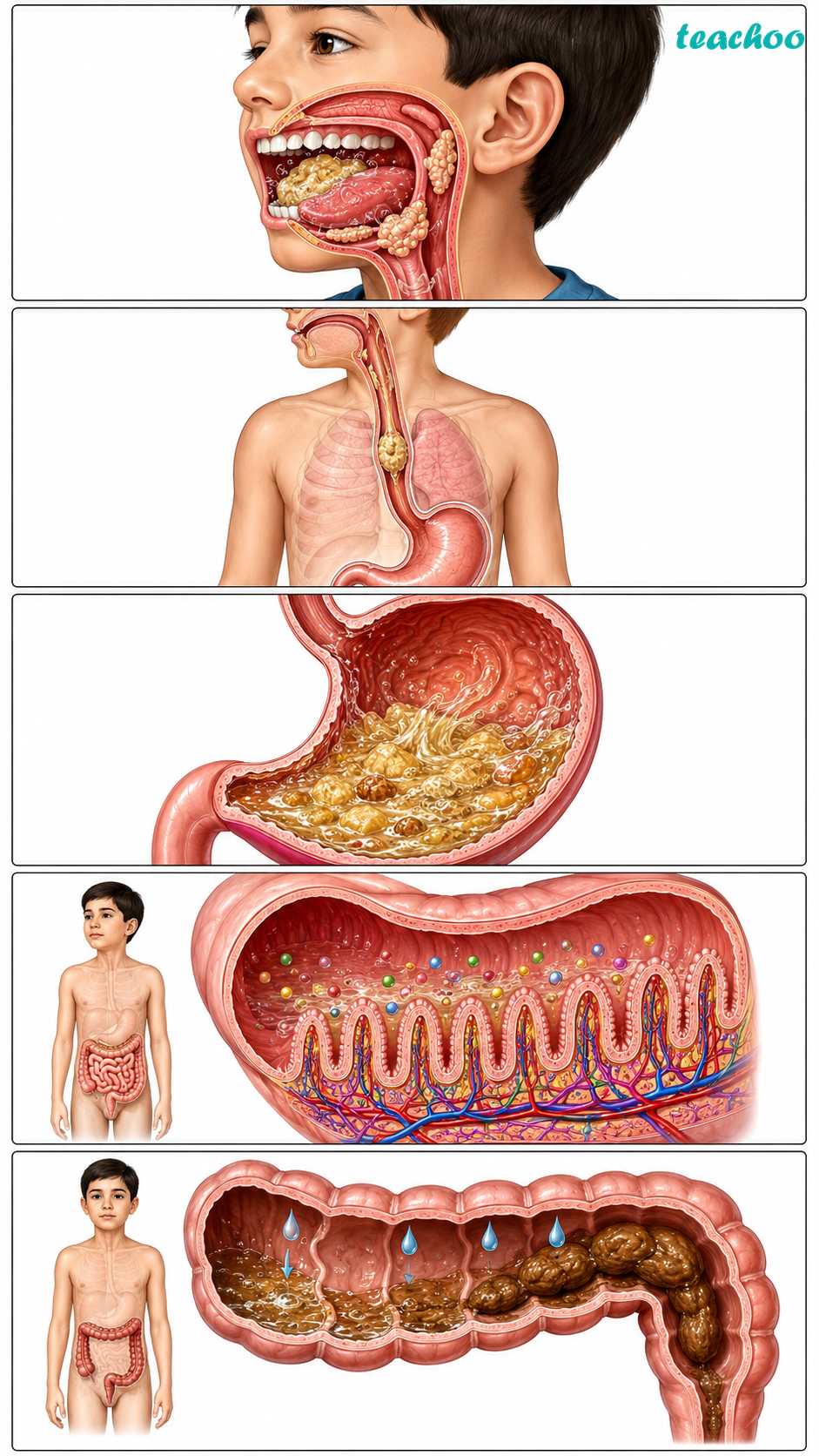
It includes the mouth, oesophagus, stomach, small intestine, large intestine, rectum, and anus.
part 3 - 9.1 Nutrition in Animals - Concepts - Chapter 9 Class 7 - Life Processes in Animals (Curiosity) - Class 7 Mouth Oesophagus Stomach Small intestine Large intestine
Food Journey: 5 Stops

What Is in Our Food?

  • The food we eat — roti, dal, paneer, rice — contains three main components.
  • Carbohydrates give the body energy — starch in chapati, sugar in fruits.
  • Proteins help the body grow and repair — dal, paneer, and eggs are rich in protein.
  • Fats store energy and protect organs — ghee, oil, and butter contain fats.
  • The body cannot absorb these directly — they are too big and complex.

Where Does Digestion Happen?

  • Digestion happens inside a long tube called the alimentary canal — from mouth to anus.
  • As food moves through the canal, digestive juices break it into simpler forms.
  • These simple forms are absorbed into the blood and carried to every cell.
The Digestive Journey
Mouth
Teeth chew · Saliva breaks starch
Food Pipe (Oesophagus)
Wave-like motion pushes food down
Stomach
Digestive juice, acid & mucus churn food
Small Intestine
Bile & pancreatic juice complete digestion · nutrients absorbed
Large Intestine
Water absorbed · stool formed
Anus — Egestion
Remove Ads Share on WhatsApp
Maninder Singh's photo - Co-founder, Teachoo

Made by

Maninder Singh

CA Maninder Singh is a Chartered Accountant with 16+ years of practical experience and 20+ years of teaching experience. He teaches Science, Economics, Accounting and English at Teachoo using clear explanations and exam-focused methods students can trust.

For faster and distraction-free study, students can choose Teachoo Black.