You are here
Exercise Set 4.4
Last updated at May 15, 2026 by Teachoo
Transcript
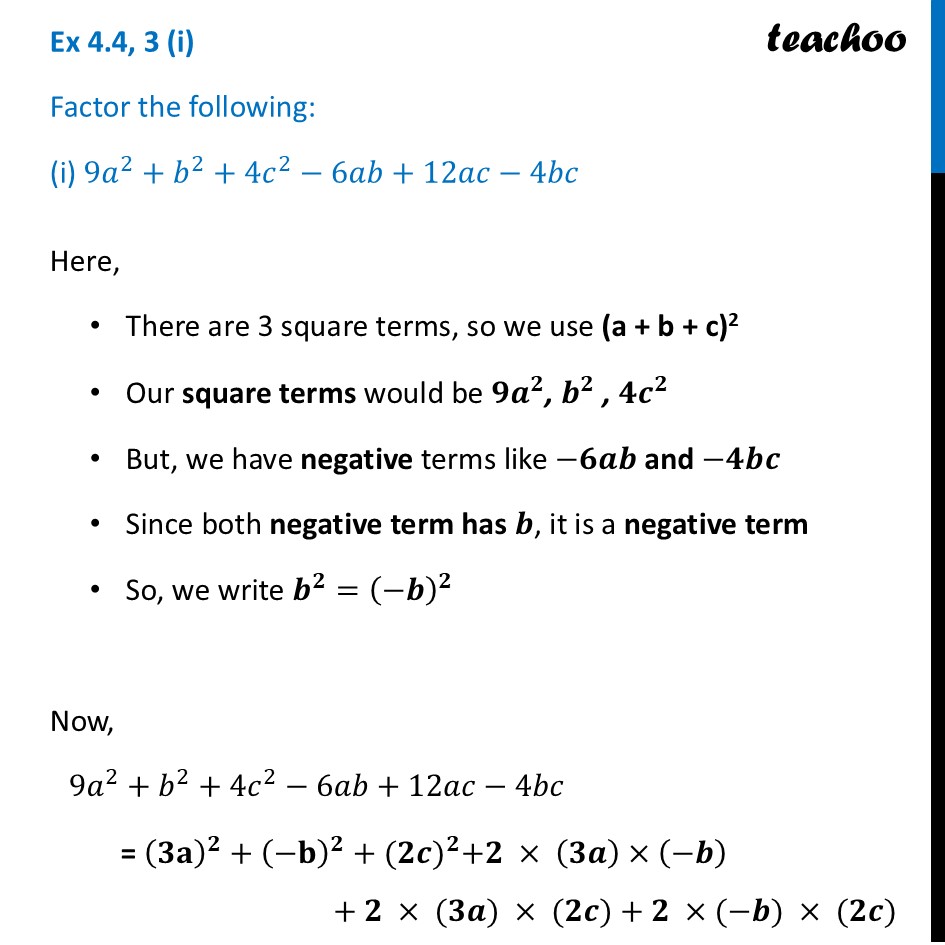
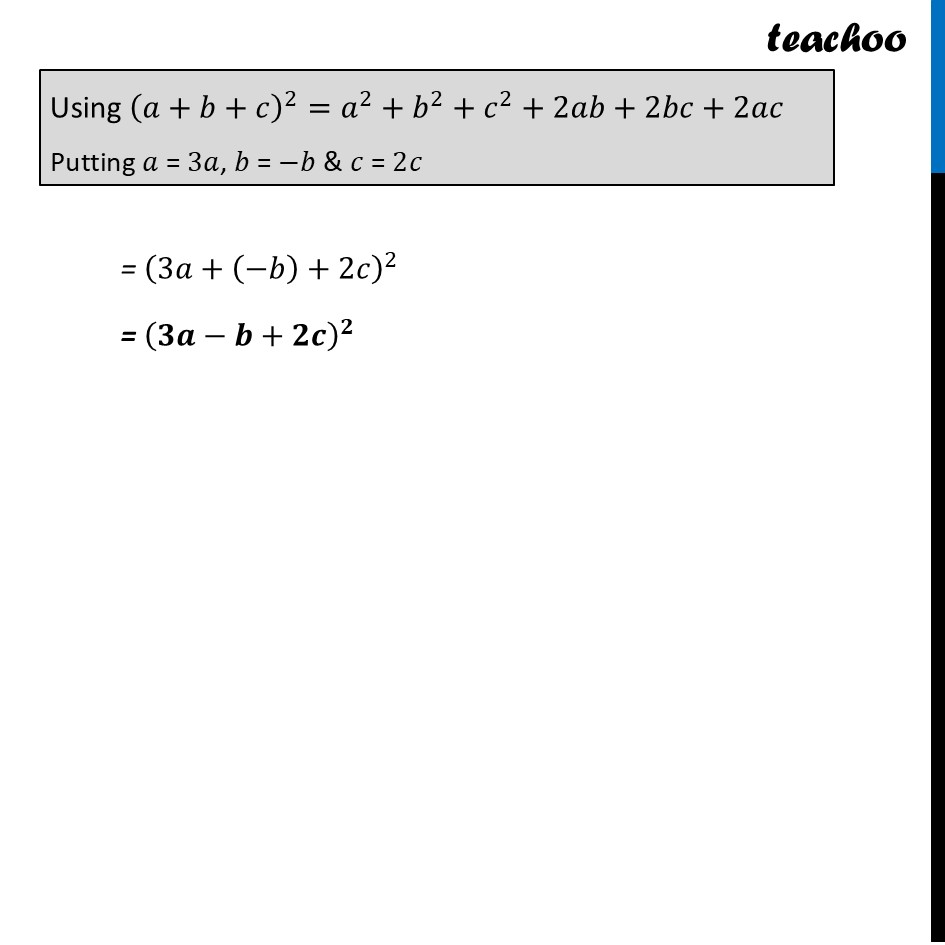
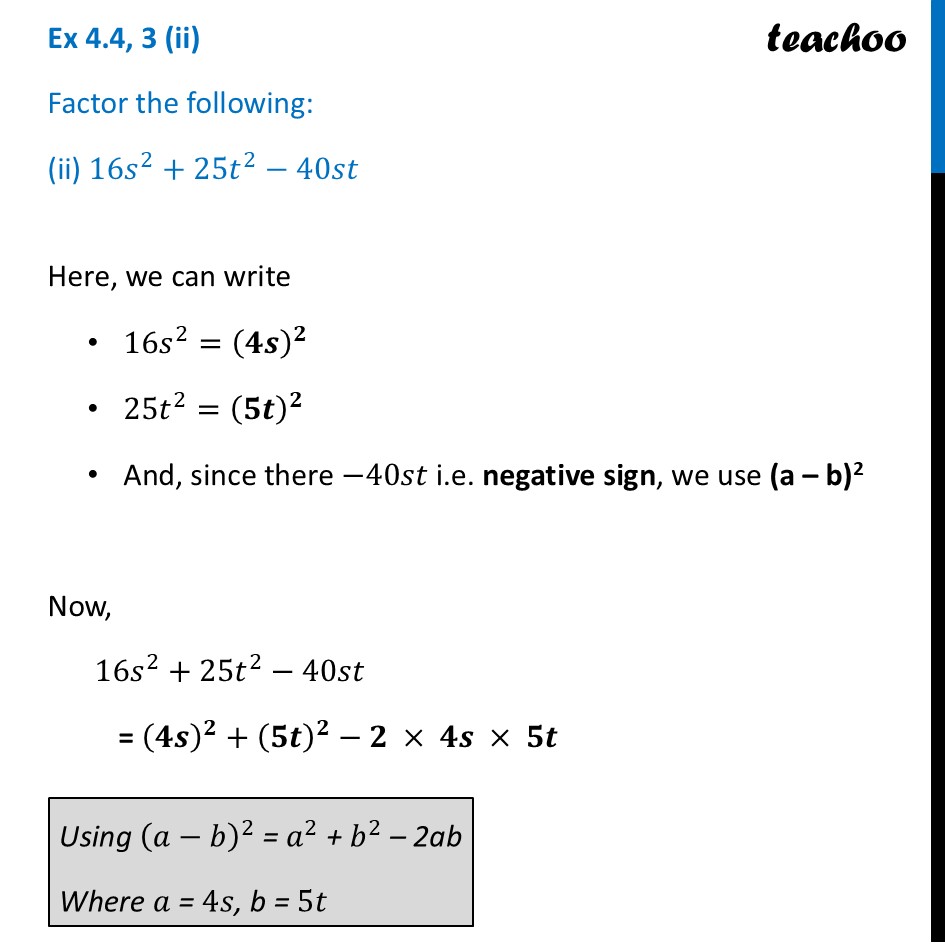
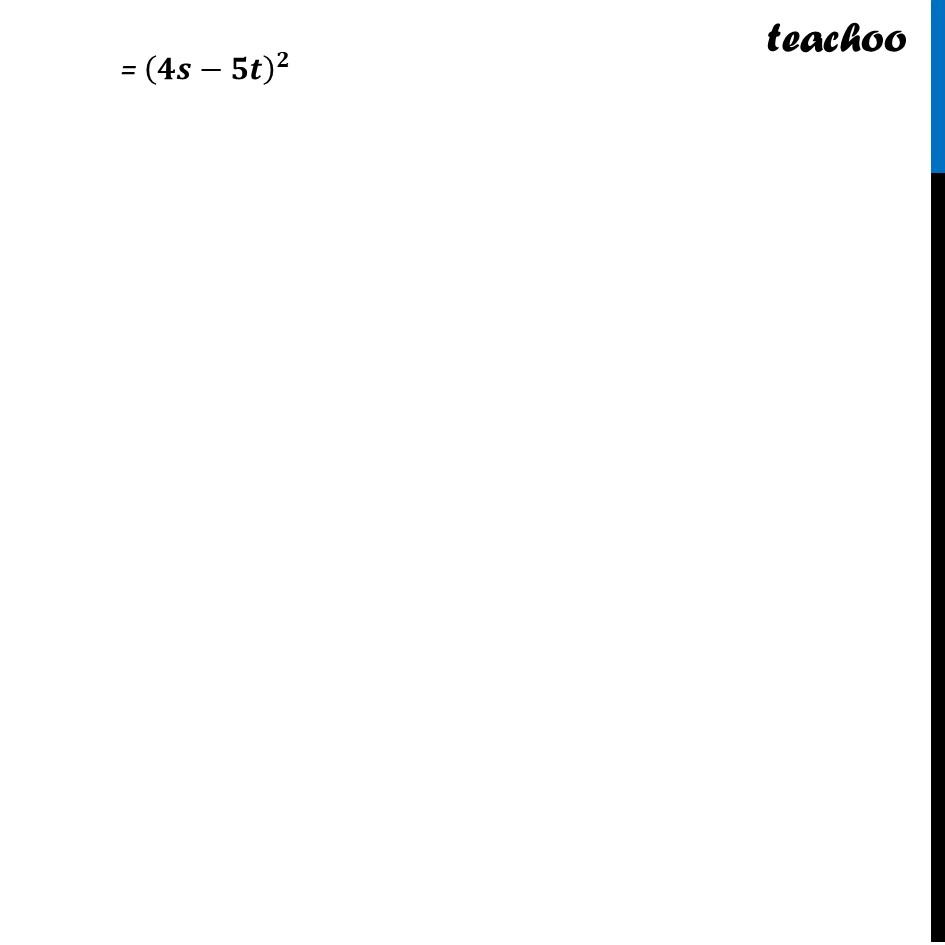
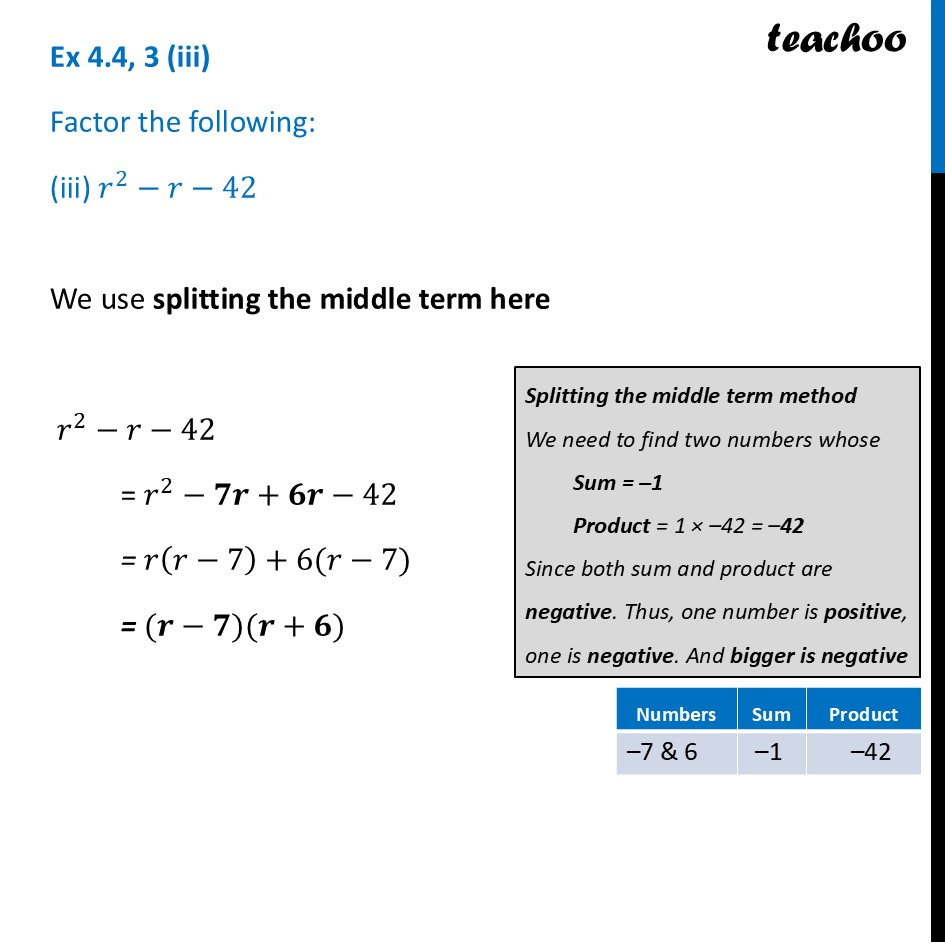
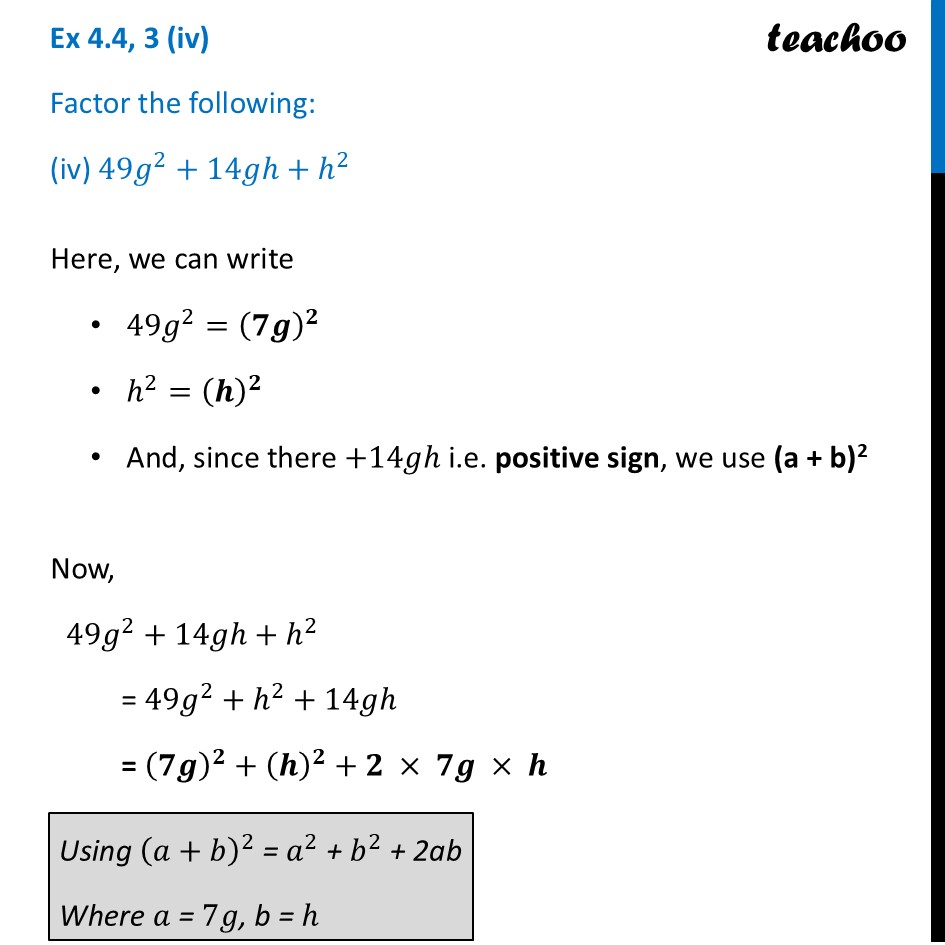
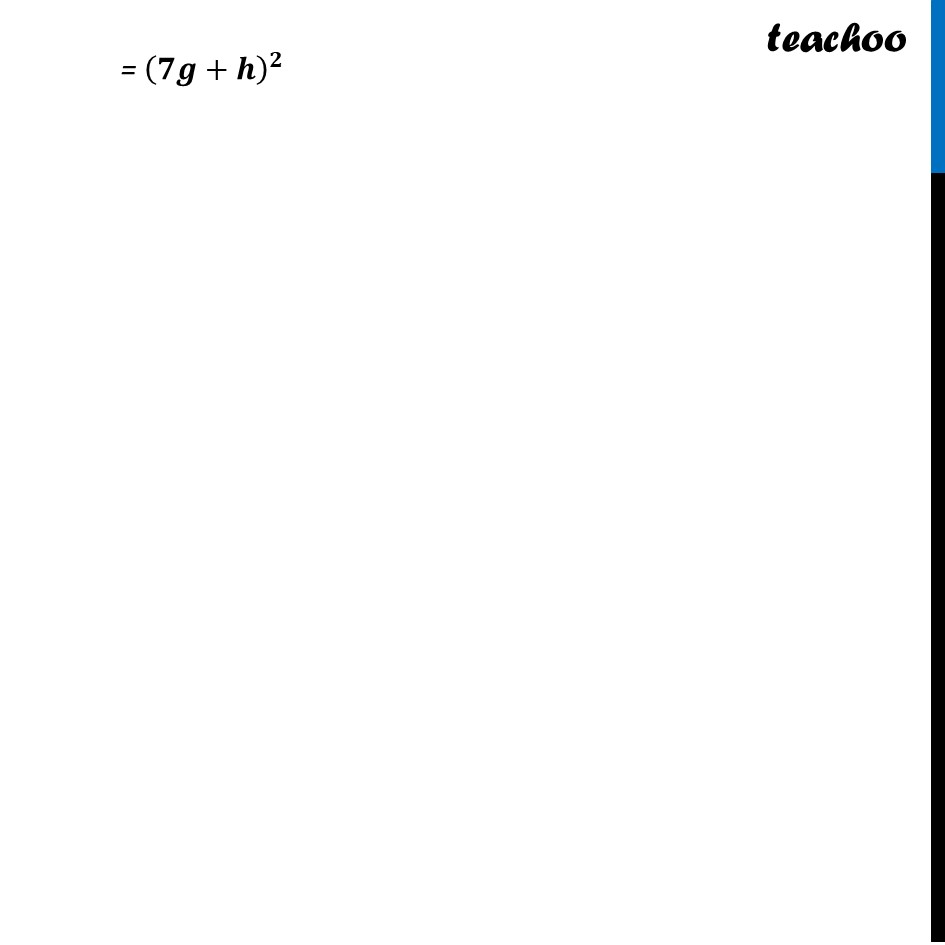
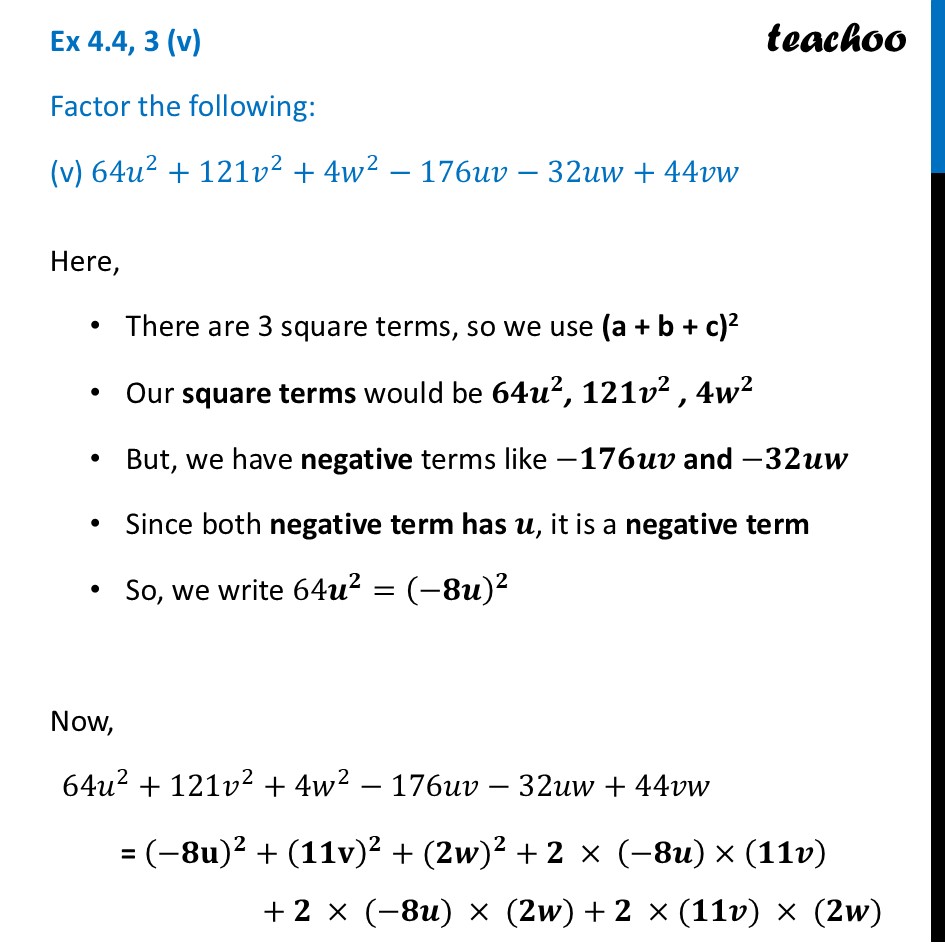
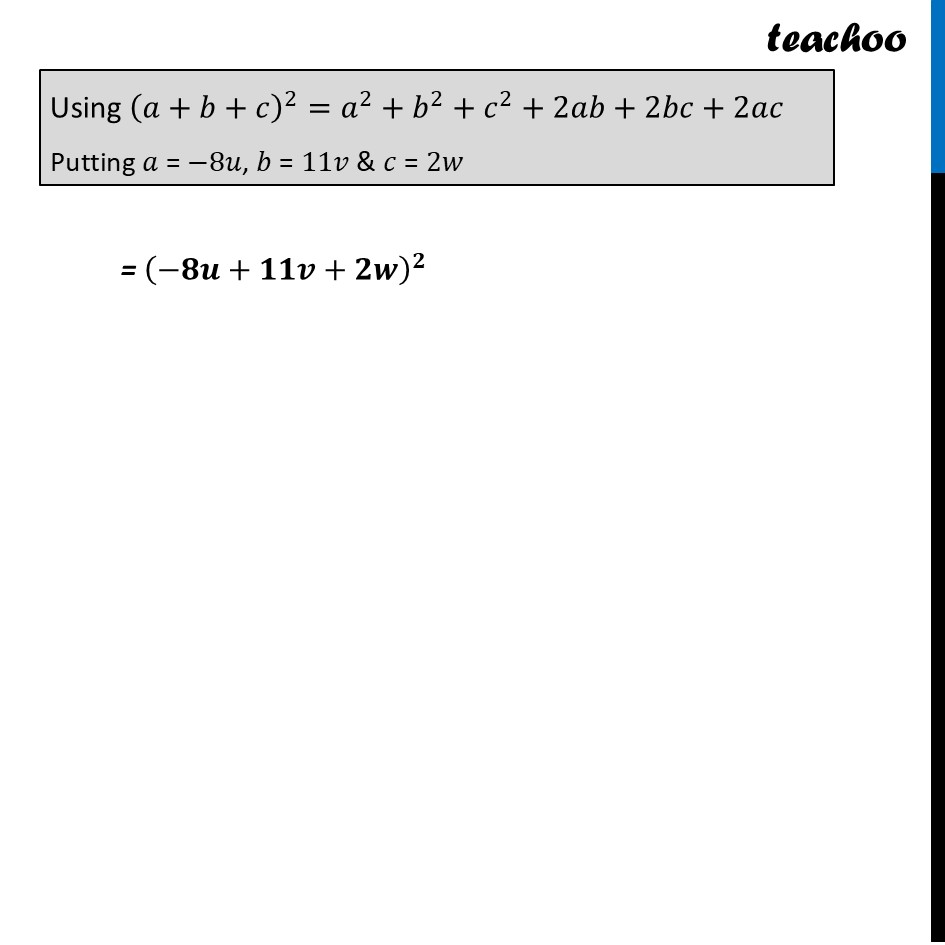
Ex 4.4, 3 (i) Factor the following: (i) 9𝑎^2+𝑏^2+4𝑐^2−6𝑎𝑏+12𝑎𝑐−4𝑏𝑐 Here, There are 3 square terms, so we use (a + b + c)2 Our square terms would be 𝟗𝒂^𝟐, 𝒃^𝟐 , 𝟒𝒄^𝟐 But, we have negative terms like −𝟔𝒂𝒃 and −𝟒𝒃𝒄 Since both negative term has 𝒃, it is a negative term So, we write 𝒃^𝟐=(−𝒃)^𝟐 Now, 9𝑎^2+𝑏^2+4𝑐^2−6𝑎𝑏+12𝑎𝑐−4𝑏𝑐 = (𝟑𝐚)^𝟐+(−𝐛)^𝟐+〖(𝟐𝒄)〗^𝟐+𝟐 × (𝟑𝒂)×(−𝒃) + 𝟐 × (𝟑𝒂) × (𝟐𝒄)+𝟐 ×(−𝒃) × (𝟐𝒄) Using (𝑎+𝑏+𝑐)^2=𝑎^2+𝑏^2+𝑐^2+2𝑎𝑏+2𝑏𝑐+2𝑎𝑐 Putting 𝑎 = 3𝑎, 𝑏 = −𝑏 & 𝑐 = 2𝑐 = (3𝑎+(−𝑏)+2𝑐)^2 = (𝟑𝒂−𝒃+𝟐𝒄)^𝟐 Ex 4.4, 1 (ii) Factor the following: (ii) 16𝑠^2+25𝑡^2−40𝑠𝑡 Here, we can write 16𝑠^2=(𝟒𝒔)^𝟐 25𝑡^2=(𝟓𝒕)^𝟐 And, since there −40𝑠𝑡 i.e. negative sign, we use (a – b)2 Now, 16𝑠^2+25𝑡^2−40𝑠𝑡 = (𝟒𝒔)^𝟐+(𝟓𝒕)^𝟐−𝟐 × 𝟒𝒔 × 𝟓𝒕 Using (𝑎−𝑏)^2 = 𝑎^2 + 𝑏^2 – 2ab Where 𝑎 = 4𝑠, b = 5𝑡 = (𝟒𝒔−𝟓𝒕)^𝟐 Ex 4.4, 3 (iii) Factor the following: (iii) 𝑟^2−𝑟−42 We use splitting the middle term here 𝑟^2−𝑟−42 = 𝑟^2−𝟕𝒓+𝟔𝒓−42 = 𝑟(𝑟−7)+6(𝑟−7) = (𝒓−𝟕)(𝒓+𝟔) Splitting the middle term method We need to find two numbers whose Sum = –1 Product = 1 × –42 = –42 Since both sum and product are negative. Thus, one number is positive, one is negative. And bigger is negative Ex 4.4, 3 (iv) Factor the following: (iv) 49𝑔^2+14𝑔ℎ+ℎ^2 Here, we can write 49𝑔^2=(𝟕𝒈)^𝟐 ℎ^2=(𝒉)^𝟐 And, since there +14𝑔ℎ i.e. positive sign, we use (a + b)2 Now, 49𝑔^2+14𝑔ℎ+ℎ^2 = 49𝑔^2+ℎ^2+14𝑔ℎ = (𝟕𝒈)^𝟐+(𝒉)^𝟐+𝟐 × 𝟕𝒈 × 𝒉 Using (𝑎+𝑏)^2 = 𝑎^2 + 𝑏^2 + 2ab Where 𝑎 = 7𝑔, b = ℎ = (𝟕𝒈+𝒉)^𝟐 Ex 4.4, 3 (v) Factor the following: (v) 64𝑢^2+121𝑣^2+4𝑤^2−176𝑢𝑣−32𝑢𝑤+44𝑣𝑤 Here, There are 3 square terms, so we use (a + b + c)2 Our square terms would be 𝟔𝟒𝒖^𝟐, 𝟏𝟐𝟏𝒗^𝟐 , 𝟒𝒘^𝟐 But, we have negative terms like −𝟏𝟕𝟔𝒖𝒗 and −𝟑𝟐𝒖𝒘 Since both negative term has 𝒖, it is a negative term So, we write 64𝒖^𝟐=(−𝟖𝒖)^𝟐 Now, 64𝑢^2+121𝑣^2+4𝑤^2−176𝑢𝑣−32𝑢𝑤+44𝑣𝑤 = (−𝟖𝐮)^𝟐+(𝟏𝟏𝐯)^𝟐+〖(𝟐𝒘)〗^𝟐 + 𝟐 × (−𝟖𝒖)×(𝟏𝟏𝒗) + 𝟐 × (−𝟖𝒖) × (𝟐𝒘)+𝟐 ×(𝟏𝟏𝒗) × (𝟐𝒘) Using (𝑎+𝑏+𝑐)^2=𝑎^2+𝑏^2+𝑐^2+2𝑎𝑏+2𝑏𝑐+2𝑎𝑐 Putting 𝑎 = −8𝑢, 𝑏 = 11𝑣 & 𝑐 = 2𝑤 = (−𝟖𝒖+𝟏𝟏𝒗+𝟐𝒘)^𝟐