You are here
Rewriting a2 - b2 Identity
Last updated at August 14, 2026 by Teachoo
Transcript
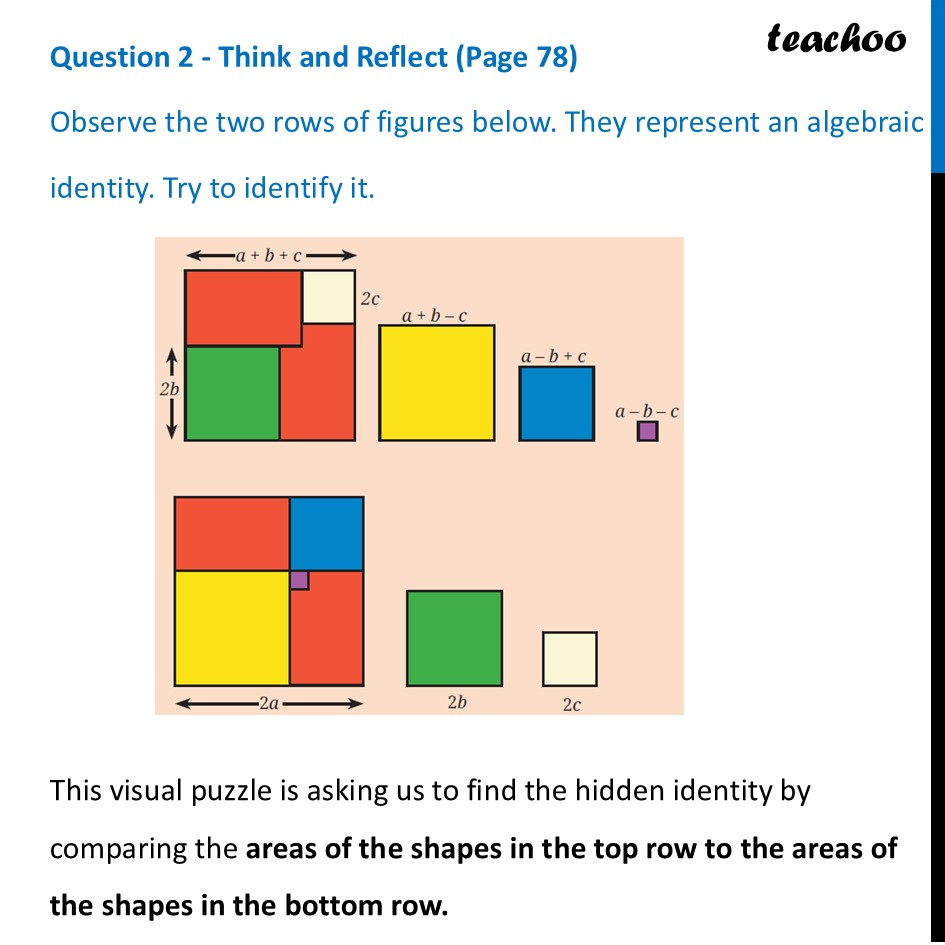
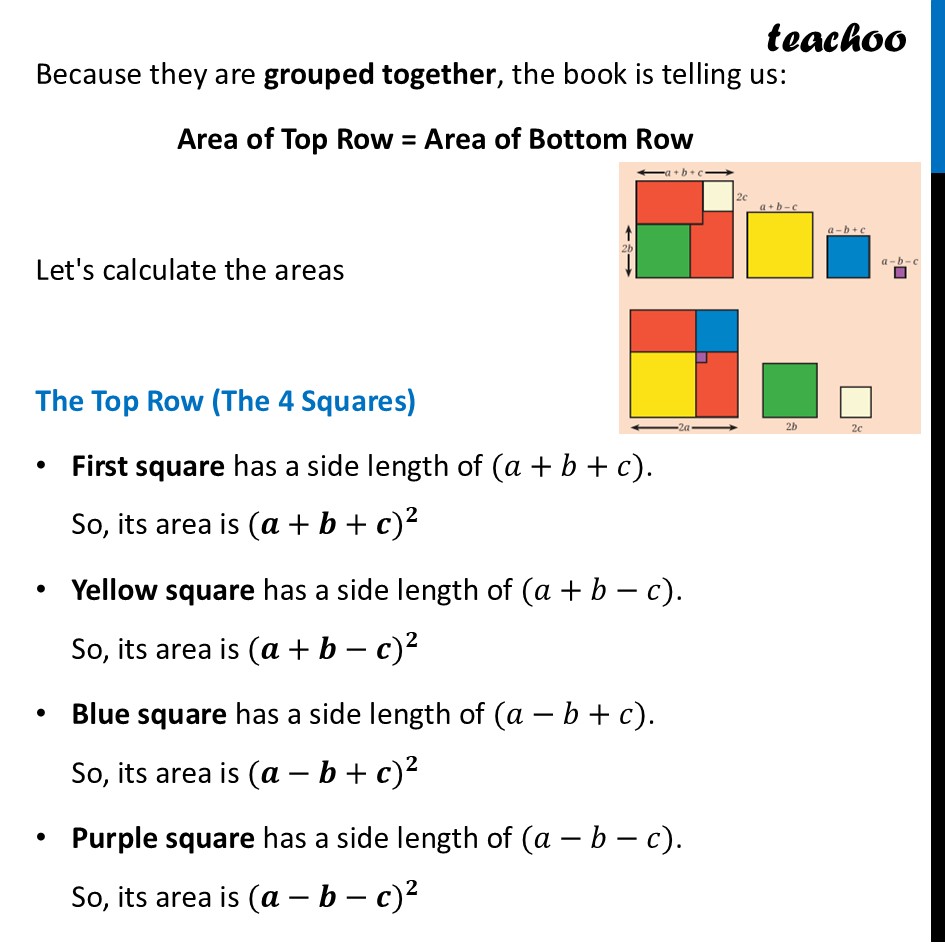
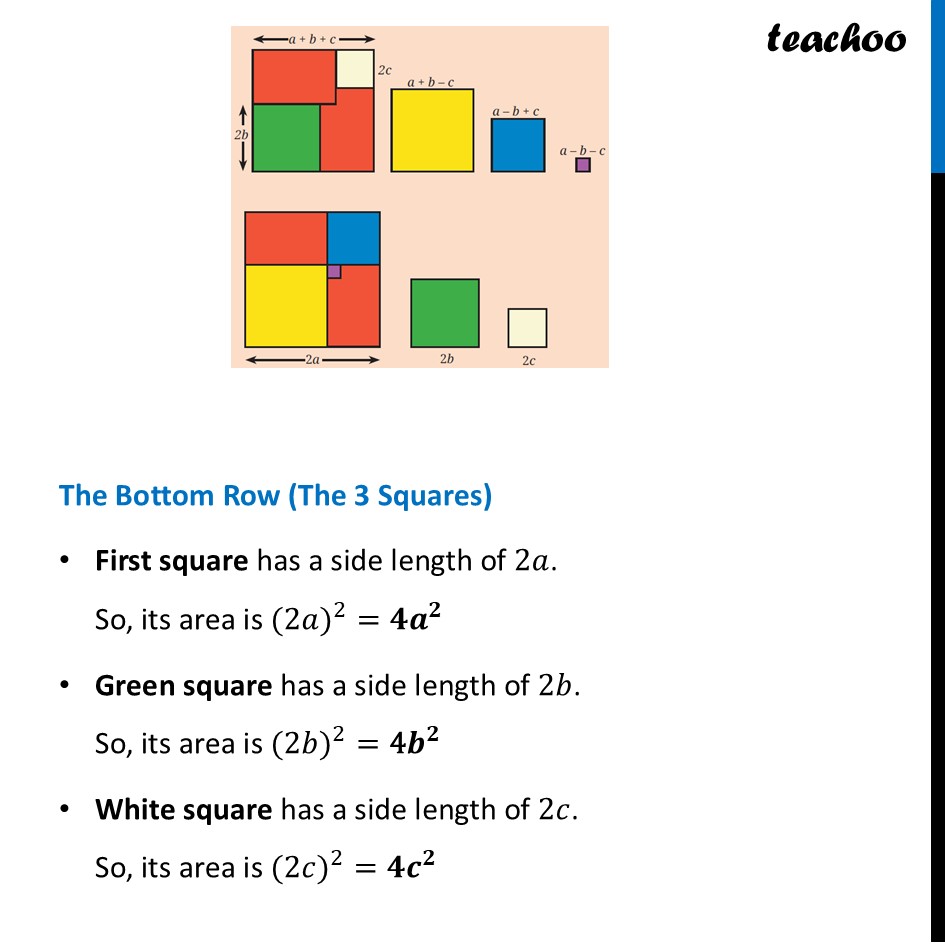
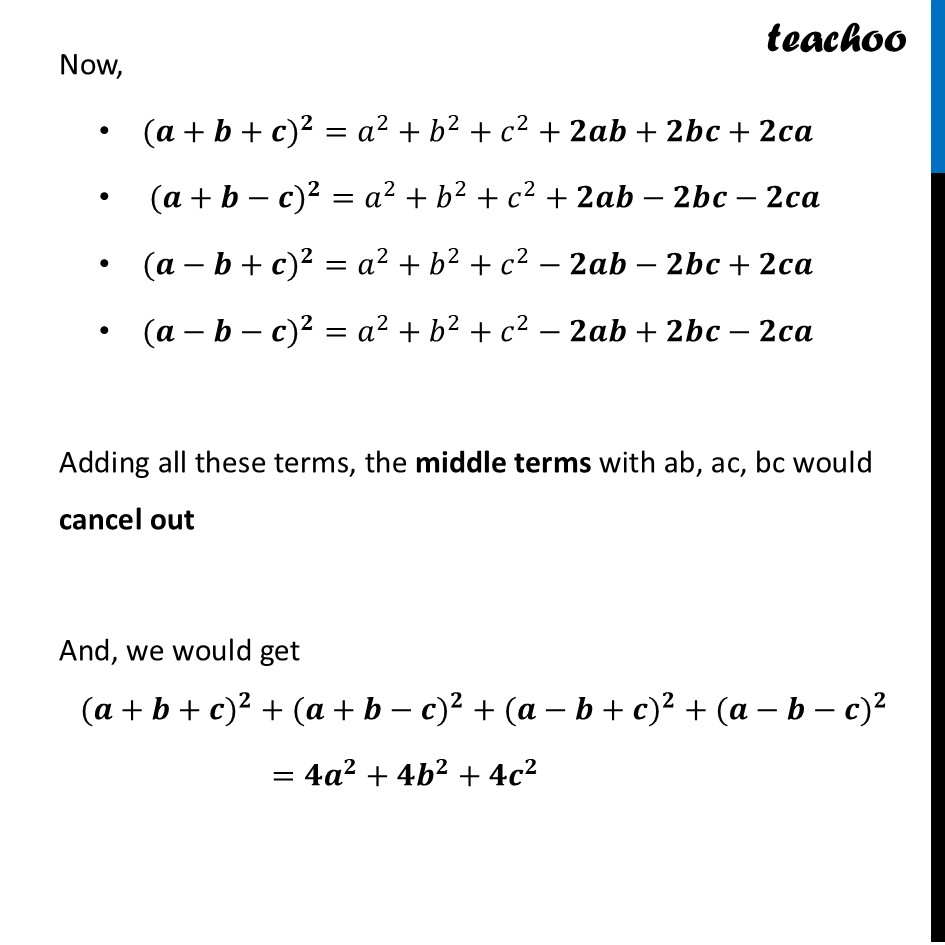
Question 2 - Think and Reflect (Page 78) Observe the two rows of figures below. They represent an algebraic identity. Try to identify it. This visual puzzle is asking us to find the hidden identity by comparing the areas of the shapes in the top row to the areas of the shapes in the bottom row. Because they are grouped together, the book is telling us: Area of Top Row = Area of Bottom Row Let's calculate the areas The Top Row (The 4 Squares) First square has a side length of (𝑎+𝑏+𝑐). So, its area is (𝒂+𝒃+𝒄)^𝟐 Yellow square has a side length of (𝑎+𝑏−𝑐). So, its area is (𝒂+𝒃−𝒄)^𝟐 Blue square has a side length of (𝑎−𝑏+𝑐). So, its area is (𝒂−𝒃+𝒄)^𝟐 Purple square has a side length of (𝑎−𝑏−𝑐). So, its area is (𝒂−𝒃−𝒄)^𝟐 The Bottom Row (The 3 Squares) First square has a side length of 2𝑎. So, its area is (2𝑎)^2=𝟒𝒂^𝟐 Green square has a side length of 2𝑏. So, its area is (2𝑏)^2=〖"4" 𝒃〗^𝟐 White square has a side length of 2𝑐. So, its area is (2𝑐)^2=𝟒𝒄^𝟐 The Hidden Identity Since Area of Top Row = Area of Bottom Row We get the identity (𝒂+𝒃+𝒄)^𝟐+(𝒂+𝒃−𝒄)^𝟐+(𝒂−𝒃+𝒄)^𝟐+(𝒂−𝒃−𝒄)^𝟐 =𝟒𝒂^𝟐+𝟒𝒃^𝟐+𝟒𝒄^𝟐 Algebraic Proof Let’s try to prove this We use the formula (𝑥+𝑦+𝑧)^2=𝑥^2+𝑦^2+𝑧^2+2𝑥𝑦+2𝑦𝑧+2𝑧𝑥. Now, (𝒂+𝒃+𝒄)^𝟐=𝑎^2+𝑏^2+𝑐^2+𝟐𝒂𝒃+𝟐𝒃𝒄+𝟐𝒄𝒂 (𝒂+𝒃−𝒄)^𝟐=𝑎^2+𝑏^2+𝑐^2+𝟐𝒂𝒃−𝟐𝒃𝒄−𝟐𝒄𝒂 (𝒂−𝒃+𝒄)^𝟐=𝑎^2+𝑏^2+𝑐^2−𝟐𝒂𝒃−𝟐𝒃𝒄+𝟐𝒄𝒂 (𝒂−𝒃−𝒄)^𝟐=𝑎^2+𝑏^2+𝑐^2−𝟐𝒂𝒃+𝟐𝒃𝒄−𝟐𝒄𝒂 Adding all these terms, the middle terms with ab, ac, bc would cancel out And, we would get (𝒂+𝒃+𝒄)^𝟐+(𝒂+𝒃−𝒄)^𝟐+(𝒂−𝒃+𝒄)^𝟐+(𝒂−𝒃−𝒄)^𝟐 =𝟒𝒂^𝟐+𝟒𝒃^𝟐+𝟒𝒄^𝟐