You are here
![Converting decimals to p/q form - Examples + Worksheet [Class 9 Maths] - Decimal Expansion of Real Numbers](https://cdn.teachoo.com/62367ec5-fed8-4d19-bf99-950c88059346/slide35.jpg)
Decimal Expansion of Real Numbers
Decimal Expansion of Real Numbers
Last updated at May 11, 2026 by Teachoo
Transcript
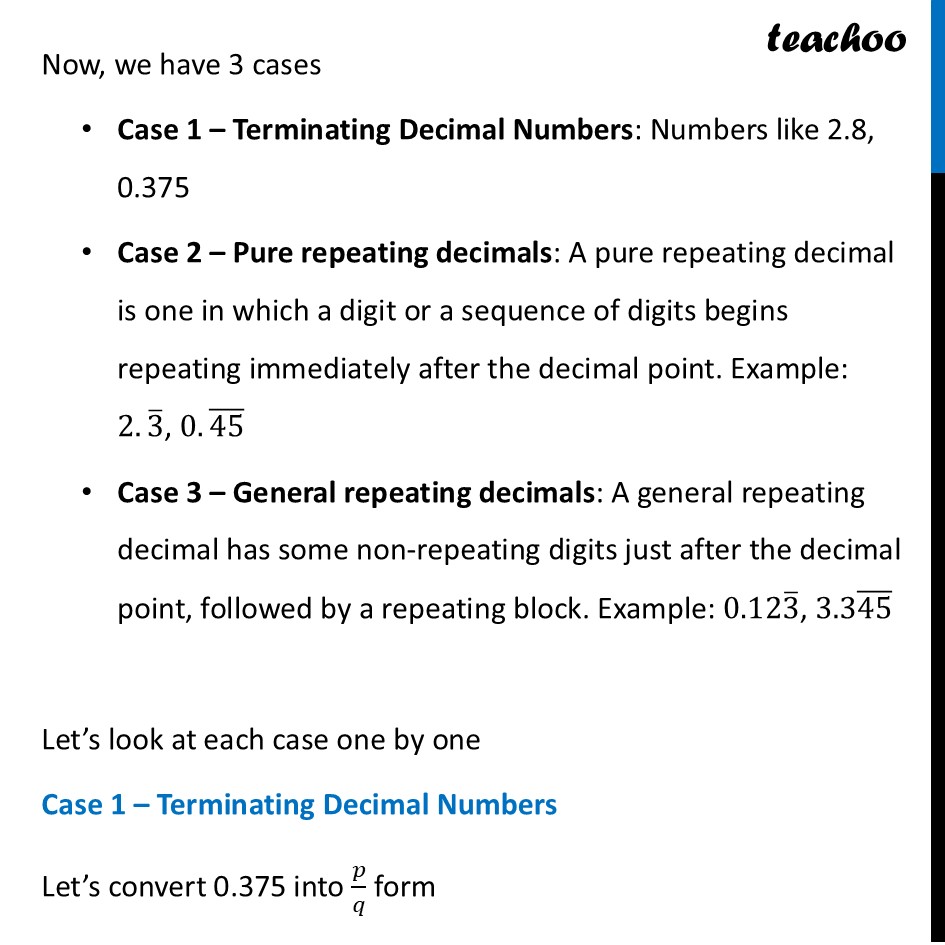
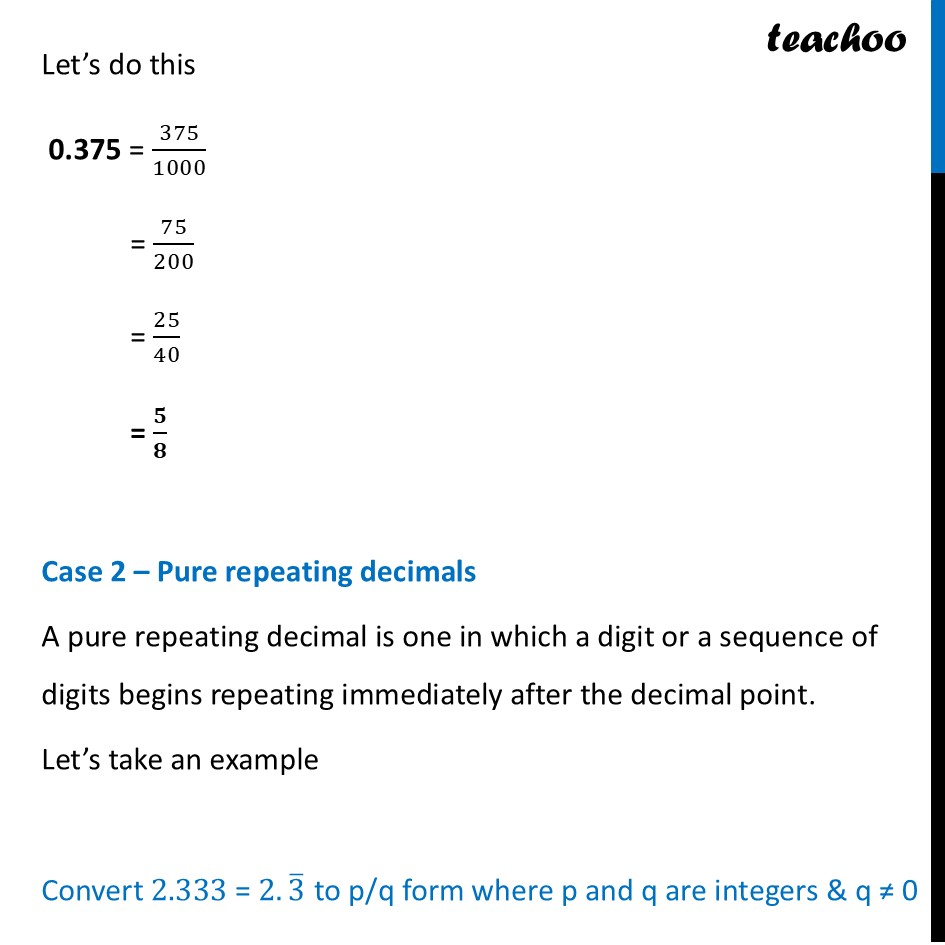
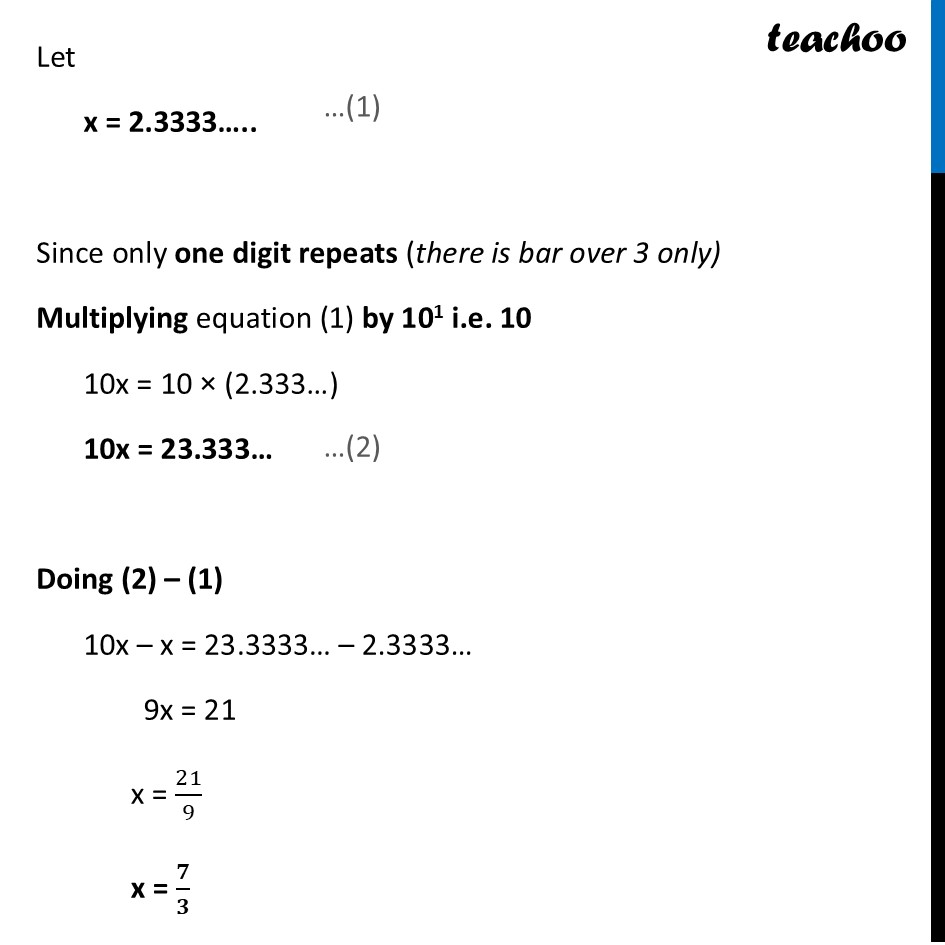
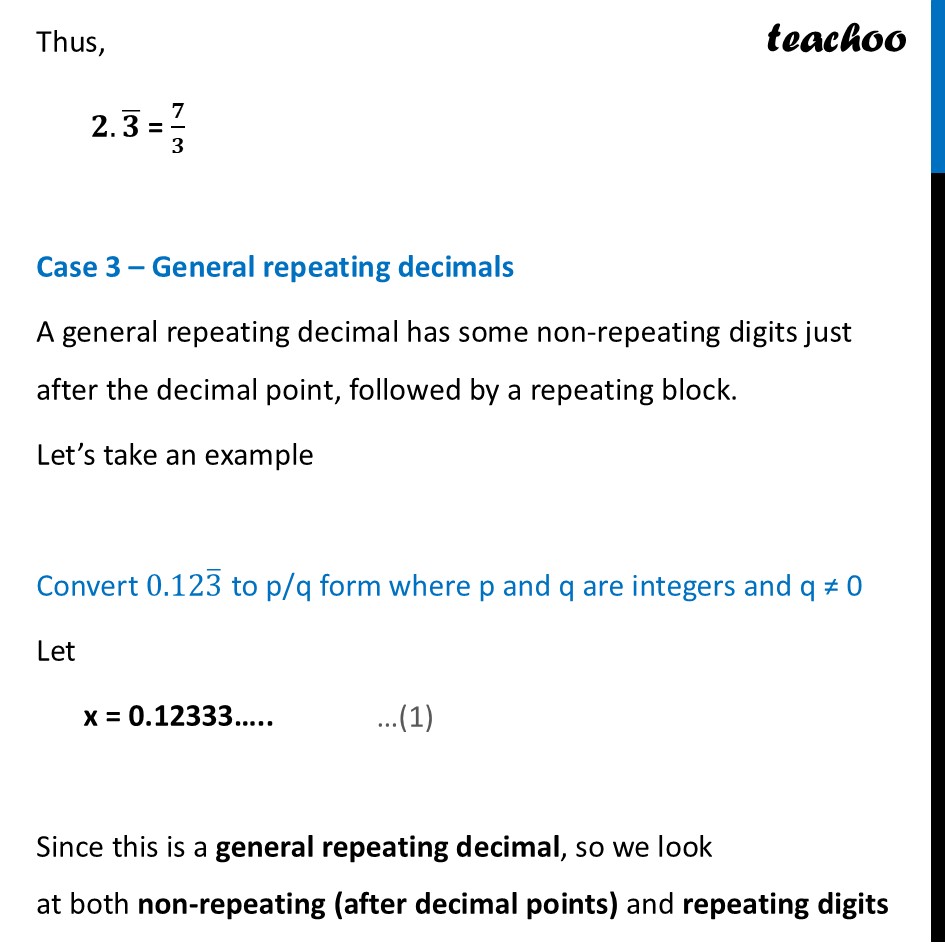
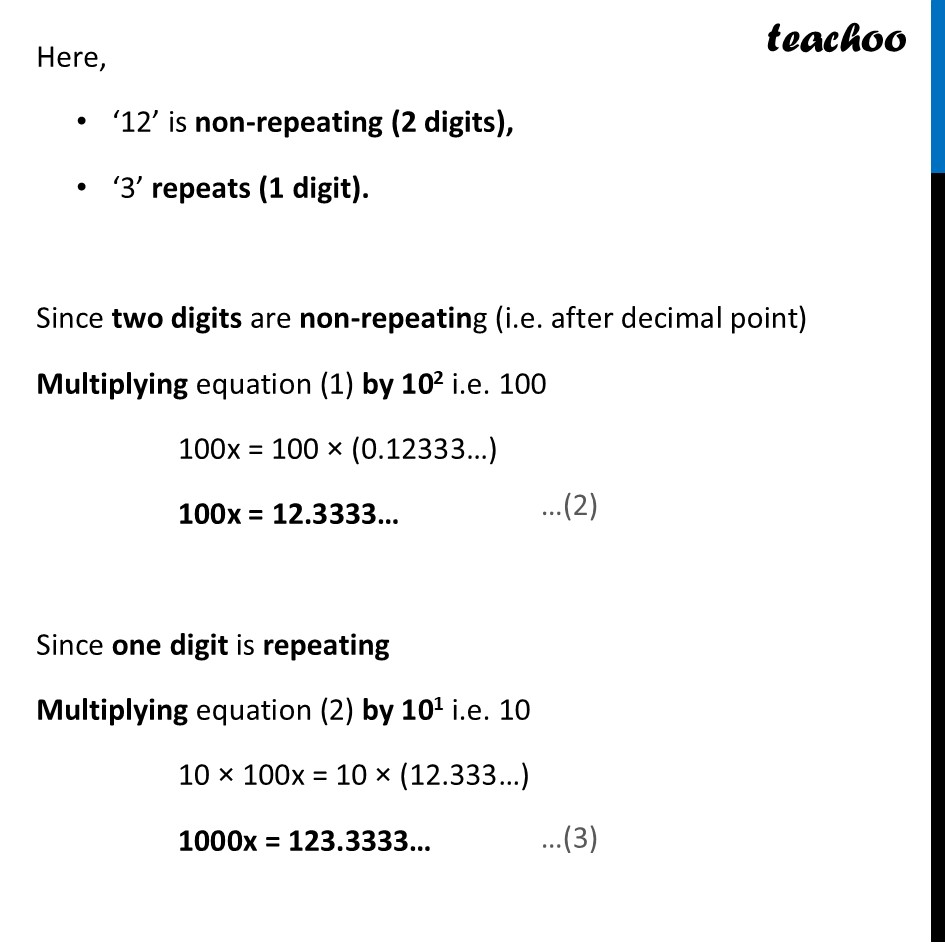
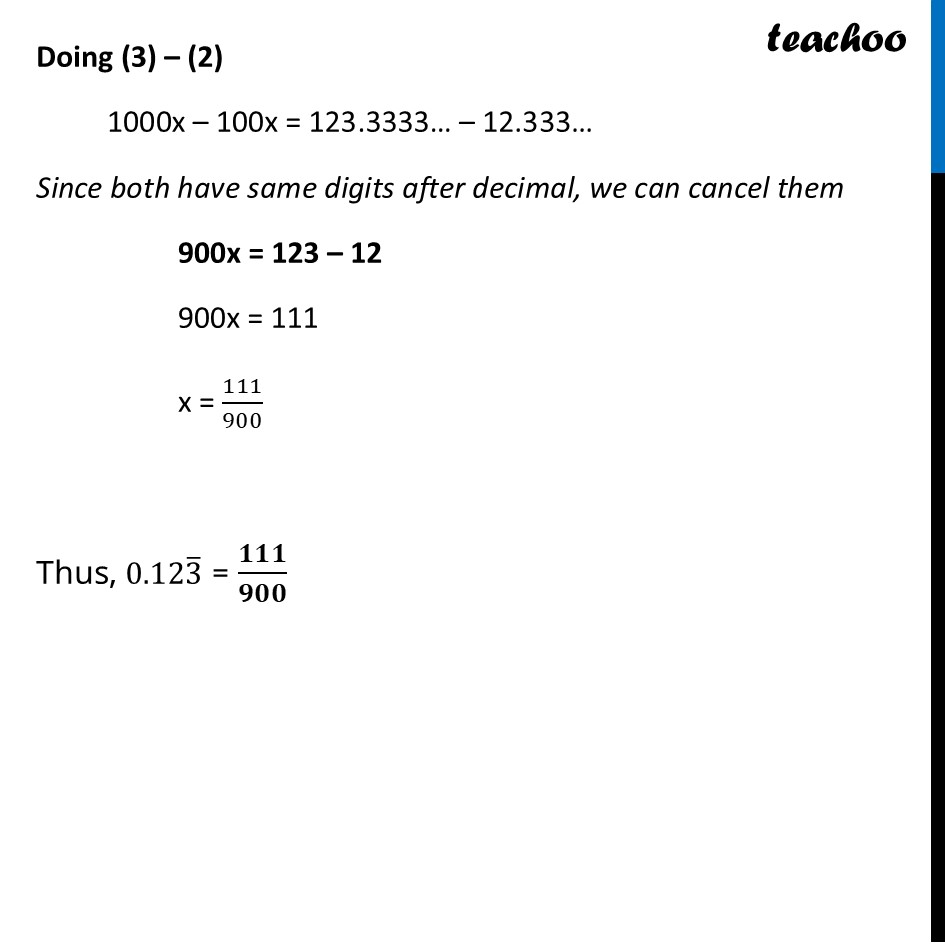
Converting decimals to p/q form We have decimals of 3 types Terminating - like 3.5, 2.8 Non-Terminating, Repeating - like 0.33…, 0.12333… Non-Terminating, Non Repeating – like 𝜋,√2 We can Convert Terminating into 𝒑/𝒒 by just removing decimal point, like 3.5 = 35/10 Cannot convert Non-Terminating, Non Repeating into 𝑝/𝑞 as irrational numbers cannot be expressed as 𝑝/𝑞 Let’s learn How to Convert Non-Terminating, Repeating Numbers like 0.333…, or 0.123333…. in 𝒑/𝒒 form Now, we have 3 cases Case 1 – Terminating Decimal Numbers: Numbers like 2.8, 0.375 Case 2 – Pure repeating decimals: A pure repeating decimal is one in which a digit or a sequence of digits begins repeating immediately after the decimal point. Example: 2.3 ̅, 0.(45) ̅ Case 3 – General repeating decimals: A general repeating decimal has some non-repeating digits just after the decimal point, followed by a repeating block. Example: 0.123 ̅, 3.3(45) ̅ Let’s look at each case one by one Case 1 – Terminating Decimal Numbers Let’s convert 0.375 into 𝑝/𝑞 form Case 2 – Pure repeating decimals A pure repeating decimal is one in which a digit or a sequence of digits begins repeating immediately after the decimal point. Case 3 – General repeating decimals A general repeating decimal has some non-repeating digits just after the decimal point, followed by a repeating block Let’s do this 0.375 = 375/1000 = 75/200 = 25/40 = 𝟓/𝟖 Case 2 – Pure repeating decimals A pure repeating decimal is one in which a digit or a sequence of digits begins repeating immediately after the decimal point. Let’s take an example Convert 2.333 = 2.3 ̅ to p/q form where p and q are integers & q ≠ 0 Let x = 2.3333….. Since only one digit repeats (there is bar over 3 only) Multiplying equation (1) by 101 i.e. 10 10x = 10 × (2.333…) 10x = 23.333… Doing (2) – (1) 10x – x = 23.3333… – 2.3333… 9x = 21 x = 21/9 x = 𝟕/𝟑 Thus, 𝟐.𝟑 ̅ = 𝟕/𝟑 Case 3 – General repeating decimals A general repeating decimal has some non-repeating digits just after the decimal point, followed by a repeating block. Let’s take an example Convert 0.123 ̅ to p/q form where p and q are integers and q ≠ 0 Let x = 0.12333….. Since this is a general repeating decimal, so we look at both non-repeating (after decimal points) and repeating digits Here, ‘12’ is non-repeating (2 digits), ‘3’ repeats (1 digit). Since two digits are non-repeating (i.e. after decimal point) Multiplying equation (1) by 102 i.e. 100 100x = 100 × (0.12333…) 100x = 12.3333… Since one digit is repeating Multiplying equation (2) by 101 i.e. 10 10 × 100x = 10 × (12.333…) 1000x = 123.3333… Doing (3) – (2) 1000x – 100x = 123.3333… – 12.333… Since both have same digits after decimal, we can cancel them 900x = 123 – 12 900x = 111 x = 111/900 Thus, 0.123 ̅ = 𝟏𝟏𝟏/𝟗𝟎𝟎