You are here
End-of-Chapter Exercises
Last updated at August 14, 2026 by Teachoo
Transcript
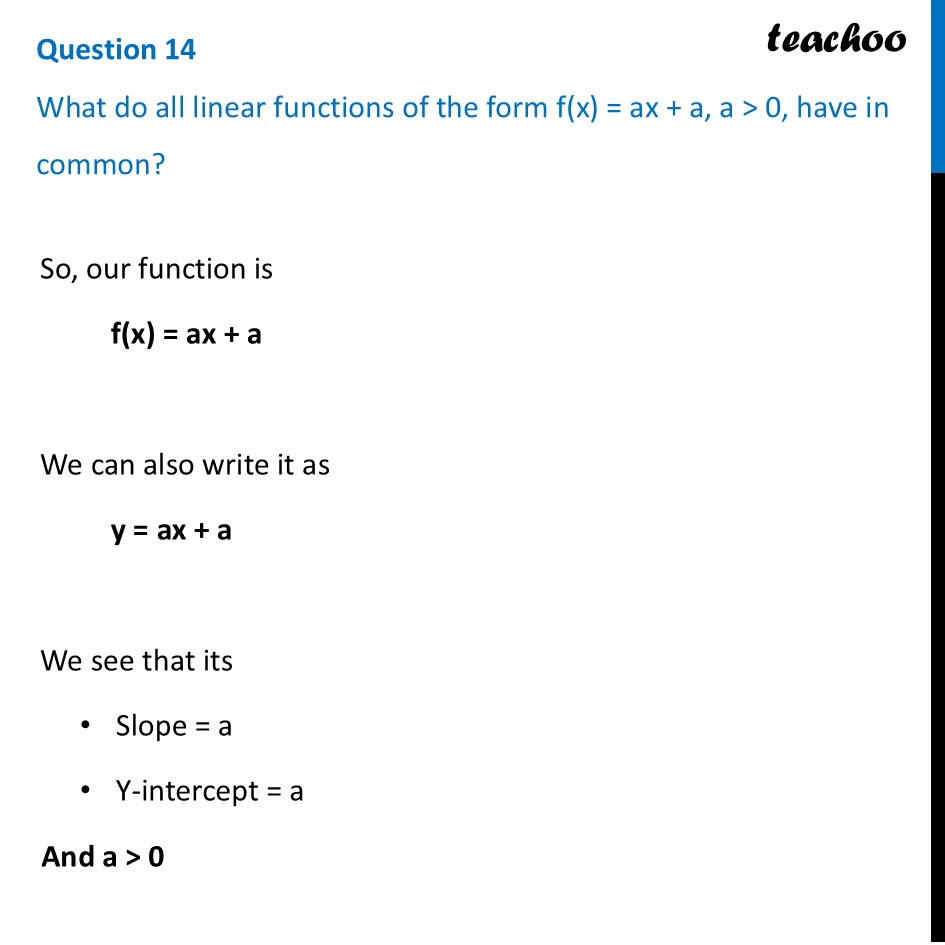
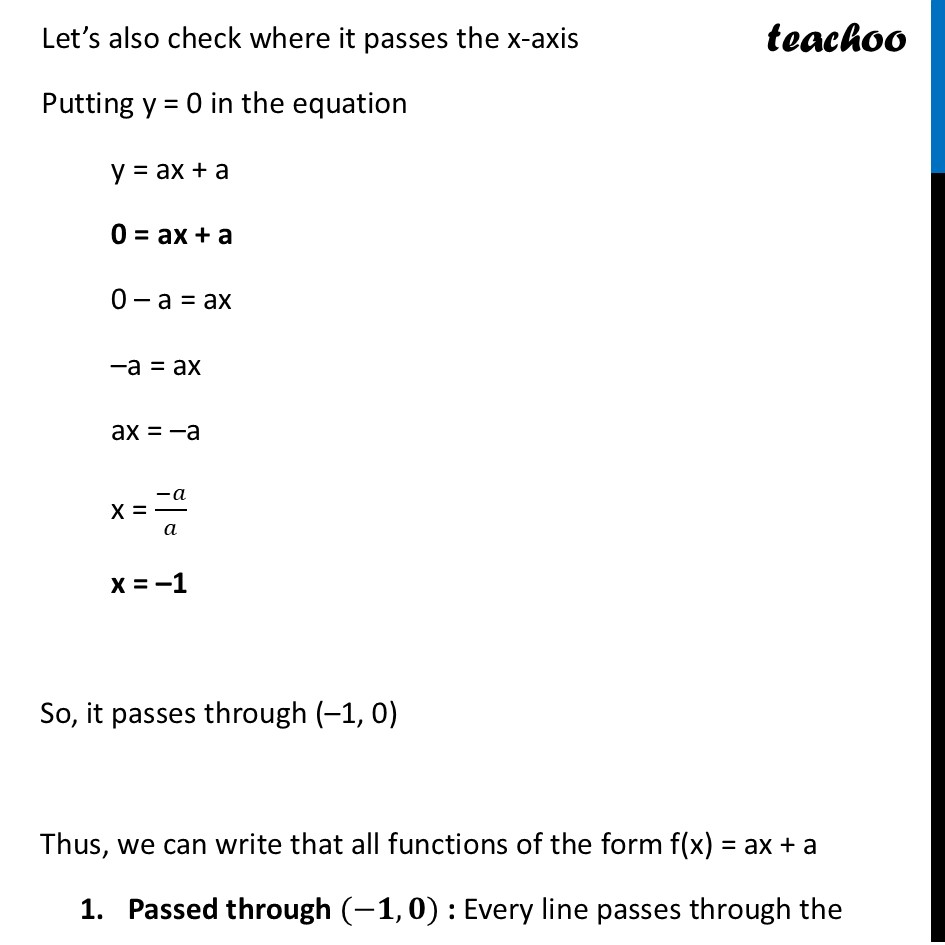
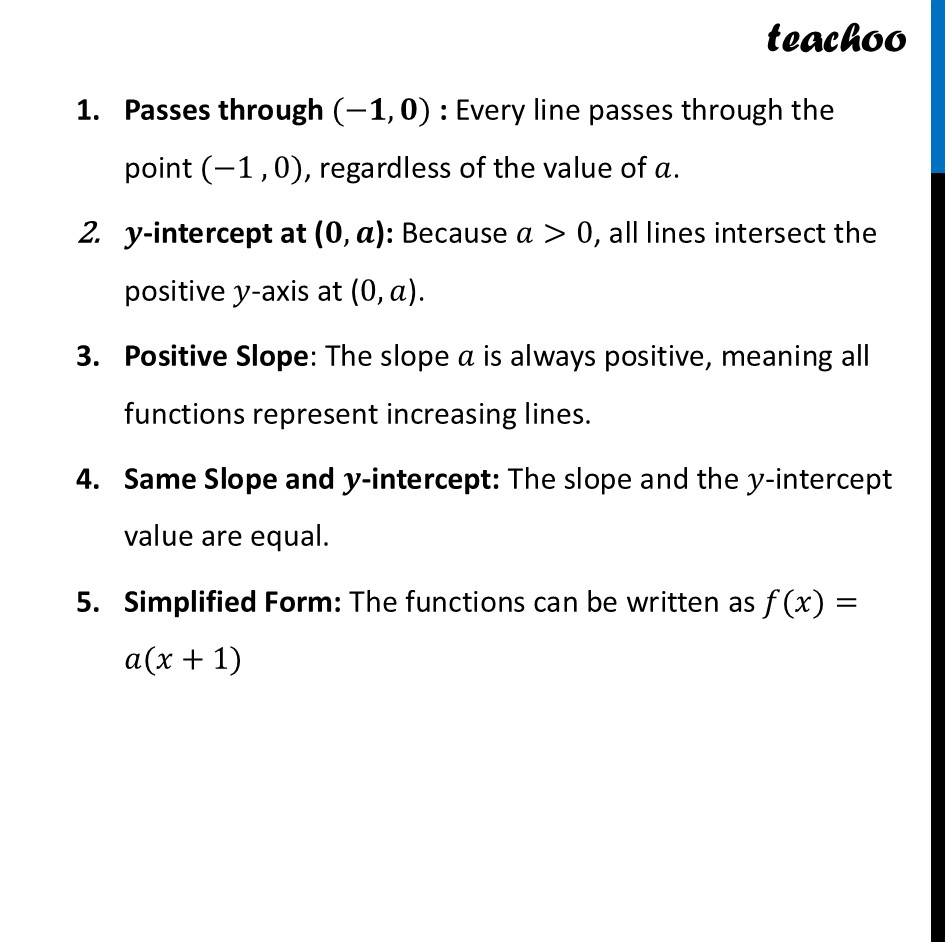
Question 14 What do all linear functions of the form f(x) = ax + a, a > 0, have in common? So, our function is f(x) = ax + a We can also write it as y = ax + a We see that its Slope = a Y-intercept = a And a > 0 Let’s also check where it passes the x-axis Putting y = 0 in the equation y = ax + a 0 = ax + a 0 – a = ax –a = ax ax = –a x = (−𝑎)/𝑎 x = –1 So, it passes through (–1, 0) Thus, we can write that all functions of the form f(x) = ax + a Passed through (−𝟏,𝟎) : Every line passes through the point (−1 ,0), regardless of the value of 𝑎. 𝒚-intercept at (𝟎,𝒂): Because 𝑎>0, all lines intersect the positive 𝑦-axis at (0,𝑎). Positive Slope: The slope 𝑎 is always positive, meaning all functions represent increasing lines. Same Slope and 𝒚-intercept: The slope and the 𝑦-intercept value are equal. Simplified Form: The functions can be written as 𝑓(𝑥)=𝑎(𝑥+1) Let’s also check where it passes the x-axis Putting y = 0 in the equation y = ax + a 0 = ax + a 0 – a = ax –a = ax ax = –a x = (−𝑎)/𝑎 x = –1 So, it passes through (–1, 0) Thus, we can write that all functions of the form f(x) = ax + a Passed through (−𝟏,𝟎) : Every line passes through the point (−1 ,0), regardless of the value of 𝑎. 𝒚-intercept at (𝟎,𝒂): Because 𝑎>0, all lines intersect the positive 𝑦-axis at (0,𝑎). Positive Slope: The slope 𝑎 is always positive, meaning all functions represent increasing lines. Same Slope and 𝒚-intercept: The slope and the 𝑦-intercept value are equal. Simplified Form: The functions can be written as 𝑓(𝑥)=𝑎(𝑥+1) Let’s also check where it passes the x-axis Putting y = 0 in the equation y = ax + a 0 = ax + a 0 – a = ax –a = ax ax = –a x = (−𝑎)/𝑎 x = –1 So, it passes through (–1, 0) Thus, we can write that all functions of the form f(x) = ax + a Passed through (−𝟏,𝟎) : Every line passes through the point (−1 ,0), regardless of the value of 𝑎. 𝒚-intercept at (𝟎,𝒂): Because 𝑎>0, all lines intersect the positive 𝑦-axis at (0,𝑎). Positive Slope: The slope 𝑎 is always positive, meaning all functions represent increasing lines. Same Slope and 𝒚-intercept: The slope and the 𝑦-intercept value are equal. Simplified Form: The functions can be written as 𝑓(𝑥)=𝑎(𝑥+1) Passes through (−𝟏,𝟎) : Every line passes through the point (−1 ,0), regardless of the value of 𝑎. 𝒚-intercept at (𝟎,𝒂): Because 𝑎>0, all lines intersect the positive 𝑦-axis at (0,𝑎). Positive Slope: The slope 𝑎 is always positive, meaning all functions represent increasing lines. Same Slope and 𝒚-intercept: The slope and the 𝑦-intercept value are equal. Simplified Form: The functions can be written as 𝑓(𝑥)=𝑎(𝑥+1)