You are here

Last updated at May 6, 2026 by Teachoo
Transcript
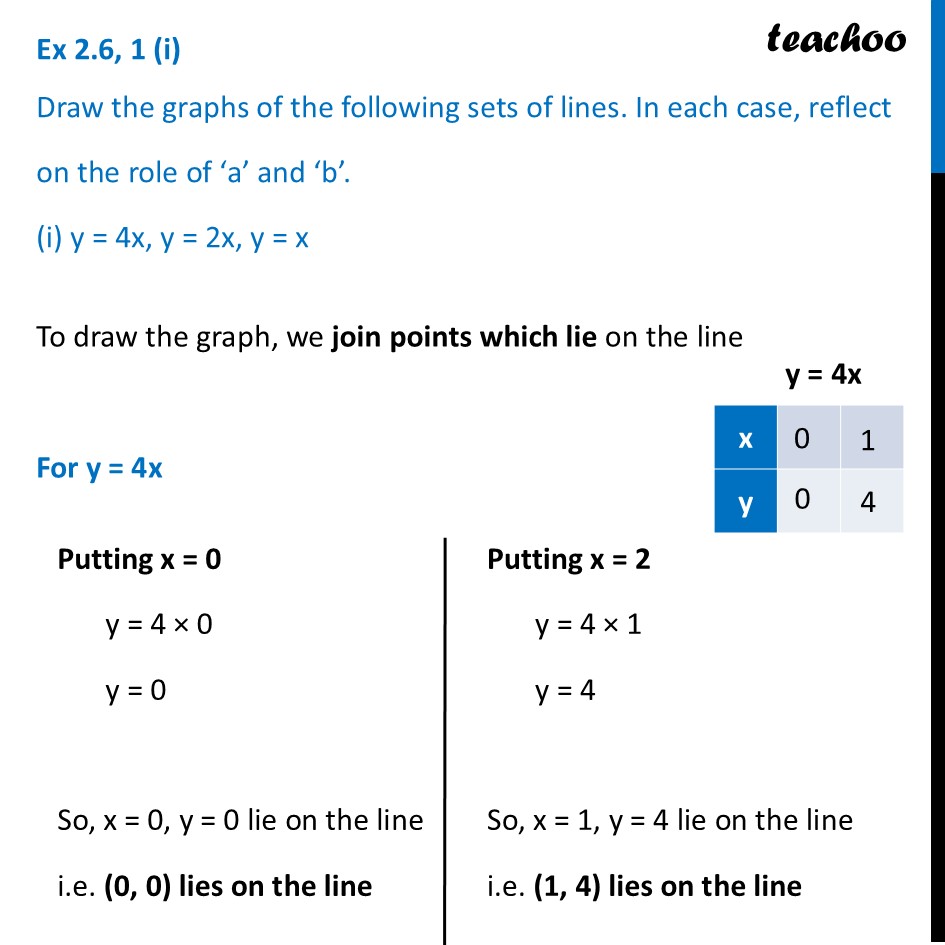
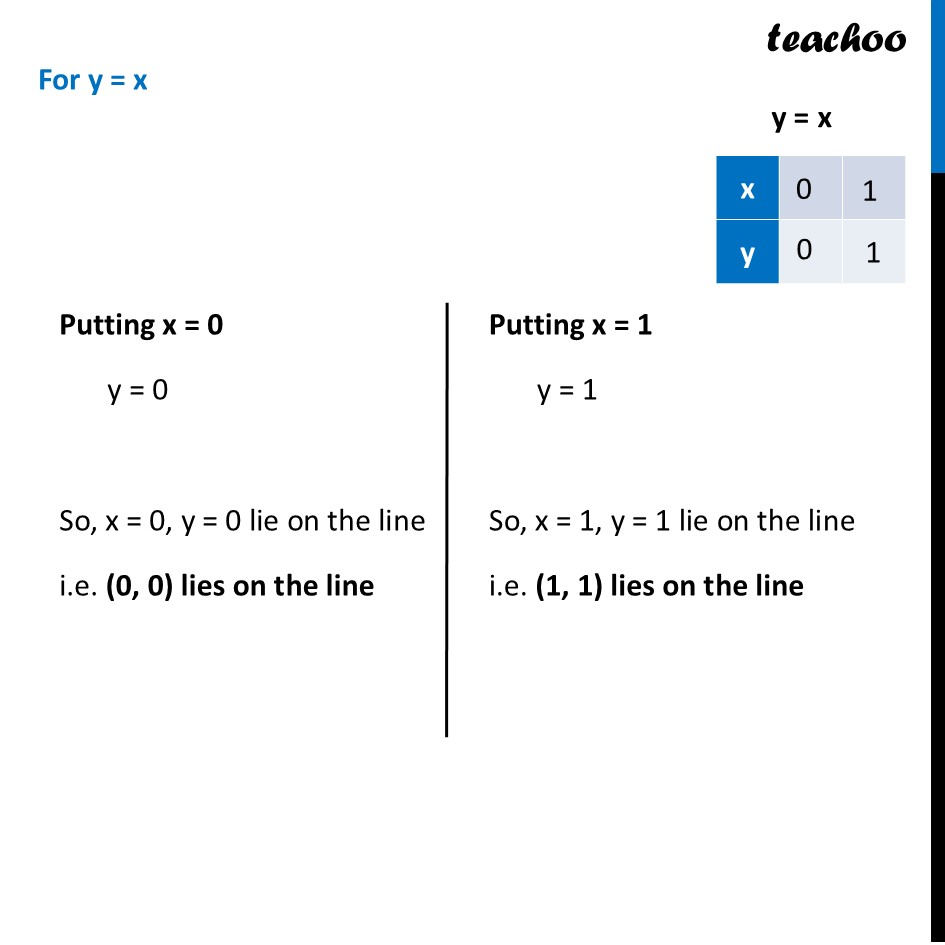
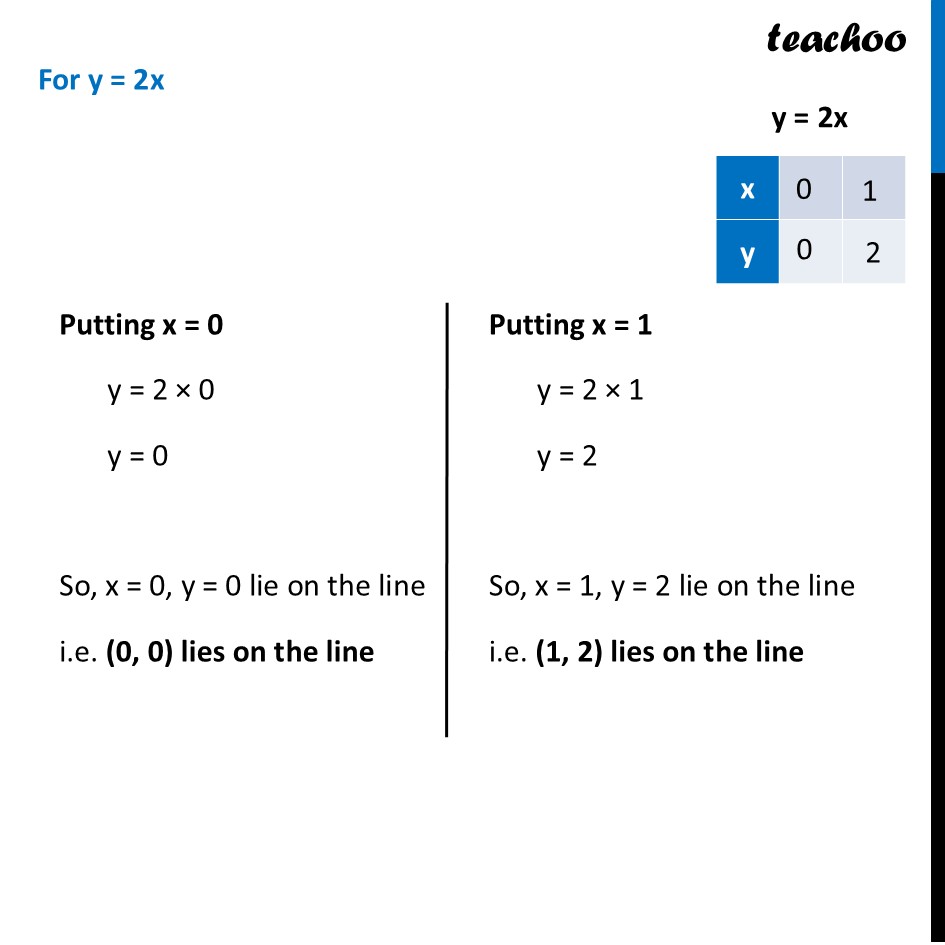
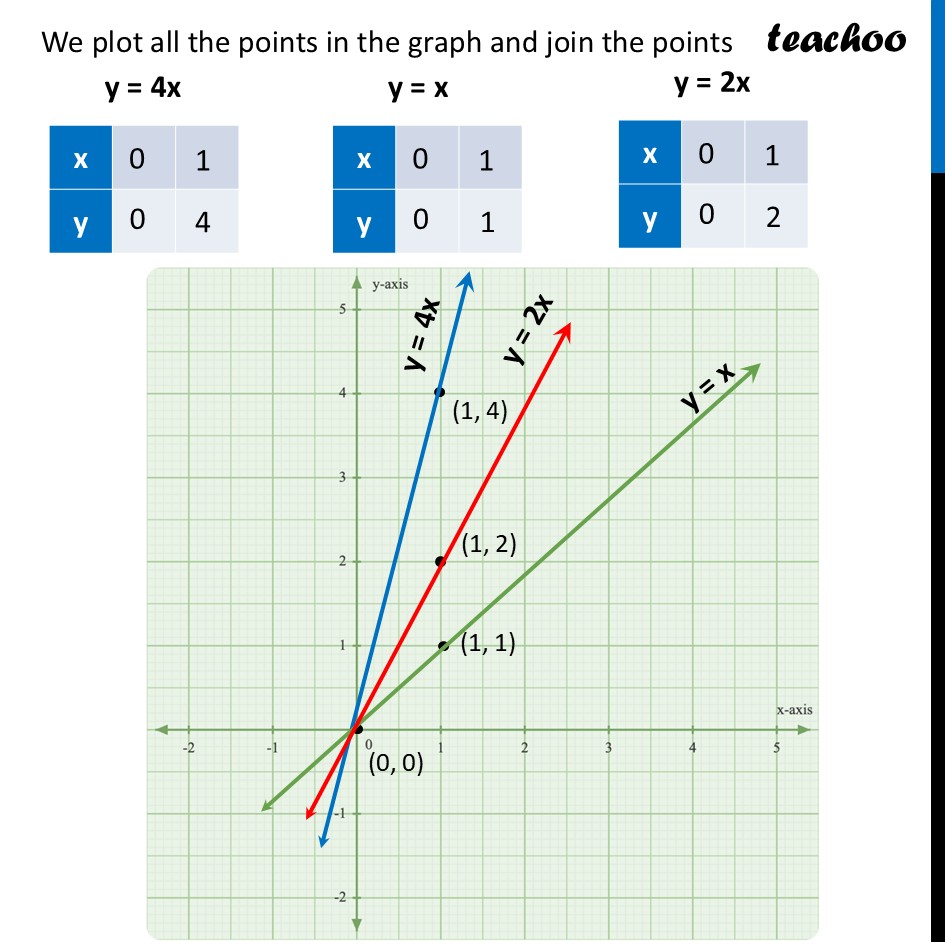
Ex 2.6, 1 (i) Draw the graphs of the following sets of lines. In each case, reflect on the role of ‘a’ and ‘b’. (i) y = 4x, y = 2x, y = x To draw the graph, we join points which lie on the line For y = 4x Putting x = 0 y = 4 × 0 y = 0 So, x = 0, y = 0 lie on the line i.e. (0, 0) lies on the line Putting x = 2 y = 4 × 1 y = 4 So, x = 1, y = 4 lie on the line i.e. (1, 4) lies on the line For y = x Putting x = 0 y = 0 So, x = 0, y = 0 lie on the line i.e. (0, 0) lies on the line Putting x = 1 y = 1 So, x = 1, y = 1 lie on the line i.e. (1, 1) lies on the line For y = 2x Putting x = 0 y = 2 × 0 y = 0 So, x = 0, y = 0 lie on the line i.e. (0, 0) lies on the line Putting x = 1 y = 2 × 1 y = 2 So, x = 1, y = 2 lie on the line i.e. (1, 2) lies on the line We plot all the points in the graph and join the points y = 4x y = x y = 2x Reflection on 'a' and 'b’ Because b = 0, all three of these lines will cross exactly through the center origin point (0, 0). Because the 'a' values are positive, they all travel "uphill" from left to right. As the value of 'a' increases from 1 to 2 to 4, the slope gets steeper.