You are here
End-of-Chapter Exercises
Last updated at August 14, 2026 by Teachoo
Transcript
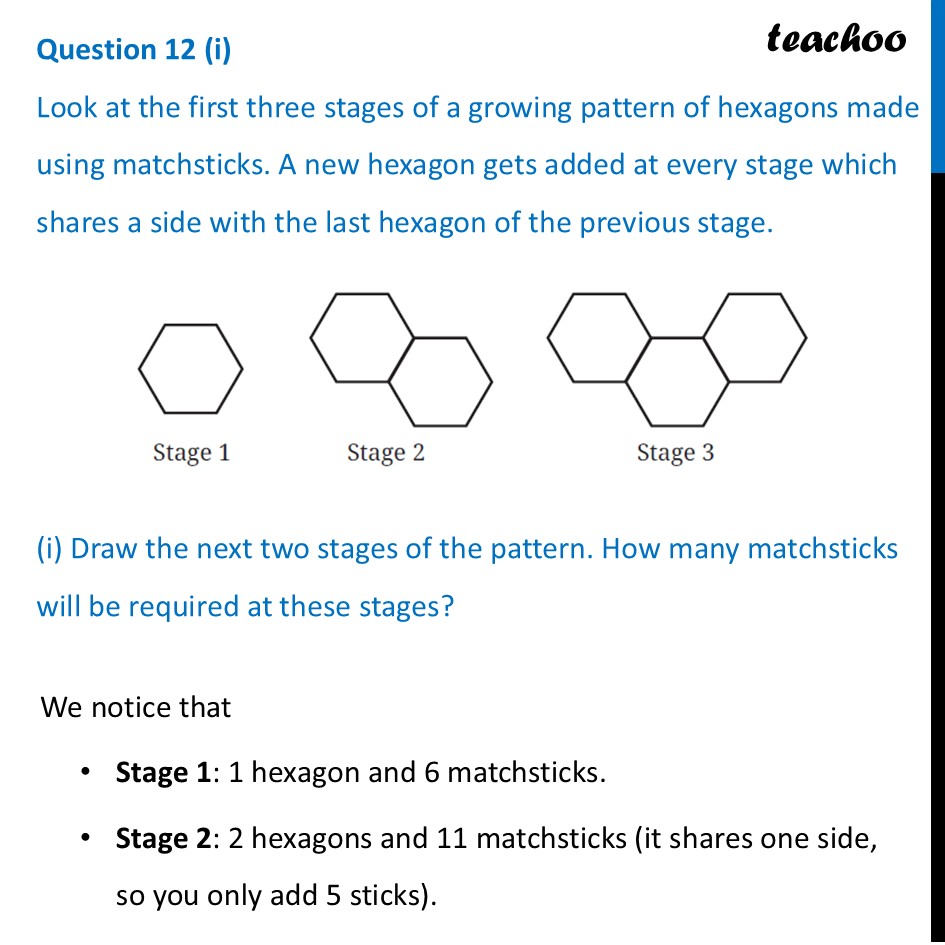
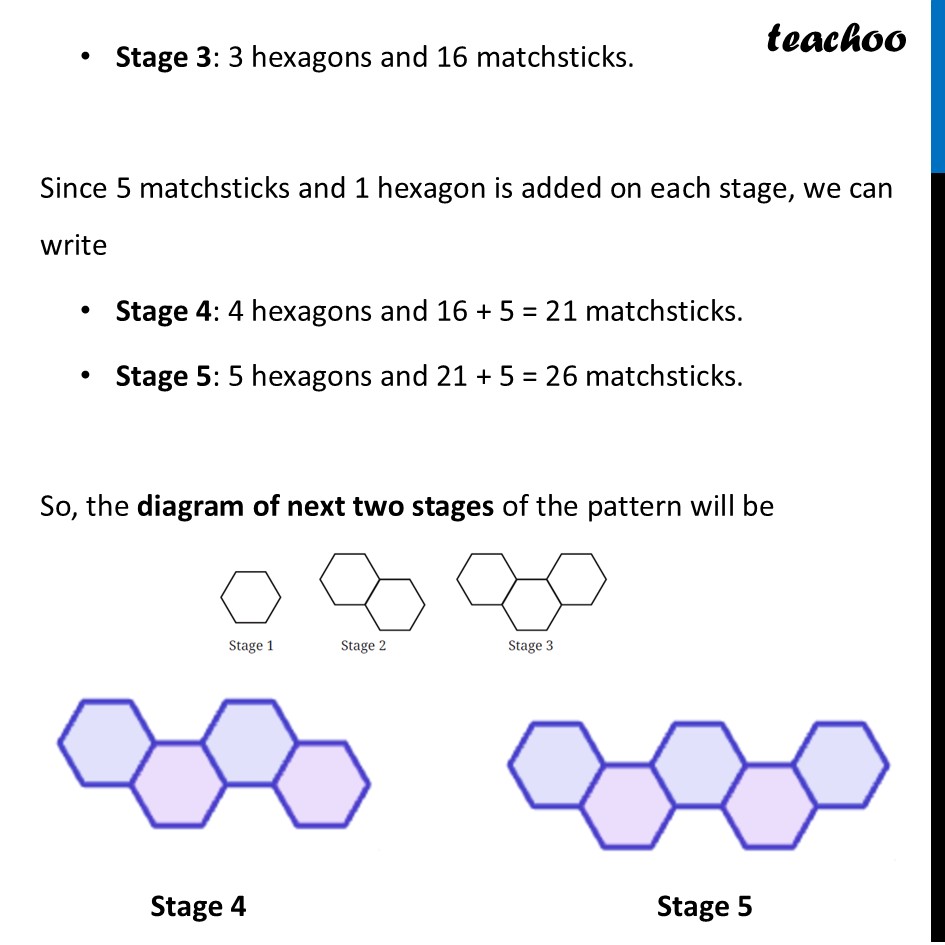
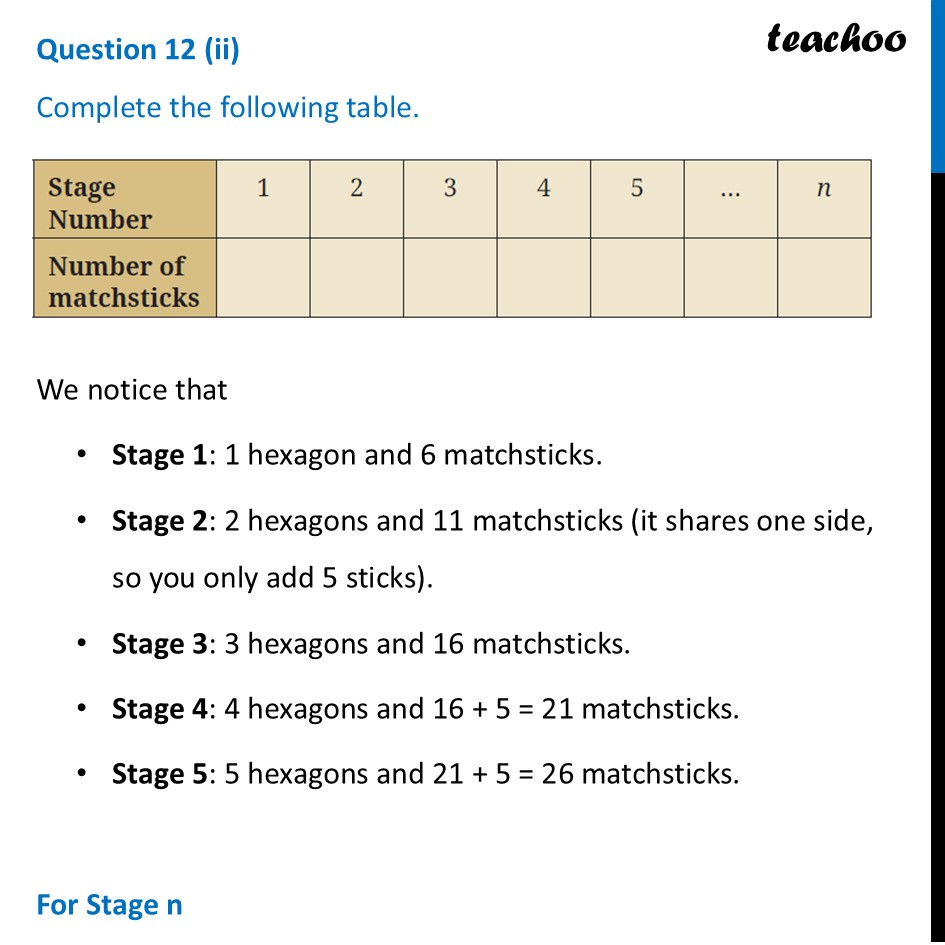
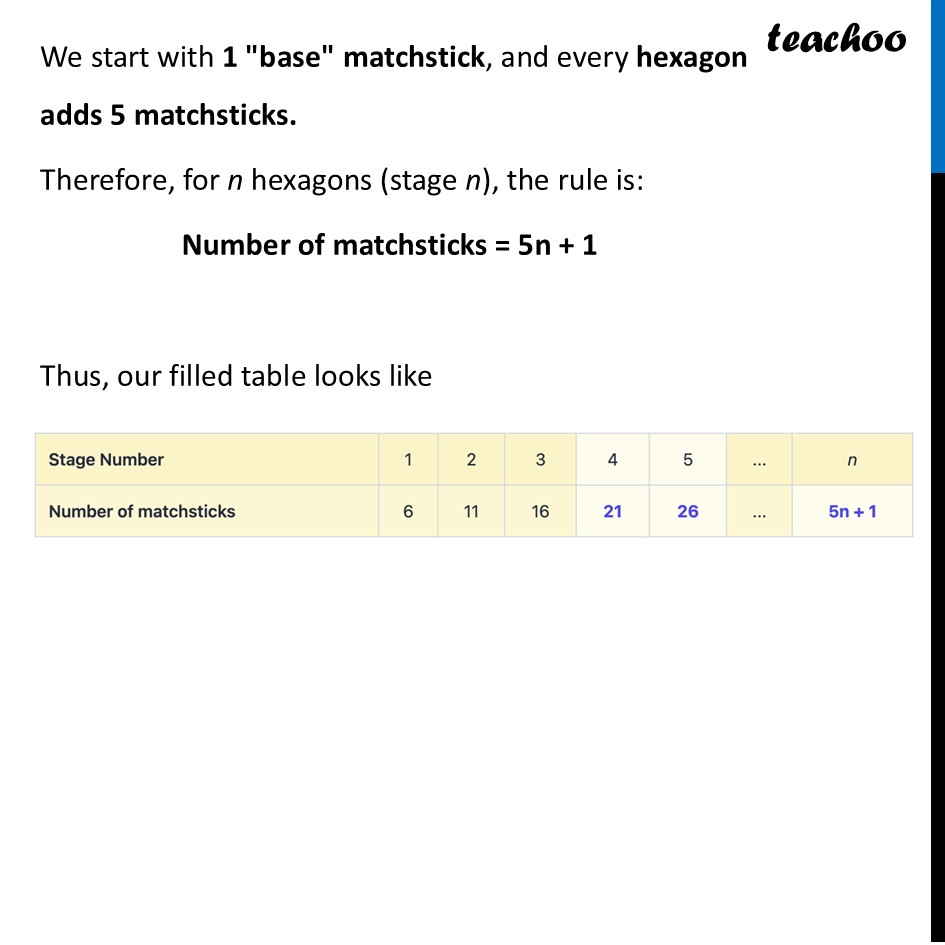
Question 12 (i) Look at the first three stages of a growing pattern of hexagons made using matchsticks. A new hexagon gets added at every stage which shares a side with the last hexagon of the previous stage. (i) Draw the next two stages of the pattern. How many matchsticks will be required at these stages? We notice that Stage 1: 1 hexagon and 6 matchsticks. Stage 2: 2 hexagons and 11 matchsticks (it shares one side, so you only add 5 sticks). Stage 3: 3 hexagons and 16 matchsticks. Since 5 matchsticks and 1 hexagon is added on each stage, we can write Stage 4: 4 hexagons and 16 + 5 = 21 matchsticks. Stage 5: 5 hexagons and 21 + 5 = 26 matchsticks. So, the diagram of next two stages of the pattern will be Stage 3: 3 hexagons and 16 matchsticks. Since 5 matchsticks and 1 hexagon is added on each stage, we can write Stage 4: 4 hexagons and 16 + 5 = 21 matchsticks. Stage 5: 5 hexagons and 21 + 5 = 26 matchsticks. So, the diagram of next two stages of the pattern will be Question 12 (ii) Complete the following table. We notice that Stage 1: 1 hexagon and 6 matchsticks. Stage 2: 2 hexagons and 11 matchsticks (it shares one side, so you only add 5 sticks). Stage 3: 3 hexagons and 16 matchsticks. Stage 4: 4 hexagons and 16 + 5 = 21 matchsticks. Stage 5: 5 hexagons and 21 + 5 = 26 matchsticks. For Stage n We start with 1 "base" matchstick, and every hexagon adds 5 matchsticks. Therefore, for n hexagons (stage n), the rule is: Number of matchsticks = 5n + 1 Thus, our filled table looks like Question 12 (iii) Find a rule to determine the number of matchsticks required for the nth stage. We did this in the last part We start with 1 "base" matchstick, and every hexagon adds 5 matchsticks. Therefore, for n hexagons (stage n), the rule is: Number of matchsticks = 5n + 1 Question 12 (iv) How many matchsticks will be required for the 15th stage of the pattern? We know that Number of matchsticks = 5n + 1 For 15th stage, putting n = 15 Number of matchsticks for 15th stage = 5 × 15 + 1 = 75 + 1 = 76 Question 12 (v) Can 200 matchsticks form a stage in this pattern? Justify your answer. We know that Number of matchsticks = 5n + 1 We put Number of matchsticks = 200 and find n So, our equation becomes 200 = 5n + 1 200 – 1 = 5n 199 = 5n 5n = 199 n = 199/5 n = 39.8 Since n represents the stage number, it must be a whole number So, n = 39.8 is not possible Therefore, 200 matchsticks cannot form a complete stage in this pattern.