You are here
![[Ganita] Let p(x) = ax + b and q(x) = cx + d be two linear polynomials - End-of-Chapter Exercises](https://cdn.teachoo.com/6a10763d-f0a4-4a35-bdf7-34f102ed279a/slide113.jpg)
End-of-Chapter Exercises
Last updated at August 14, 2026 by Teachoo
Transcript
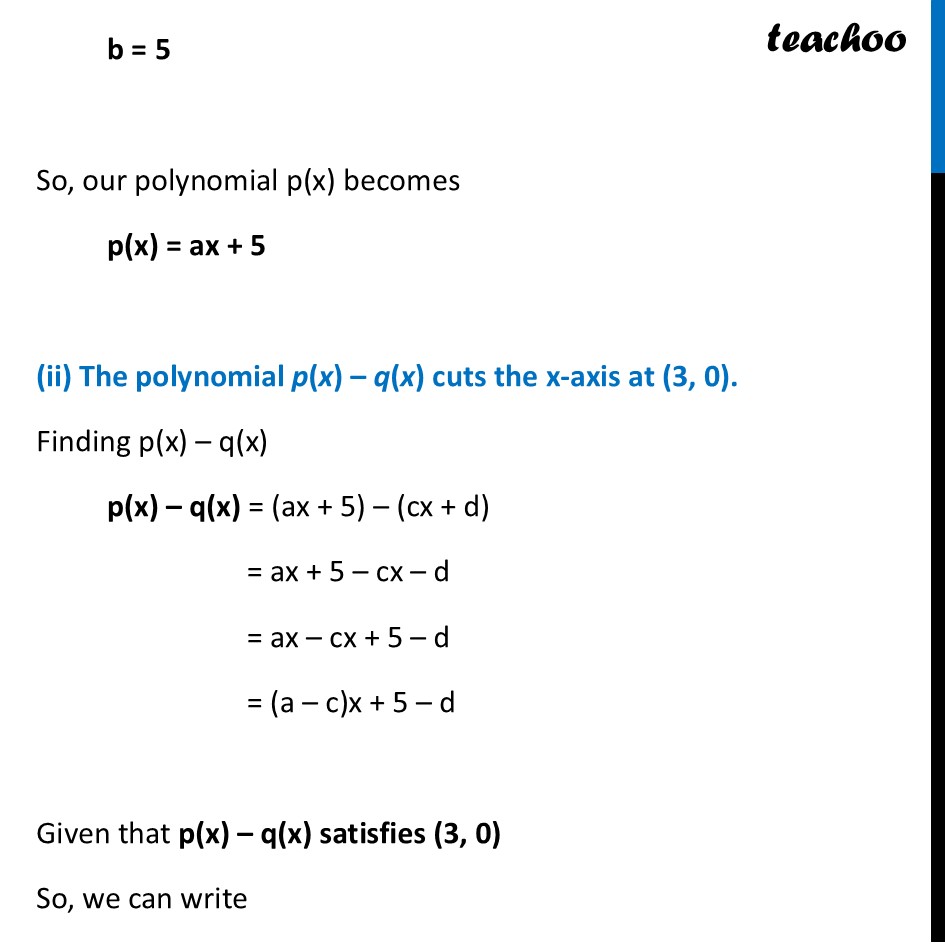
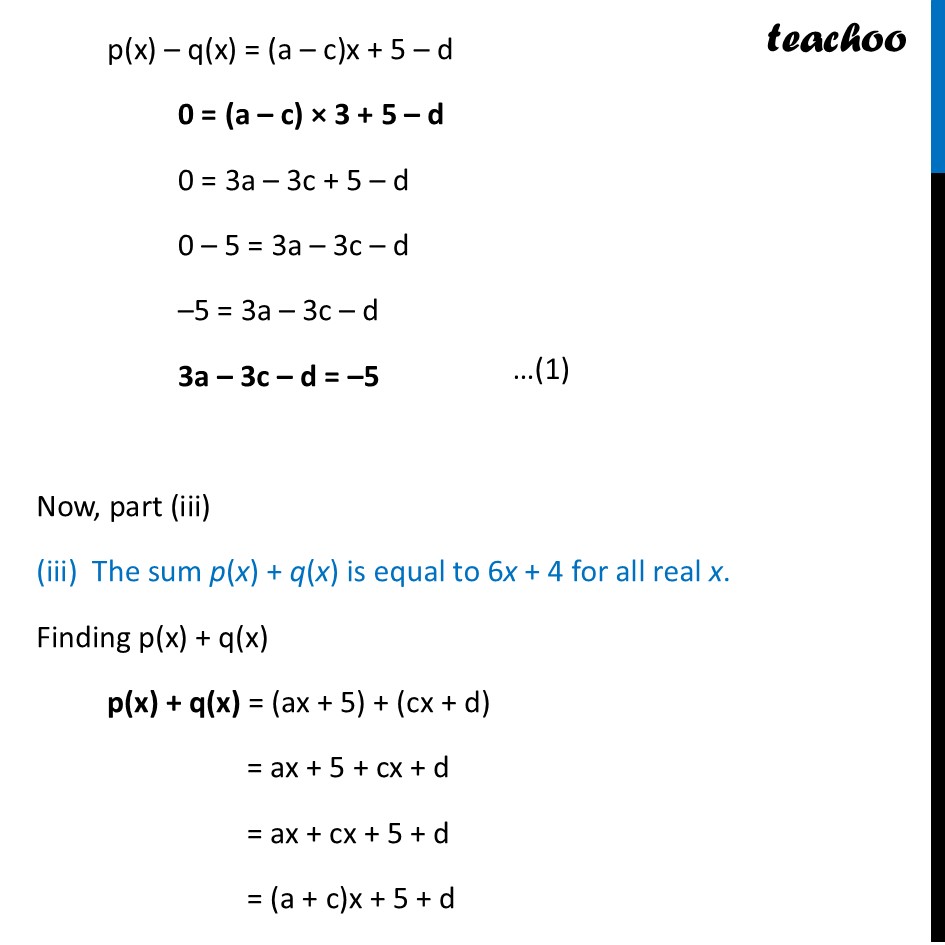
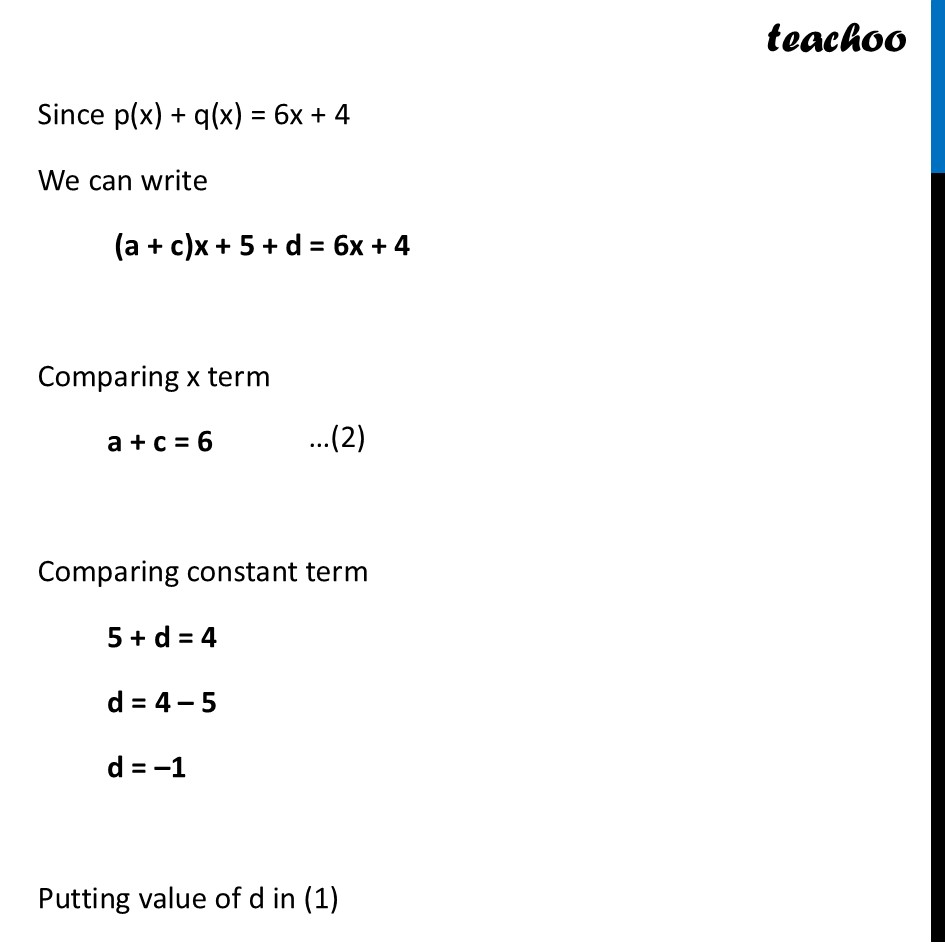
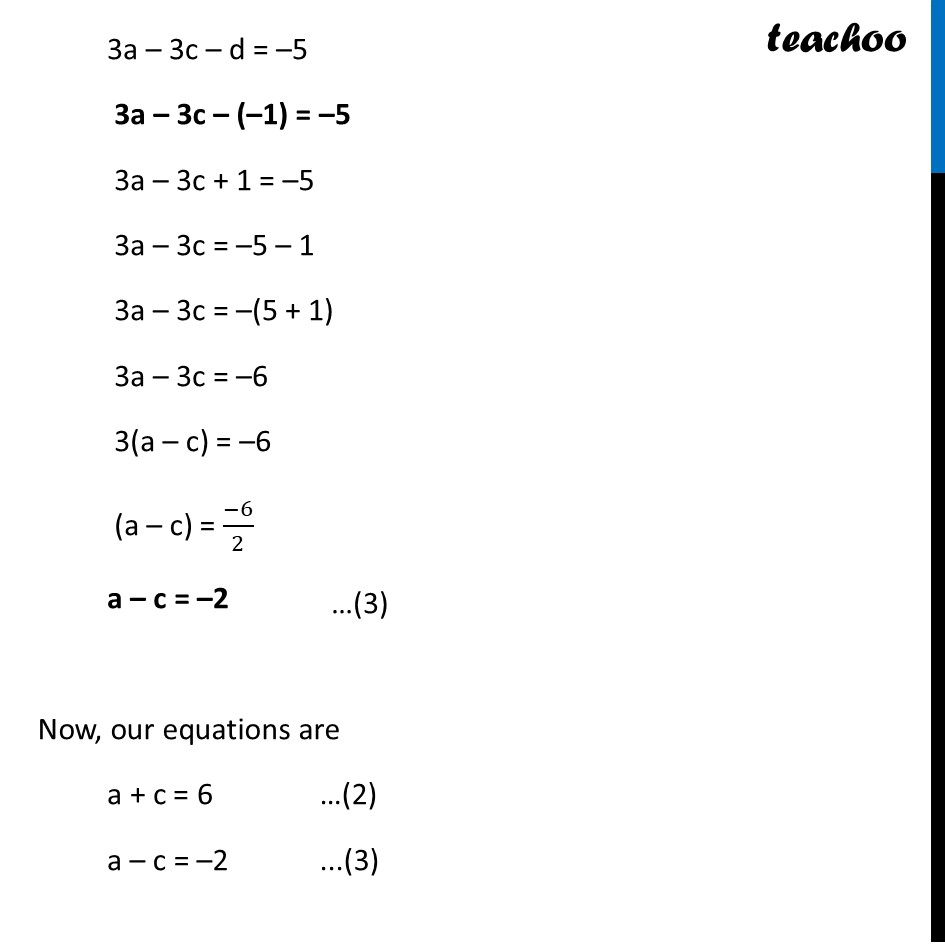
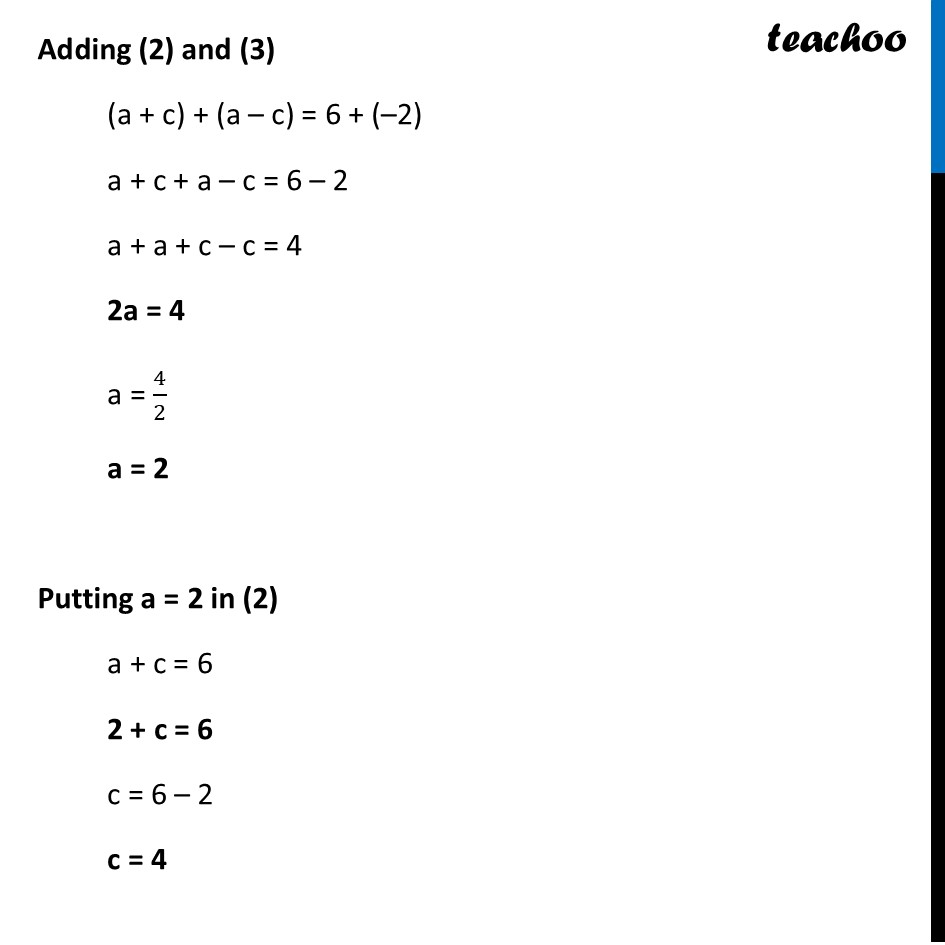
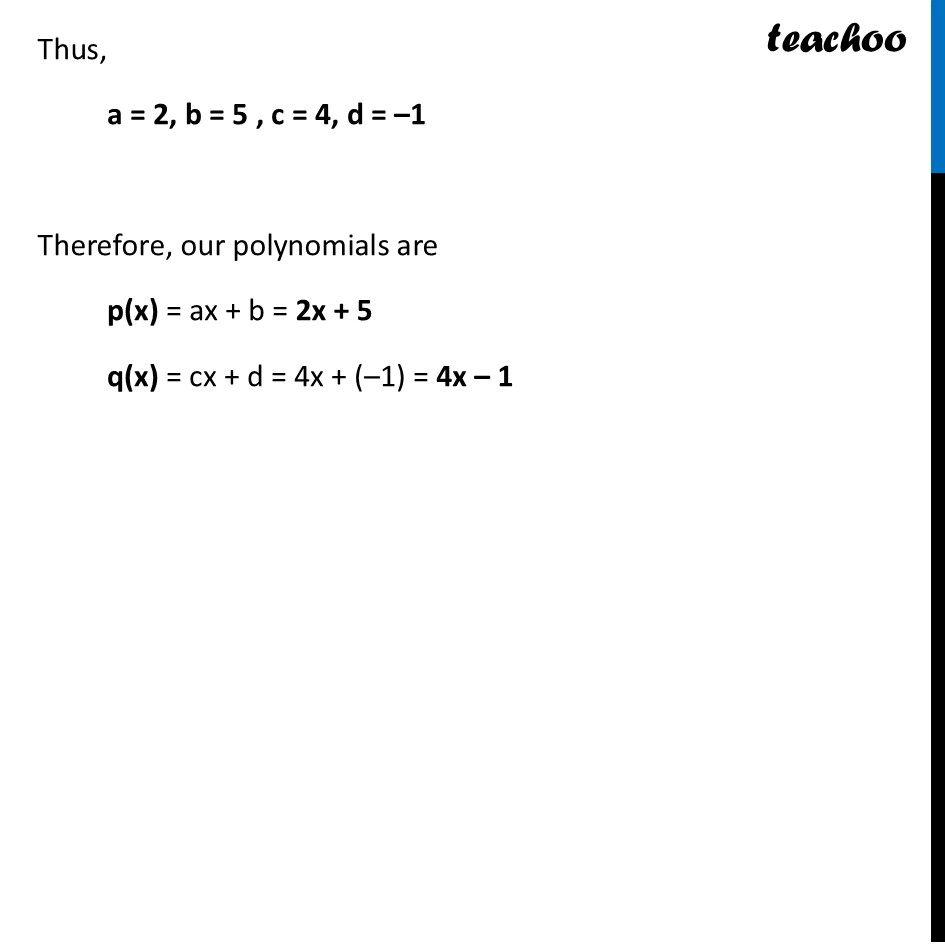
Question 11 Let p(x) = ax + b and q(x) = cx + d be two linear polynomials such that: (i) p(0) = 5. (ii) The polynomial p(x) – q(x) cuts the x-axis at (3, 0). (iii) The sum p(x) + q(x) is equal to 6x + 4 for all real x. Find the polynomials p(x) and q(x) Let’s do this one by one (i) Given p(0) = 5 Putting x = 0, p(0) = 5 in p(x) formula p(x) = ax + b p(0) = a × 0 + b 5 = 0 + b 5 = b b = 5 So, our polynomial p(x) becomes p(x) = ax + 5 (ii) The polynomial p(x) – q(x) cuts the x-axis at (3, 0). Finding p(x) – q(x) p(x) – q(x) = (ax + 5) – (cx + d) = ax + 5 – cx – d = ax – cx + 5 – d = (a – c)x + 5 – d Given that p(x) – q(x) satisfies (3, 0) So, we can write p(x) – q(x) = (a – c)x + 5 – d 0 = (a – c) × 3 + 5 – d 0 = 3a – 3c + 5 – d 0 – 5 = 3a – 3c – d –5 = 3a – 3c – d 3a – 3c – d = –5 Now, part (iii) (iii) The sum p(x) + q(x) is equal to 6x + 4 for all real x. Finding p(x) + q(x) p(x) + q(x) = (ax + 5) + (cx + d) = ax + 5 + cx + d = ax + cx + 5 + d = (a + c)x + 5 + d Since p(x) + q(x) = 6x + 4 We can write (a + c)x + 5 + d = 6x + 4 Comparing x term a + c = 6 Comparing constant term 5 + d = 4 d = 4 – 5 d = –1 Putting value of d in (1) 3a – 3c – d = –5 3a – 3c – (–1) = –5 3a – 3c + 1 = –5 3a – 3c = –5 – 1 3a – 3c = –(5 + 1) 3a – 3c = –6 3(a – c) = –6 (a – c) = (−6)/2 a – c = –2 Now, our equations are a + c = 6 …(2) a – c = –2 ...(3) Adding (2) and (3) (a + c) + (a – c) = 6 + (–2) a + c + a – c = 6 – 2 a + a + c – c = 4 2a = 4 a = 4/2 a = 2 Putting a = 2 in (2) a + c = 6 2 + c = 6 c = 6 – 2 c = 4 Thus, a = 2, b = 5 , c = 4, d = –1 Therefore, our polynomials are p(x) = ax + b = 2x + 5 q(x) = cx + d = 4x + (–1) = 4x – 1 b = 5 So, our polynomial p(x) becomes p(x) = ax + 5 (ii) The polynomial p(x) – q(x) cuts the x-axis at (3, 0). Finding p(x) – q(x) p(x) – q(x) = (ax + 5) – (cx + d) = ax + 5 – cx – d = ax – cx + 5 – d = (a – c)x + 5 – d Given that p(x) – q(x) satisfies (3, 0) So, we can write p(x) – q(x) = (a – c)x + 5 – d 0 = (a – c) × 3 + 5 – d 0 = 3a – 3c + 5 – d 0 – 5 = 3a – 3c – d –5 = 3a – 3c – d 3a – 3c – d = –5 Now, part (iii) (iii) The sum p(x) + q(x) is equal to 6x + 4 for all real x. Finding p(x) + q(x) p(x) + q(x) = (ax + 5) + (cx + d) = ax + 5 + cx + d = ax + cx + 5 + d = (a + c)x + 5 + d Since p(x) + q(x) = 6x + 4 We can write (a + c)x + 5 + d = 6x + 4 Comparing x term a + c = 6 Comparing constant term 5 + d = 4 d = 4 – 5 d = –1 Putting value of d in (1) 3a – 3c – d = –5 3a – 3c – (–1) = –5 3a – 3c + 1 = –5 3a – 3c = –5 – 1 3a – 3c = –(5 + 1) 3a – 3c = –6 3(a – c) = –6 (a – c) = (−6)/2 a – c = –2 Now, our equations are a + c = 6 …(2) a – c = –2 ...(3) Adding (2) and (3) (a + c) + (a – c) = 6 + (–2) a + c + a – c = 6 – 2 a + a + c – c = 4 2a = 4 a = 4/2 a = 2 Putting a = 2 in (2) a + c = 6 2 + c = 6 c = 6 – 2 c = 4 Thus, a = 2, b = 5 , c = 4, d = –1 Therefore, our polynomials are p(x) = ax + b = 2x + 5 q(x) = cx + d = 4x + (–1) = 4x – 1 p(x) – q(x) = (a – c)x + 5 – d 0 = (a – c) × 3 + 5 – d 0 = 3a – 3c + 5 – d 0 – 5 = 3a – 3c – d –5 = 3a – 3c – d 3a – 3c – d = –5 Now, part (iii) (iii) The sum p(x) + q(x) is equal to 6x + 4 for all real x. Finding p(x) + q(x) p(x) + q(x) = (ax + 5) + (cx + d) = ax + 5 + cx + d = ax + cx + 5 + d = (a + c)x + 5 + d Since p(x) + q(x) = 6x + 4 We can write (a + c)x + 5 + d = 6x + 4 Comparing x term a + c = 6 Comparing constant term 5 + d = 4 d = 4 – 5 d = –1 Putting value of d in (1) 3a – 3c – d = –5 3a – 3c – (–1) = –5 3a – 3c + 1 = –5 3a – 3c = –5 – 1 3a – 3c = –(5 + 1) 3a – 3c = –6 3(a – c) = –6 (a – c) = (−6)/2 a – c = –2 Now, our equations are a + c = 6 …(2) a – c = –2 ...(3) Adding (2) and (3) (a + c) + (a – c) = 6 + (–2) a + c + a – c = 6 – 2 a + a + c – c = 4 2a = 4 a = 4/2 a = 2 Putting a = 2 in (2) a + c = 6 2 + c = 6 c = 6 – 2 c = 4 Thus, a = 2, b = 5 , c = 4, d = –1 Therefore, our polynomials are p(x) = ax + b = 2x + 5 q(x) = cx + d = 4x + (–1) = 4x – 1