You are here
End-of-Chapter Exercises
Last updated at August 14, 2026 by Teachoo
Transcript
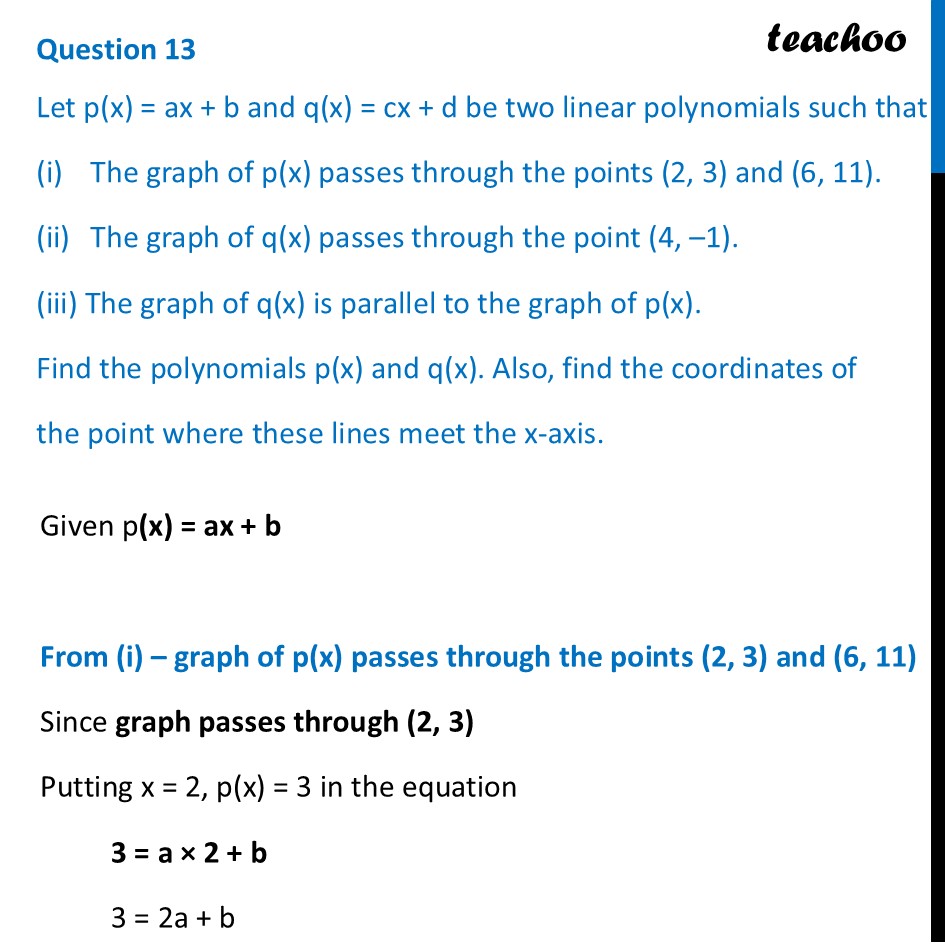
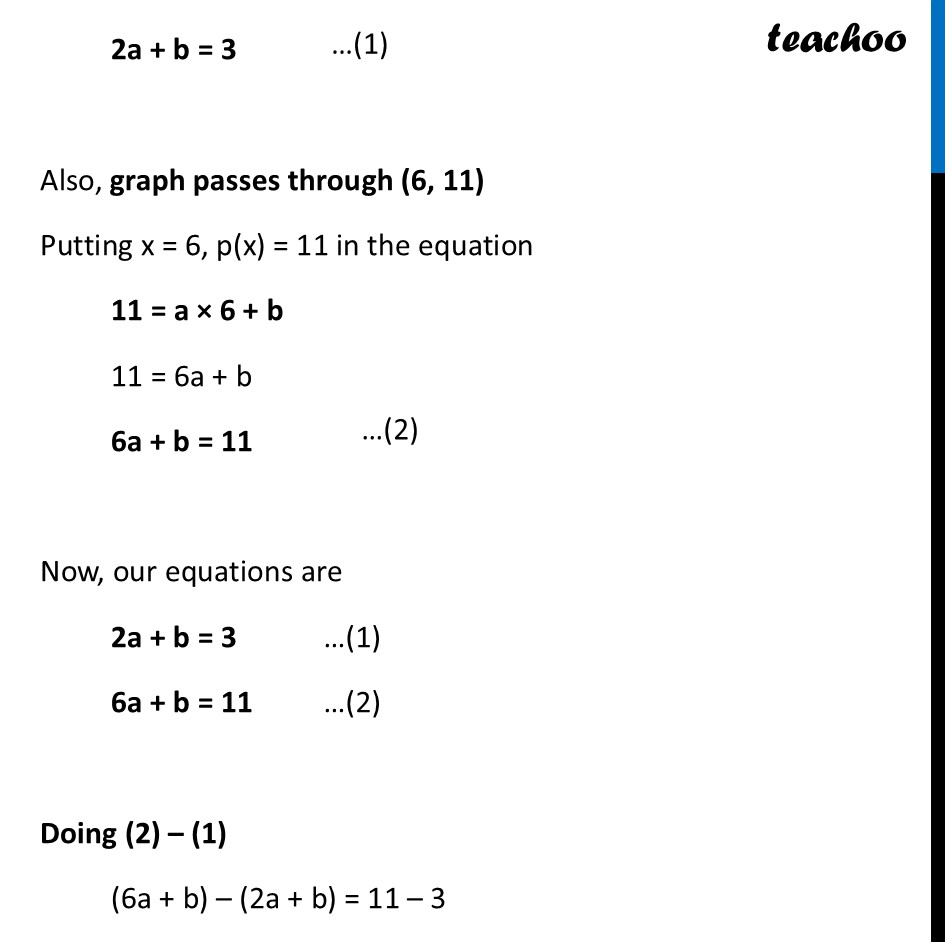
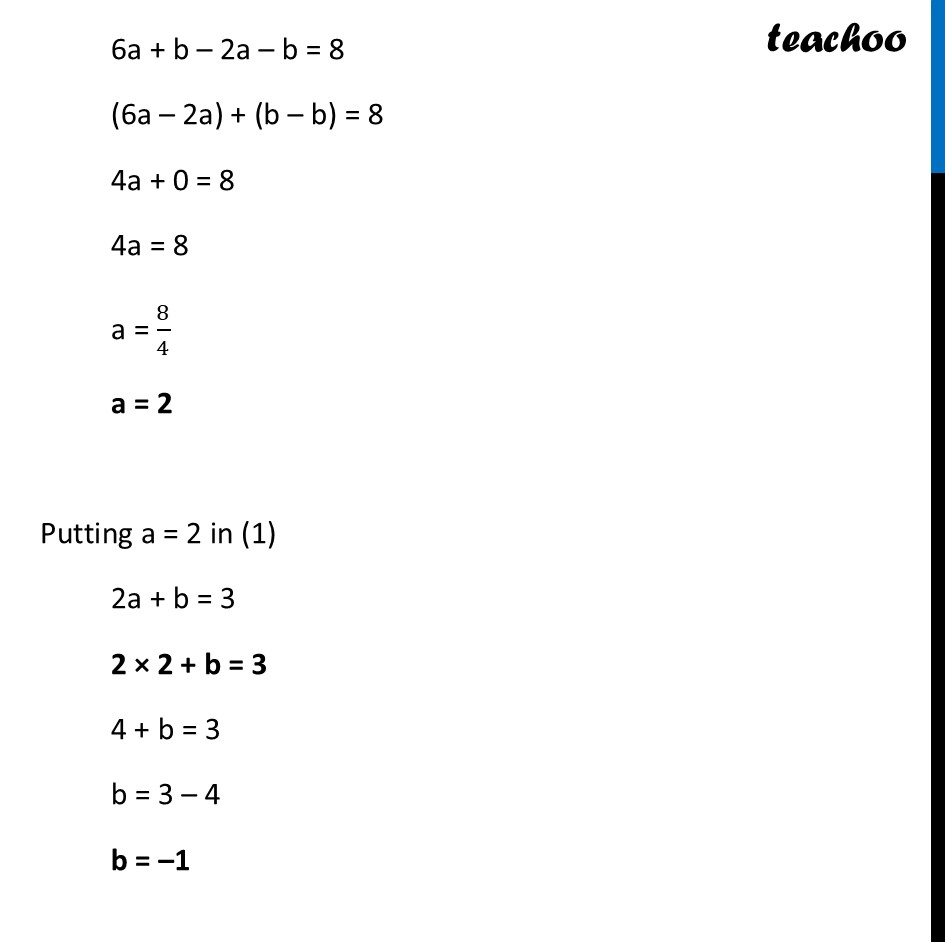
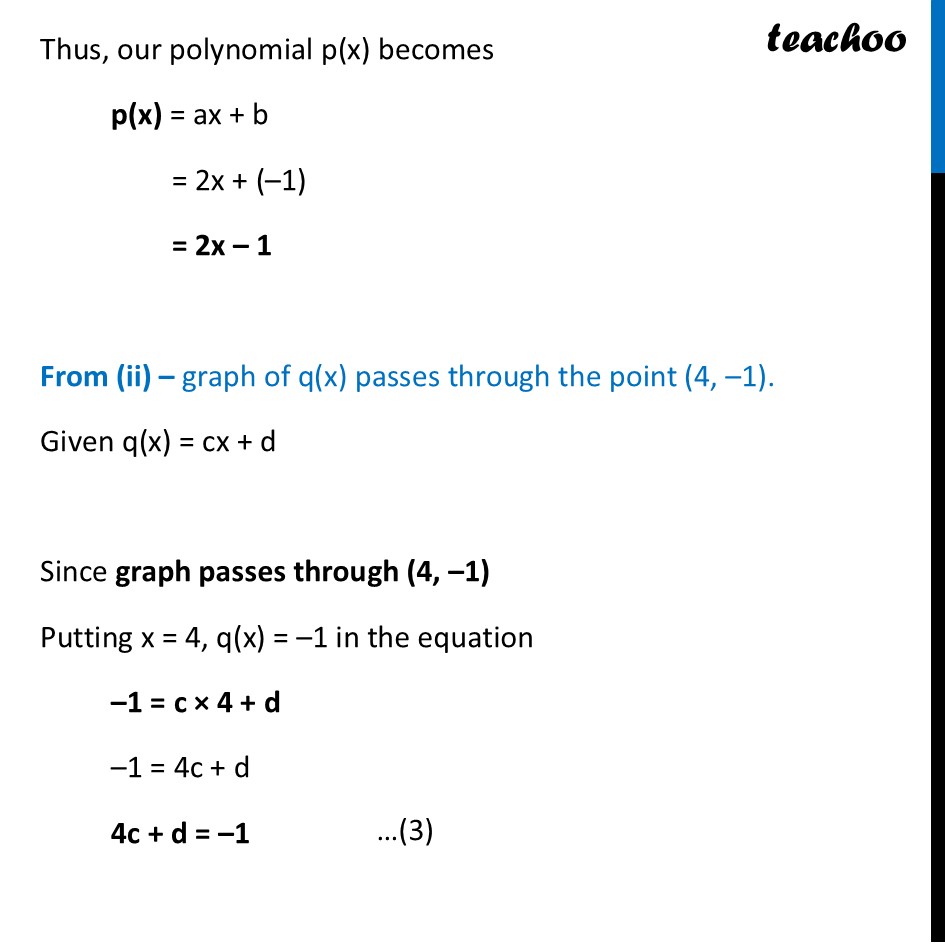
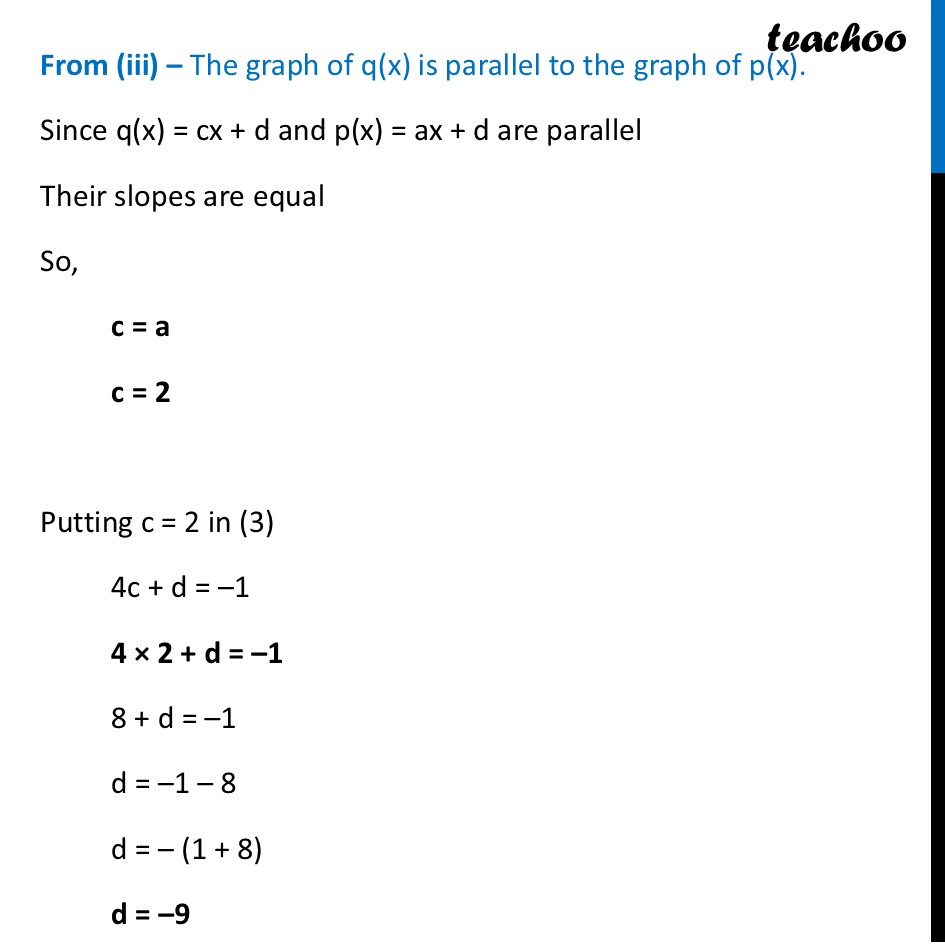
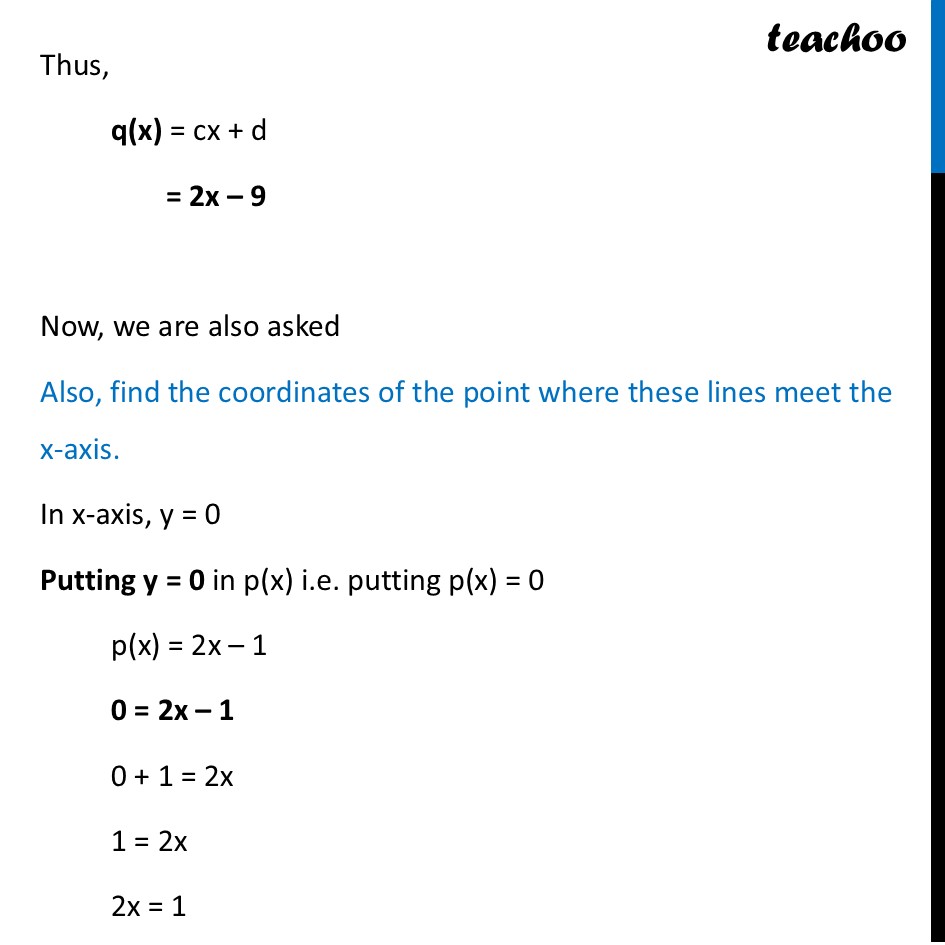
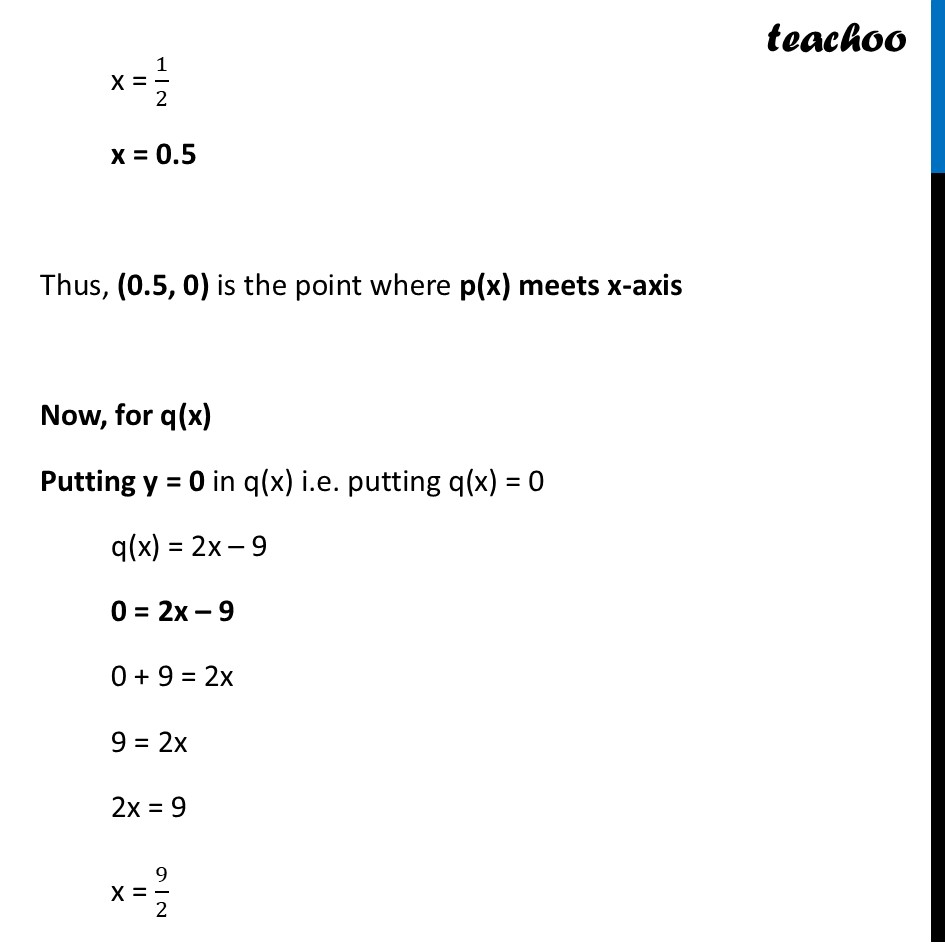
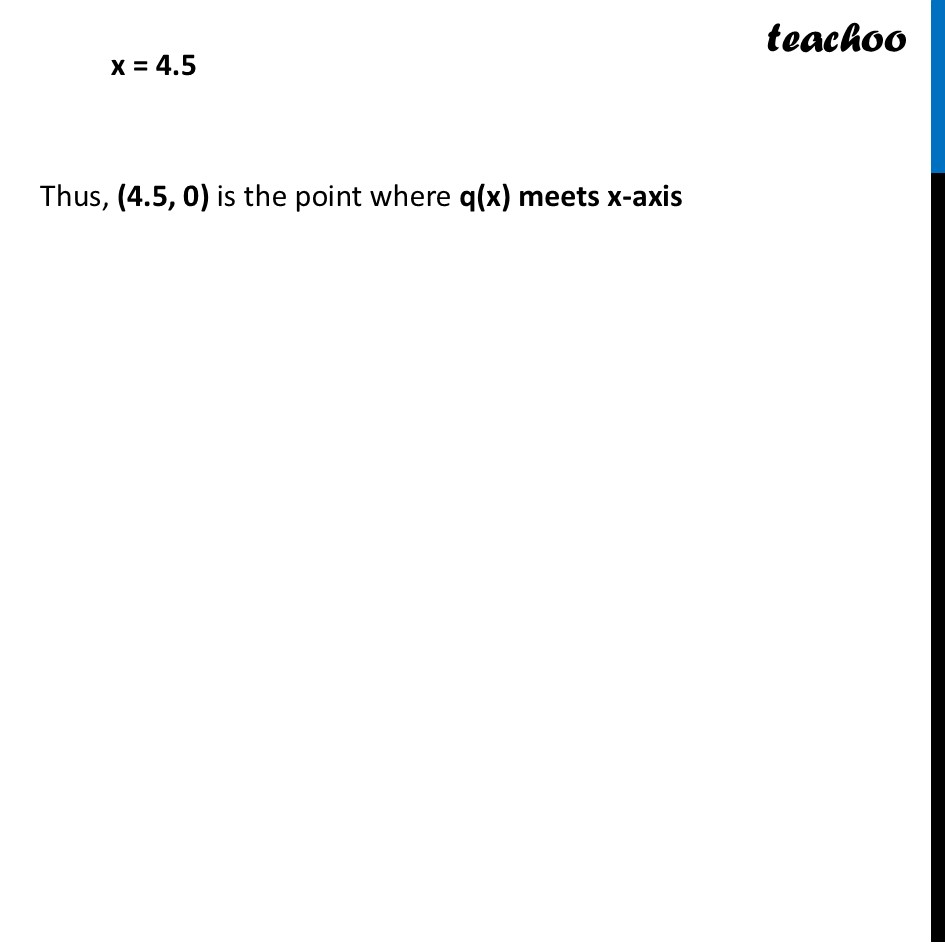
Question 13 Let p(x) = ax + b and q(x) = cx + d be two linear polynomials such that: The graph of p(x) passes through the points (2, 3) and (6, 11). The graph of q(x) passes through the point (4, –1). (iii) The graph of q(x) is parallel to the graph of p(x). Find the polynomials p(x) and q(x). Also, find the coordinates of the point where these lines meet the x-axis. Given p(x) = ax + b From (i) – graph of p(x) passes through the points (2, 3) and (6, 11) Since graph passes through (2, 3) Putting x = 2, p(x) = 3 in the equation 3 = a × 2 + b 3 = 2a + b 2a + b = 3 Also, graph passes through (6, 11) Putting x = 6, p(x) = 11 in the equation 11 = a × 6 + b 11 = 6a + b 6a + b = 11 Now, our equations are 2a + b = 3 …(1) 6a + b = 11 …(2) Doing (2) – (1) (6a + b) – (2a + b) = 11 – 3 6a + b – 2a – b = 8 (6a – 2a) + (b – b) = 8 4a + 0 = 8 4a = 8 a = 8/4 a = 2 Putting a = 2 in (1) 2a + b = 3 2 × 2 + b = 3 4 + b = 3 b = 3 – 4 b = –1 Thus, our polynomial p(x) becomes p(x) = ax + b = 2x + (–1) = 2x – 1 2a + b = 3 Also, graph passes through (6, 11) Putting x = 6, p(x) = 11 in the equation 11 = a × 6 + b 11 = 6a + b 6a + b = 11 Now, our equations are 2a + b = 3 …(1) 6a + b = 11 …(2) Doing (2) – (1) (6a + b) – (2a + b) = 11 – 3 6a + b – 2a – b = 8 (6a – 2a) + (b – b) = 8 4a + 0 = 8 4a = 8 a = 8/4 a = 2 Putting a = 2 in (1) 2a + b = 3 2 × 2 + b = 3 4 + b = 3 b = 3 – 4 b = –1 Thus, our polynomial p(x) becomes p(x) = ax + b = 2x + (–1) = 2x – 1 From (iii) – The graph of q(x) is parallel to the graph of p(x). Since q(x) = cx + d and p(x) = ax + d are parallel Their slopes are equal So, c = a c = 2 Putting c = 2 in (3) 4c + d = –1 4 × 2 + d = –1 8 + d = –1 d = –1 – 8 d = – (1 + 8) d = –9 Thus, q(x) = cx + d = 2x – 9 Now, we are also asked Also, find the coordinates of the point where these lines meet the x-axis. In x-axis, y = 0 Putting y = 0 in p(x) i.e. putting p(x) = 0 p(x) = 2x – 1 0 = 2x – 1 0 + 1 = 2x 1 = 2x 2x = 1 x = 1/2 x = 0.5 Thus, (0.5, 0) is the point where p(x) meets x-axis Now, for q(x) Putting y = 0 in q(x) i.e. putting q(x) = 0 q(x) = 2x – 9 0 = 2x – 9 0 + 9 = 2x 9 = 2x 2x = 9 x = 9/2 x = 4.5 Thus, (4.5, 0) is the point where q(x) meets x-axis