
 You are here
![[Class 8 Maths] Using the constructions you have now seen, how would - Baudhāyana’s Theorem on Right-angled triangles](https://cdn.teachoo.com/eadea783-9b56-4ef8-8319-b4d9b562ced3/slide82.jpg)
Baudhāyana’s Theorem on Right-angled triangles
Last updated at August 14, 2026 by Teachoo
Transcript
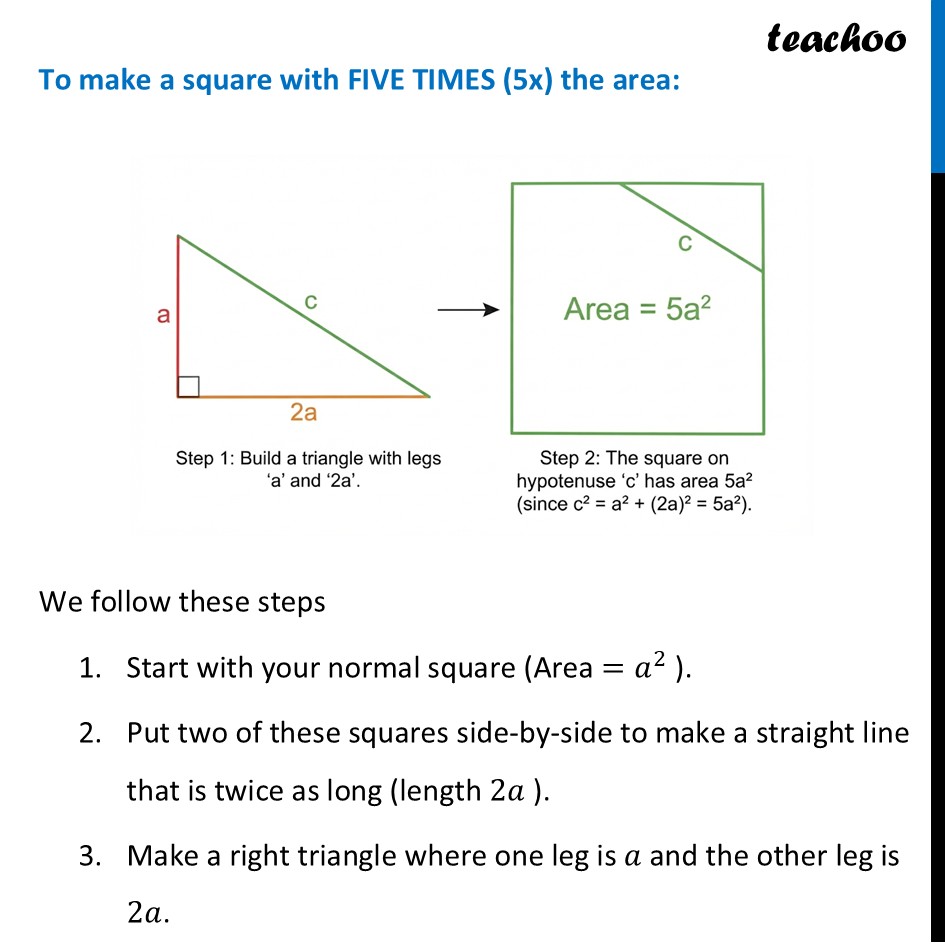
Question 3 - Figure it out (Page 47) Using the constructions you have now seen, how would you construct a square whose area is triple the area of a given square? Five times the area of a given square? (Baudhāyana’s Śulba-Sūtra, Verse 1.10)To make a square with TRIPLE (3x) the area: We follow these steps Start with your normal square (Area =𝑎^2 ). Draw a diagonal line right across it. The square built on this diagonal has double the area (2𝑎^2 ). Let's call this diagonal length 𝑑. Now, draw a brand new right triangle. Make one short side equal to 𝑎 (from your original square) and the other short side equal to 𝑑 (your diagonal). According to our theorem, the new hypotenuse ( 𝑐 ) will be: 𝑐^2=𝑎^2+𝑑^2. Since we know 𝑑^2=2𝑎^2, then 𝑐^2=𝑎^2+2𝑎^2=3𝑎^2. Answer: If you draw a square on that new hypotenuse, it will be exactly 3 times the size of your original square! To make a square with FIVE TIMES (5x) the area: We follow these steps Start with your normal square (Area =𝑎^2 ). Put two of these squares side-by-side to make a straight line that is twice as long (length 2𝑎 ). Make a right triangle where one leg is 𝑎 and the other leg is 2𝑎. The hypotenuse formula looks like this: 𝑐^2=𝑎^2+(2𝑎)^2. 𝑐^2=𝑎^2+4𝑎^2=5𝑎^2. Answer: Draw a square on this hypotenuse, and it will be exactly 5 times the area!

