 You are here

![Combining Two squares - Trick with Questions [Class 8 Ganita Prakash] - Combining Two squares](https://cdn.teachoo.com/49a40d05-3a97-4a1a-9163-b590f1b3b25c/slide62.jpg)
Combining Two squares
Last updated at February 20, 2026 by Teachoo
Transcript
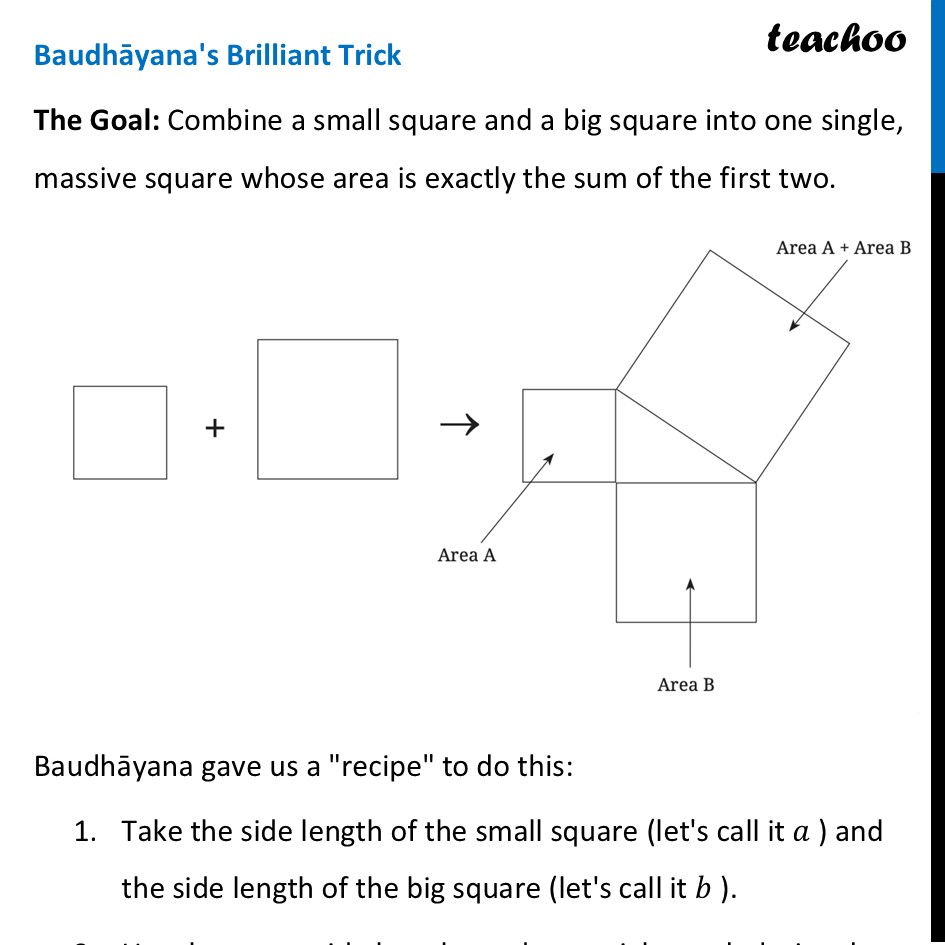
Combining Two squaresUp until now, we were only combining identical squares. Now, we combine squares of entirely different sizes. Baudhāyana's Brilliant Trick The Goal: Combine a small square and a big square into one single, massive square whose area is exactly the sum of the first two. Baudhāyana gave us a "recipe" to do this: Take the side length of the small square (let's call it 𝑎 ) and the side length of the big square (let's call it 𝑏 ). Use those two side lengths to draw a right-angled triangle. Draw a new square using the hypotenuse of that triangle as the side length. Question: Can you see why the method works in the case where the two squares are the same size? Does it agree with the method we used earlier...? Answer: Yes, it agrees perfectly! If the two starting squares are the exact same size, then side 𝑎 and 𝑏 are equal. If you draw a right triangle with equal legs, you get an isosceles right triangle. The square built on the hypotenuse of that triangle is exactly double the area of one original square, which is exactly what we proved back on page 37. Page 43: Building the Proof To prove why this works for different-sized squares, the book walks us through a visual puzzle. We place our small square (side 𝑎 ) and large square (side 𝑏 ) right next to each other. We mark off a rectangle inside the large square that is 𝑎 wide and 𝑏 tall, and draw a diagonal line right through it. This creates our crucial right triangle with legs 𝑎 and 𝑏 (the blue triangle). The book then shows us how to draw three more identical (congruent) right triangles around the outside to build a completely new, tilted 4 -sided shape on the hypotenuse. Page 44: Proving It is a Square Now we have a tilted 4-sided shape made up of pieces labeled T, U, and V. The book makes a bold claim: this shape is a perfect square. Question: Explain why all the angles of this new 4 -sided figure are right angles and so it is a square. Answer: Let's look at the angles of our blue right triangle. It has a 90 -degree corner. The other two sharp corners must add up to 90 degrees (since a whole triangle is 180 degrees). Let's cal one sharp corner 𝑥 and the other corner 90−𝑥.
