 You are here

![Doubling a square [Class 8 Chapter 2 Ganita Prakash II] - Teachoo - Doubling a square](https://cdn.teachoo.com/c154b03a-555b-4b51-a6cb-4cd567a30e52/slide3.jpg)
Doubling a square
Last updated at February 20, 2026 by Teachoo
Transcript
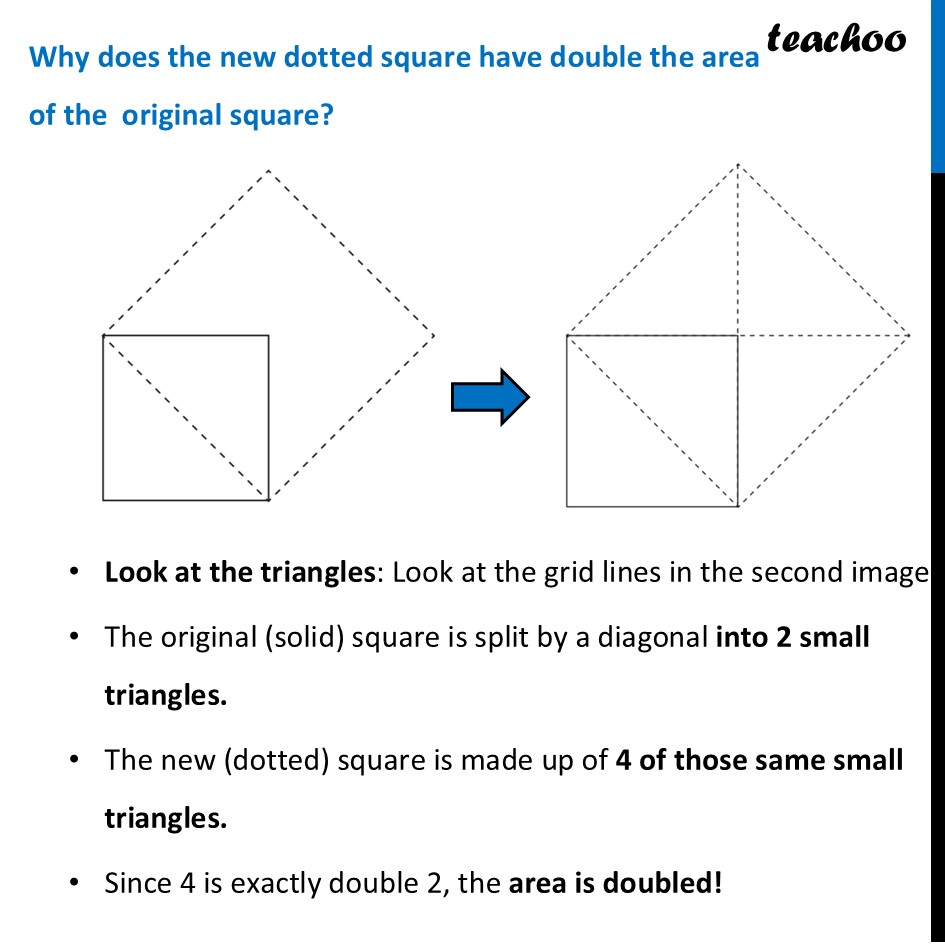
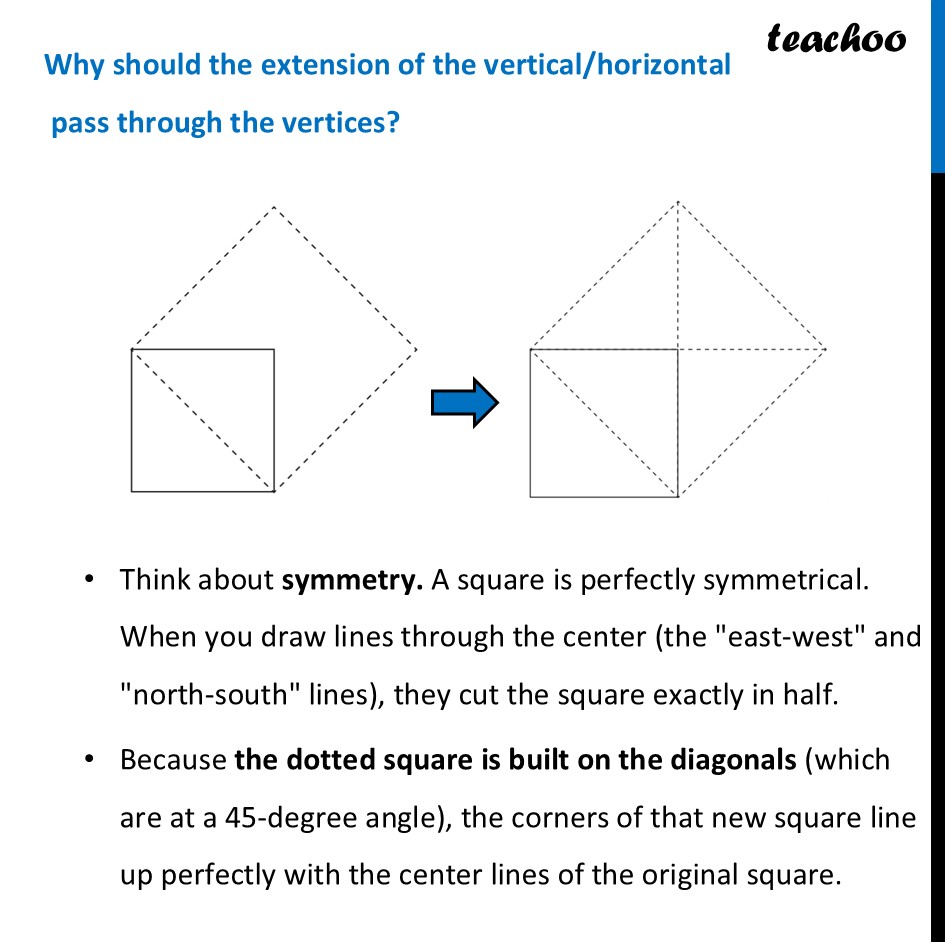
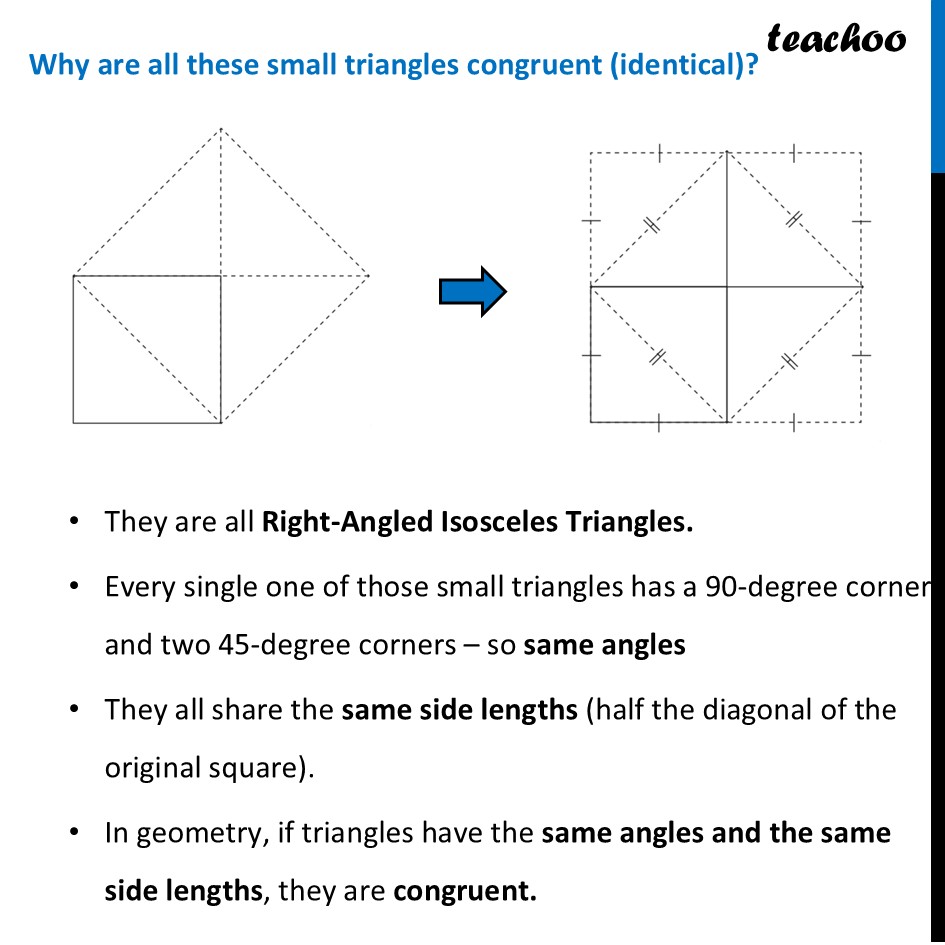
Doubling a squareIn Baudhāyana’s Śulba-Sūtra (c. 800 BCE), Baudhāyana considers the following question: How can one construct a square having double the area of a given square? The "Trap" (First Guess) Most people think, "Easy! Just double the length of the sides." Look at the first image. If you have a small square and you double the sides, you don't get 2 squares worth of area... you get 4! Mathematically: 2 × 2 = 4 So, simply making the square "twice as wide and tall" makes it four times as big. We need a different trick. The Baudhāyana Solution Baudhāyana gave us a brilliant answer: Use the diagonal. If you build a square using the diagonal of your first square as the side length, that new square will have exactly double the area. Why does the new dotted square have double the area of the original square? Look at the triangles: Look at the grid lines in the second image. The original (solid) square is split by a diagonal into 2 small triangles. The new (dotted) square is made up of 4 of those same small triangles. Since 4 is exactly double 2, the area is doubled! Why should the extension of the vertical/horizontal pass through the vertices? Think about symmetry. A square is perfectly symmetrical. When you draw lines through the center (the "east-west" and "north-south" lines), they cut the square exactly in half. Because the dotted square is built on the diagonals (which are at a 45-degree angle), the corners of that new square line up perfectly with the center lines of the original square. Why are all these small triangles congruent (identical)? They are all Right-Angled Isosceles Triangles. Every single one of those small triangles has a 90-degree corner and two 45-degree corners – so same angles They all share the same side lengths (half the diagonal of the original square). In geometry, if triangles have the same angles and the same side lengths, they are congruent.
