 You are here

![Decimal Representation of √2 [Class 8 Ganita Prakash Part 2] - Decimal Representation of √2](https://cdn.teachoo.com/e0562ab5-1f86-4ef6-994a-d328cead804c/slide24.jpg)
Decimal Representation of √2
Decimal Representation of √2
Last updated at February 20, 2026 by Teachoo
Transcript
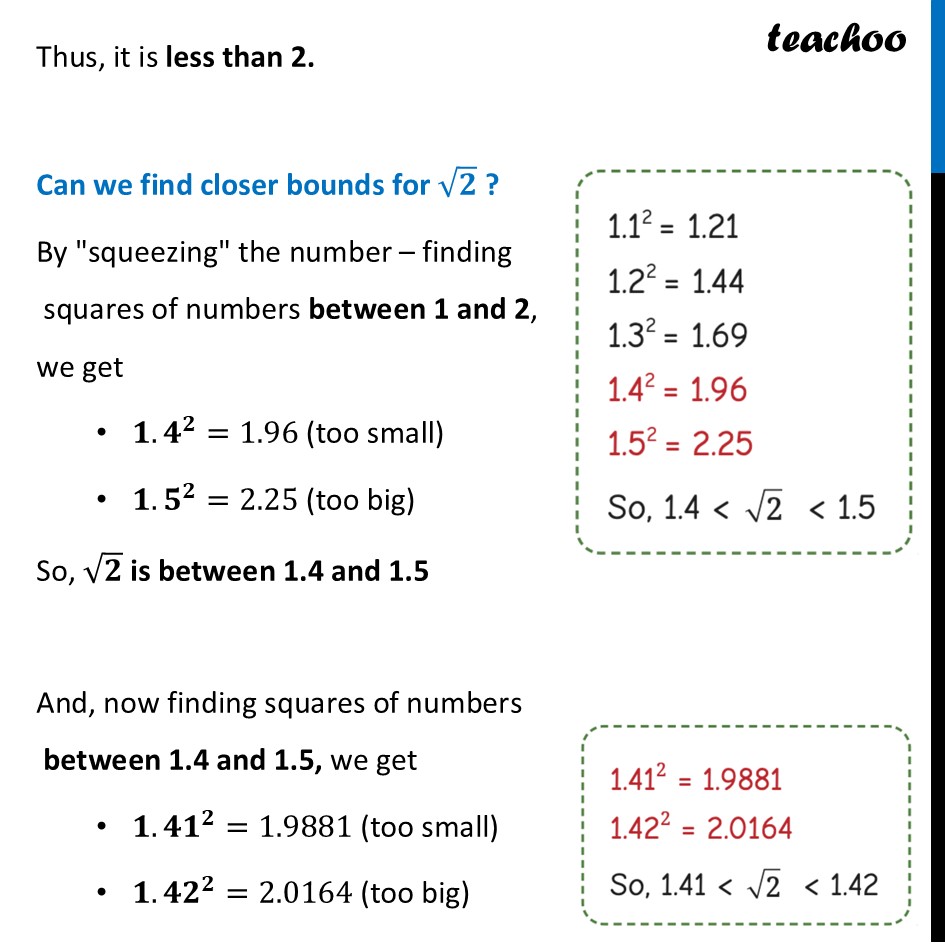
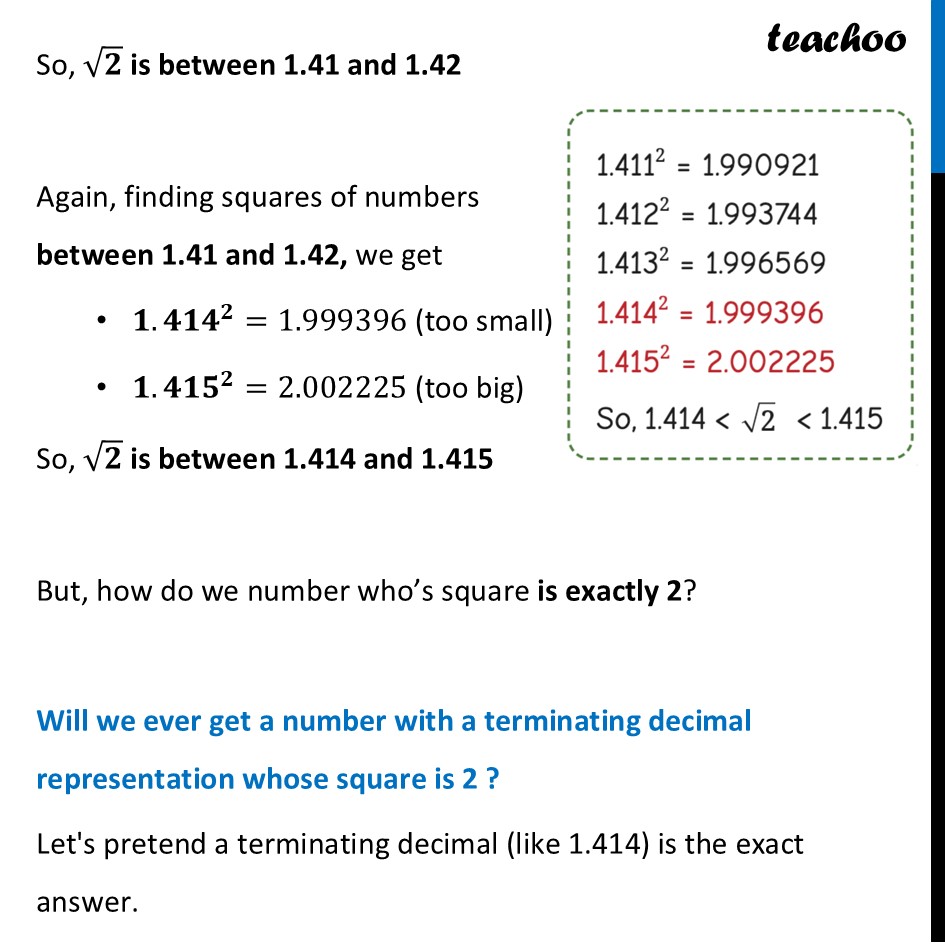
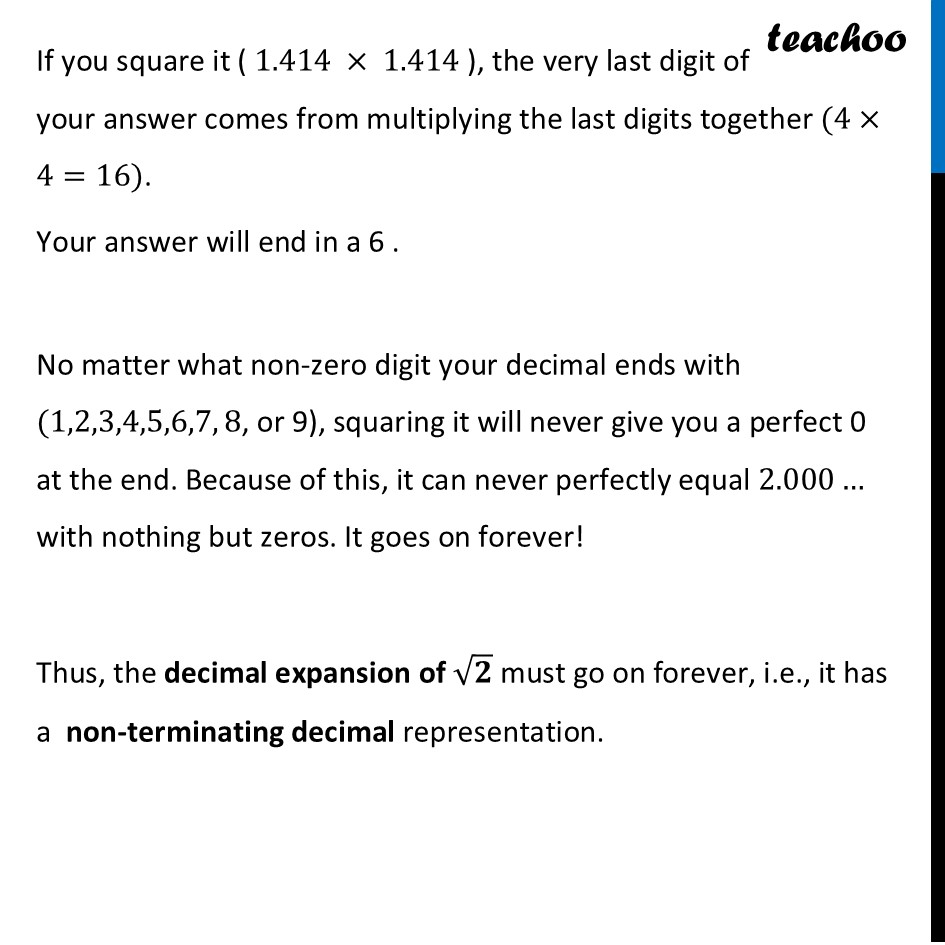
Decimal Representation of √𝟐We know √2 exists (we just drew it as a hypotenuse!), but what is its actual value as a normal decimal number? Is √𝟐 less than or greater than 1? A square with side 1 has an area of 1 . Our square REST has an area of 2 . Since 2 is bigger than 1 , the side length of REST must be bigger than 1 . So, 1<√2 Thus, it is greater than 1. Is √𝟐 less than or greater than 2? If a square has a side length of 2 , its area is 2 × 2=4. Our square REST only has an area of 2 . Since 2 is smaller than 4 , the side length must be smaller than 2 . So, √2<2. Thus, it is less than 2. Can we find closer bounds for √𝟐 ? By "squeezing" the number – finding squares of numbers between 1 and 2, we get 〖𝟏.𝟒〗^𝟐=1.96 (too small) 〖𝟏.𝟓〗^𝟐=2.25 (too big) So, √𝟐 is between 1.4 and 1.5 And, now finding squares of numbers between 1.4 and 1.5, we get 〖𝟏.𝟒𝟏〗^𝟐=1.9881 (too small) 〖𝟏.𝟒𝟐〗^𝟐=2.0164 (too big) So, √𝟐 is between 1.41 and 1.42 Again, finding squares of numbers between 1.41 and 1.42, we get 〖𝟏.𝟒𝟏𝟒〗^𝟐=1.999396 (too small) 〖𝟏.𝟒𝟏𝟓〗^𝟐=2.002225 (too big) So, √𝟐 is between 1.414 and 1.415 But, how do we number who’s square is exactly 2? Question: Will we ever get a number with a terminating decimal representation whose square is 2 ? Let's pretend a terminating decimal (like 1.414) is the exact answer. If you square it ( 1.414×1.414 ), the very last digit of your answer comes from multiplying the last digits together (4×4=16). Your answer will end in a 6 . No matter what non-zero digit your decimal ends with (1,2,3,4,5,6,7,8, or 9 ), squaring it will never give you a perfect 0 at the end. Because of this, it can never perfectly equal 2.000… with nothing but zeros. It goes on forever! Thus, the decimal expansion of √𝟐 must go on forever, i.e., it has a non-terminating decimal representation.
