
 You are here
Decimal Representation of √2
Decimal Representation of √2
Last updated at February 20, 2026 by Teachoo
Transcript
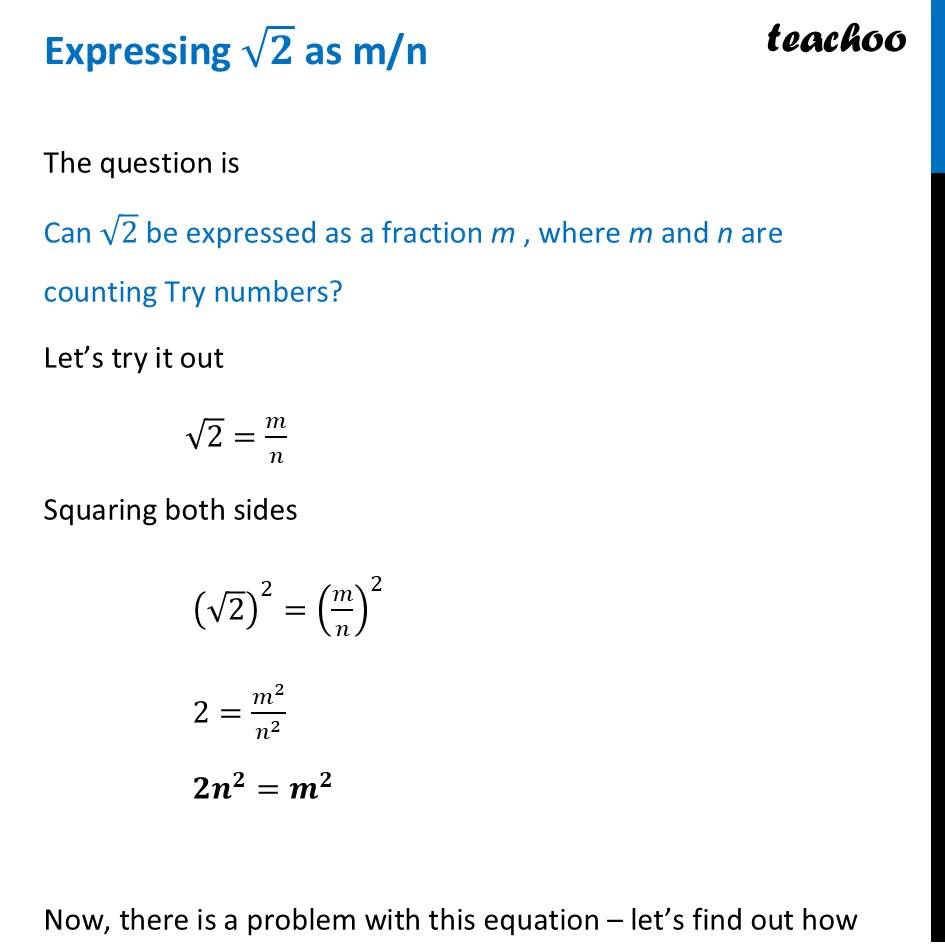
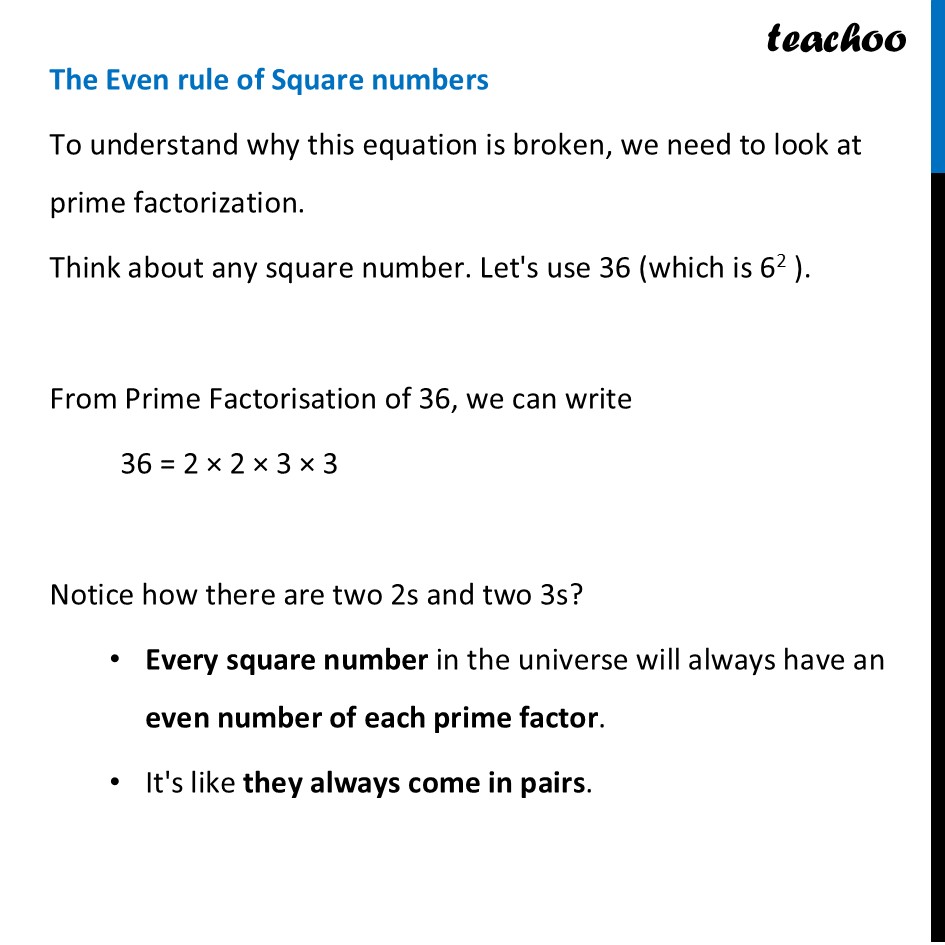
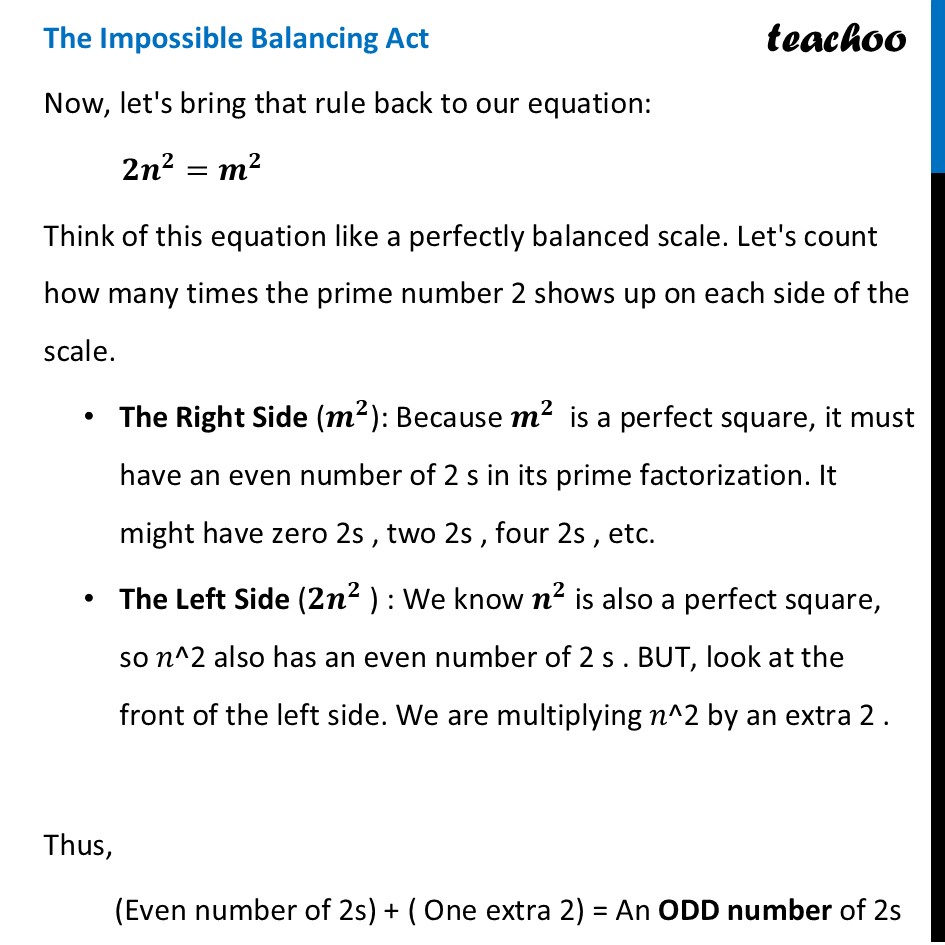
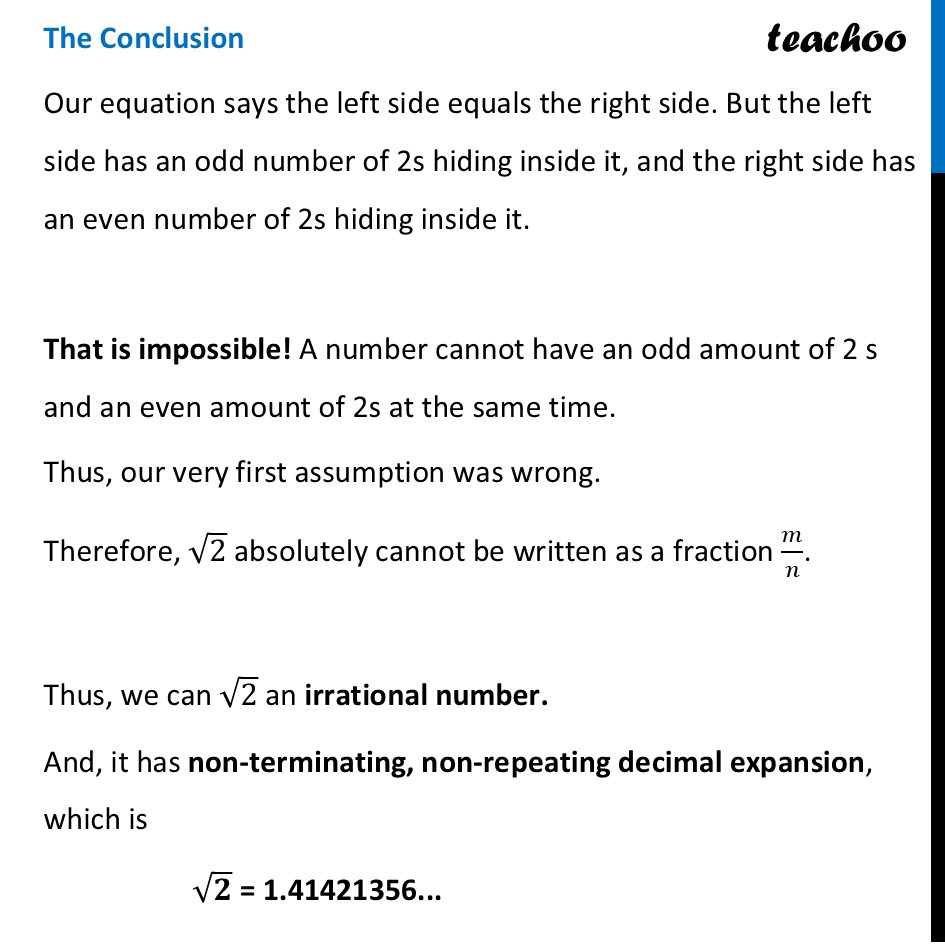
Expressing √𝟐 as m/nThe question is Can √2 be expressed as a fraction m , where m and n are counting Try numbers? Let’s try it out √2=𝑚/𝑛 Squaring both sides (√2)^2=(𝑚/𝑛)^2 2=𝑚^2/𝑛^2 𝟐𝒏^𝟐=𝒎^𝟐 Now, there is a problem with this equation – let’s find out how The Even rule of Square numbers To understand why this equation is broken, we need to look at prime factorization. Think about any square number. Let's use 36 (which is 62 ). From Prime Factorisation of 36, we can write 36 = 2 × 2 × 3 × 3 Notice how there are two 2 s and two 3 s? Every square number in the universe will always have an even number of each prime factor. It's like they always come in pairs. The Impossible Balancing Act Now, let's bring that rule back to our equation: 𝟐𝒏^𝟐=𝒎^𝟐 Think of this equation like a perfectly balanced scale. Let's count how many times the prime number 2 shows up on each side of the scale. The Right Side (𝒎^𝟐): Because 𝒎^𝟐 is a perfect square, it must have an even number of 2 s in its prime factorization. It might have zero 2 s , two 2 s , four 2 s , etc. The Left Side (𝟐𝒏^𝟐 ) : We know 𝒏^𝟐 is also a perfect square, so 𝑛^2 also has an even number of 2 s . BUT, look at the front of the left side. We are multiplying 𝑛^2 by an extra 2 . Thus, (Even number of 2s) + ( One extra 2) = An ODD number of 2𝐬. The Conclusion Our equation says the left side equals the right side. But the left side has an odd number of 2s hiding inside it, and the right side has an even number of 2s hiding inside it. That is impossible! A number cannot have an odd amount of 2 s and an even amount of 2s at the same time. Because our algebra was perfect, the only explanation is that our very first assumption was wrong. Therefore, √2 absolutely cannot be written as a fraction 𝑚/𝑛. Thus, we can √2 an irrational number. And, it has non-terminating, non-repeating decimal expansion, which is √𝟐 = 1.41421356...
