Prove that if 1/2 ≤ x ≤ 1, then cos −1 x + cos −1 [x/2+√(3 - 3x 2 )/2] = π/3
This is a question of CBSE Sample Paper - Class 12 - 2017/18.
You can download the question paper here https://www.teachoo.com/cbse/sample-papers/

CBSE Class 12 Sample Paper for 2018 Boards

 You are here
CBSE Class 12 Sample Paper for 2018 Boards
Last updated at August 13, 2026 by Teachoo
This is a question of CBSE Sample Paper - Class 12 - 2017/18.
You can download the question paper here https://www.teachoo.com/cbse/sample-papers/
Transcript
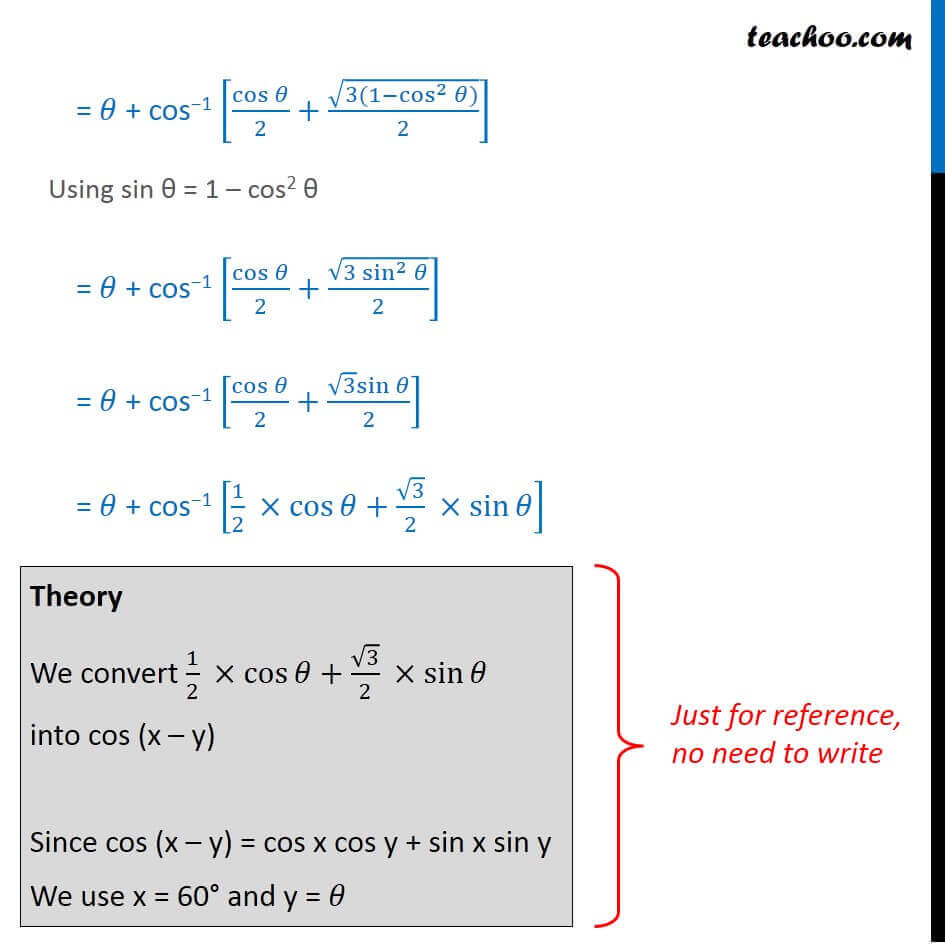
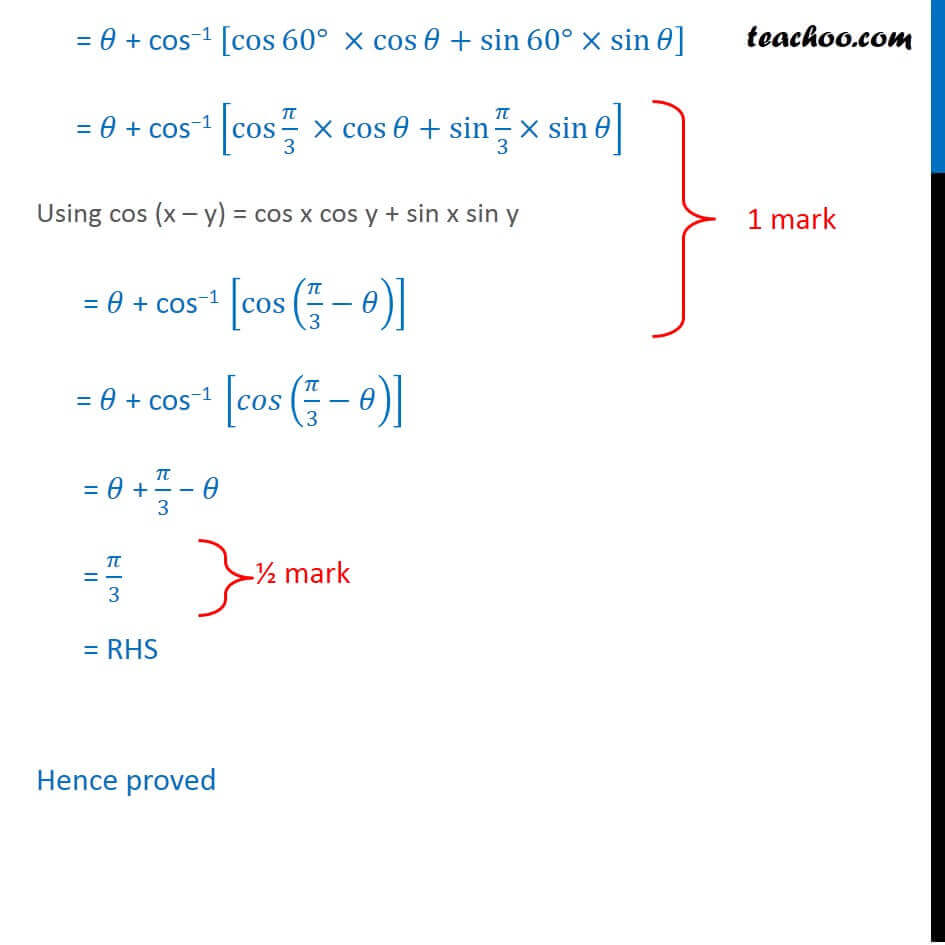
Question 7 Prove that if 1/2 ≤ x ≤ 1 then cos−1 x + cos−1 [𝑥/2+√(3 − 3𝑥^2 )/2] = 𝜋/3 Solving LHS cos−1 x + cos−1 [𝑥/2+√(3 − 3𝑥^2 )/2] = cos−1 x + cos−1 [𝑥/2+√(3(1 − 𝑥^2))/2] Let x = cos 𝜃 i.e. cos−1 x = 𝜃 Theory Since it is √(1−𝑥^2 ) we can use x = sin 𝜃 or x = cos 𝜃 Since it is given cos-1 x, we use x = cos 𝜃 = 𝜃 + cos−1 [cos𝜃/2+√(3(1−cos^2〖𝜃)〗 )/2] Using sin θ = 1 – cos2 θ = 𝜃 + cos−1 [cos𝜃/2+√(3 sin^2𝜃 )/2] = 𝜃 + cos−1 [cos𝜃/2+〖√3 sin〗𝜃/2] = 𝜃 + cos−1 [1/2 ×cos𝜃+√3/2 ×sin𝜃 ] Theory We convert 1/2 ×cos𝜃+√3/2 ×sin𝜃 into cos (x – y) Since cos (x – y) = cos x cos y + sin x sin y We use x = 60° and y = 𝜃 = 𝜃 + cos−1 [cos〖60°〗 ×cos𝜃+sin〖60°〗×sin𝜃 ] = 𝜃 + cos−1 [cos〖𝜋/3〗 ×cos𝜃+sin〖𝜋/3〗×sin𝜃 ] Using cos (x – y) = cos x cos y + sin x sin y = 𝜃 + cos−1 [cos(𝜋/3−𝜃) ] = 𝜃 + cos−1 [𝑐𝑜𝑠(𝜋/3−𝜃)] = 𝜃 + 𝜋/3 − 𝜃 = 𝜋/3 = RHS Hence proved