
 You are here
Last updated at November 5, 2026 by Teachoo
Transcript
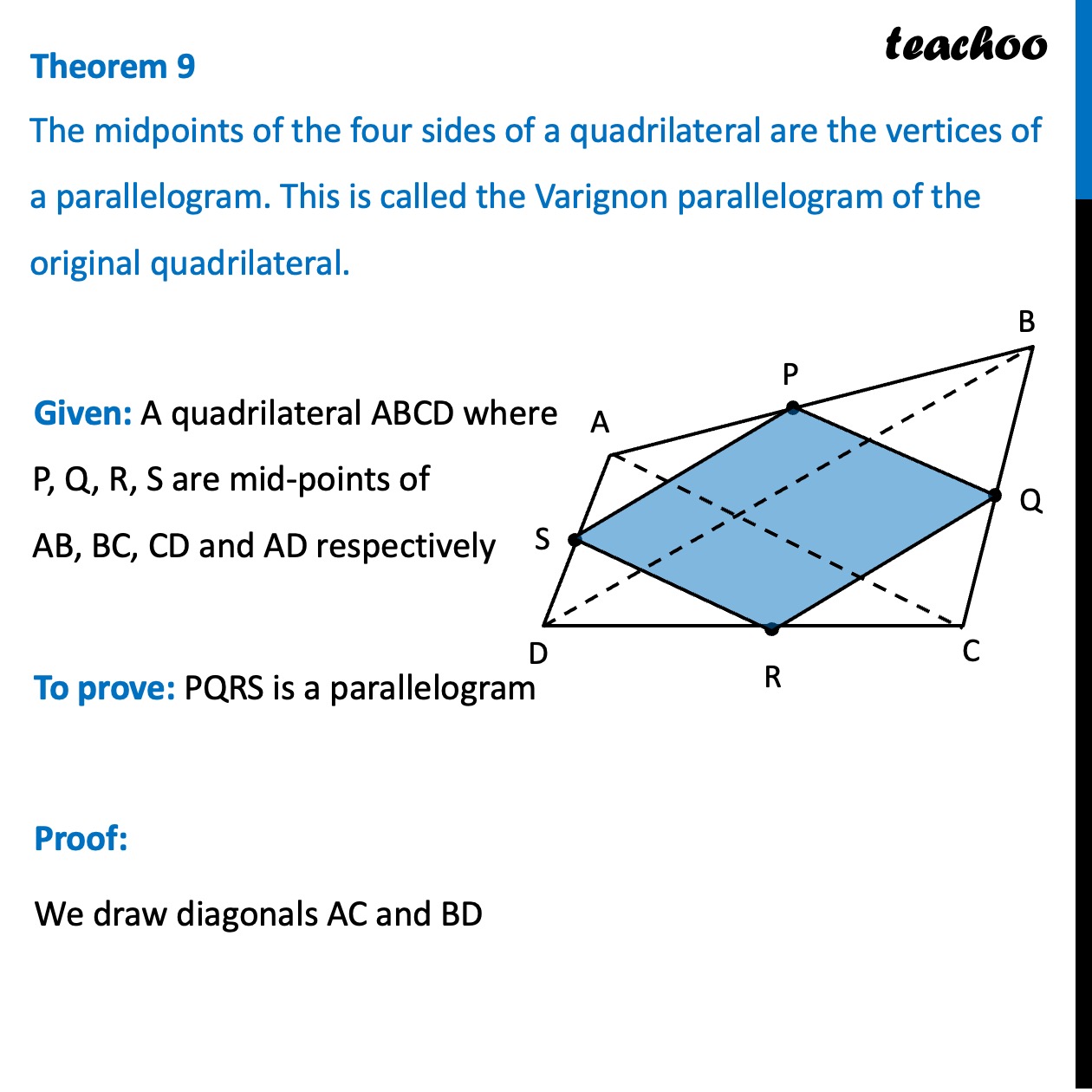
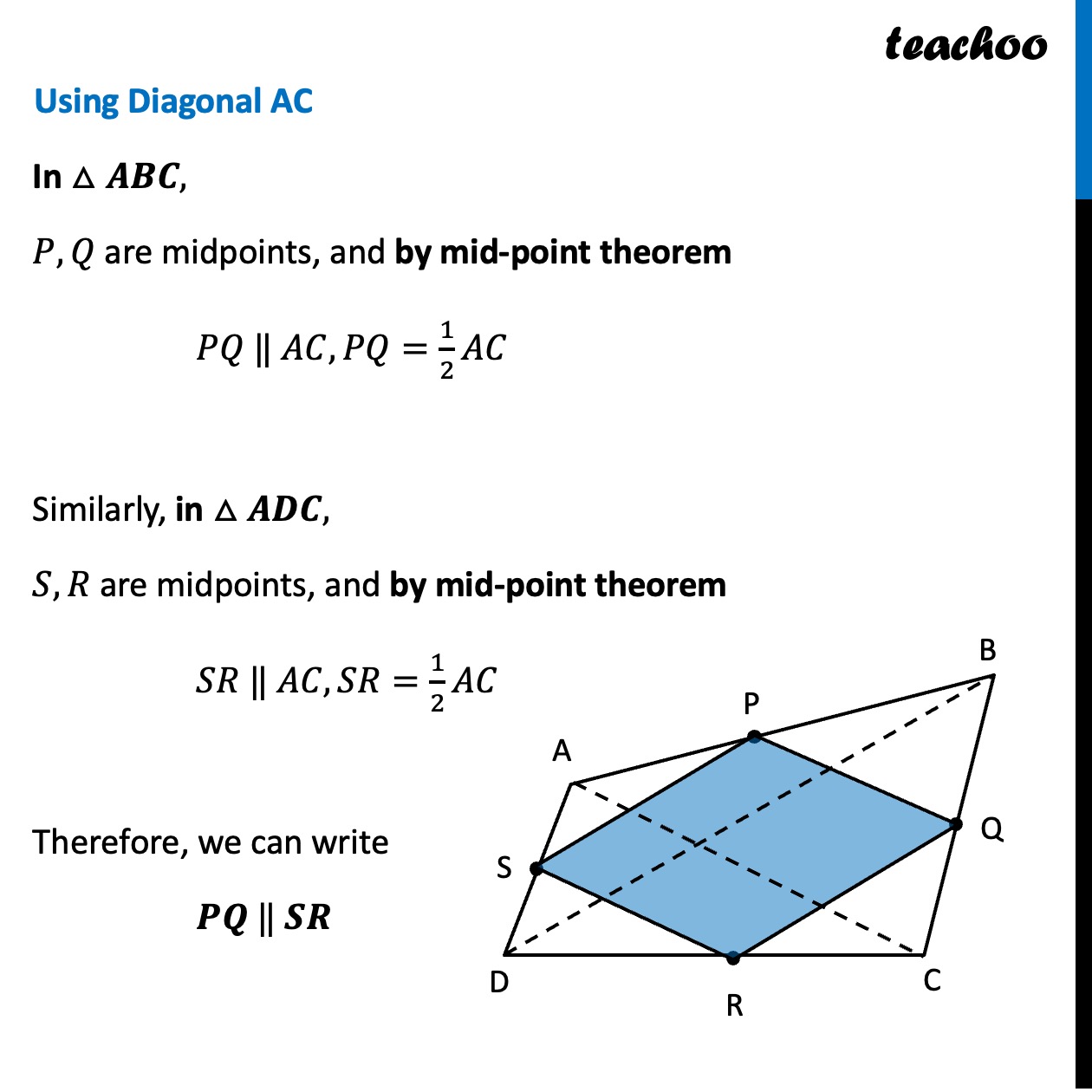
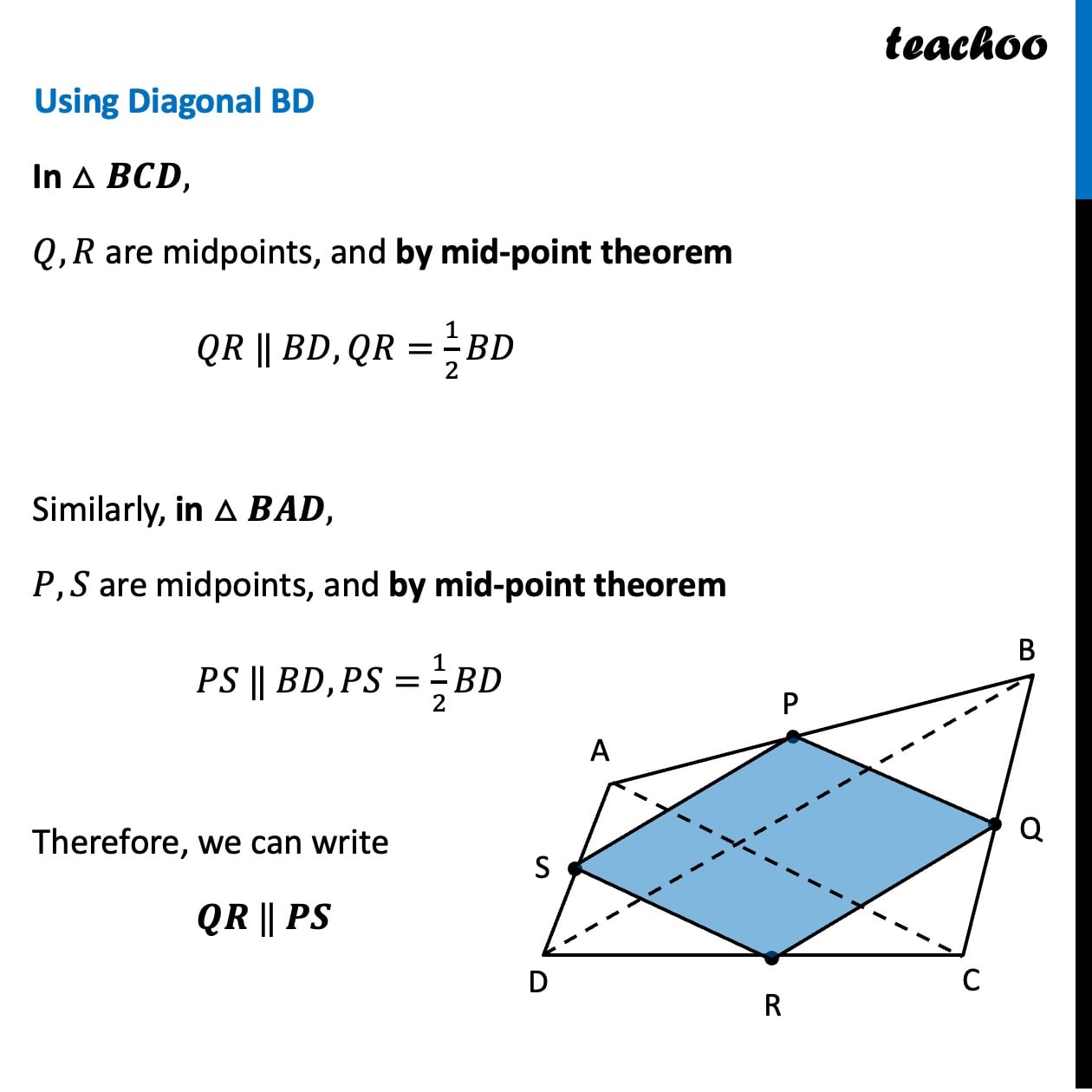
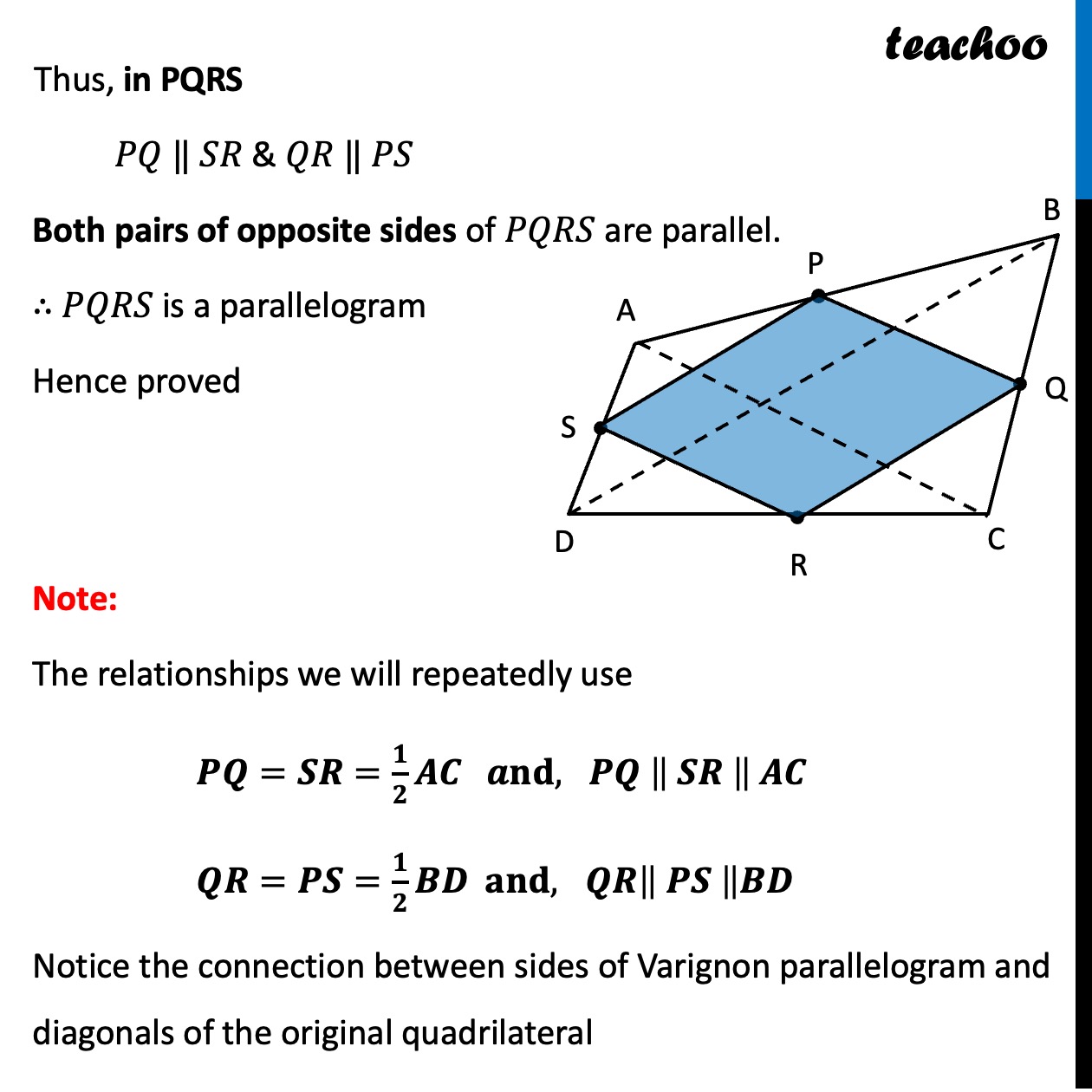
Theorem 9 The midpoints of the four sides of a quadrilateral are the vertices of a parallelogram. This is called the Varignon parallelogram of the original quadrilateral. Given: A quadrilateral ABCD where P, Q, R, S are mid-points of AB, BC, CD and AD respectively To prove: PQRS is a parallelogram Proof: We draw diagonals AC and BD D A C B P Q R S Using Diagonal AC In △𝑨𝑩𝑪, 𝑃,𝑄 are midpoints, and by mid-point theorem 𝑃𝑄 ‖ 𝐴𝐶, 𝑃𝑄=(1)/(2)𝐴𝐶 Similarly, in △𝑨𝑫𝑪, 𝑆,𝑅 are midpoints, and by mid-point theorem 𝑆𝑅 ‖ 𝐴𝐶, 𝑆𝑅=(1)/(2)𝐴𝐶 Therefore, we can write 𝑷𝑸 ‖ 𝑺𝑹 D A C B P Q R S Using Diagonal BD In △𝑩𝑪𝑫, 𝑄,𝑅 are midpoints, and by mid-point theorem 𝑄𝑅 ‖ 𝐵𝐷, 𝑄𝑅=(1)/(2)𝐵𝐷 Similarly, in △𝑩𝑨𝑫, 𝑃,𝑆 are midpoints, and by mid-point theorem 𝑃𝑆 ‖ 𝐵𝐷, 𝑃𝑆=(1)/(2)𝐵𝐷 Therefore, we can write 𝑸𝑹 ‖ 𝑷𝑺 D A C B P Q R S Thus, in PQRS 𝑃𝑄 ‖ 𝑆𝑅 & 𝑄𝑅 ‖ 𝑃𝑆 Both pairs of opposite sides of 𝑃𝑄𝑅𝑆 are parallel. ∴ 𝑃𝑄𝑅𝑆 is a parallelogram Hence proved Note: The relationships we will repeatedly use 𝑷𝑸=𝑺𝑹=(𝟏)/(𝟐)𝑨𝑪 𝒂𝐧𝐝, 𝑷𝑸 ‖ 𝑺𝑹 ‖ 𝑨𝑪 𝑸𝑹=𝑷𝑺=(𝟏)/(𝟐)𝑩𝑫 𝐚𝐧𝐝, 𝑸𝑹‖ 𝑷𝑺 ‖𝑩𝑫 Notice the connection between sides of Varignon parallelogram and diagonals of the original quadrilateral D A C B P Q R S
