You are here
Last updated at November 5, 2026 by Teachoo
Transcript
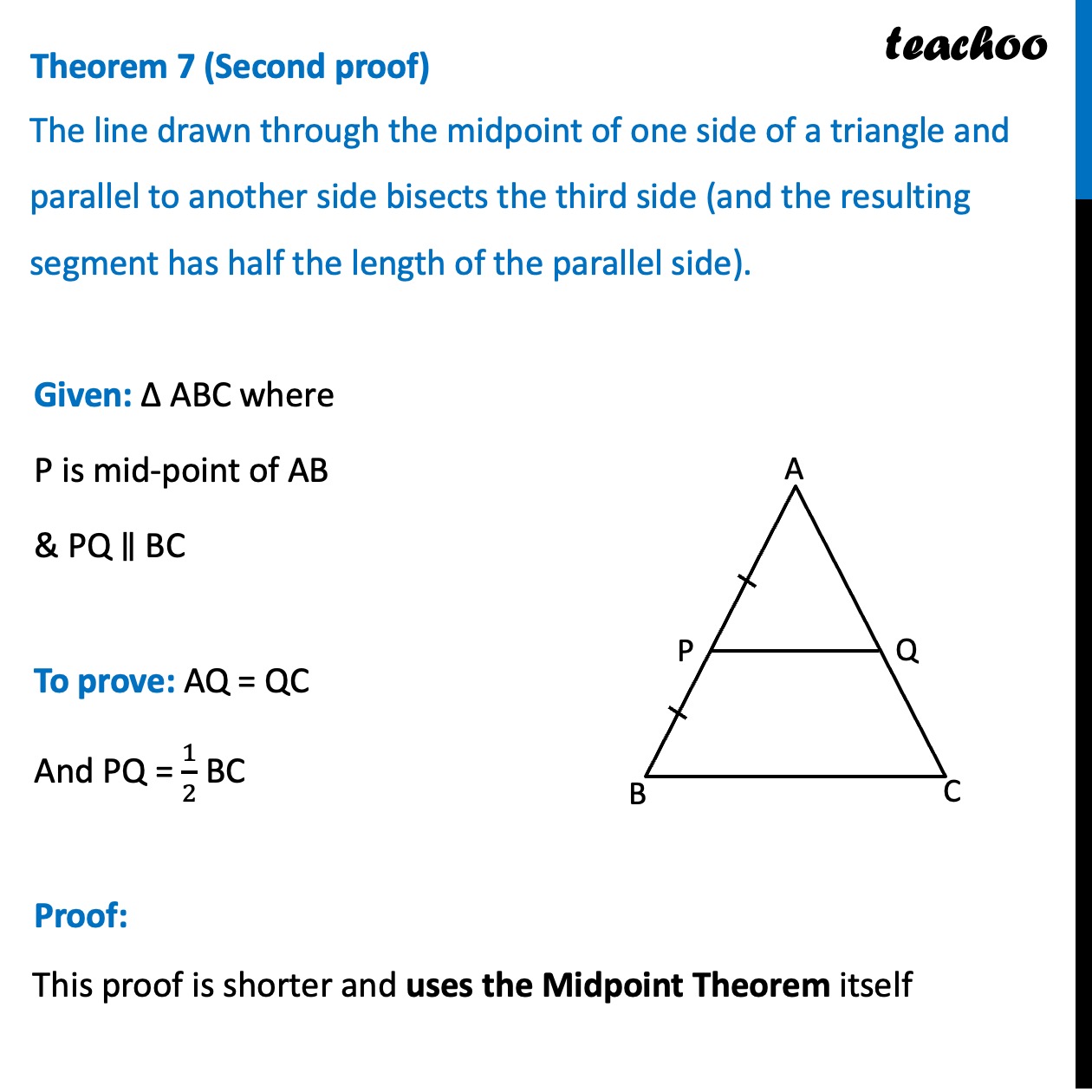
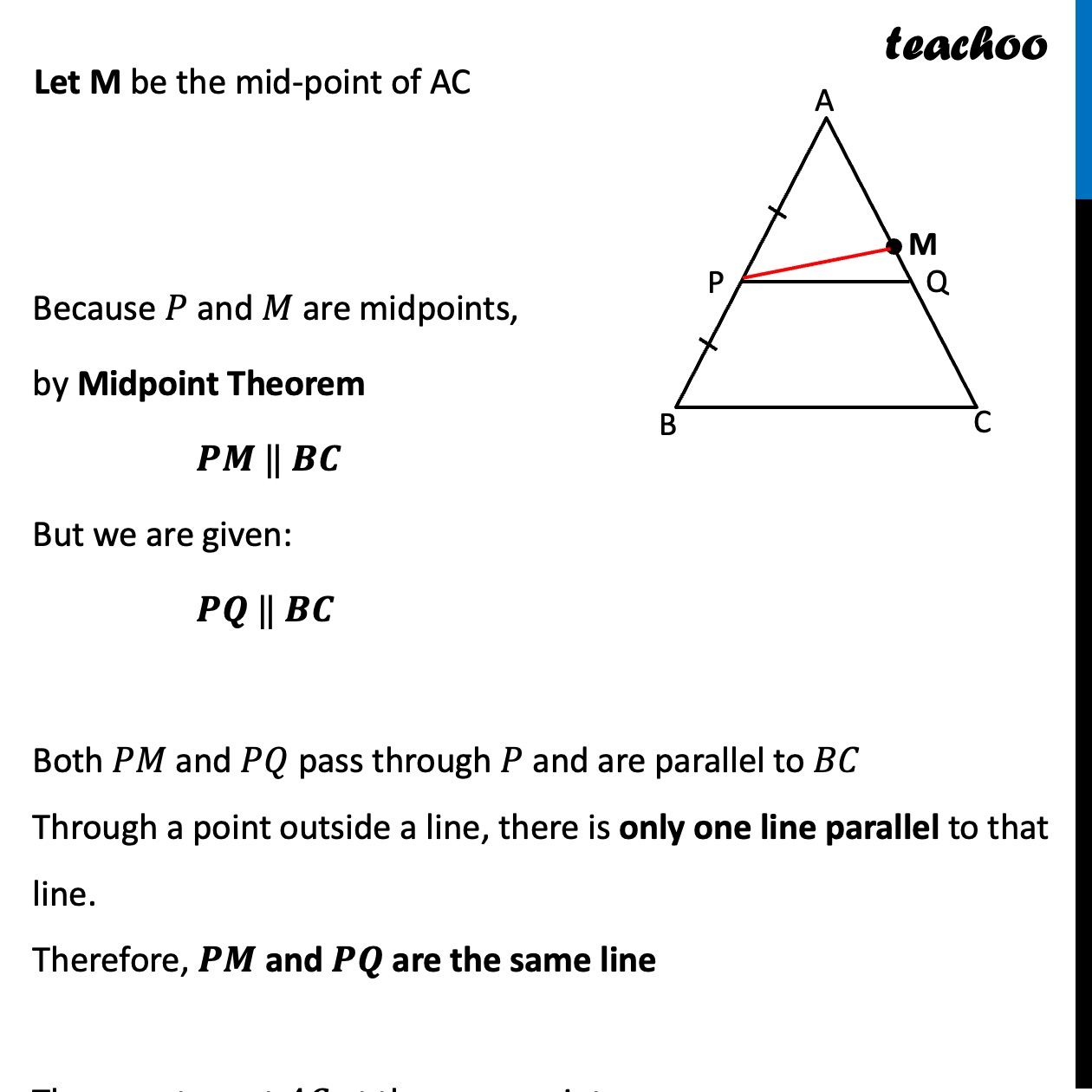
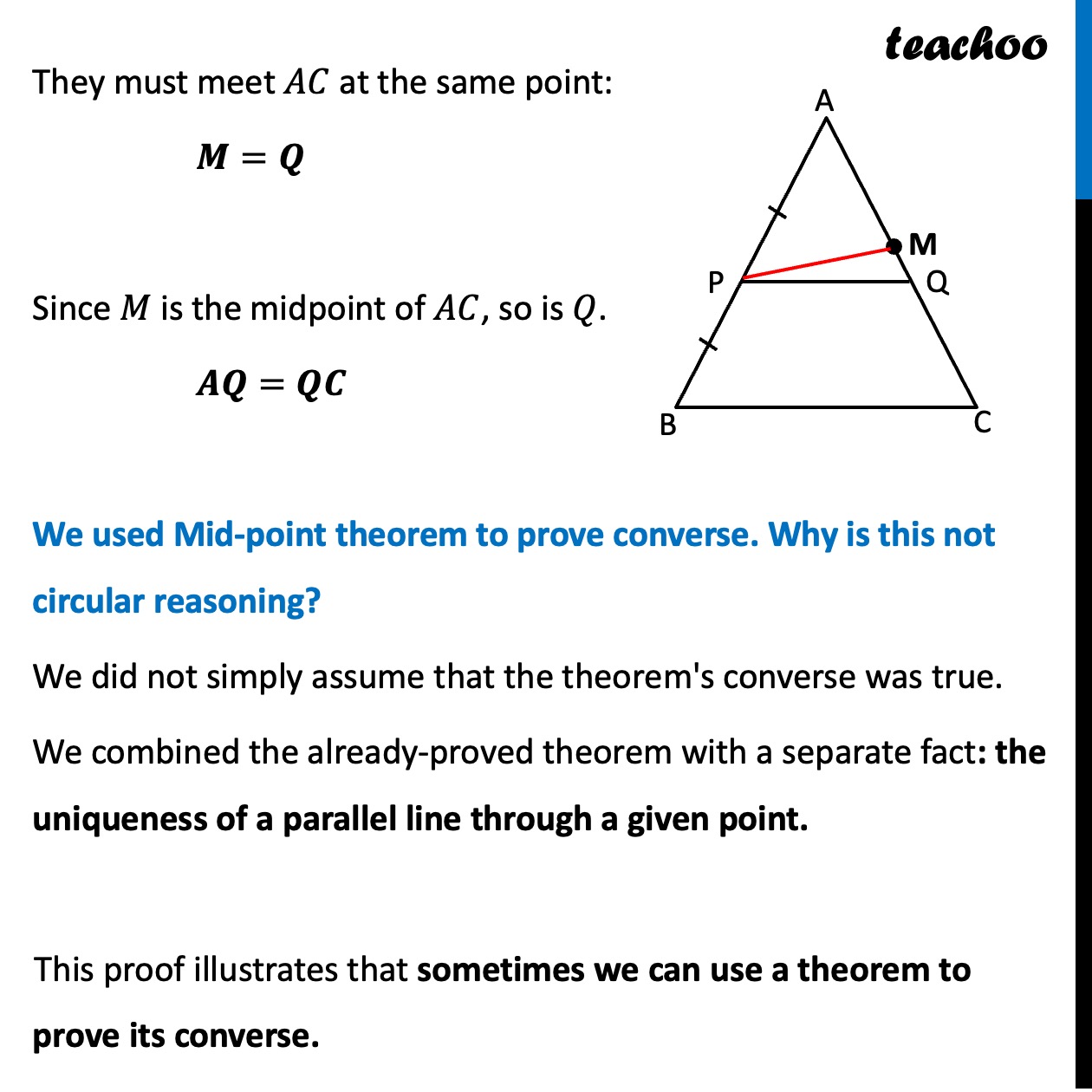
Theorem 7 (Second proof) The line drawn through the midpoint of one side of a triangle and parallel to another side bisects the third side (and the resulting segment has half the length of the parallel side). Given: ∆ ABC where P is mid-point of AB & PQ ∥ BC To prove: AQ = QC And PQ = (1)/(2) BC Proof: This proof is shorter and uses the Midpoint Theorem itself A B C P Q Let M be the mid-point of AC Because 𝑃 and 𝑀 are midpoints, by Midpoint Theorem 𝑷𝑴 ‖ 𝑩𝑪 But we are given: 𝑷𝑸 ‖ 𝑩𝑪 Both 𝑃𝑀 and 𝑃𝑄 pass through 𝑃 and are parallel to 𝐵𝐶 Through a point outside a line, there is only one line parallel to that line. Therefore, 𝑷𝑴 and 𝑷𝑸 are the same line They must meet 𝐴𝐶 at the same point: 𝑴=𝑸 Since 𝑀 is the midpoint of 𝐴𝐶, so is 𝑄. 𝑨𝑸=𝑸𝑪 We used Mid-point theorem to prove converse. Why is this not circular reasoning? We did not simply assume that the theorem's converse was true. We combined the already-proved theorem with a separate fact: the uniqueness of a parallel line through a given point. This proof illustrates that sometimes we can use a theorem to prove its converse. A B C P Q M They must meet 𝐴𝐶 at the same point: 𝑴=𝑸 Since 𝑀 is the midpoint of 𝐴𝐶, so is 𝑄. 𝑨𝑸=𝑸𝑪 We used Mid-point theorem to prove converse. Why is this not circular reasoning? We did not simply assume that the theorem's converse was true. We combined the already-proved theorem with a separate fact: the uniqueness of a parallel line through a given point. This proof illustrates that sometimes we can use a theorem to prove its converse. A B C P Q M