You are here
Last updated at November 5, 2026 by Teachoo
Transcript
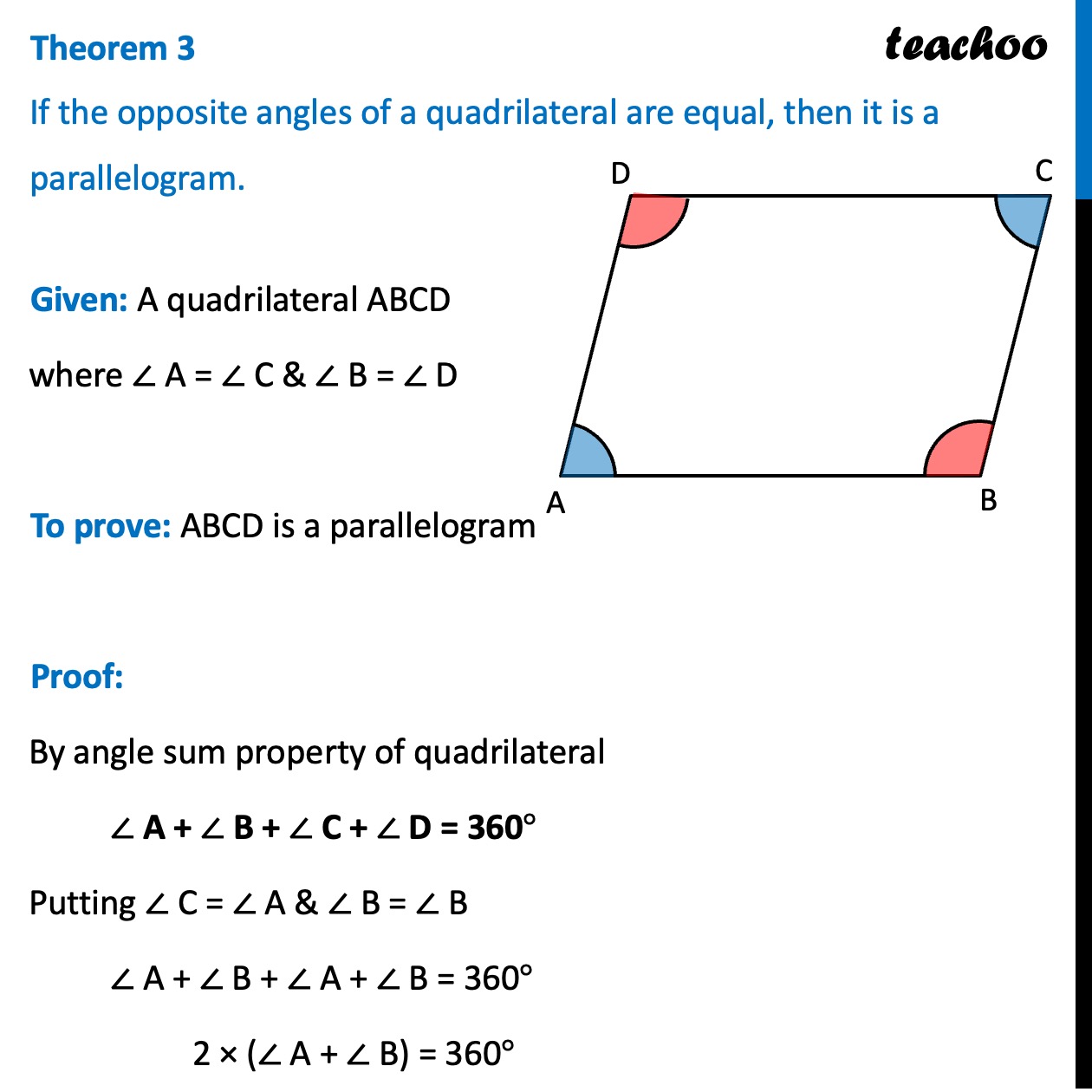
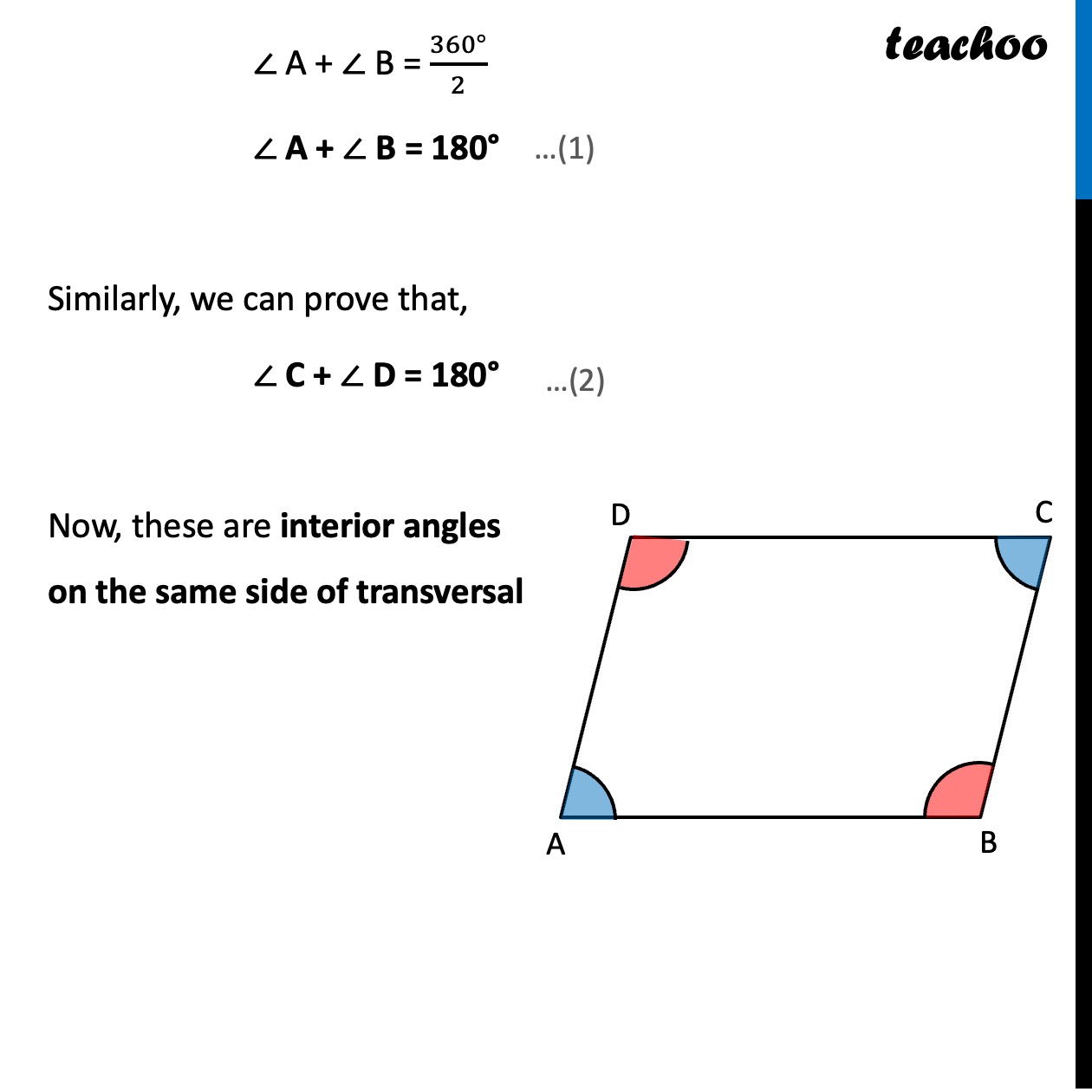
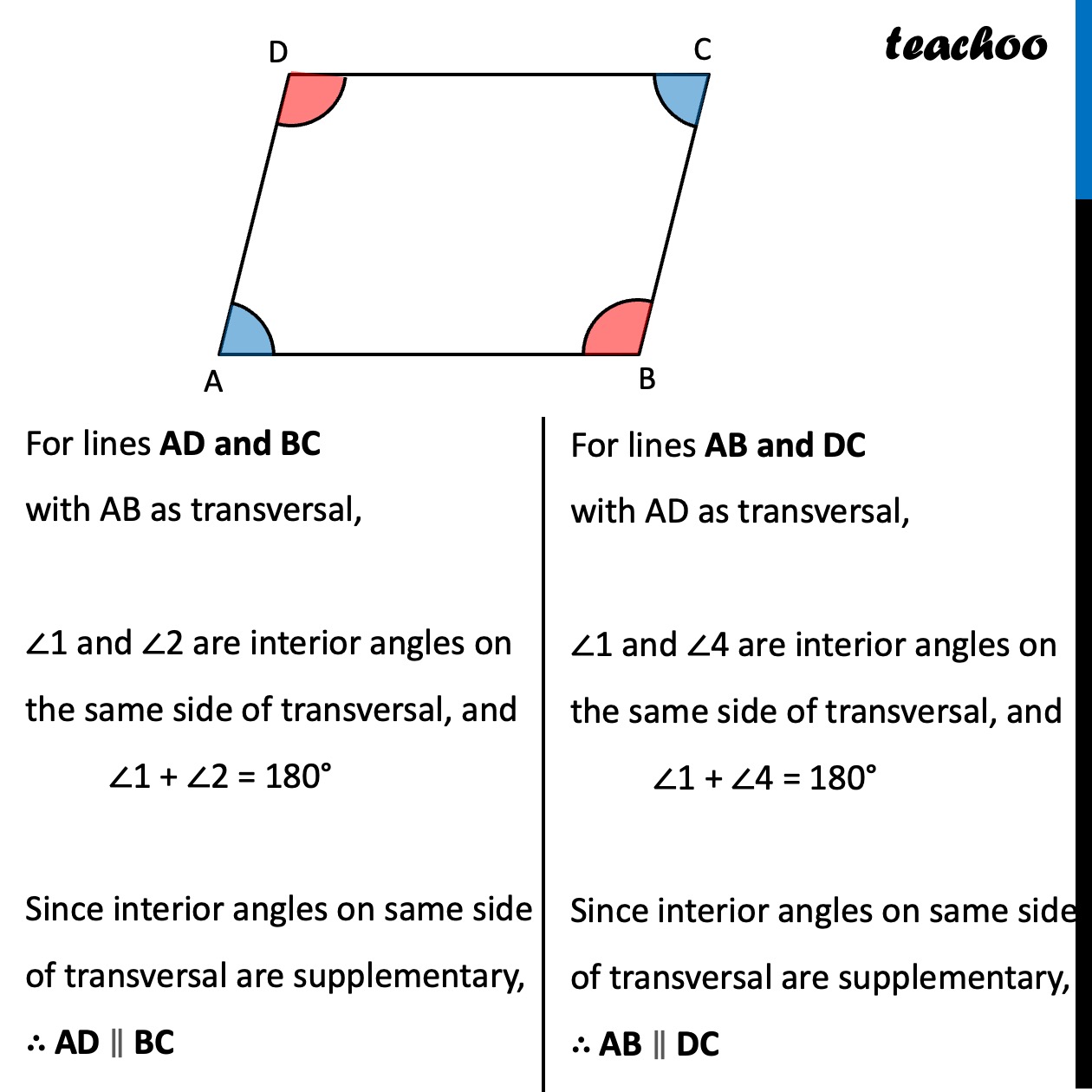
Theorem 3 If the opposite angles of a quadrilateral are equal, then it is a parallelogram. Given: A quadrilateral ABCD where ∠ A = ∠ C & ∠ B = ∠ D To prove: ABCD is a parallelogram Proof: By angle sum property of quadrilateral ∠ A + ∠ B + ∠ C + ∠ D = 360° Putting ∠ C = ∠ A & ∠ B = ∠ B ∠ A + ∠ B + ∠ A + ∠ B = 360° 2 × (∠ A + ∠ B) = 360° A D B C ∠ A + ∠ B = (360°)/(2) ∠ A + ∠ B = 180° Similarly, we can prove that, ∠ C + ∠ D = 180° Now, these are interior angles on the same side of transversal …(1) …(2) A D B C For lines AD and BC with AB as transversal, ∠1 and ∠2 are interior angles on the same side of transversal, and ∠1 + ∠2 = 180° Since interior angles on same side of transversal are supplementary, ∴ AD ∥ BC For lines AB and DC with AD as transversal, ∠1 and ∠4 are interior angles on the same side of transversal, and ∠1 + ∠4 = 180° Since interior angles on same side of transversal are supplementary, ∴ AB ∥ DC A D B C Thus, in ABCD, Both pairs of opposite sides are parallel ∴ ABCD is a parallelogram Hence proved