Theorem 2 - If the opposite sides of a quadrilateral are of equal - Theorems (and their Proofs)

part 2 - Theorem 2 - Theorems (and their Proofs) - Chapter 12 Class 9 - Quadrilaterals (Ganita Manjari) - Maths Class 9

part 3 - Theorem 2 - Theorems (and their Proofs) - Chapter 12 Class 9 - Quadrilaterals (Ganita Manjari) - Maths Class 9

part 4 - Theorem 2 - Theorems (and their Proofs) - Chapter 12 Class 9 - Quadrilaterals (Ganita Manjari) - Maths Class 9

Remove Ads
Teachoo · Class 9 Explore Class 9

Transcript

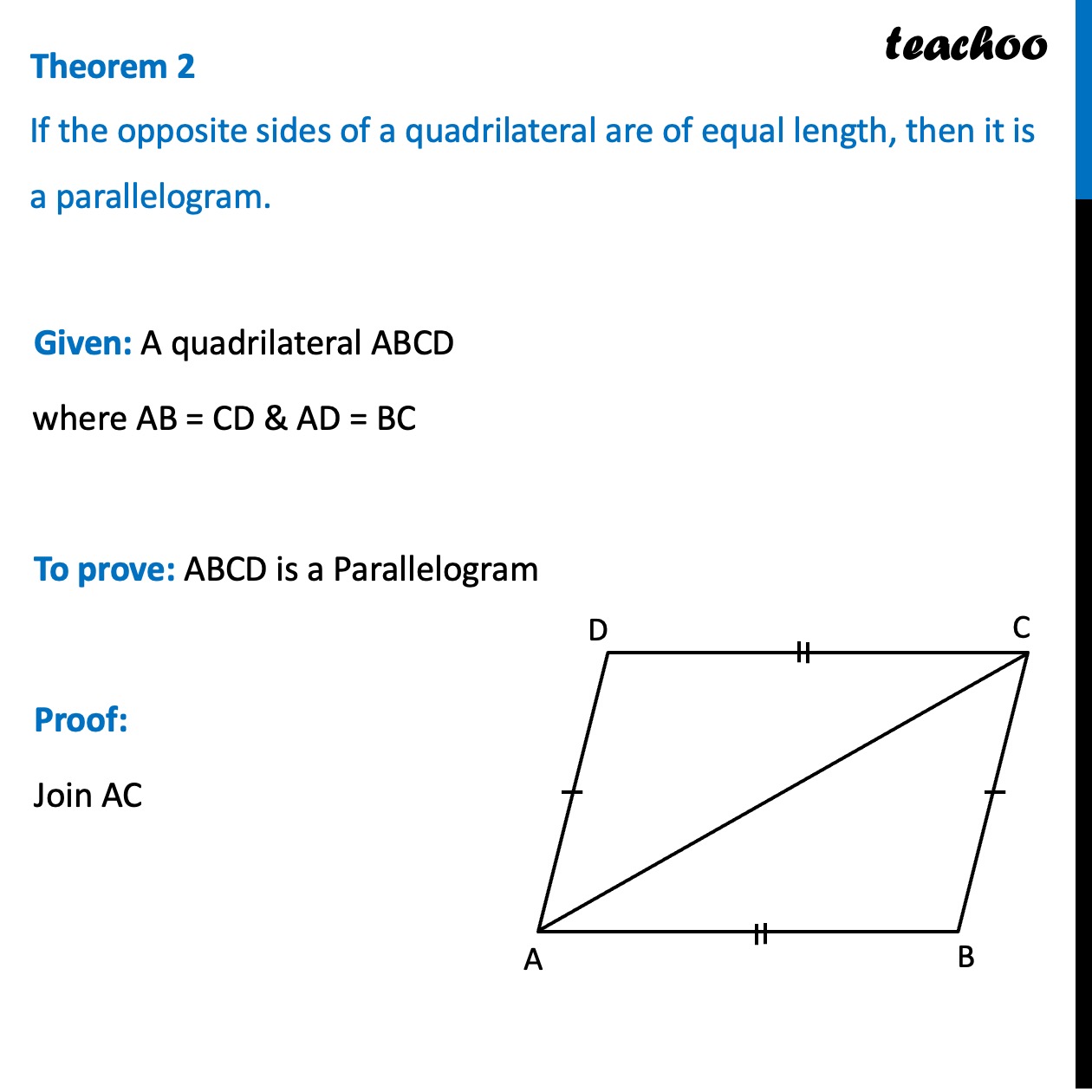
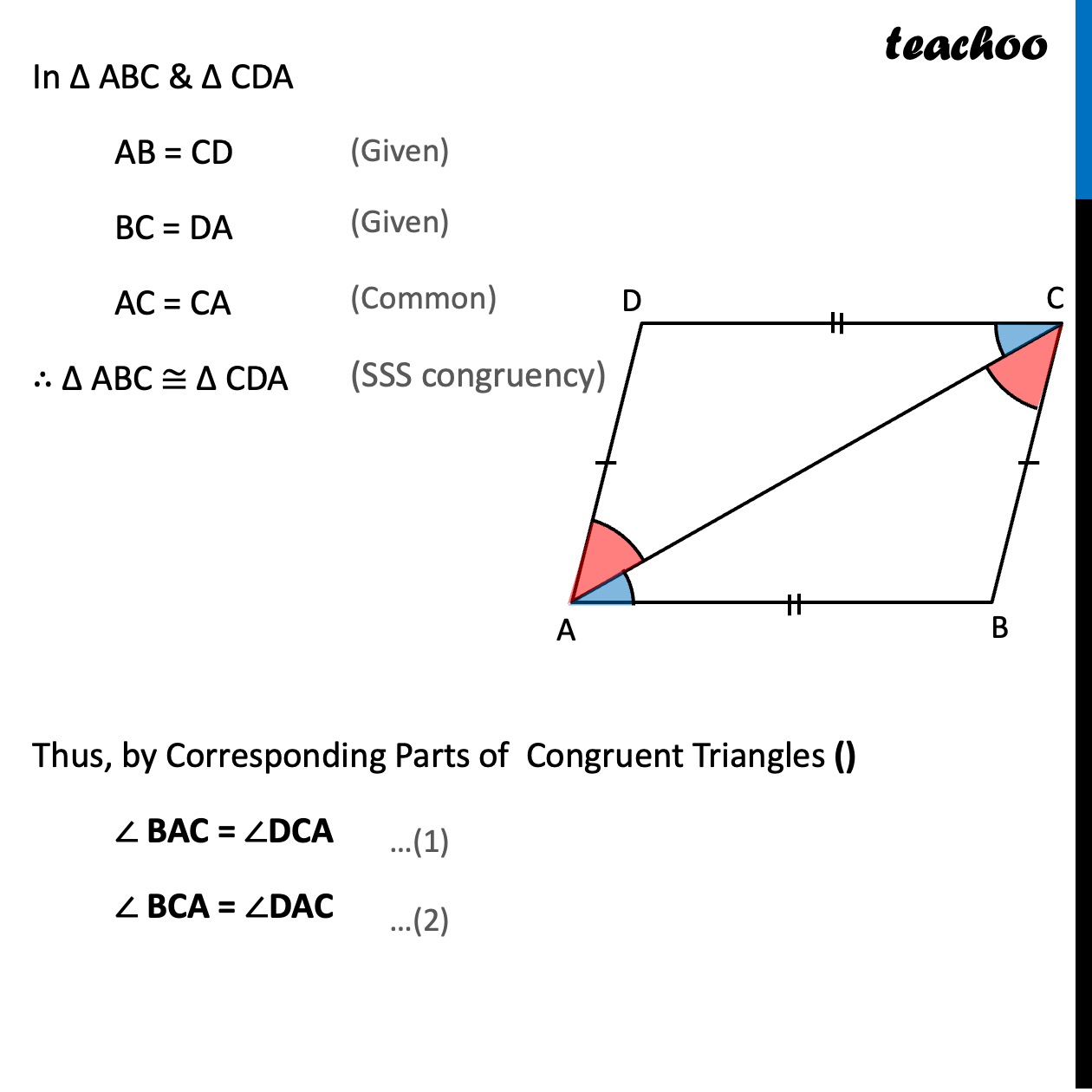
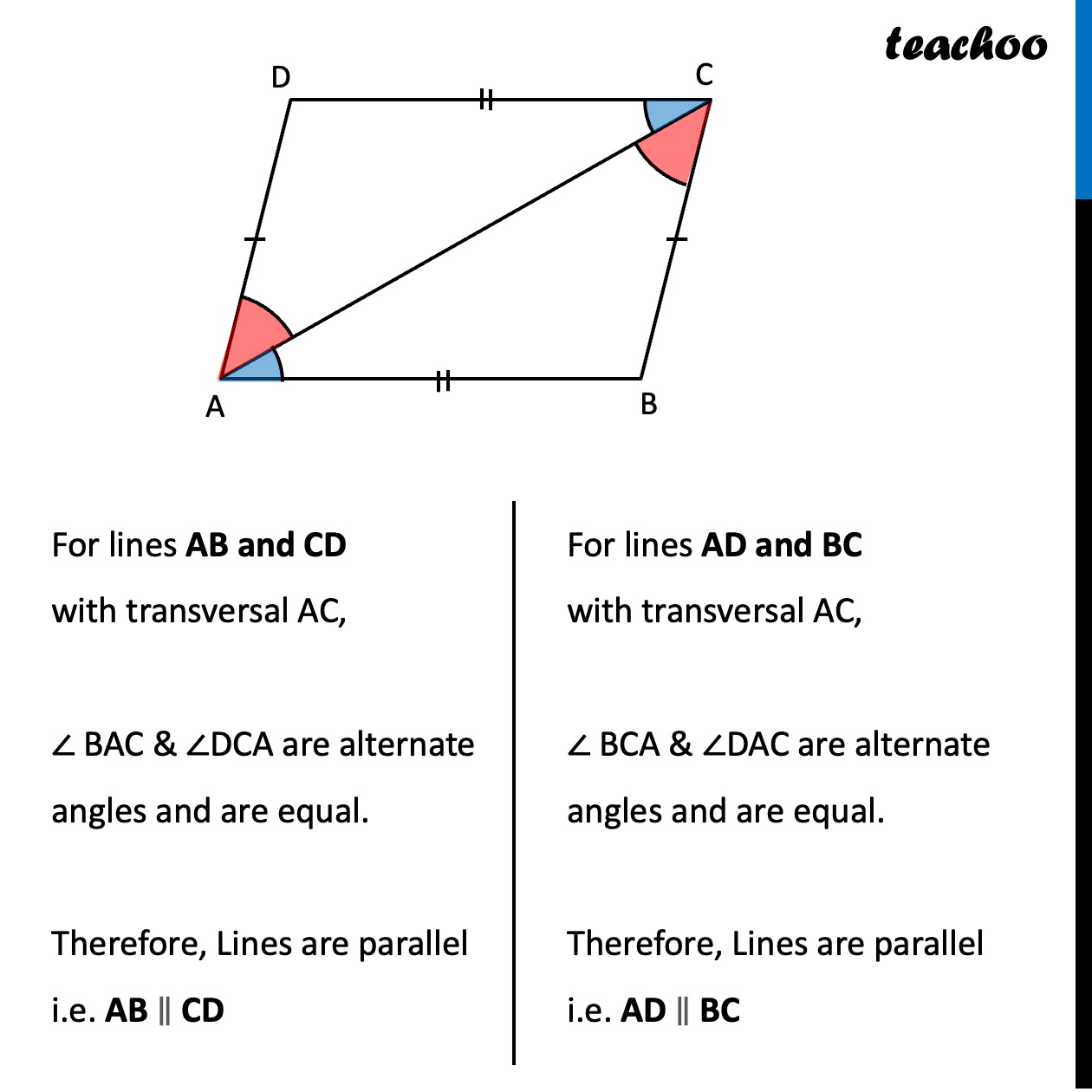
Theorem 2 If the opposite sides of a quadrilateral are of equal length, then it is a parallelogram. Given: A quadrilateral ABCD where AB = CD & AD = BC To prove: ABCD is a Parallelogram Proof: Join AC A D B C In Δ ABC & Δ CDA AB = CD BC = DA AC = CA ∴ Δ ABC ≅ Δ CDA Thus, by Corresponding Parts of Congruent Triangles () ∠ BAC = ∠DCA ∠ BCA = ∠DAC A D B C (Given) (Given) (Common) (SSS congruency) …(1) …(2) For lines AB and CD with transversal AC, ∠ BAC & ∠DCA are alternate angles and are equal. Therefore, Lines are parallel i.e. AB ∥ CD For lines AD and BC with transversal AC, ∠ BCA & ∠DAC are alternate angles and are equal. Therefore, Lines are parallel i.e. AD ∥ BC A D B C Thus, in ABCD, Both pairs of opposite sides are parallel ∴ ABCD is a parallelogram Hence proved

CA Maninder Singh's photo - Co-founder, Teachoo

Made by

CA Maninder Singh

CA Maninder Singh is a Chartered Accountant qualified since 2010 and an educator teaching since 2006. At Teachoo, he draws on his accounting and tax experience to explain Accounts, Income Tax and GST through step-by-step lessons and practical examples.

For an uninterrupted learning experience, students can use Teachoo Black to remove ads and focus better.