You are here
Last updated at November 5, 2026 by Teachoo
Transcript
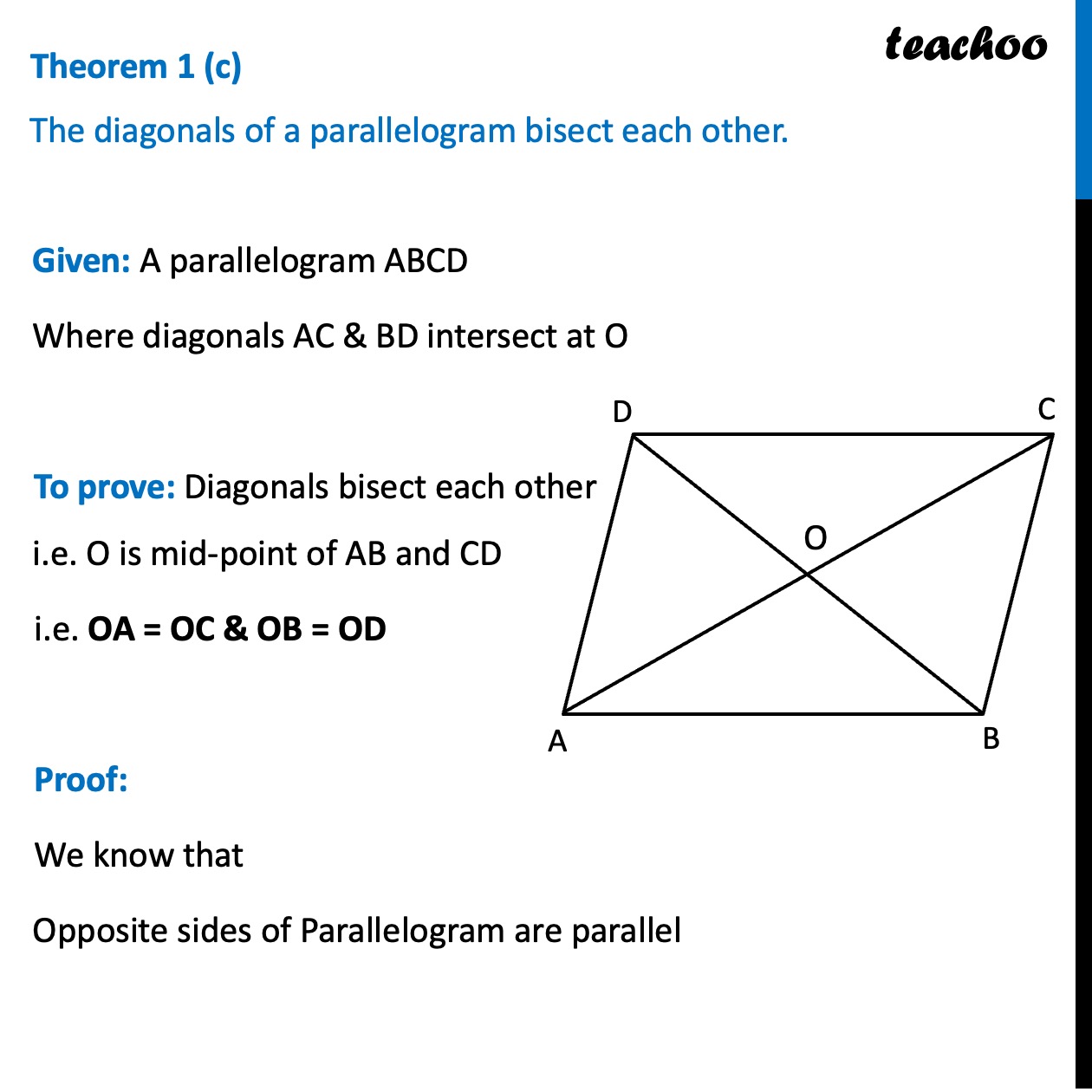
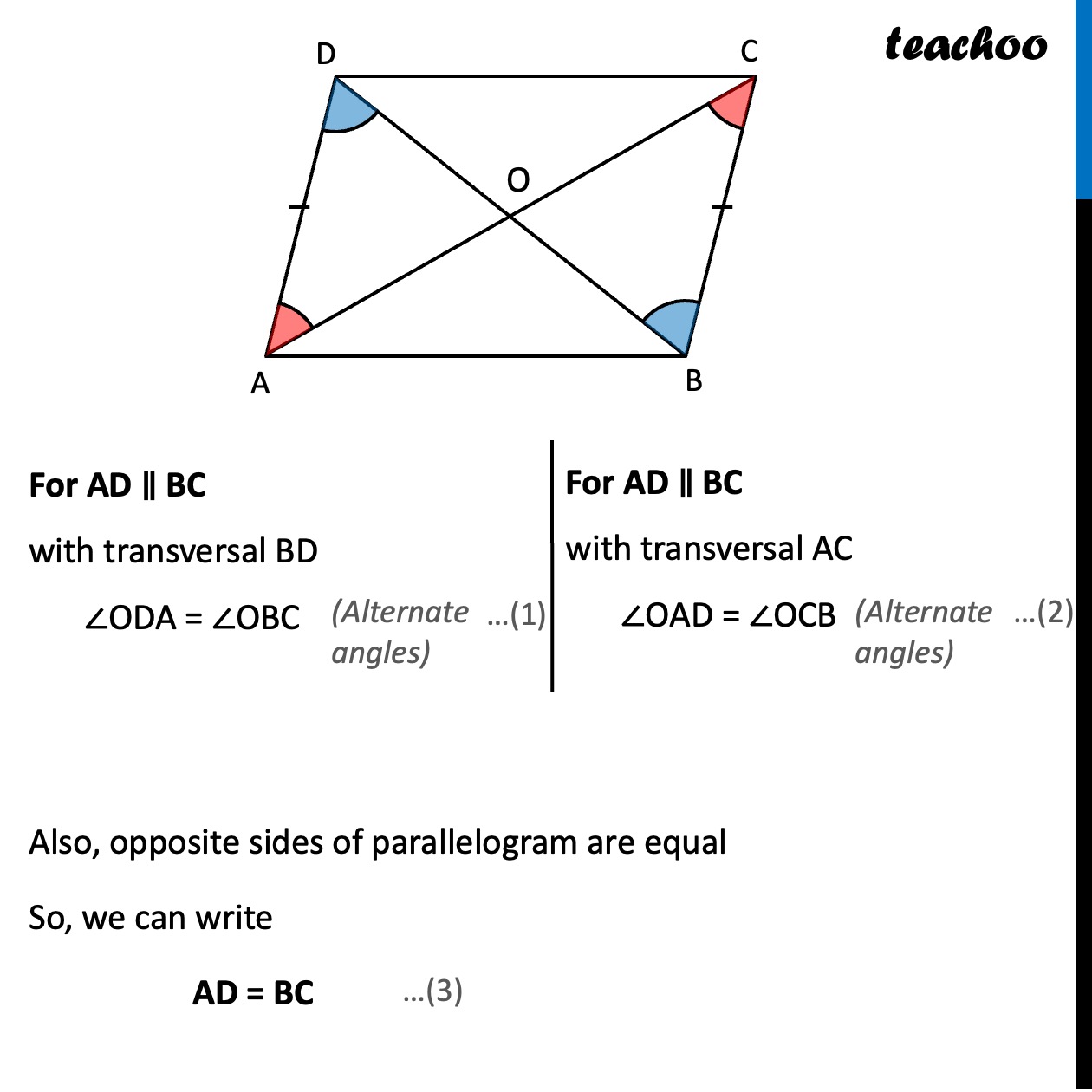
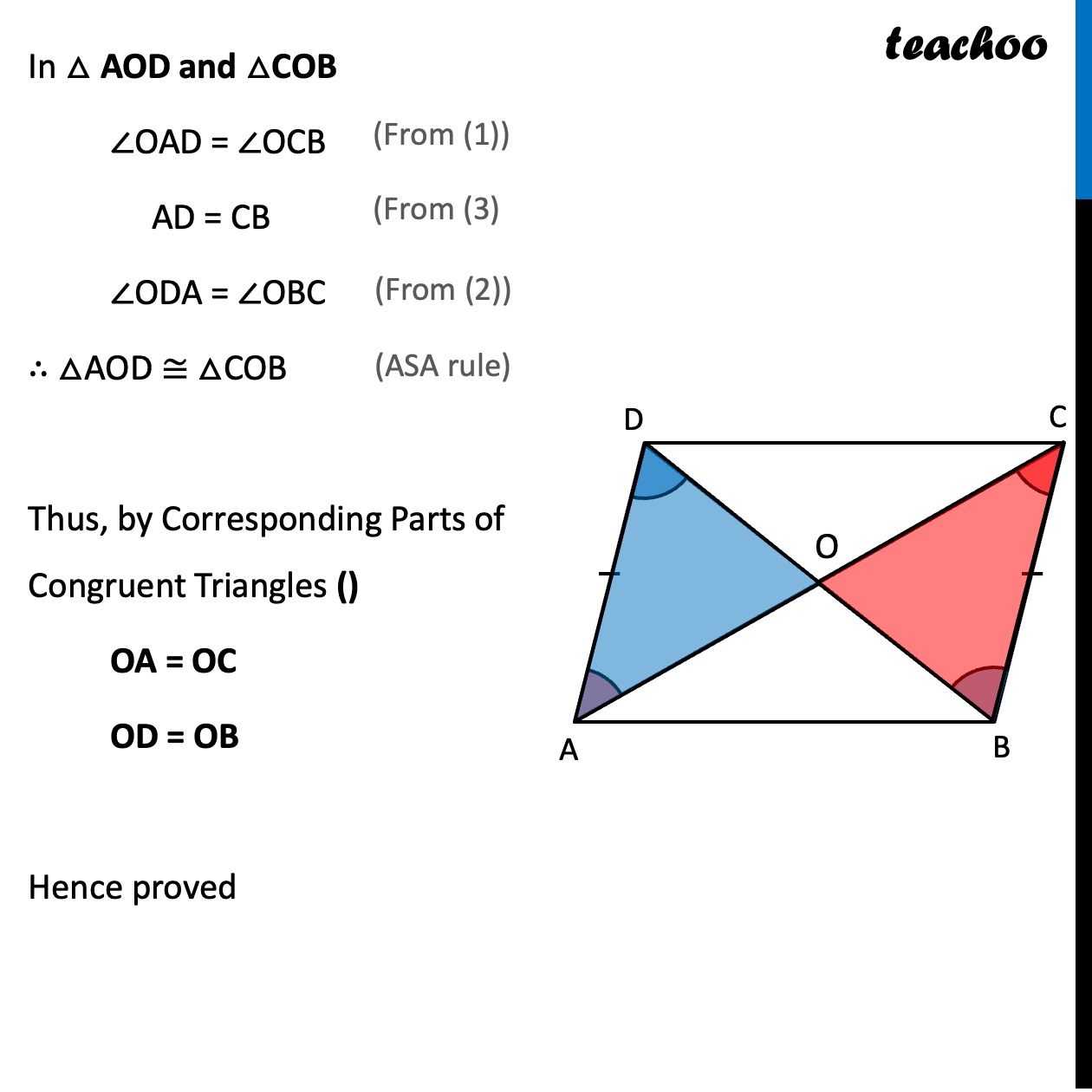
Theorem 1 (c) The diagonals of a parallelogram bisect each other. Given: A parallelogram ABCD Where diagonals AC & BD intersect at O To prove: Diagonals bisect each other i.e. O is mid-point of AB and CD i.e. OA = OC & OB = OD Proof: We know that Opposite sides of Parallelogram are parallel A D B C O Also, opposite sides of parallelogram are equal So, we can write AD = BC A D B C O For AD ∥ BC with transversal BD ∠ODA = ∠OBC For AD ∥ BC with transversal AC ∠OAD = ∠OCB (Alternate angles) (Alternate angles) …(1) …(2) …(3) In △ AOD and △COB ∠OAD = ∠OCB AD = CB ∠ODA = ∠OBC ∴ △AOD ≅ △COB Thus, by Corresponding Parts of Congruent Triangles () OA = OC OD = OB Hence proved A D B C O (From (1)) (From (3) (From (2)) (ASA rule)