
 You are here
Last updated at November 5, 2026 by Teachoo
Transcript
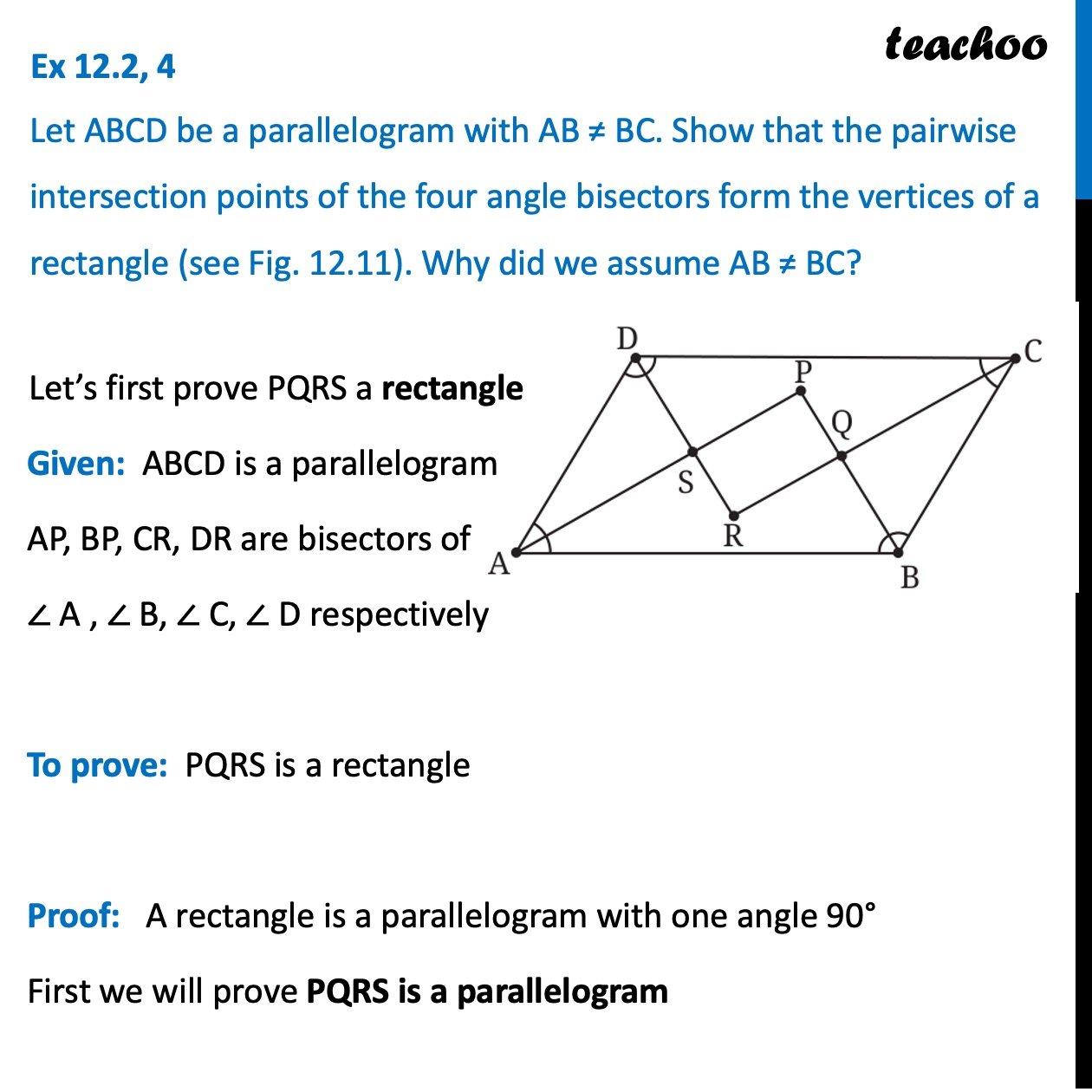
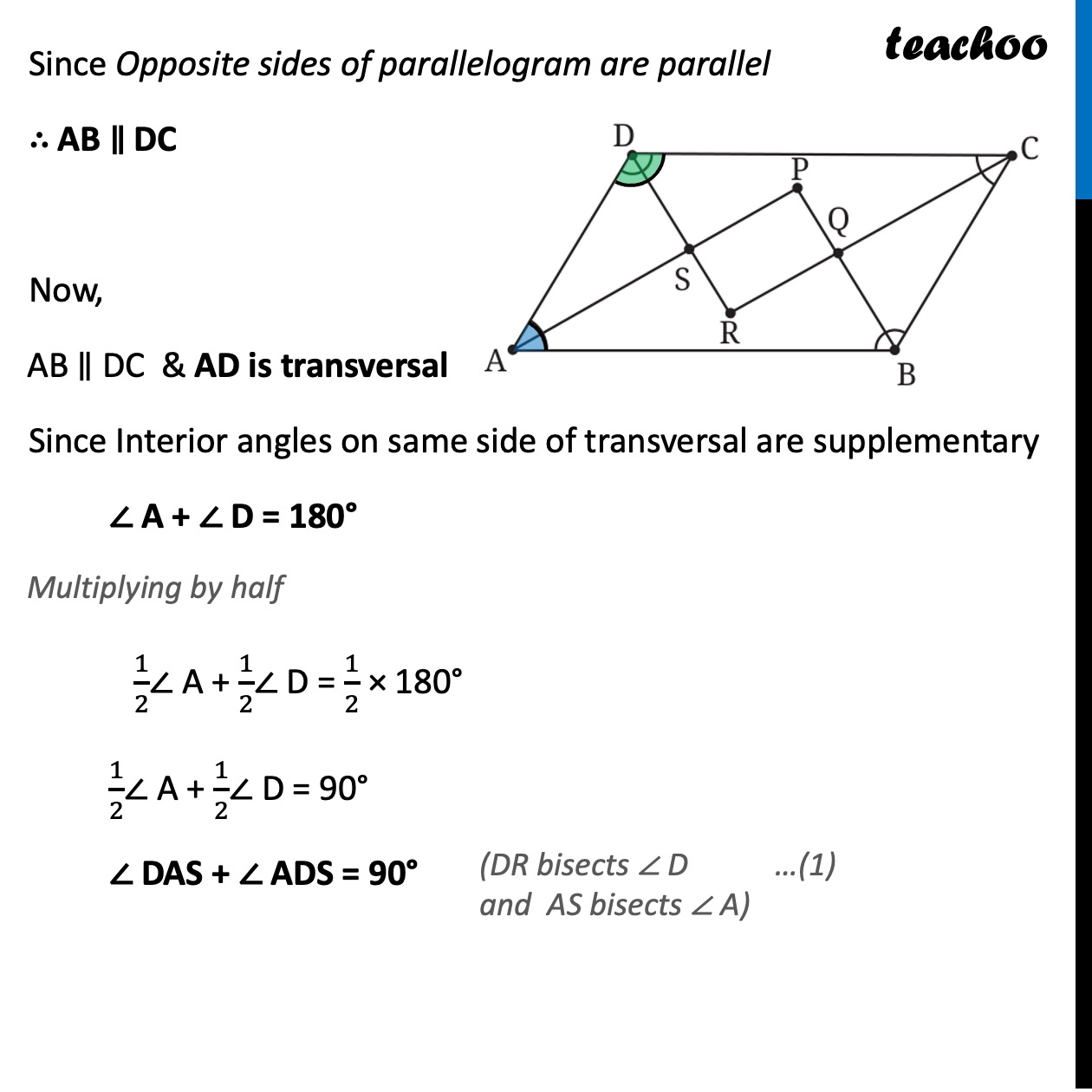
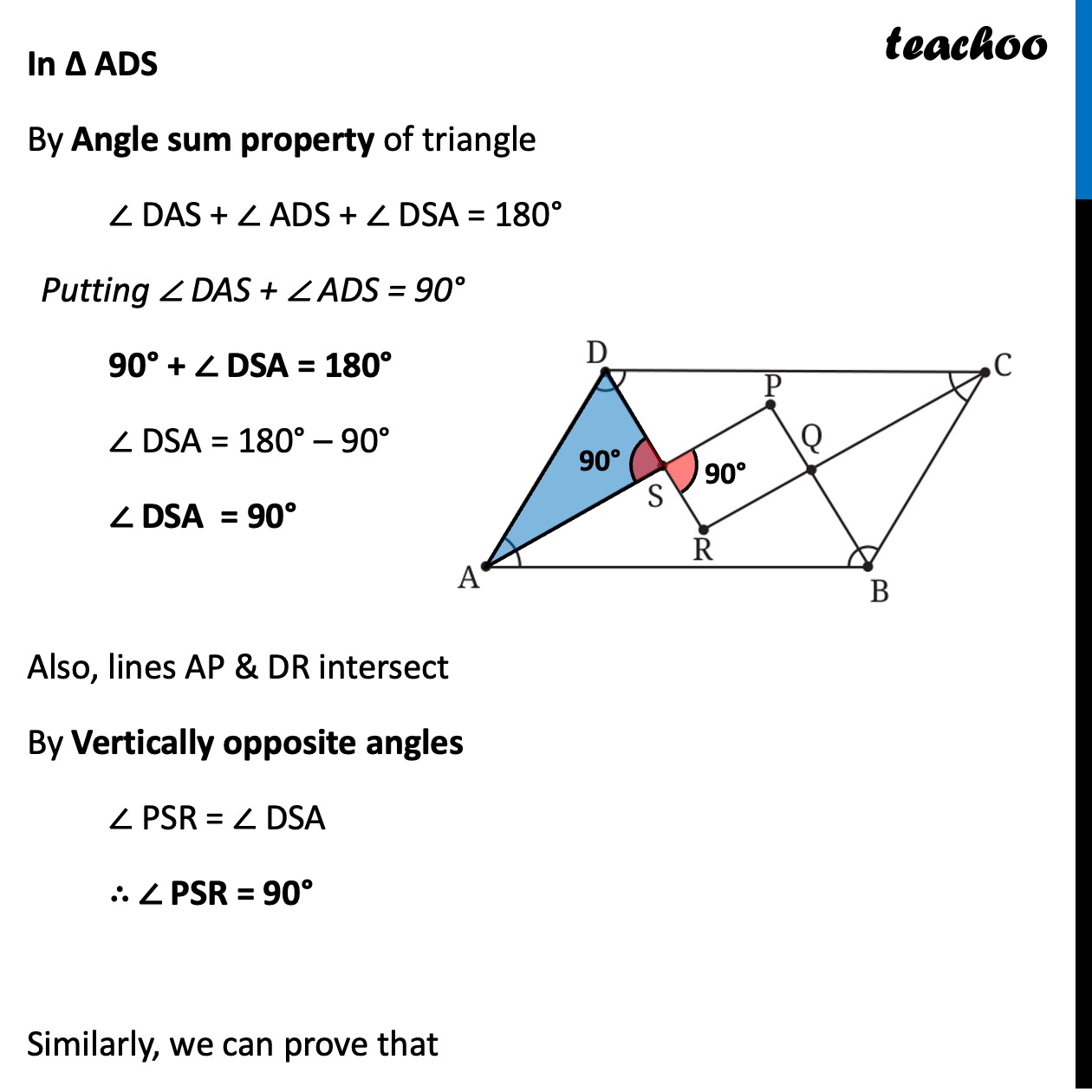
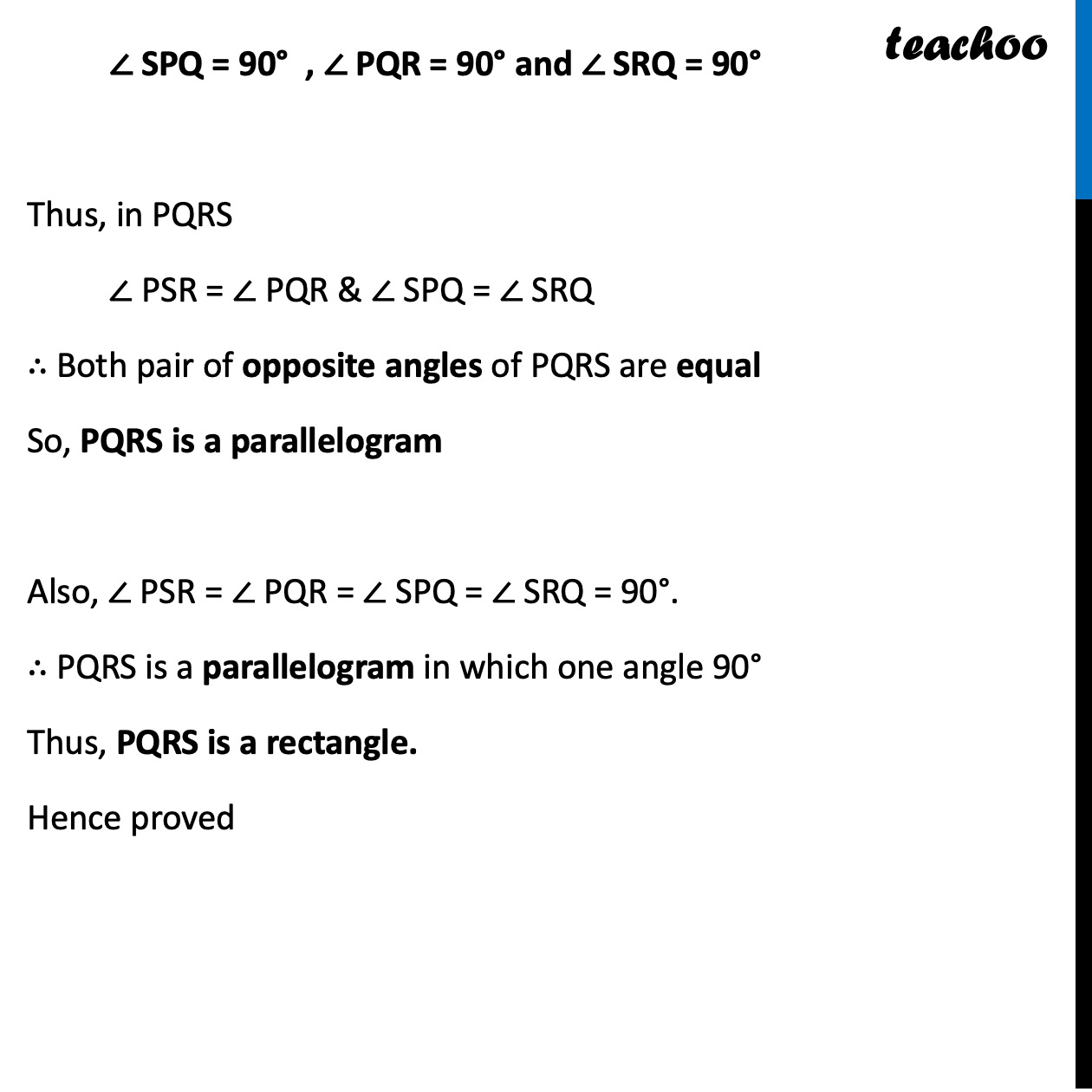
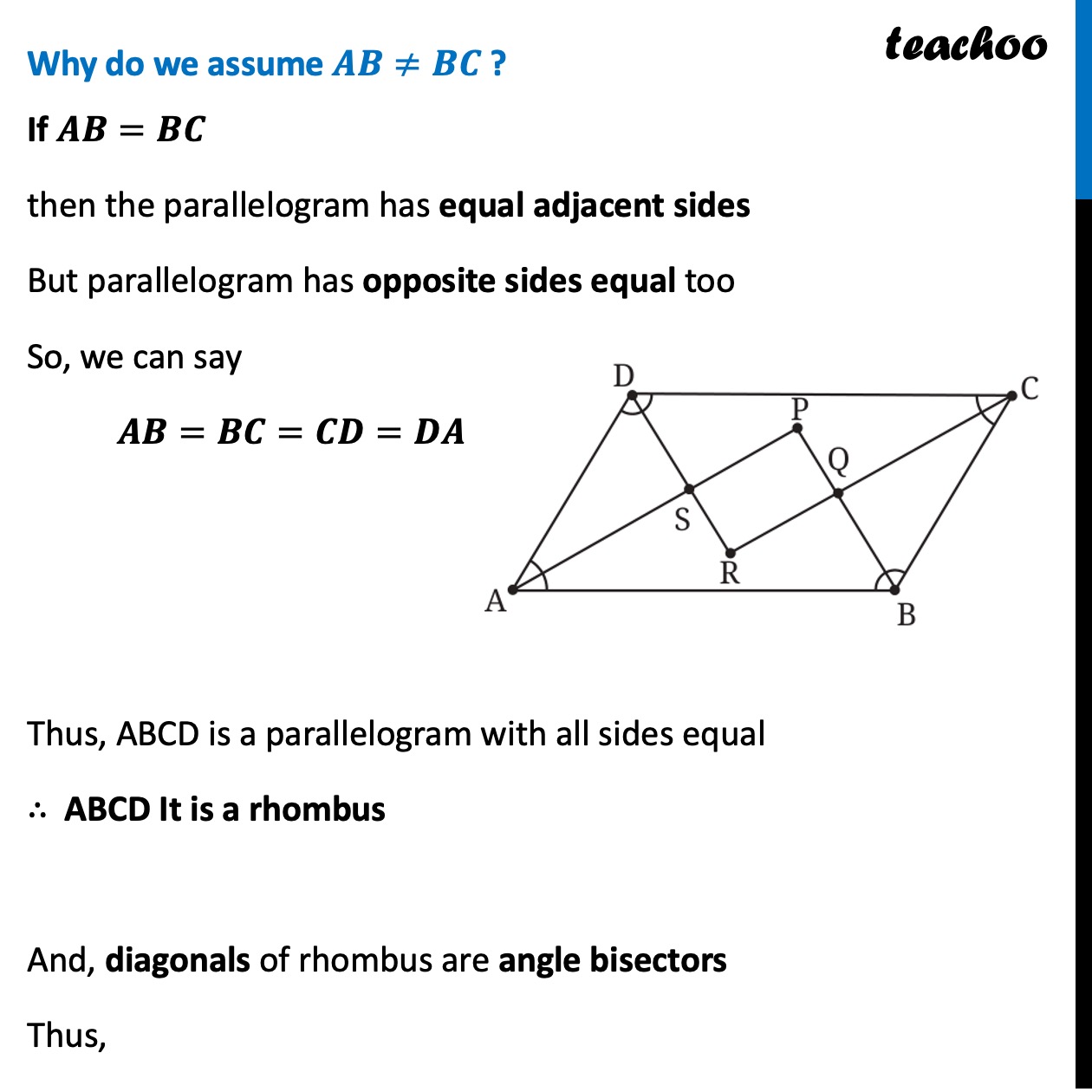
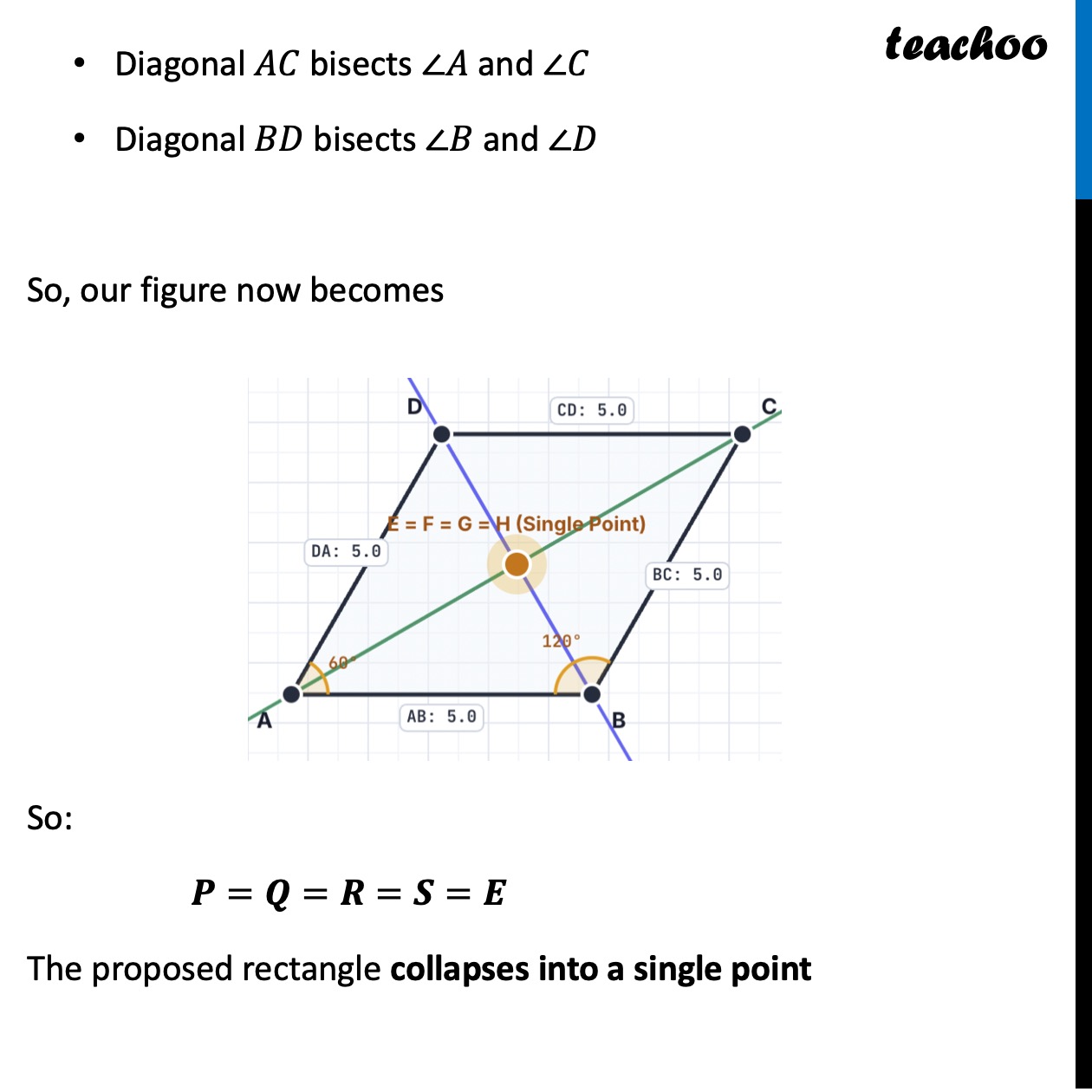
Ex 12.2, 4 Let ABCD be a parallelogram with AB ≠ BC. Show that the pairwise intersection points of the four angle bisectors form the vertices of a rectangle (see Fig. 12.11). Why did we assume AB ≠ BC? Let’s first prove PQRS a rectangle Given: ABCD is a parallelogram AP, BP, CR, DR are bisectors of ∠ A , ∠ B, ∠ C, ∠ D respectively To prove: PQRS is a rectangle Proof: A rectangle is a parallelogram with one angle 90° First we will prove PQRS is a parallelogram Fig. 12.11 Since Opposite sides of parallelogram are parallel ∴ AB ∥ DC Now, AB ∥ DC & AD is transversal Since Interior angles on same side of transversal are supplementary ∠ A + ∠ D = 180° Multiplying by half (1)/(2)∠ A + (1)/(2)∠ D = (1)/(2) × 180° (1)/(2)∠ A + (1)/(2)∠ D = 90° ∠ DAS + ∠ ADS = 90° (DR bisects ∠ D and AS bisects ∠ A) …(1) Fig. 12.11 In Δ ADS By Angle sum property of triangle ∠ DAS + ∠ ADS + ∠ DSA = 180° Putting ∠ DAS + ∠ ADS = 90° 90° + ∠ DSA = 180° ∠ DSA = 180° – 90° ∠ DSA = 90° Also, lines AP & DR intersect By Vertically opposite angles ∠ PSR = ∠ DSA ∴ ∠ PSR = 90° Similarly, we can prove that ∠ SPQ = 90° , ∠ PQR = 90° and ∠ SRQ = 90° 90° 90° Fig. 12.11 ∠ SPQ = 90° , ∠ PQR = 90° and ∠ SRQ = 90° Thus, in PQRS ∠ PSR = ∠ PQR & ∠ SPQ = ∠ SRQ ∴ Both pair of opposite angles of PQRS are equal So, PQRS is a parallelogram Also, ∠ PSR = ∠ PQR = ∠ SPQ = ∠ SRQ = 90°. ∴ PQRS is a parallelogram in which one angle 90° Thus, PQRS is a rectangle. Hence proved Why do we assume 𝑨𝑩≠𝑩𝑪 ? If 𝑨𝑩=𝑩𝑪 then the parallelogram has equal adjacent sides But parallelogram has opposite sides equal too So, we can say 𝑨𝑩=𝑩𝑪=𝑪𝑫=𝑫𝑨 Thus, ABCD is a parallelogram with all sides equal ∴ ABCD It is a rhombus And, diagonals of rhombus are angle bisectors Thus, Diagonal 𝐴𝐶 bisects ∠𝐴 and ∠𝐶 Diagonal 𝐵𝐷 bisects ∠𝐵 and ∠𝐷 So, our figure now becomes These facts follow by comparing the triangles on either side of each diagonal using SSS. Therefore the four angle bisectors lie along just two diagonal lines. They all meet at the diagonal intersection 𝐸. So: 𝑃=𝑄=𝑅=𝑆=𝐸. The proposed rectangle collapses into a single point. Hence the condition: 𝐴𝐵≠𝐵𝐶 excludes the rhombus case and ensures that the angle bisectors produce four distinct corners of a rectangle. Fig. 12.11 Diagonal 𝐴𝐶 bisects ∠𝐴 and ∠𝐶 Diagonal 𝐵𝐷 bisects ∠𝐵 and ∠𝐷 So, our figure now becomes So: 𝑷=𝑸=𝑹=𝑺=𝑬 The proposed rectangle collapses into a single point Hence the condition: 𝑨𝑩≠𝑩𝑪 excludes the rhombus case and ensures that the angle bisectors produce four distinct corners of a rectangle. AB: 5.0 AY Hence the condition: 𝑨𝑩≠𝑩𝑪 excludes the rhombus case and ensures that the angle bisectors produce four distinct corners of a rectangle.
