You are here
Last updated at November 5, 2026 by Teachoo
Transcript
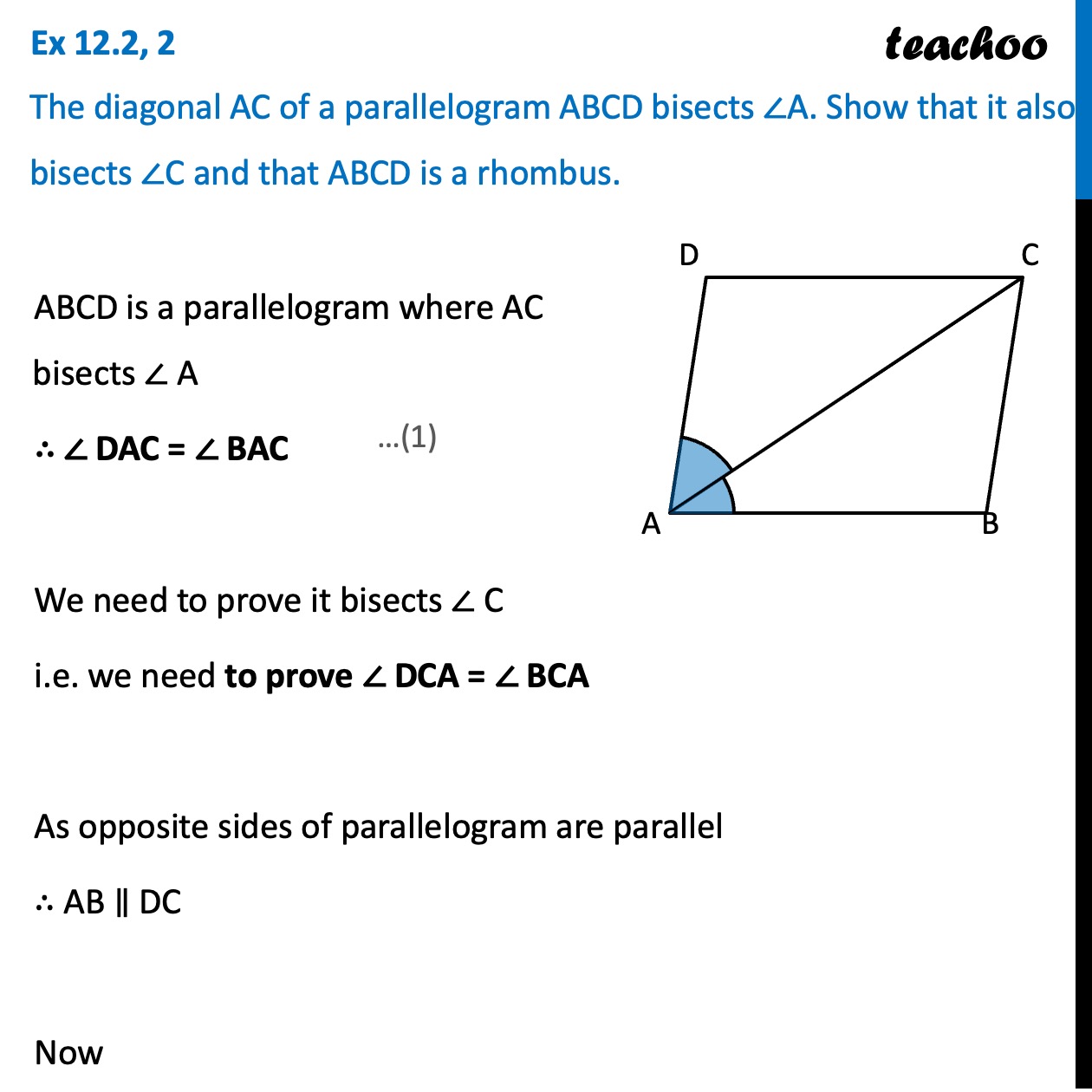
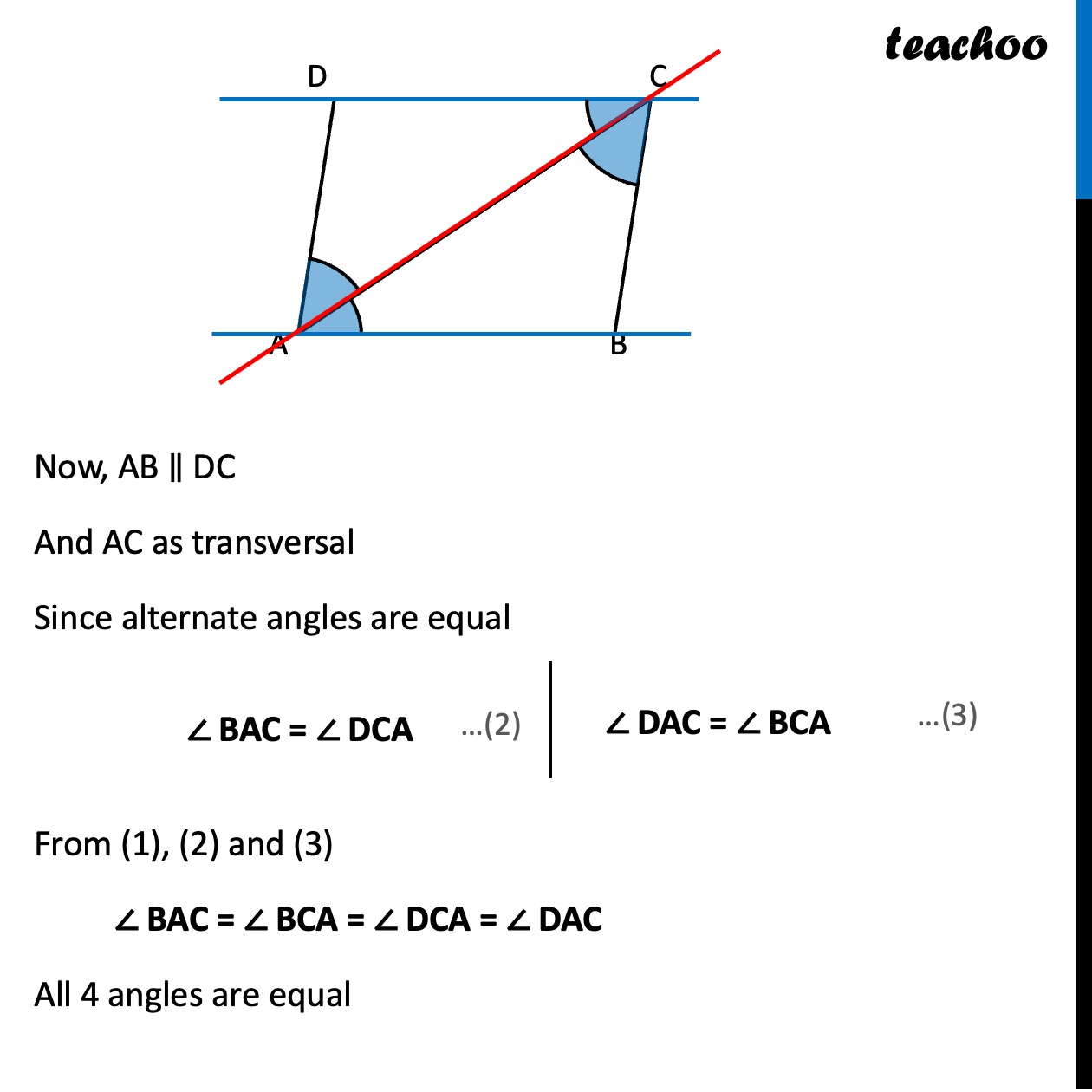
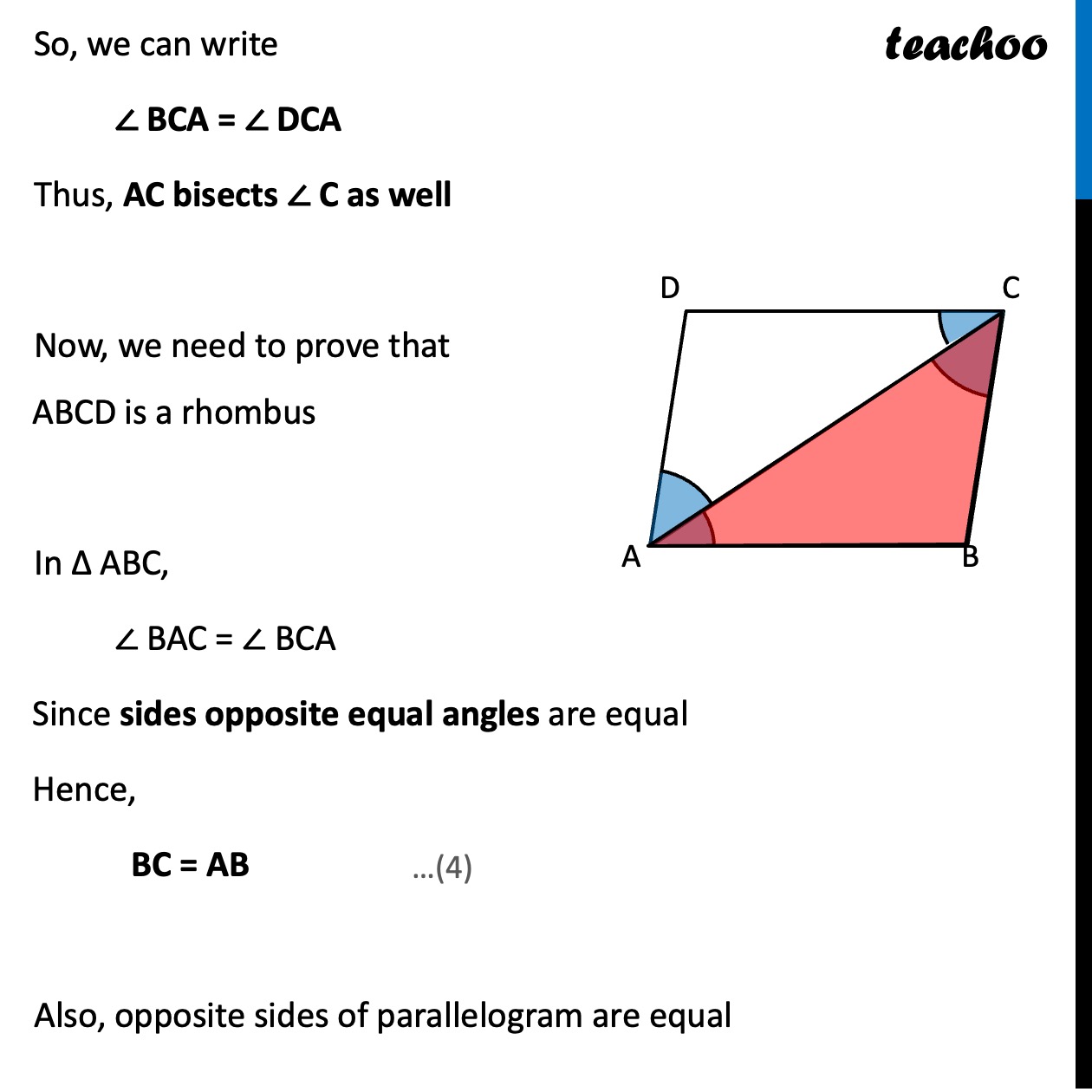
Ex 12.2, 2 The diagonal AC of a parallelogram ABCD bisects ∠A. Show that it also bisects ∠C and that ABCD is a rhombus. ABCD is a parallelogram where AC bisects ∠ A ∴ ∠ DAC = ∠ BAC We need to prove it bisects ∠ C i.e. we need to prove ∠ DCA = ∠ BCA As opposite sides of parallelogram are parallel ∴ AB ∥ DC Now A B C D …(1) Now, AB ∥ DC And AC as transversal Since alternate angles are equal From (1), (2) and (3) ∠ BAC = ∠ BCA = ∠ DCA = ∠ DAC All 4 angles are equal So, we can write ∠ BCA = ∠ DCA Thus, AC bisects ∠ C as well Now, we need to prove that ABCD is a rhombus A B C D …(2) …(3) ∠ BAC = ∠ DCA ∠ DAC = ∠ BCA So, we can write ∠ BCA = ∠ DCA Thus, AC bisects ∠ C as well Now, we need to prove that ABCD is a rhombus In ∆ ABC, ∠ BAC = ∠ BCA Since sides opposite equal angles are equal Hence, BC = AB Also, opposite sides of parallelogram are equal A B C D …(4) ∴ AB = CD & BC = AD Thus, from (4) and (5) AB = BC = CD = AD So, ABCD is a parallelogram with all 4 sides equal ∴ ABCD is a rhombus Hence proved …(5)