You are here
Last updated at November 5, 2026 by Teachoo
Transcript
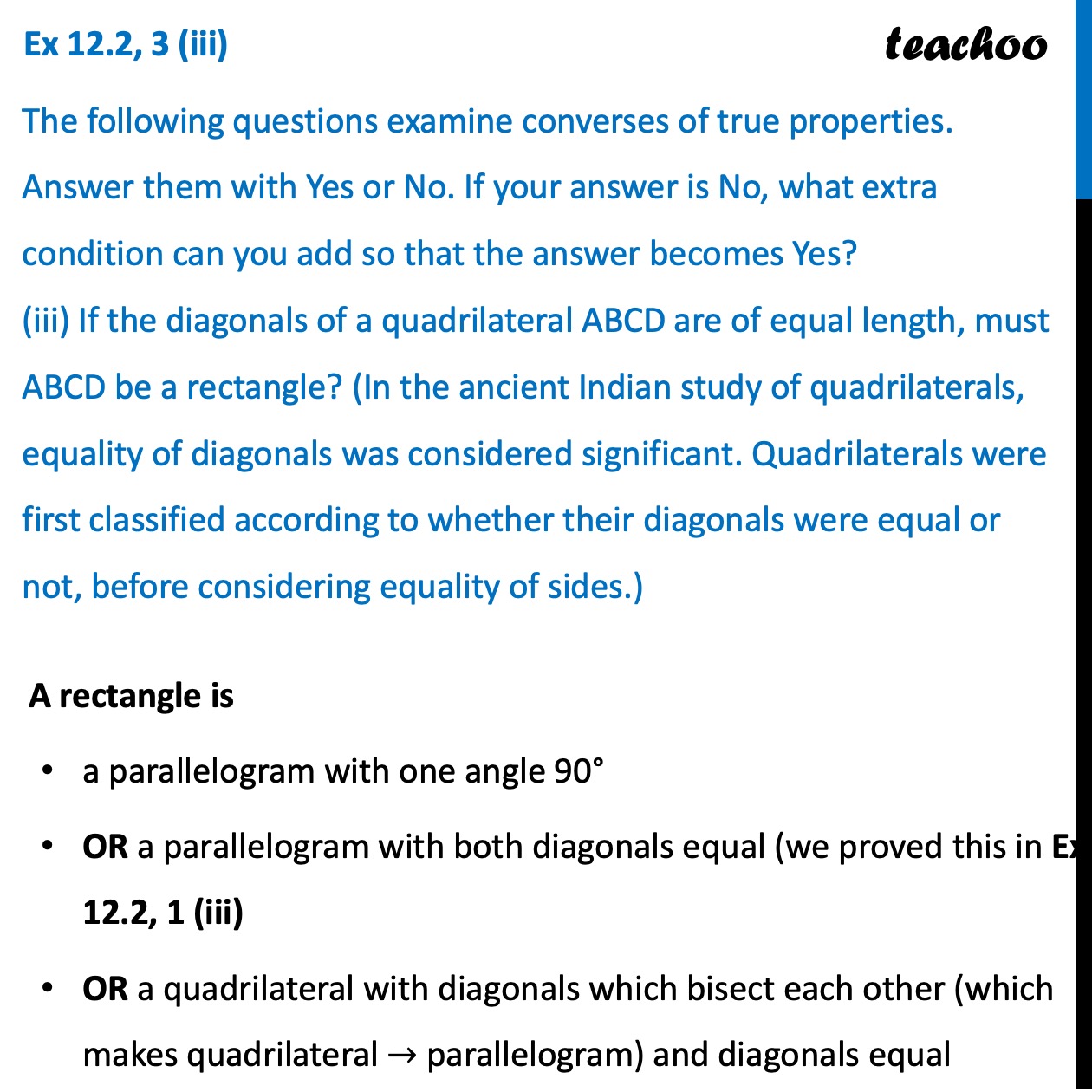
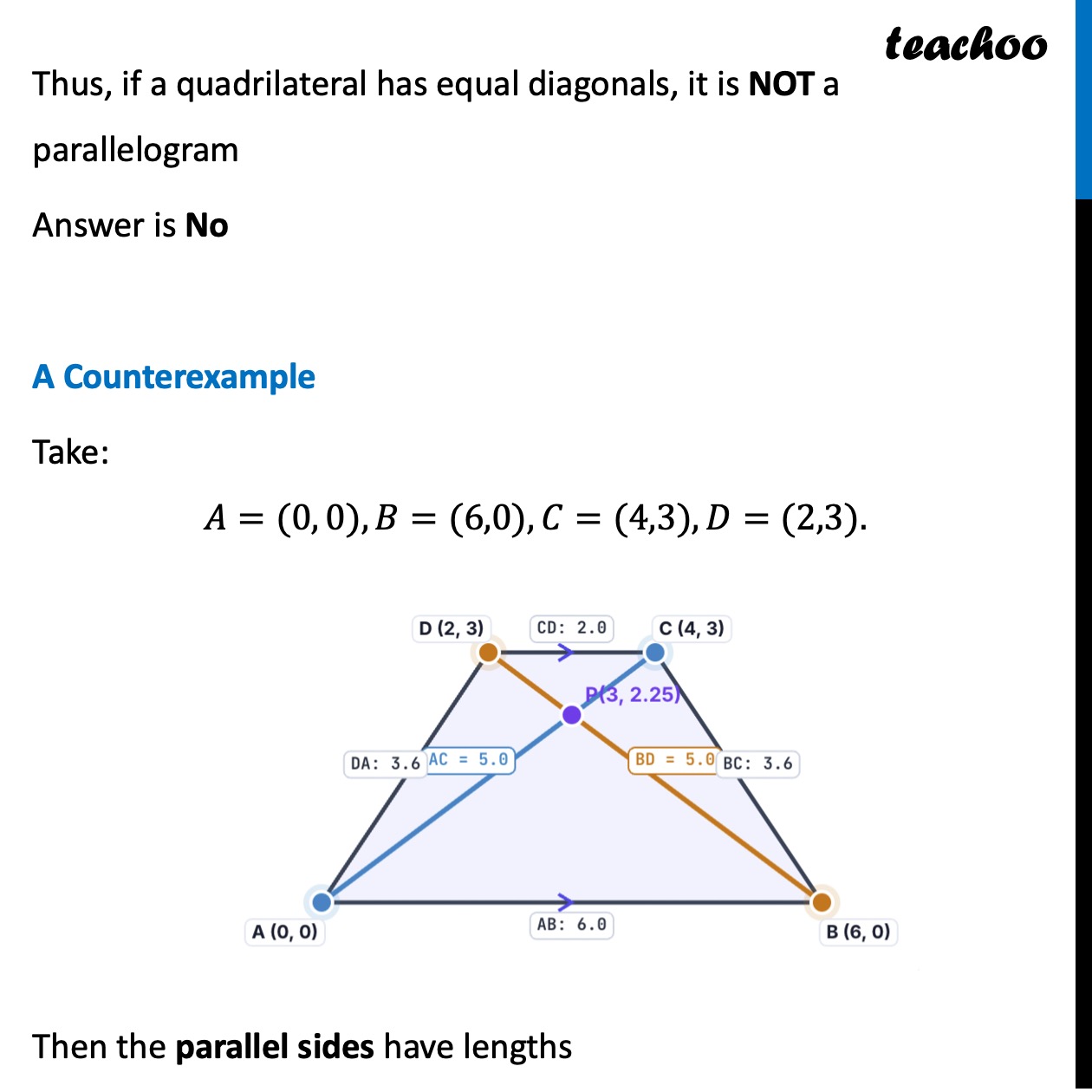
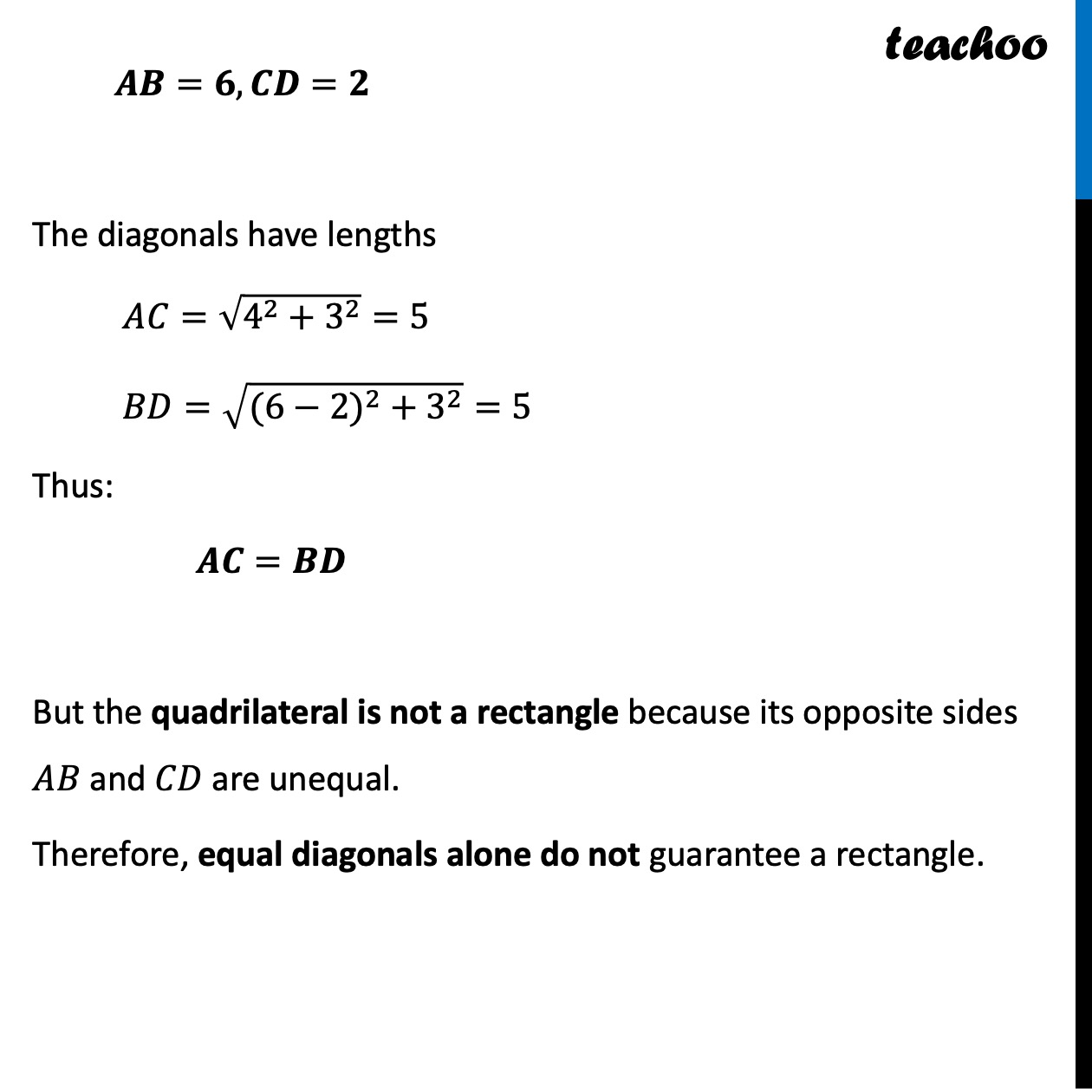
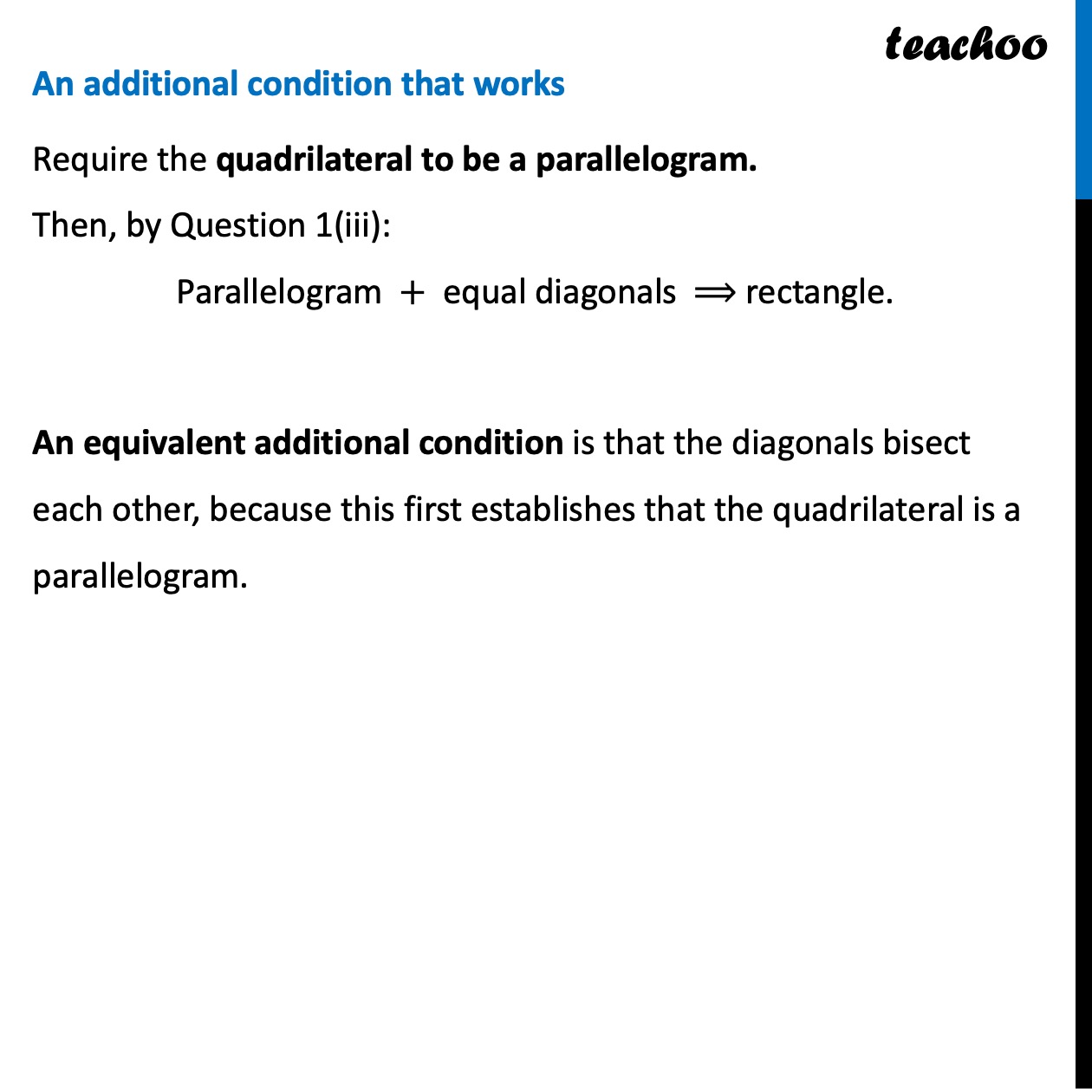
Ex 12.2, 3 (iii) The following questions examine converses of true properties. Answer them with Yes or No. If your answer is No, what extra condition can you add so that the answer becomes Yes? (iii) If the diagonals of a quadrilateral ABCD are of equal length, must ABCD be a rectangle? (In the ancient Indian study of quadrilaterals, equality of diagonals was considered significant. Quadrilaterals were first classified according to whether their diagonals were equal or not, before considering equality of sides.) A rectangle is a parallelogram with one angle 90° OR a parallelogram with both diagonals equal (we proved this in Ex 12.2, 1 (iii) OR a quadrilateral with diagonals which bisect each other (which makes quadrilateral → parallelogram) and diagonals equal Thus, if a quadrilateral has equal diagonals, it is NOT a parallelogram Answer is No A Counterexample Take: 𝐴=(0, 0), 𝐵=(6,0), 𝐶=(4,3), 𝐷=(2,3). Then the parallel sides have lengths 𝑨𝑩=𝟔, 𝑪𝑫=𝟐 The diagonals have lengths: [𝐴𝐶=sqrt(4^(2)+3^(2))=5; 𝐵𝐷=sqrt((6−2)^(2)+3^(2))=5.] Thus: 𝐴𝐶=𝐵𝐷. But the quadrilateral is not a rectangle-for example, its opposite sides 𝐴𝐵 and 𝐶𝐷 are unequal. Therefore equal diagonals alone do not guarantee a rectangle. Require the quadrilateral to be a parallelogram. Then, by Question 1(iii): Parallelogram + equal diagonals ⟹ rectangle. An equivalent additional condition is that the diagonals bisect each other, because this first establishes that the quadrilateral is a parallelogram. A (0, 0) AB: 6.6 B (6, 0) 𝑨𝑩=𝟔, 𝑪𝑫=𝟐 The diagonals have lengths 𝐴𝐶=sqrt(4^(2)+3^(2))=5 𝐵𝐷=sqrt((6−2)^(2)+3^(2))=5 Thus: 𝑨𝑪=𝑩𝑫 But the quadrilateral is not a rectangle because its opposite sides 𝐴𝐵 and 𝐶𝐷 are unequal. Therefore, equal diagonals alone do not guarantee a rectangle. An additional condition that works Require the quadrilateral to be a parallelogram. Then, by Question 1(iii): Parallelogram + equal diagonals ⟹ rectangle. An equivalent additional condition is that the diagonals bisect each other, because this first establishes that the quadrilateral is a parallelogram.