You are here
Last updated at November 5, 2026 by Teachoo
Transcript
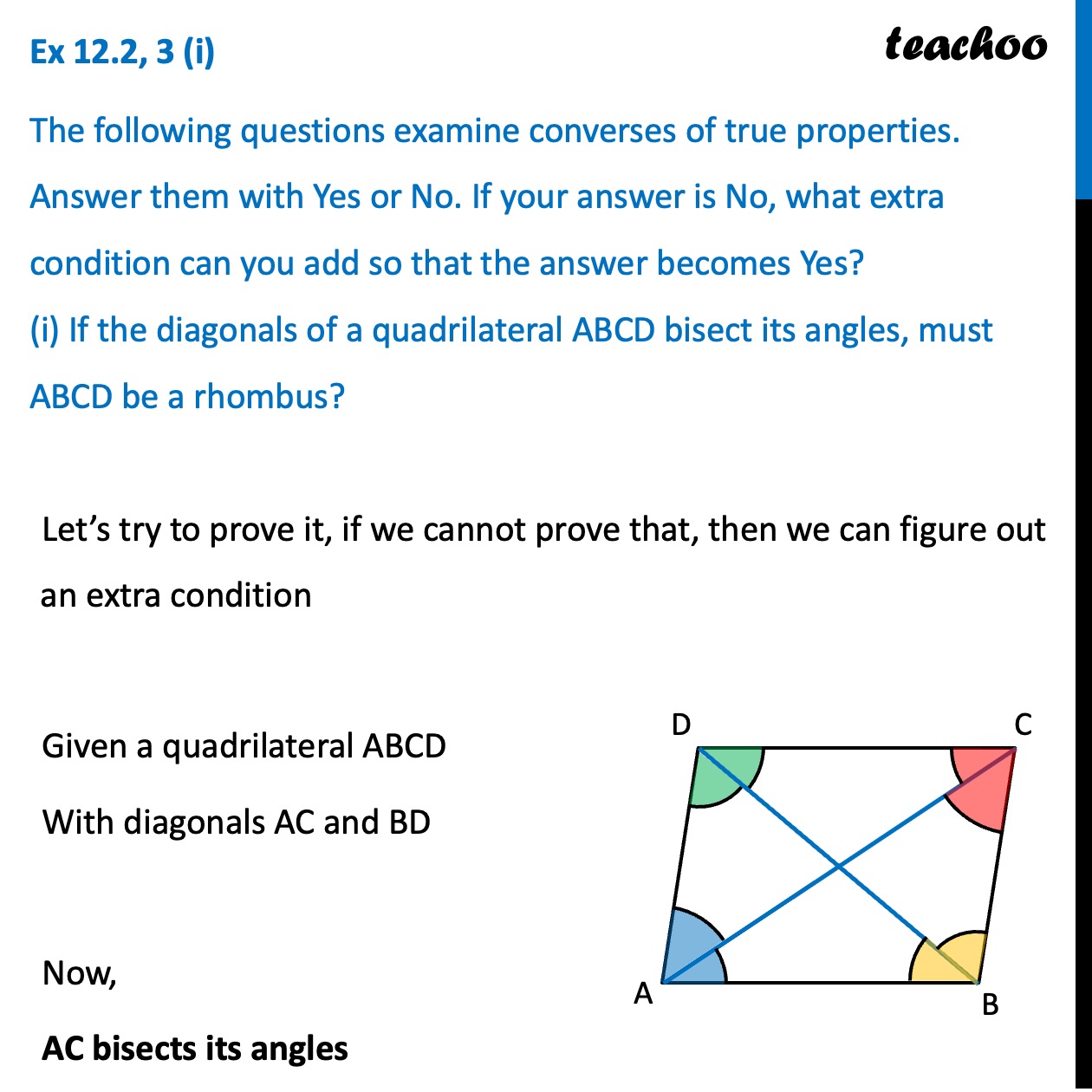
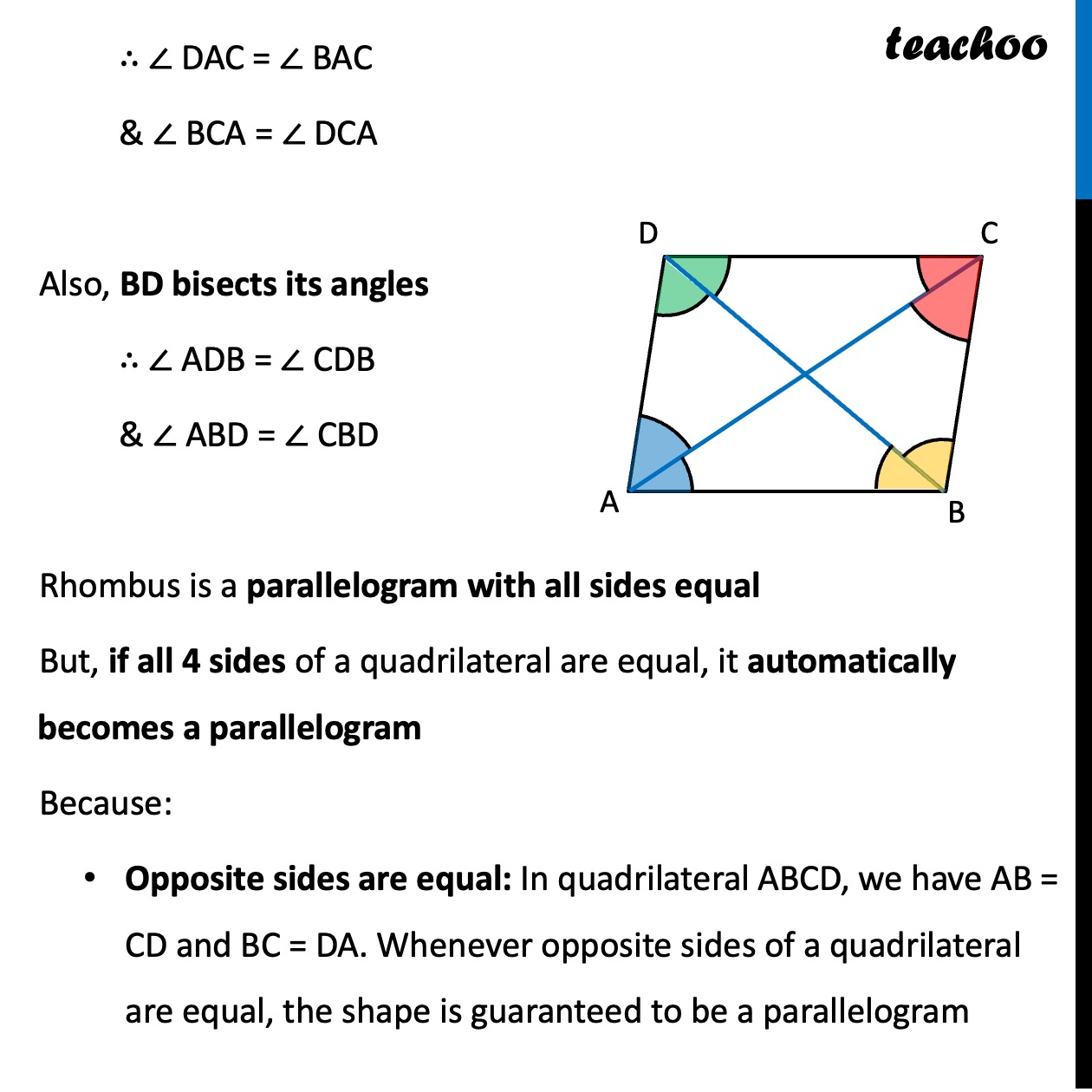
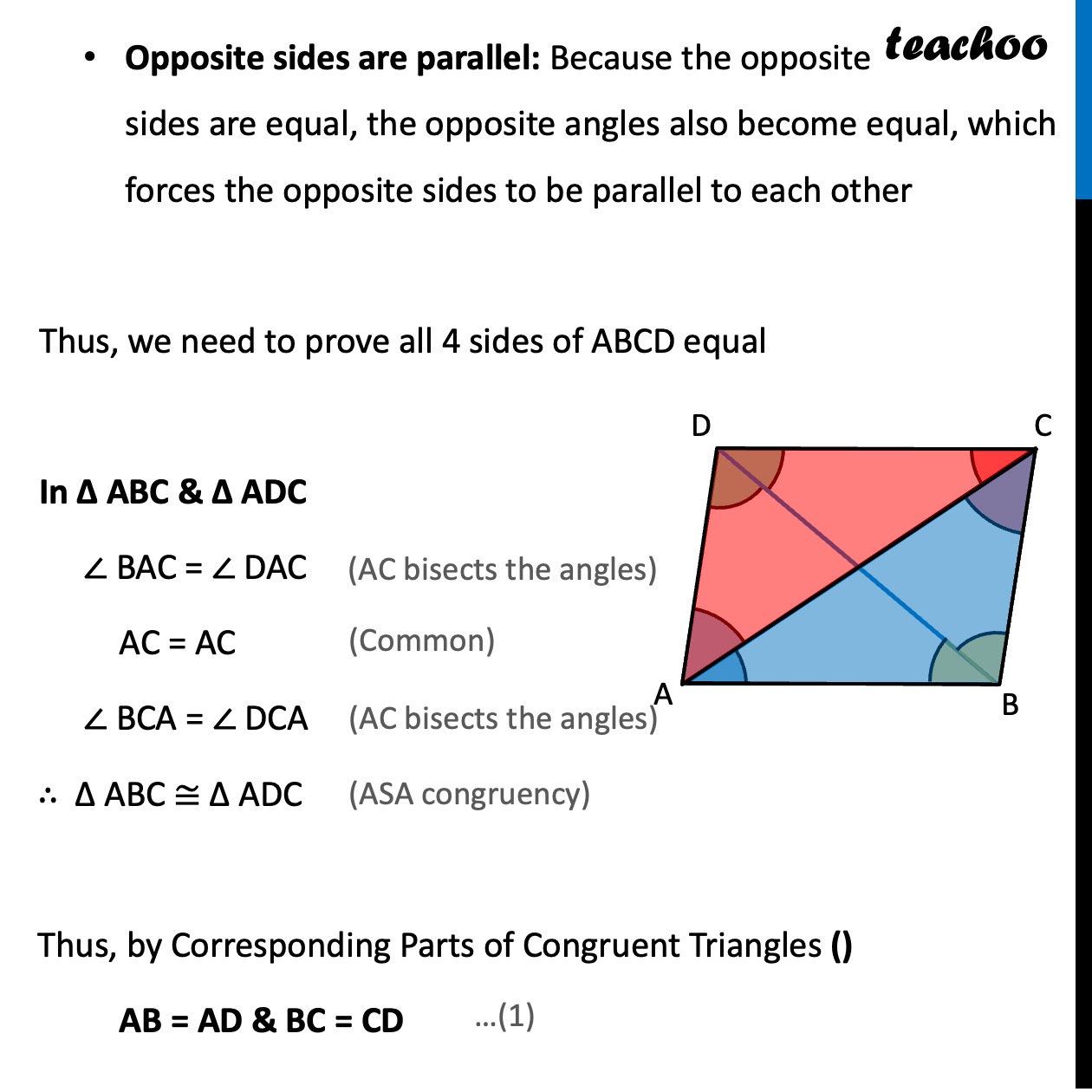
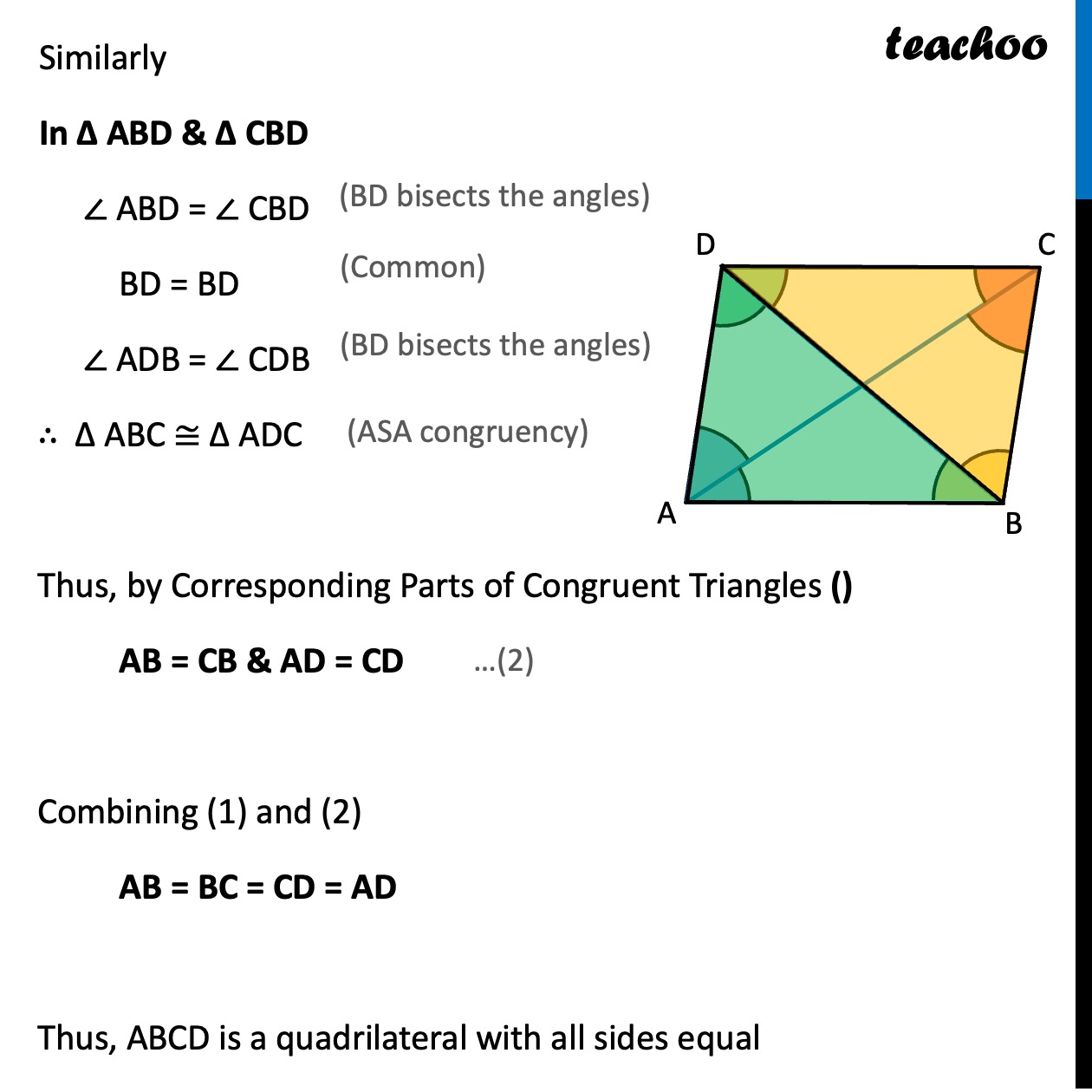
Ex 12.2, 3 (i) The following questions examine converses of true properties. Answer them with Yes or No. If your answer is No, what extra condition can you add so that the answer becomes Yes? (i) If the diagonals of a quadrilateral ABCD bisect its angles, must ABCD be a rhombus? Let’s try to prove it, if we cannot prove that, then we can figure out an extra condition Given a quadrilateral ABCD With diagonals AC and BD Now, AC bisects its angles ∴ ∠ DAC = ∠ BAC & ∠ BCA = ∠ DCA Also, BD bisects its angles ∴ ∠ ADB = ∠ CDB & ∠ ABD = ∠ CBD A B C D ∴ ∠ DAC = ∠ BAC & ∠ BCA = ∠ DCA Also, BD bisects its angles ∴ ∠ ADB = ∠ CDB & ∠ ABD = ∠ CBD Rhombus is a parallelogram with all sides equal But, if all 4 sides of a quadrilateral are equal, it automatically becomes a parallelogram Because: Opposite sides are equal: In quadrilateral ABCD, we have AB = CD and BC = DA. Whenever opposite sides of a quadrilateral are equal, the shape is guaranteed to be a parallelogram A B C D Opposite sides are parallel: Because the opposite sides are equal, the opposite angles also become equal, which forces the opposite sides to be parallel to each other Thus, we need to prove all 4 sides of ABCD equal In ∆ ABC & ∆ ADC ∠ BAC = ∠ DAC AC = AC ∠ BCA = ∠ DCA ∴ Δ ABC ≅ Δ ADC Thus, by Corresponding Parts of Congruent Triangles () AB = AD & BC = CD A B C D (AC bisects the angles) (Common) (AC bisects the angles) …(1) (ASA congruency) Similarly In ∆ ABD & ∆ CBD ∠ ABD = ∠ CBD BD = BD ∠ ADB = ∠ CDB ∴ Δ ABC ≅ Δ ADC Thus, by Corresponding Parts of Congruent Triangles () AB = CB & AD = CD Combining (1) and (2) AB = BC = CD = AD Thus, ABCD is a quadrilateral with all sides equal ∴ ABCD is a rhombus Here, no extra condition is needed A B C D (BD bisects the angles) (Common) (BD bisects the angles) …(2) (ASA congruency) ∴ ABCD is a rhombus Here, no extra condition is needed