You are here
Last updated at November 5, 2026 by Teachoo
Transcript
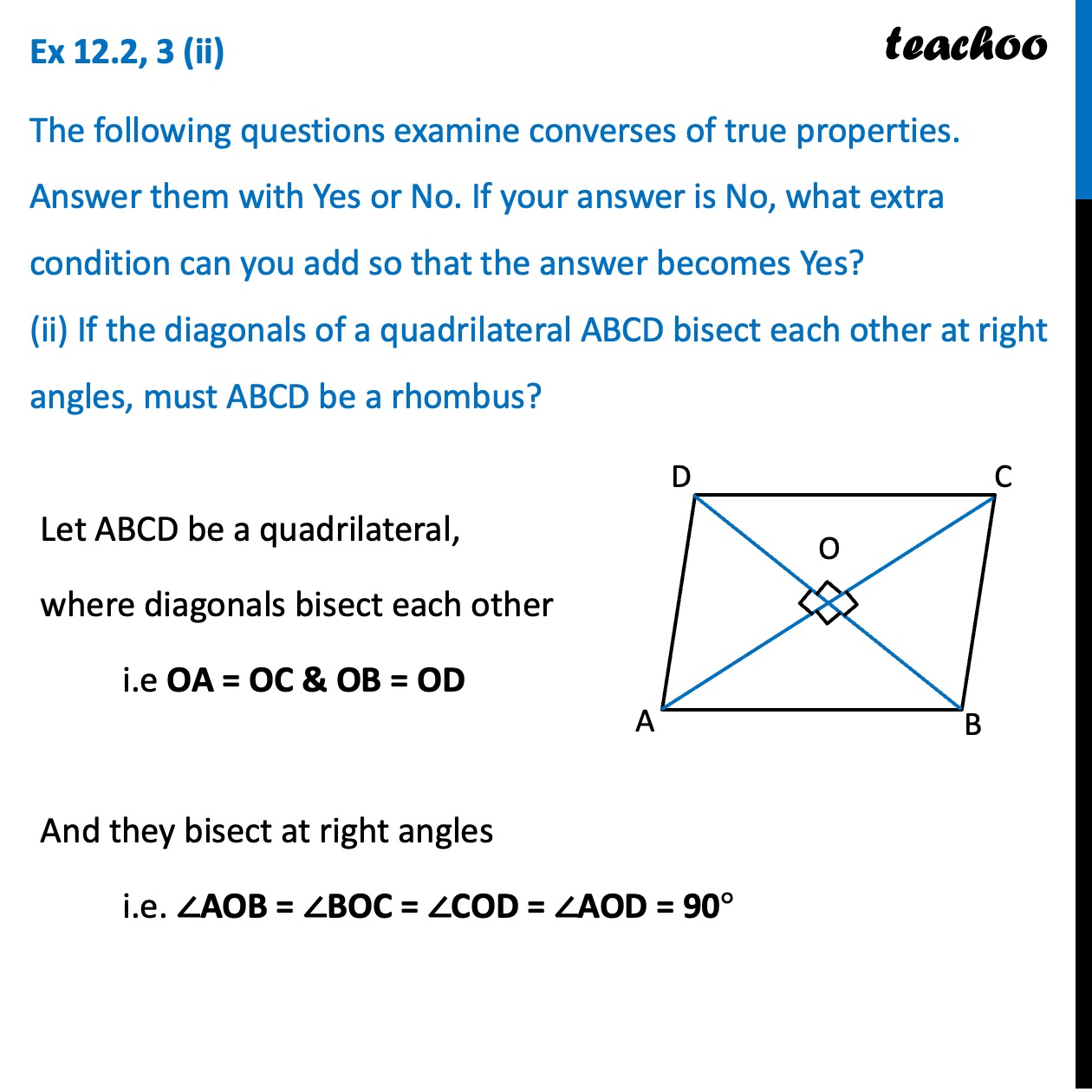
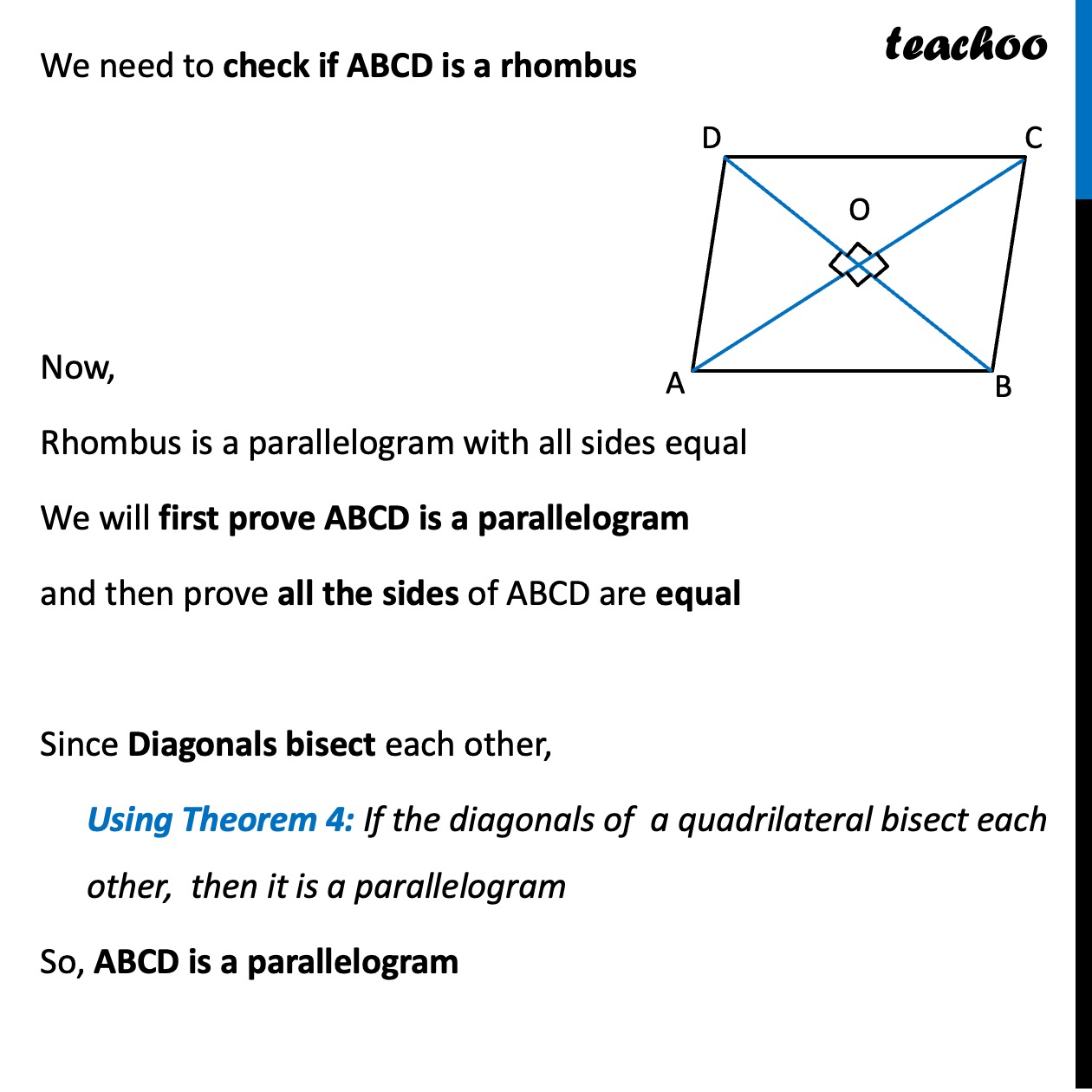
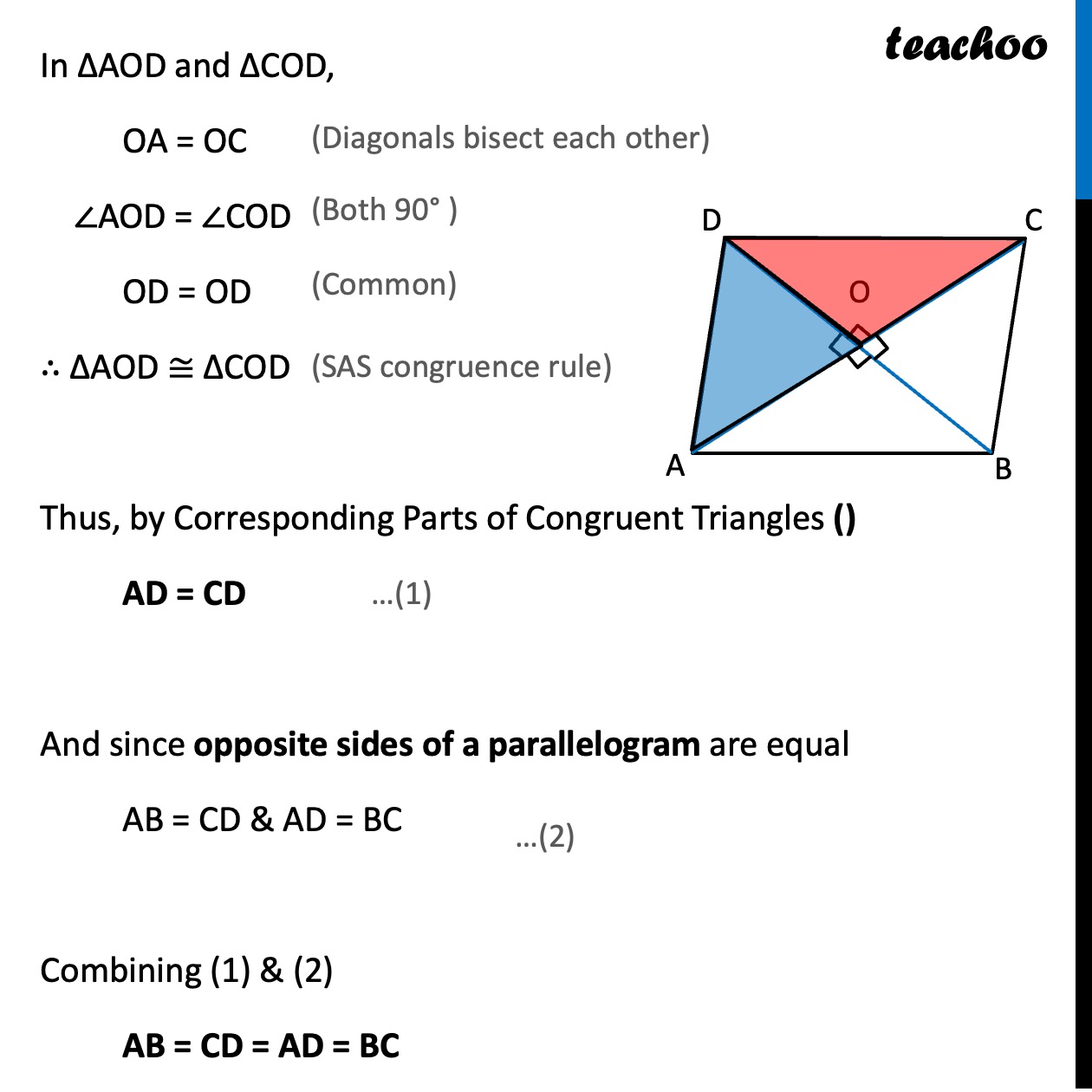
Ex 12.2, 3 (ii) The following questions examine converses of true properties. Answer them with Yes or No. If your answer is No, what extra condition can you add so that the answer becomes Yes? (ii) If the diagonals of a quadrilateral ABCD bisect each other at right angles, must ABCD be a rhombus? Let ABCD be a quadrilateral, where diagonals bisect each other i.e OA = OC & OB = OD And they bisect at right angles i.e. ∠AOB = ∠BOC = ∠COD = ∠AOD = 90° A B C D O We need to check if ABCD is a rhombus Now, Rhombus is a parallelogram with all sides equal We will first prove ABCD is a parallelogram and then prove all the sides of ABCD are equal Since Diagonals bisect each other, Using Theorem 4: If the diagonals of a quadrilateral bisect each other, then it is a parallelogram So, ABCD is a parallelogram A B C D O In ΔAOD and ΔCOD, OA = OC ∠AOD = ∠COD OD = OD ∴ ΔAOD ≅ ΔCOD Thus, by Corresponding Parts of Congruent Triangles () AD = CD And since opposite sides of a parallelogram are equal AB = CD & AD = BC Combining (1) & (2) AB = CD = AD = BC A B C D O (SAS congruence rule) (Diagonals bisect each other) (Both 90° ) (Common) …(1) …(2) Thus, ABCD is a parallelogram with all sides equal ∴ ABCD is a rhombus Here, no extra condition is needed