
 You are here
What are the properties of covalent compounds?
- Covalent compounds are formed when non-metal atoms share electrons. They are made of molecules .
- The forces between these molecules are weak .
| Property | Covalent compounds | Why |
|---|---|---|
| Melting and boiling points | Low | Only weak forces hold the molecules together, so little heat is needed to separate them |
| Solubility in water | Most are insoluble | Example: camphor, naphthalene . But sugar is covalent and dissolves in water. |
| Solubility in kerosene and petrol | Most are soluble | Example: camphor, naphthalene |
| Electrical conductivity | Most do not conduct | They have no ions (no charged particles) to carry the current |
What are the properties of ionic compounds?
- Ionic compounds are formed when electrons are transferred from a metal to a non-metal . They are made of oppositely charged ions , held by strong forces (ionic bonds).
| Property | Ionic compounds | Why |
|---|---|---|
| Melting and boiling points | High | Strong attraction between the ions , so a lot of heat is needed to break it |
| Solubility in water | Generally soluble | Example: sodium chloride, copper sulfate |
| Solubility in kerosene and petrol | Insoluble | Example: sodium chloride, copper sulfate |
| Conductivity in solid state | Do not conduct | Ions are fixed in place |
| Conductivity when dissolved in water or molten | Conduct | Ions are free to move |
-
Ionic compounds generally have high melting and boiling points due to strong inter-ionic attractions, whereas covalent compounds usually have low melting and boiling points.
- Inter-ionic attraction means the pull between the ions.
How can we test these properties?
What do we need?
- Samples of camphor, sodium chloride, copper sulfate, sugar and naphthalene
- Water, kerosene and petrol
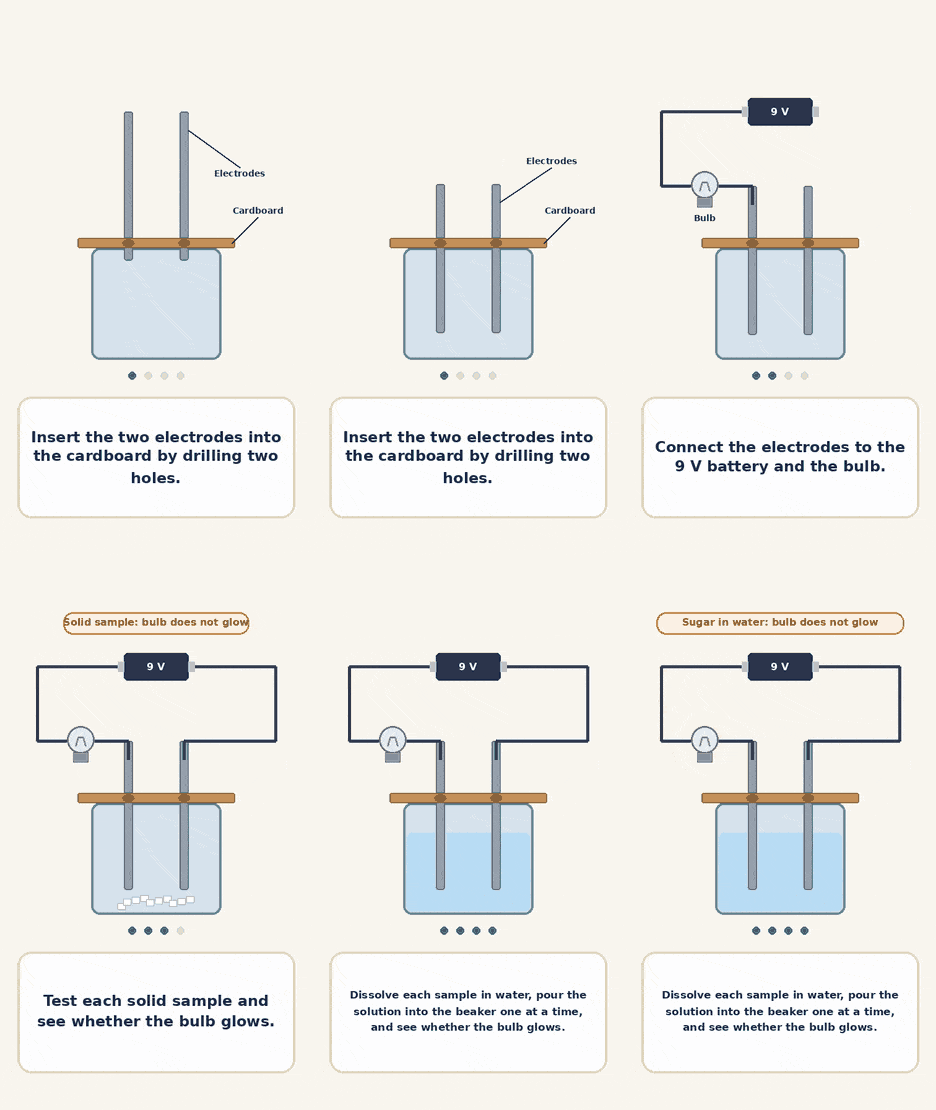
- A beaker, two carbon or metal electrodes , a piece of cardboard
- A 9 V battery , a light bulb and connecting wires
What do we do?
(A) Solubility in (i) water, (ii) kerosene, and (iii) petrol
- Try dissolving each sample separately in water, kerosene and petrol.
- Record the observations in Table.
(B) Electrical conductivity in the water
- Insert the two electrodes into the cardboard by drilling two holes.
- Connect the electrodes to the 9 V battery and the bulb .
- Test each solid sample and see whether the bulb glows.
- Dissolve each sample in water, pour the solution into the beaker one at a time, and see whether the bulb glows.
⚠️ Safety first
Do not touch the electrodes when they are connected to the battery but use a low-voltage battery to avoid the risk of shock. Petrol and kerosene are flammable liquids, so be careful while working with them.
What do we observe?
(Table)
| Compound | Type | Water | Kerosene | Petrol | Conducts in solid state? | Conducts in water? |
|---|---|---|---|---|---|---|
| Sodium chloride | Ionic | Soluble | Insoluble | Insoluble | No | Yes |
| Copper sulfate | Ionic | Soluble | Insoluble | Insoluble | No | Yes |
| Sugar | Covalent | Soluble | Insoluble | Insoluble | No | No |
| Camphor | Covalent | Insoluble | Soluble | Soluble | No | No |
| Naphthalene | Covalent | Insoluble | Soluble | Soluble | No | No |
What does this tell us?
- Ionic compounds like sodium chloride and copper sulfate are generally soluble in water but insoluble in solvents, such as kerosene and petrol.
-
In contrast, most covalent compounds, such as camphor and naphthalene are insoluble in water but dissolve in kerosene and petrol.
- A solvent is the liquid in which a substance dissolves.
Why do ionic compounds conduct only when dissolved or molten?
- To conduct electricity, ions must be free to move.
- Ionic compounds do not conduct electricity in the solid state because their ions are held in fixed positions by strong forces.
- Ions become free to move when the ionic compounds, such as sodium chloride and copper sulfate, are dissolved in water.
Predict whether ionic and covalent compounds would conduct electricity in the molten state.
- Molten state means the melted state of a substance .
- Ionic compounds will conduct in the molten state. On melting, the ions are no longer fixed and become free to move .
- Covalent compounds will not conduct , because even when melted they have no ions .
| State | Ions in an ionic compound | Conducts? |
|---|---|---|
| Solid | Fixed | No |
| Dissolved in water | Free to move | Yes |
| Molten | Free to move | Yes |
Why do covalent compounds not conduct electricity?
- Some covalent compounds, such as sugar, are soluble in water but do not provide ions in solution; therefore, they do not conduct electricity.
- Other covalent compounds, such as camphor and naphthalene, also do not conduct electricity.
Can you give a reason?
- Camphor and naphthalene are made of molecules , not ions.
- Molecules have no charge .
- They also do not dissolve in water.
- With no charged particles to carry the current, electricity cannot pass.
How are ionic and covalent compounds different? (Comparison at a glance)
| Property | Covalent compounds | Ionic compounds |
|---|---|---|
| Formed by | Sharing of electrons (non-metal + non-metal) | Transfer of electrons (metal + non-metal) |
| Made of | Molecules | Ions |
| Melting and boiling points | Low | High |
| Solubility in water | Mostly insoluble (sugar is an exception) | Generally soluble |
| Solubility in kerosene and petrol | Mostly soluble | Insoluble |
| Conductivity in solid state | No | No |
| Conductivity in water | No | Yes |
| Conductivity in molten state | No | Yes |
| Examples | Sugar, camphor, naphthalene | Sodium chloride, copper sulfate |
Questions from the book for this section
-
🤔 Pause and Ponder 19
What type of chemical bond is present in a solid compound that does not conduct electricity in the solid state but conducts electricity when dissolved in water?View answer
Answer- Ionic bond.
- In the solid state, the ions are fixed , so it does not conduct.
- When dissolved in water, the ions become free to move , so it conducts.
-
🤔 Pause and Ponder 20
Metal M, with two electrons in its valence shell (M shell), reacts with oxygen to form a compound that is slightly soluble in water. Predict its:
(i) formula
(ii) type of bond
(iii) electrical conductivity of its aqueous solution.View answer
Answer- The M shell is the third shell. So M = 2, 8, 2 (magnesium).
- M loses 2 electrons → M²⁺ . Oxygen gains 2 electrons → O²⁻ .
- (i) Formula: M²⁺ and O²⁻ → cross 2 and 2 → M₂O₂ → ÷ 2 → MO (like MgO )
- (ii) Type of bond: Ionic bond (electrons are transferred from M to oxygen)
-
(iii) Electrical conductivity of its aqueous solution:
it
conducts
electricity, because the dissolved part gives
free ions
.
- Aqueous solution means a solution in water .
- Since it is only slightly soluble, the conductivity will be weak .
-
📋 Revise, Reflect, Refine, Q14
Assertion (A): Copper sulfate conducts electricity in the molten state but not in the solid state.
Reason (R): Copper and sulfate ions are fixed in the lattice in molten state, while in solid state they can move freely.
Choose the correct option:
(i) Both A and R are true, and R is the correct explanation of A.
(ii) Both A and R are true, but R is not the correct explanation of A.
(iii) A is true, but R is false.
(iv) A is false, but R is true.View answer
Answer- Assertion is true. Copper sulfate is ionic. It conducts when its ions are free (molten) and not when they are fixed (solid).
- Reason is false. It is the other way round : ions are fixed in the solid state and free to move in the molten state.
- Correct option: (iii) A is true, but R is false.
